English
 Le français
 Türkçe




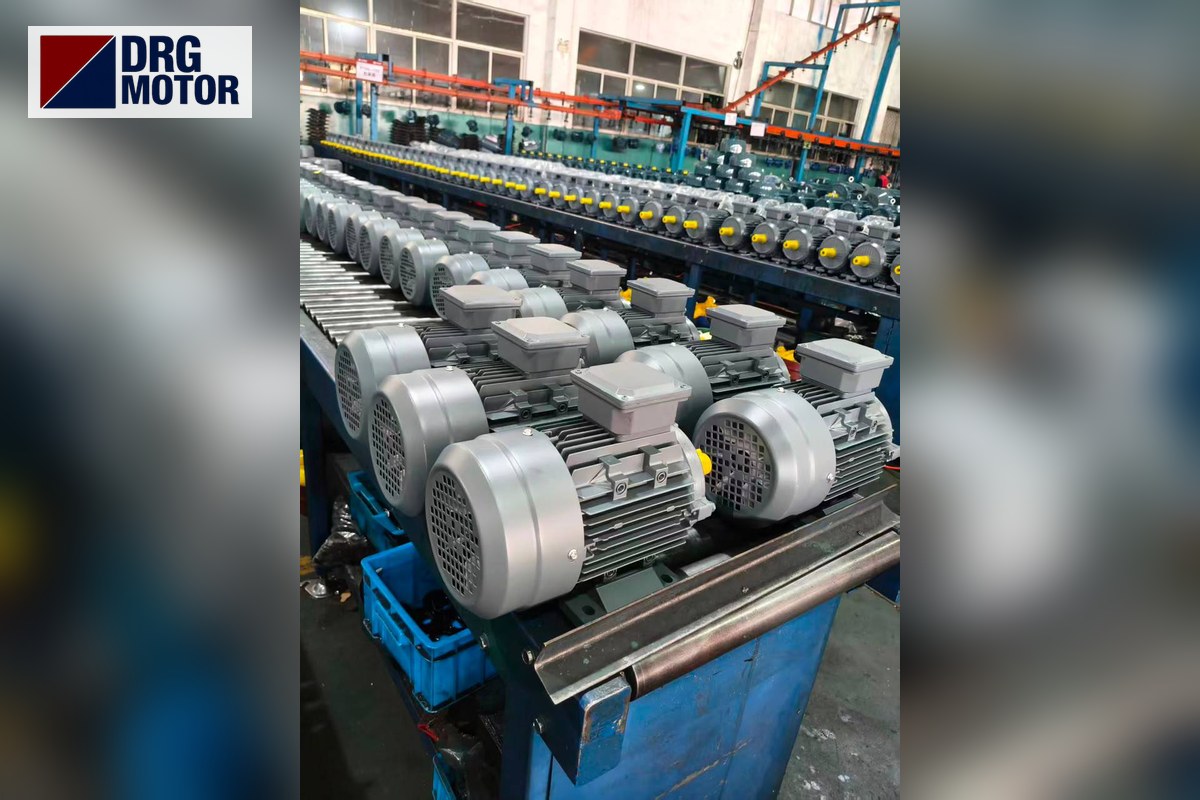

Sawmill and band saw motors fall into two groups depending on the machine type: a band saw uses a 4-pole motor driving the wheel through a belt — in the DRG catalogue the rated speed of this class is 1445–1465 rpm — while circular saws and planers prefer a 2-pole motor (2895–2945 rpm) to spin the blade or cutter head fast. Power depends on cutting height and wood species: joinery-shop band saws usually have 1.5–4 kW, log band sawmills 7.5–15 kW or more. The exact value is the machine nameplate and the builder's data; the ranges below are conservative and the calculations are given with their assumptions.
A saw is an exposed, sharp cutting tool: when replacing the motor, isolate and lock out the machine, and have the connection and overload setting done by a qualified electrician. Petrol-driven portable sawmills are not covered here; this article deals with three-phase motors fixed to the machine.
You can find the right frame and power for your woodworking machine among the models on the Buy Electric Motors Online page.
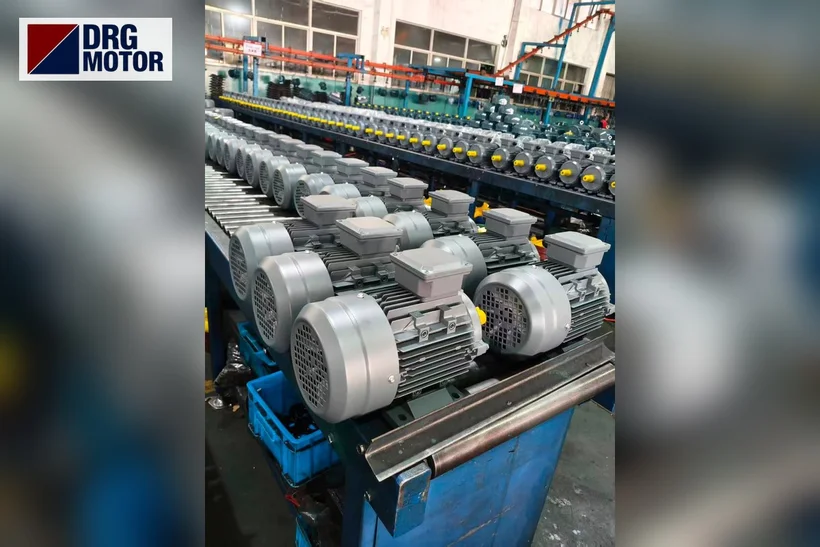
Band saw, circular saw and planer: which motor goes where?
| Machine | Typical poles / speed | Drive | Guidance power range |
|---|---|---|---|
| Joinery band saw (small wheel) | 4 poles, ≈1450 rpm | Belt and pulley | 1.5–4 kW |
| Log / timber band sawmill (large wheel) | 4 poles, ≈1460 rpm | Belt and pulley, often multiple belts | 7.5–15 kW and above |
| Circular saw (ripping, panel sizing) | 2 poles, ≈2930 rpm | Direct shaft or belt | 3–11 kW |
| Planer / thicknesser | 2 poles, 2895–2945 rpm | Belt step-up | 2.2–7.5 kW |
The ranges in the table are guidance by machine class; there are differences between builders within the same class. If the old motor's nameplate is still there, take the power and number of poles from it.
Pulley calculation from wheel diameter on a band saw
What determines cutting on a band saw is the blade speed: v = π·D·n/60 (D wheel diameter, n wheel speed). Example assumptions: wheel diameter 800 mm, target blade speed 30 m/s.
- Required wheel speed: n = 60 × 30 / (π × 0.8) ≈ 716 rpm
- Motor: DRG-132M-4, rated speed 1460 rpm → pulley ratio 1460 / 716 ≈ 2.04
- With a 160 mm motor pulley, the wheel-side pulley should be ≈ 160 × 2.04 ≈ 326 mm
- Check: with a 325 mm pulley the wheel speed is 1460 × 160 / 325 ≈ 719 rpm and blade speed π × 0.8 × 719 / 60 ≈ 30.1 m/s
The target blade speed is the recommendation of the machine builder and blade maker; the 30 m/s used here is only a calculation example. Use the pulley and belt calculator with your own wheel and pulley sizes; general rules for belt drives are in our article on motor selection for belt and pulley drives.
Replacing the old motor with a 2-pole motor roughly doubles the blade speed with the same pulleys; that is dangerous if the blade and wheels were not designed for it. If you change the number of poles, do not run the machine before recalculating the pulleys.
Cutting power: wood species and cutting height
Cutting power is roughly cutting force times blade speed: P = Fc × v. Cutting force rises with cutting height, feed rate, tooth pitch and wood hardness. Example assumption: average cutting force of 200 N when sawing logs, blade speed 30 m/s.
- Cutting power ≈ 200 × 30 = 6000 W = 6 kW
- 20% margin for knots, hardwood and feed variation: 6 × 1.2 = 7.2 kW
- Next standard rating: 7.5 kW → DRG-132M-4
Check: the catalogue rated torque of DRG-132M-4 is 49.1 Nm; 9550 × 7.5 / 1460 ≈ 49.1 Nm. If the same machine is to saw oak or beech instead of soft pine, or the cutting height increases, the cutting force rises; you then need to reduce the feed or choose the next rating (DRG-160M-4, 11 kW). The 200 N figure is an assumed example, not a measurement.
2-pole motors on circular saws and planers
On a circular saw the blade's peripheral speed is found with the same formula. A 400 mm blade mounted directly on DRG-132S1-2 (5.5 kW, 2930 rpm): v = π × 0.4 × 2930 / 60 ≈ 61.4 m/s. If the maximum speed marked on the blade is lower than the motor speed, that blade must not be used with this motor; check this every time the blade is changed.
On planers and thicknessers the cutter head usually turns faster than the motor and the speed is raised by belt. For example, if 6000 rpm is wanted at the cutter head, the pulley ratio with a 2-pole ≈2930 rpm motor is 6000 / 2930 ≈ 2.05 (large motor pulley, small head pulley). Belt tension and bearing load matter here; check that the motor shaft (D×E) matches the pulley hub.
Starting inertia and the need for a brake
A band sawmill with large wheels and a circular saw with a heavy blade take a long time to run up. For DRG-132M-4 the catalogue starting current ratio is Is/In = 7.5: with a rated current of 14.3 A at 400 V, direct-on-line starting current rises to ≈ 107 A. With star-delta starting this falls to roughly one third (≈ 36 A); the 7.5 kW model is wound 400/690 V and runs in delta at 400 V, so it suits this method. Torque also drops to one third in star, so the saw should start unloaded and cutting should begin only after switching to delta. Compare the methods on our starting methods and star-delta page.
The same inertia works when stopping: when power is cut, the wheel or blade keeps turning for a long time. On machines where the operator approaches an exposed blade, stopping time is a safety issue and often requires a brake motor or a separate braking arrangement. We cover when a brake motor is needed in when is a brake electric motor needed; check the stopping time required for your machine in the builder's data.
Chips and dust: keeping the motor cool
In woodworking, fine sawdust sticks to the motor's fan cowl and housing fins; since the motor is cooled by its own fan, this build-up directly raises temperature. Use motors with at least IP55 protection in the workshop, keep the air inlet away from the chip outlet and clean the cowl regularly. Details are in our article on IP55 motor selection for dusty areas.
Checklist before replacing a saw motor
- Record the kW, speed, voltage and connection (Δ/Y) from the old motor's nameplate.
- Keep the number of poles; if it changes, recalculate the pulley ratio.
- Compare the motor shaft D×E with the pulley hub bore.
- Match the foot hole spacing and shaft height (H) with the tensioning slide.
- Check the maximum permitted speed of the wheel or blade.
- If stopping time is long, clarify the braking requirement with the machine builder.
- Set the overload relay to the new motor's rated current; check current values in the motor current chart.
- Clean sawdust from the fan cowl and fins.
Suitable DRG models for sawmills and band saws
Values are from the DRG catalogue (cast iron frame, 400 V). The first seven rows are 4-pole options for belt-driven band saws; the last three are 2-pole options for circular saws and planers.
| Model | Power (kW) | Rated speed (rpm) | Frame | Current 400 V (A) | Rated torque (Nm) | Is/In | Shaft D×E (mm) |
|---|---|---|---|---|---|---|---|
| DRG-90L-4 | 1.5 | 1445 | 90L cast iron | 3.3 | 9.91 | 7 | 24×50 |
| DRG-100L2-4 | 3 | 1450 | 100L cast iron | 6.02 | 19.8 | 7.6 | 28×60 |
| DRG-112M-4 | 4 | 1450 | 112M cast iron | 7.95 | 26.3 | 7.8 | 28×60 |
| DRG-132S-4 | 5.5 | 1460 | 132S cast iron | 10.7 | 36 | 7.9 | 38×80 |
| DRG-132M-4 | 7.5 | 1460 | 132M cast iron | 14.3 | 49.1 | 7.5 | 38×80 |
| DRG-160M-4 | 11 | 1465 | 160M cast iron | 20.4 | 71.7 | 7.7 | 42×110 |
| DRG-160L-4 | 15 | 1465 | 160L cast iron | 27.3 | 97.8 | 7.8 | 42×110 |
| DRG-132S1-2 | 5.5 | 2930 | 132S cast iron | 10.1 | 17.9 | 8.3 | 38×80 |
| DRG-132S2-2 | 7.5 | 2930 | 132S cast iron | 13.7 | 24.4 | 7.9 | 38×80 |
| DRG-160M1-2 | 11 | 2945 | 160M cast iron | 19.6 | 35.7 | 8.1 | 42×110 |
Motors in this power range
- DRG-100L2-4 – 3 kW – 1450 rpm – 100L cast iron
- DRG-132S-4 – 5.5 kW – 1460 rpm – 132S cast iron
- DRG-132M-4 – 7.5 kW – 1460 rpm – 132M cast iron
- DRG-160M-4 – 11 kW – 1465 rpm – 160M cast iron
- DRG-132S2-2 – 7.5 kW – 2930 rpm – 132S cast iron
- DRG-160M1-2 – 11 kW – 2945 rpm – 160M cast iron
Click to see current prices and order these motors nowSEE PRICES →
Frequently Asked Questions
What kW should a band saw motor be?
Joinery band saws usually have 1.5–4 kW, log band sawmills 7.5–15 kW or more. The exact value is the machine nameplate and the builder's data.
What speed should a sawmill motor have?
Belt-driven band saws use a 4-pole motor (1445–1465 rpm in the DRG catalogue); circular saws and planers use a 2-pole motor (2895–2945 rpm). Blade speed is set by the pulley ratio.
How many amps does a 7.5 kW saw motor draw?
The 4-pole DRG-132M-4 draws 14.3 A at 400 V and 15 A at 380 V at full load; the 2-pole DRG-132S2-2 draws 13.7 A at 400 V.
Does a band sawmill motor need star-delta starting?
It is common on large-wheel machines to reduce starting current. In the DRG catalogue, models of 4 kW and above are wound 400/690 V and suit star-delta starting; your electrician should assess the supply and panel conditions.
Send us the power, speed, shaft and mounting data from your machine nameplate and we will pin down the matching DRG model together. Phone: +90 (542) 666 11 11 · E-mail: [email protected] · Contact page. For all models and ordering: Buy Electric Motors Online.