English
 Le français
 Türkçe




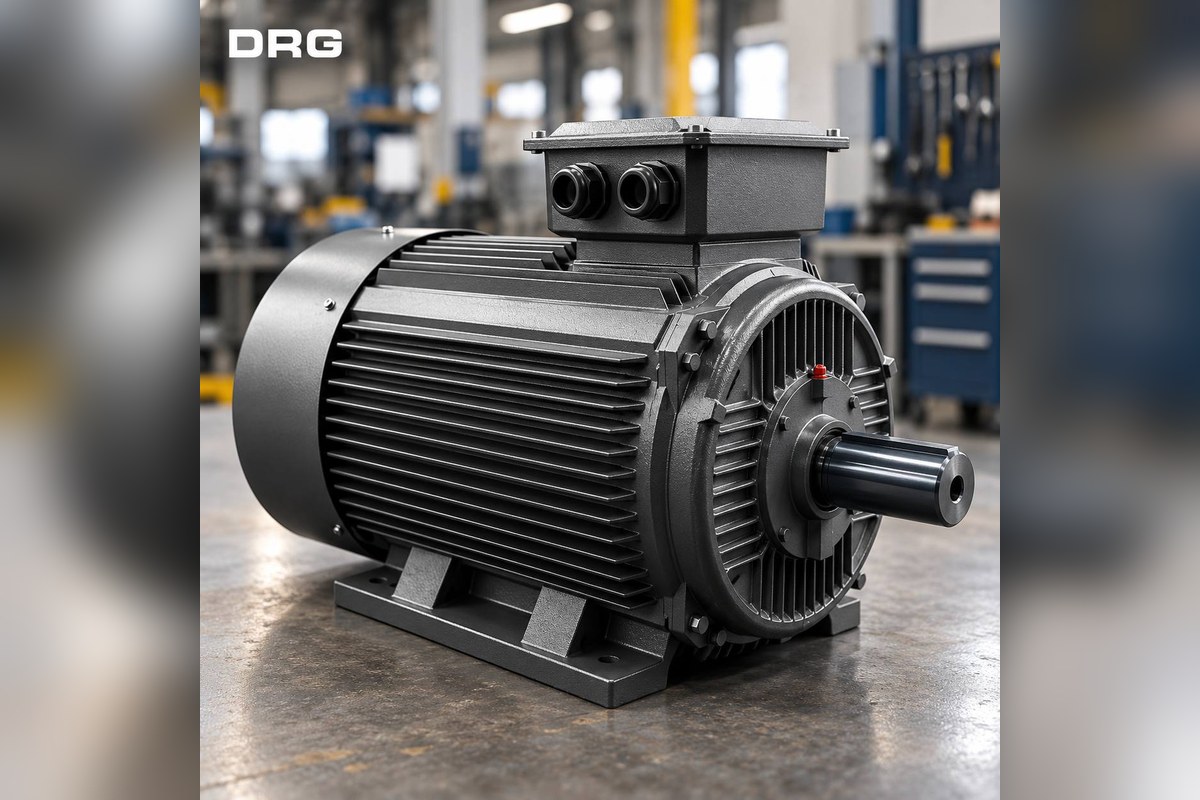

On a belt grinder or belt sander, the motor is chosen by belt speed: a 2-pole motor at 2895 rpm driving a 200 mm drive drum directly moves the belt at about 30.3 m/s; with a 4-pole motor at 1445 rpm on the same drum the speed falls to 15.1 m/s. For workshop machines used for deburring steel and stainless, weld grinding and similar jobs, a 1.5–3 kW 2-pole three-phase motor covers most needs; for example the 2.2 kW DRG-90L-2 draws 4.35 A at 400 V and the 3 kW DRG-100L-2 draws 5.71 A. The exact power is the value on the machine builder's nameplate; the calculations below are a check for an unreadable plate or for builders making their own machine.
When choosing the motor you answer three questions: what is the drum diameter in millimetres and what belt speed is needed, how much power do belt width and workload require, and is the motor coupled to the drum directly or through pulleys. Terminal wiring, overload setting and earthing must be done by a qualified electrician; grinding dust can carry conductive metal particles, and a badly earthed frame is a direct electric-shock risk. You can filter suitable motors by power and speed among the 120 models in our online store.
The 3 most common mistakes with a sander motor
- Changing the drum diameter but keeping the motor: replacing a 150 mm drum with a 250 mm one raises belt speed from 22.7 m/s to 37.9 m/s. The belt may exceed the speed allowed by its maker, and at the same contact pressure the motor draws more power.
- Fitting a 4-pole motor instead of a 2-pole one: when a burnt 2895 rpm motor is replaced with a 1445 rpm motor that happened to be on the shelf, belt speed halves, the abrasive stops cutting, the operator presses harder and work slows down. The number of poles is read from the nameplate and must not change.
- Pointing the dust outlet at the motor fan inlet: the fan cowl sucks in dust, it builds up between the fins and the frame cannot cool. When the motor starts tripping, the cause is usually blocked cooling rather than lack of power.
How is belt speed calculated? Drum diameter and speed table
Belt speed is the peripheral speed of the drive drum: v (m/s) = π × D (m) × n (rpm) / 60. D is the drive drum diameter measured over the belt, n is the drum speed. If the motor is coupled to the drum directly, n is the motor's rated speed; in the DRG range it is 2895 rpm for small 2-pole frames and 1445 rpm for 4-pole ones. The table below was calculated in Python for these two speeds:
| Drum diameter | 2-pole · 2895 rpm | 4-pole · 1445 rpm |
|---|---|---|
| 100 mm | 15.2 m/s | 7.6 m/s |
| 150 mm | 22.7 m/s | 11.3 m/s |
| 200 mm | 30.3 m/s | 15.1 m/s |
| 250 mm | 37.9 m/s | 18.9 m/s |
When reading the table, the permitted speed printed on the back of the belt is what counts. Metalworking belts are generally made for high speed; wood and delicate surface work need lower speed. There are two ways to lower belt speed: a smaller drum, or a pulley drive that reduces speed. With pulleys the drum speed is n₂ = n₁ × d₁ / d₂; for example, on a 2895 rpm motor a 100 mm motor pulley and a 160 mm drum pulley bring the drum down to about 1809 rpm. You can check the ratio with your own dimensions using the pulley and belt calculator.
How many kW are needed? Power from tangential force
The power a sander draws is the tangential (friction and cutting) force between belt and workpiece multiplied by belt speed: P (kW) = Ft (N) × v (m/s) / 1000. Ft depends on belt width, grit and how hard the operator presses, so the forces below are example assumptions. 35 N is taken for light deburring, 60 N for medium load and 90 N for heavy grinding on a wide belt; belt speed is 30.3 m/s (200 mm drum at 2895 rpm), and a 1.25 margin is added for a loaded belt and heavy pressure:
| Tangential force | Shaft power | With 1.25 margin | Motor to choose |
|---|---|---|---|
| 35 N | 1.06 kW | 1.33 kW | DRG-90S-2 · 1.5 kW |
| 60 N | 1.82 kW | 2.27 kW | DRG-100L-2 · 3 kW |
| 90 N | 2.73 kW | 3.41 kW | DRG-112M-2 · 4 kW |
The calculation shows that a narrow-belt, hand-fed workshop sander is fine with 1.5 kW, a 100–150 mm wide belt with heavy pressure goes to 3 kW and heavy grinding to 4 kW. Measuring the tangential force directly is hard; the practical way is to measure the existing motor's current under load with a clamp meter. If the current often rises above the nameplate rated current while working, the motor is too small; if it always stays below half, the motor is oversized and cos φ drops at low load. Check the overload relay setting for the new motor's current with the overload, fuse and contactor selection tool.
Click to see current electric motor prices and order nowSEE PRICES →
Why a 2-pole motor driving the drum directly?
For high belt speed the simplest solution is mounting the drum directly on a 2-pole motor shaft: no belt, pulley or extra bearing, and no slip loss. The motor shaft then carries the drum hub, so the shaft size must match exactly. In the DRG catalogue the shaft is 24 × 50 mm on 90S and 90L frames and 28 × 60 mm on 100L and 112M frames. If the old motor has a 24 mm shaft and the new one 28 mm, the drum hub cannot be fitted without re-machining; that is why staying in the same frame matters as much as staying at the same power.
The compact range helps here: the 3 kW 2-pole DRG-90L-2K comes in a 90L frame with a 24 × 50 mm shaft, so it keeps the same foot and shaft dimensions as a 2.2 kW 90L motor while giving one step more power. When the drum sits directly on the shaft, the load on the motor shaft increases: belt tension adds to the drum's weight, and a drum mounted far from the shaft shoulder puts a larger moment on the bearing. Mount the drum as close to the shaft shoulder as possible.
A 4-pole motor is right for wood calibrating sanders, wide-belt machines with large drums and surface work that needs low speed. The 1.5 kW, 1445 rpm DRG-90L-4 draws 3.3 A at 400 V and gives 9.91 Nm rated torque; the 2-pole motor of the same power has 4.95 Nm. At lower speed the same power means more torque, which helps accelerate a wide, heavy drum.
Dust, slip and tension: three things that wear the motor
Dust and IP55
Grinding dust harms in two ways: it clogs the fan cowl and fins and cuts cooling, and fine metal dust entering the terminal box reduces insulation distances. An IP55 frame is protected against dust, but a clean outer surface is still essential for cooling. Leave at least a hand's width of space in front of the fan cowl, place the dust extraction inlet on the side opposite the motor, point the cable entry downwards and choose a gland that fits the cable diameter.
Belt slip
If the belt slips on the drive drum, the motor turns at full speed while the belt slows, the drum surface heats up and the belt opens at the joint. The fix is not a bigger motor but renewing the drum lagging (rubber or knurled surface) and setting the tension correctly. A rough sign of slip: the motor current is not high, but the belt stops when the workpiece is pressed.
Tension force and bearings
An over-tensioned belt puts radial load on the front bearing of a motor that carries the drum directly. The bearing is 6205-ZZ-C3 on the 90 frame and 6206-ZZ-C3 on 100L and 112M. If the bearing hums or runs hot, first slacken the tension and listen again; for symptoms see our article how to tell motor bearing failure.
Which DRG motor should I buy? Model table for sanders
The models below cover the power range met on workshop and small-production belt sanders. The 2-pole models are for direct-drum metal sanders, the 4-pole model for slow machines with wide drums:
| Model | Power / speed | Frame | Current 400 V |
|---|---|---|---|
| DRG-90S-2 | 1.5 kW / 2895 rpm | 90S · cast iron | 3.06 A |
| DRG-90L-2 | 2.2 kW / 2895 rpm | 90L · cast iron | 4.35 A |
| DRG-100L-2 | 3 kW / 2895 rpm | 100L · cast iron | 5.71 A |
| DRG-90L-2K | 3 kW / 2895 rpm | 90L · cast iron | 5.71 A |
| DRG-112M-2 | 4 kW / 2905 rpm | 112M · cast iron | 7.45 A |
| DRG-90L-4 | 1.5 kW / 1445 rpm | 90L · cast iron | 3.3 A |
Fill in this checklist before replacing the old motor; this is the information needed for the order:
- kW, speed and voltage on the old motor's nameplate (230/400 V or 400/690 V)
- Frame size (shaft height H) and foot hole spacing
- Shaft diameter and length (D × E), key width
- Is the drum on the motor shaft or driven by pulleys; pulley diameters
- Drive drum diameter measured over the belt
- Belt width and the permitted speed printed on the belt
- Overload relay setting range and contactor size in the panel
- Position of the dust extraction inlet and direction of the terminal box
As an example, the model that stands out for a metal sander with a 100 mm belt and a 200 mm drum:
- Power: 3 kW
- Rated speed: 2895 rpm
- Frame: 100L · cast iron
- Current 400 V: 5.71 A
- Current 380 V: 6.02 A
- cos φ: 0.87
- Rated torque: 9.9 Nm
- Starting torque: 2.2 × Tn
- Shaft D × E: 28 × 60 mm
- Bearing: 6206-ZZ-C3
- Voltage: 230/400 V (Δ/Y)
DRG Motor is a manufacturer, supplier and seller of electric motors; our motors are guaranteed for 2 years from the delivery date against material and manufacturing defects (warranty certificate). For dimension checks, see the technical drawings page.
Motors in this power range
- DRG-90S-2 – 1.5 kW – 2895 rpm – 90S cast iron
- DRG-90L-2 – 2.2 kW – 2895 rpm – 90L cast iron
- DRG-100L-2 – 3 kW – 2895 rpm – 100L cast iron
- DRG-90L-2K – 3 kW – 2895 rpm – 90L cast iron
- DRG-112M-2 – 4 kW – 2905 rpm – 112M cast iron
- DRG-90L-4 – 1.5 kW – 1445 rpm – 90L cast iron
Click to see current prices and order these motors nowSEE PRICES →
Frequently Asked Questions
What speed should a sander motor have?
Direct-drum metal sanders usually use a 2-pole motor of about 2900 rpm; on a 200 mm drum this gives 30.3 m/s belt speed. Wood and wide-drum machines use a 4-pole 1445 rpm motor. What counts is the speed on the old motor's nameplate.
How many kW does a belt sander need?
1.5 kW for a narrow-belt workshop sander, 2.2–3 kW for a 100–150 mm belt with heavy pressure, and 4 kW for heavy grinding is the usual range. Confirm it on your machine by measuring the current under load.
How many amps does a 2.2 kW sander motor draw?
The 2-pole DRG-90L-2 draws 4.35 A at 400 V and 4.58 A at 380 V; its cos φ is 0.85. Set the overload relay to this rated current.
Will a three-phase sander motor run on 220 V?
Not directly. A three-phase motor rated 230/400 V can run in delta from the 3 × 230 V output of a single-phase-input frequency inverter; the inverter's output current must cover the motor's 230 V current. We explain why running on a capacitor loses power in can a three-phase motor run on single phase. The wiring must be done by a qualified electrician.
Send us the old motor's nameplate or dimensions and we will narrow down the right DRG model together: phone +90 (542) 666 11 11, e-mail info@drgmotor.com, contact page. For all models and current prices, see Buy Electric Motors Online.