English
 Le français
 Türkçe




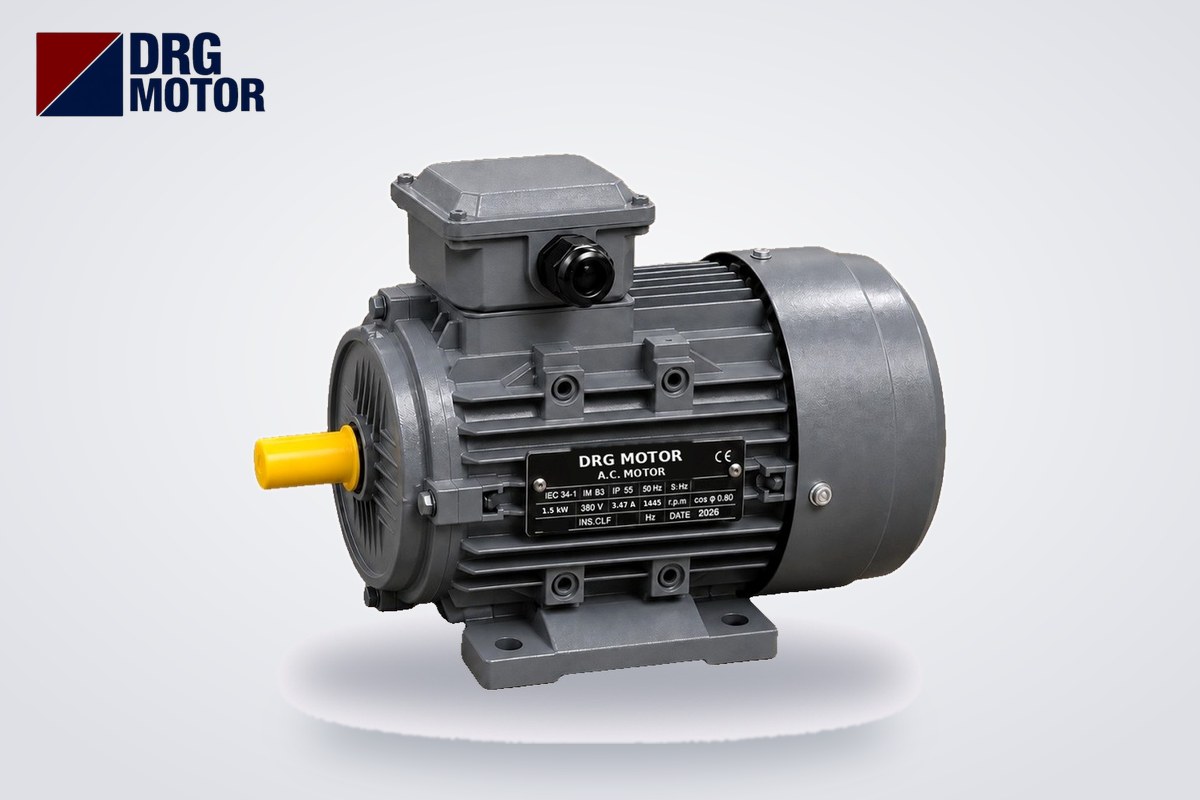

Yes, but only at small ratings and with a loss of output. A three-phase motor whose nameplate reads 230/400 V (Δ/Y) can run on a 230 V single-phase supply if its windings are connected in delta and a run capacitor is fitted to the third terminal; this is known as the Steinmetz connection. The trade-off is a clear drop in usable power and a much weaker starting torque: for example, the 1.5 kW, 1500 rpm DRG-90L-4 starts with 2.3 times its rated torque on three phases but loses most of that margin on a single phase. On motors rated 400/690 V (4 kW and above in our online store) the method is of no practical use.
This connection means working directly at mains voltage; opening the terminal box, wiring the capacitor and setting the protection is a job for a qualified electrician. A capacitor can stay charged after the power is cut, so never touch its terminals with bare hands. Below we explain, based on catalogue data, which motors are suitable for single phase, how the connection is made terminal by terminal, why power falls and when another solution makes more sense.
One thing first: all 120 models in our Buy Electric Motors Online section are three-phase induction motors.
Which Three-Phase Motors Can Be Connected to 230 V? Check the Nameplate Voltage
The deciding factor is not motor power but winding voltage. On a 230/400 V motor each phase winding is designed for 230 V: it is connected in star on a 400 V supply and in delta on 230 V. The 230 V from a single-phase socket matches exactly that winding voltage. On a 400/690 V motor the winding is designed for 400 V; even in delta at 230 V each winding only sees 230/400 of what it needs. Since the torque of an induction motor varies roughly with the square of voltage, this means (230/400)² ≈ 0.33, i.e. torque falls to about one third, before the single-phase penalty is even added.
In our range, models up to 3 kW are wound for 230/400 V and models from 4 kW upwards for 400/690 V. The table shows examples from the 4-pole (1500 rpm) series. The "230 V Δ current" column is the line current the motor would draw on a three-phase 230 V supply in delta, calculated from the 400 V current with I ∝ 1/U (I₂₃₀ = I₄₀₀ × 400 / 230).
| Model | Power | Nameplate voltage | Current at 400 V | 230 V Δ current (calc.) | cos φ | Ts/Tn | Single phase with capacitor |
|---|---|---|---|---|---|---|---|
| DRG-712-4 | 0.37 kW | 230/400 V | 0.92 A | ≈ 1.6 A | 0.75 | 2.1 | Possible |
| DRG-802-4 | 0.75 kW | 230/400 V | 1.75 A | ≈ 3.04 A | 0.75 | 2.3 | Possible |
| DRG-90L-4 | 1.5 kW | 230/400 V | 3.3 A | ≈ 5.74 A | 0.77 | 2.3 | Possible, light loads |
| DRG-100L1-4 | 2.2 kW | 230/400 V | 4.52 A | ≈ 7.86 A | 0.81 | 2.3 | Borderline, drive recommended |
| DRG-100L2-4 | 3 kW | 230/400 V | 6.02 A | ≈ 10.47 A | 0.82 | 2.3 | Borderline, drive recommended |
| DRG-112M-4 | 4 kW | 400/690 V | 7.95 A | — | 0.82 | 2.2 | Not suitable |
"Possible" in the table means the motor will survive; it does not mean your machine will do its job with this reduced torque. Therefore, in the 2.2–3 kW band the drive solution described below usually causes fewer problems than a capacitor.
Steinmetz Connection: Which Terminal Does the Capacitor Go On?
The terminal box has six terminals: U1 V1 W1 on the top row, W2 U2 V2 on the bottom row. For single-phase operation the windings are first connected in delta, i.e. the three links are fitted vertically. Line and neutral then go to two corners, and the capacitor is connected between the third corner and one of those two terminals.
| Step | Connection | Note |
|---|---|---|
| 1. Links | U1–W2, V1–U2, W1–V2 | Delta (Δ) connection; all three windings see 230 V |
| 2. Line (L) | U1 | Via fuse / motor protection circuit breaker |
| 3. Neutral (N) | V1 | From the neutral terminal of the protective device |
| 4. Capacitor | Between W1 and U1 | Feeds a phase-shifted current to the third winding |
| 5. Protective conductor (PE) | Earth screw in the terminal box | If the capacitor housing is metal, earth it too |
The capacitor feeds the winding at W1 with a current shifted in phase relative to the supply, roughly imitating a three-phase rotating field. The imitation is good only at one particular load; as the load changes, the winding currents drift apart. Every limitation of the Steinmetz connection stems from this.
How do you reverse the direction of rotation?
The capacitor lead on W1 stays put; its other lead is moved from U1 (line side) to V1 (neutral side) and the motor runs the other way. This is the single-phase equivalent of the three-phase rule "swap two phases". The links are not touched. If you need to reverse often, do it with a two-contactor circuit; never remove the capacitor by hand while the motor is running.
How Do You Choose the Capacitor Value and Type?
Rules giving a fixed number of microfarads per kilowatt circulate online; we deliberately do not give one here, because the right value depends on the winding design, the number of poles and above all on the load. A capacitor that balances the motor at no load may leave it unbalanced under load. The reliable route is:
- If the motor documentation or the capacitor manufacturer's table gives a recommendation for this use, start there.
- If not, start with a small value and run the motor at its real load; measure the three currents at the motor terminals (L, N and the capacitor leg) with a clamp meter.
- Change the value step by step and find the point where the three currents are closest to each other. A larger value strengthens starting but overloads the capacitor winding at no load and light load.
- Use only a motor run capacitor (AC, designed to stay in circuit permanently) with a voltage rating comfortably above the supply. Electrolytic (DC) capacitors must not be used.
If starting torque is insufficient, a second start capacitor is added in parallel with the run capacitor and switched out by a relay or timer once the motor reaches speed. If it stays in circuit, the motor overheats quickly. Start and run capacitors work on the same principle as in single-phase motors; see our article why single-phase motors need a capacitor for details.
Why Do Power and Starting Torque Drop on Single Phase?
On three phases each winding carries equal current and the rotating field is uniform. On a single phase one winding (between U1 and V1) sees the supply voltage directly, the other two remain in series and the capacitor sits in parallel with one of them; the field resembles an ellipse rather than a circle and pulsates. The result shows up in three places:
- Continuous power: the winding with the highest current reaches its thermal limit before the others. If you load the motor to its nameplate power, that winding overheats; the motor must therefore be used well below its rated power. How far below depends on the load and capacitor and can only be determined by measurement.
- Starting torque: the capacitor gives a good phase shift at only one speed (the load point). At standstill the field is weak, so the catalogue Ts/Tn ratio (2.3 for the 1.5 kW model) does not apply on single phase. This motor, with a rated torque of 9.91 Nm, starts with about 2.3 × 9.91 ≈ 22.8 Nm on three phases but far less on single phase.
- Vibration and noise: the pulsating field produces a hum and slight vibration at twice the supply frequency; this is not a fault in itself, but it sounds different from three-phase operation.
What current limit should you keep to? Worked example
The DRG-90L-4 draws 3.3 A at 400 V in star; in star the line current equals the winding current, so each winding is good for 3.3 A. Connected in delta at 230 V, the same motor has an equivalent line current of 3.3 × 400 / 230 ≈ 5.74 A and a winding current of 5.74 / √3 ≈ 3.31 A, so the winding limit is the same. In the Steinmetz connection none of the three terminal currents should exceed about 5.74 A; but since the currents are unbalanced this is not sufficient on its own, and the final verdict comes from the frame temperature after a period under load. You can check current values for other ratings with our motor current chart.
Heating and Protection: Do Not Leave a Capacitor-Run Motor Under Load Without Measuring
The most common failure with the Steinmetz connection is a single winding gradually overheating until its insulation breaks down. Because the motor appears to run normally, this often goes unnoticed. On the protection side, pay attention to the following:
- The motor protection circuit breaker or overload relay is set according to the single-phase line current, and the setting does not exceed the 230 V Δ equivalent current (≈ 5.74 A for 1.5 kW).
- Since the overload device sees single-phase current, check its documentation to confirm it is suitable for single-phase use and how its poles must be wired.
- If a start capacitor is used, confirm on the first trial, visually and by current measurement, that the relay switching it out actually operates.
- The protective conductor (PE) in the terminal box must be connected properly; if the single-phase socket circuit has no earth, the motor must not be run on it.
First start-up checklist
- Is the nameplate 230/400 V (Δ/Y)? If not, stop.
- Are the three links in delta and the nuts tight?
- Is the capacitor an AC run type, is its voltage rating sufficient, is it secured?
- Is the direction of rotation correct at no load?
- Have the three terminal currents been measured under load; are they close to each other and is any above the limit?
- After a long run under load, have the frame temperature and currents been measured again?
- Is maintenance only done after the capacitor terminals have been discharged?
When Does Running on a Capacitor Make No Sense?
Running on a capacitor is an acceptable stopgap for jobs with a light start and a steady load (small fan, machine tool starting unloaded, light sander, mixer). Choose another route in these cases:
- Machines that start under load: piston compressor, loaded conveyor, crusher, dough mixer. Low starting torque makes the motor hum and trips the overload.
- Frequent stop-start: every start puts extra stress on the capacitor winding.
- Strongly varying loads: a single capacitor is balanced at only one load point.
- Motors rated 400/690 V: the winding voltage does not match, torque falls to about one third.
The Better Route: Single-Phase-Input Drive or Single-Phase Motor
If only 230 V is available on site and you need the full motor power, there are two proper solutions. A single-phase-input variable frequency drive takes 230 V single phase and supplies the motor with three-phase 230 V. The motor is connected in delta, all three windings carry equal current and nameplate power and torque are available; soft starting and speed control come as a bonus. The drive's output current must cover the motor's 230 V current: ≈ 5.74 A for the 1.5 kW 4-pole model, ≈ 10.47 A for 3 kW. Because the output is 230 V, this method too is valid only for 230/400 V motors. The second solution, if the load is small, is to use a single-phase motor directly.
| Criterion | Capacitor (Steinmetz) | Single-phase-input drive | Single-phase motor |
|---|---|---|---|
| Usable power | Well below nameplate | Nameplate power | Its own nameplate power |
| Starting torque | Weak | Adjustable, strong | Depends on capacitor type |
| Speed control | No | Yes | No |
| Winding balance | Unbalanced | Balanced | By design |
| Suitable nameplate | 230/400 V | 230/400 V | — |
| If three-phase arrives later | Capacitor removed | Motor stays as is | Motor replaced |
The last row matters: if the workshop will get a three-phase supply later, buying a three-phase motor and running it on a drive in the meantime does not waste the investment. When choosing a three-phase motor, check values such as current and cable size beforehand with our electric motor calculators.
230/400 V Three-Phase Motors That Can Be Adapted to Single Phase
4-pole examples in our online store rated 230/400 V (Δ/Y) that can run at 230 V with a drive or a capacitor:
- DRG-712-4 – 0.37 kW – 1500 rpm – aluminium frame, IEC 71
- DRG-802-4 – 0.75 kW – 1500 rpm – aluminium frame, IEC 80
- DRG-90L-4 – 1.5 kW – 1500 rpm – aluminium frame, IEC 90L
- DRG-90L-4 – 1.5 kW – 1500 rpm – cast iron frame, IEC 90L
- DRG-100L1-4 – 2.2 kW – 1500 rpm – aluminium frame, IEC 100L
- DRG-100L2-4 – 3 kW – 1500 rpm – aluminium frame, IEC 100L
Click to see current prices and order these motors nowSEE PRICES →
Frequently Asked Questions
Can a 3 kW three-phase motor be connected to 230 volts?
If its nameplate reads 230/400 V, yes, connected in delta. The DRG-100L2-4 belongs to this class; its equivalent three-phase 230 V current is about 10.47 A. Run on a capacitor, power and starting torque drop noticeably; at this rating a single-phase-input drive is the better solution.
How many microfarads does a capacitor need to run a three-phase motor on single phase?
There is no single value that suits every motor and load. Start with the motor or capacitor manufacturer's recommendation, run the motor at its real load, adjust the value by measuring the three terminal currents and confirm with the frame temperature. This adjustment should be done by an electrician.
I fitted a capacitor and the motor hums but does not turn; why?
The most common cause is starting under load: on single phase the starting torque drops sharply. An open or degraded capacitor, links left in star instead of delta, and a 400/690 V nameplate give the same symptom. Switch the motor off immediately; leaving it humming heats the winding.
Will a 380 V motor run on 220 V?
Motors commonly called "380 V motors" are rated either 230/400 V or 400/690 V. The 230/400 V ones can run at 230 V in delta (at full power with a drive, with losses on a capacitor). The 400/690 V ones cannot produce enough torque at 230 V; they need a three-phase 400 V supply.
Send us your motor's nameplate and the machine it will drive, and we will help you choose the right three-phase model: +90 (542) 666 11 11, [email protected] or our contact page. To see every model, browse the 120 three-phase motors in our online store.