English
 Le français
 Türkçe




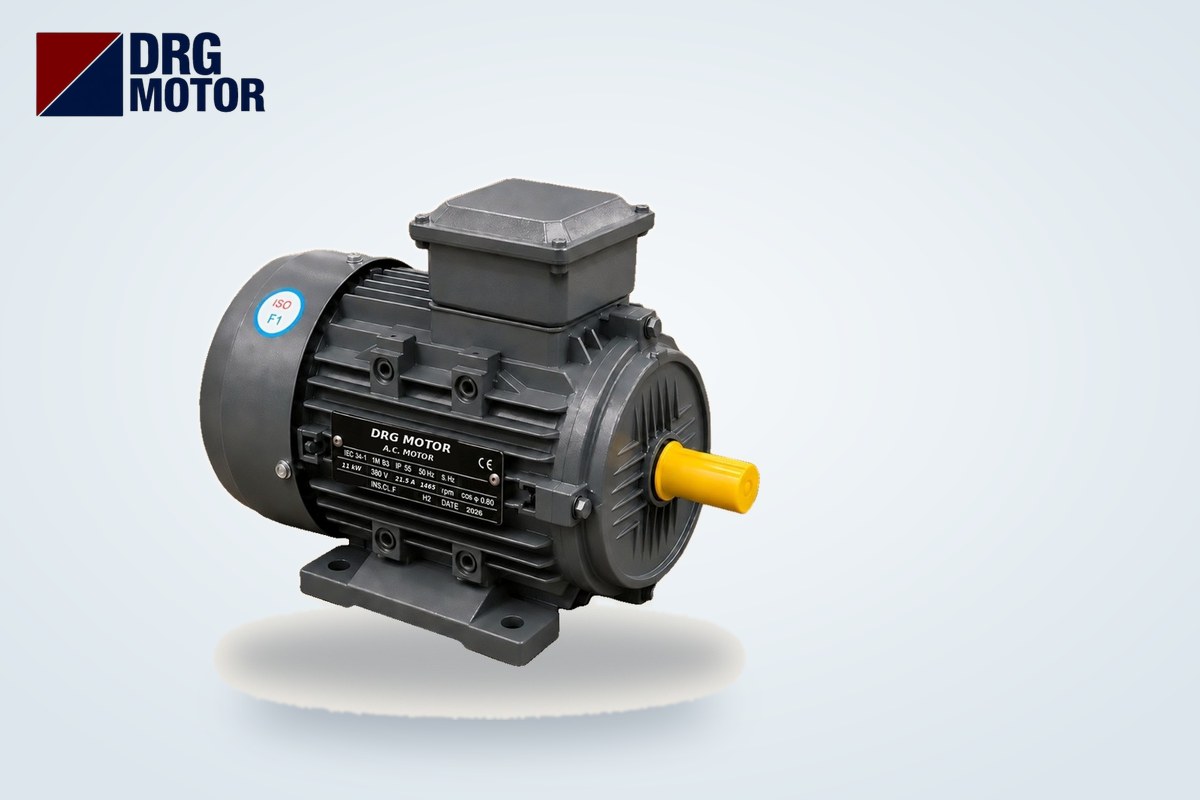

Motor bearing failure is usually recognised on site by three signs: a hum or growl that rises with speed, the bearing-side end shield running noticeably hotter than the opposite one, and an increase in vibration you can feel or measure. If, after stopping the motor and locking out the supply, the shaft feels rough, catches at a point or shows up-and-down play when turned by hand, the bearing has most likely reached the end of its life.
These symptoms do not appear overnight. At first there is only a faint noise audible in a quiet room; heat and vibration follow over the weeks, and finally the shaft starts to rub and the rotor can touch the stator and burn the winding. A fault caught early is usually closed with a bearing change; caught late, the motor itself is lost. If you are considering a replacement, you can compare models with the same frame and shaft size on the Buy Electric Motors Online page.
Bearing types, general failure symptoms and greasing intervals are covered in separate articles on our site: Bearing Types and Selection in Electric Motors, Motor Bearing Failure Symptoms and Causes and Bearing Greasing and Lubrication Intervals. This article focuses on the diagnostic steps a maintenance technician follows on site and on a table showing which bearing sits in which frame.
Step-by-Step On-Site Diagnosis
The sequence below lets you reach a clear decision within half an hour, even in a workshop with few instruments. Before any mechanical check, switch off the motor, lock and tag the isolator; leave all work inside the electrical panel to a qualified electrician.
- Listen while running: determine which end (drive end / fan end) the noise comes from.
- Cut the power and keep listening: if the noise continues unchanged while the motor coasts, the source is mechanical; if it stops the moment power is cut, the problem is most likely electrical or magnetic.
- Compare end-shield temperatures: measure the front and rear bearing housings at the same point.
- Check vibration in three directions: horizontal, vertical and axial.
- Isolate the load: remove the coupling or belt and run the motor unloaded; if the symptom disappears, the problem lies in the driven machine or the alignment.
- Check the shaft by hand: rotation, radial and axial movement.
- Measure the current: compare it with the nameplate current.
Diagnosis by Sound: Hum, Clicking and Squealing
An industrial stethoscope is best for listening; without one, rest the tip of a long screwdriver on the bearing housing and bring the handle close to your ear for the same result. Touch the end-shield hub where the bearing sits, not the fan cover, and listen to both ends in turn. Keep hair, clothing and hands away from rotating parts.
| Noise heard | Probable source | Confirmation step |
|---|---|---|
| Steady, soft hum | Healthy bearing or magnetic noise | If it disappears when power is cut, it is electrical and considered normal |
| Growl, gritty sound | Bearing out of grease or contaminated | Roughness when turned by hand, rising housing temperature |
| Rhythmic clicking | Pitting on a ball or ring | Continues after power is cut, slowing down as speed drops |
| High-pitched squeal or whistle | Running dry, bearing turning in its housing | Local heating at the end-shield hub, axial play at the shaft end |
| Knocking, impacts | Coupling, key or soft foot | If the noise disappears with the coupling removed and the motor unloaded, the motor is not the source |
Noise from the fan end does not always mean a bearing: a broken fan blade or an impeller rubbing the fan cover makes a similar clicking. Removing the fan cover and inspecting the fan eliminates this possibility in two minutes.
Checking Temperature, Vibration and Shaft Play
Temperature
Measure the front and rear bearing housings with an infrared thermometer under the same load. On a healthy motor both end shields are at a similar temperature; the one housing the faulty bearing stands out clearly. Rather than a single reading, logging weekly measurements of the same motor and watching the trend is more reliable. General heating on the winding side may come from overload or phase imbalance rather than the bearing, so assess it together with a current measurement.
Vibration and rotational frequency
If you have a vibration meter, first know the motor's rotational frequency: rated speed ÷ 60. For example, for the DRG-132S-4 running at 1460 rpm this is about 24.3 Hz, and for the DRG-132S1-2 running at 2930 rpm about 48.8 Hz. If vibration is concentrated exactly at this frequency, unbalance or coupling misalignment is more likely; bearing damage shows up at higher frequencies that are not exact multiples of the rotational frequency, usually with a "noisy" spectrum. For detailed spectrum interpretation, get support from a team that performs vibration analysis.
Shaft play
With the motor locked out, hold the shaft end with both hands and move it up-and-down and back-and-forth. Motors with rolling bearings should show no visible radial play. A small axial movement may be by design; this is explained in the Motor Axial End-Float and Bearing Load article. If the shaft catches at one point while turning and then frees up, the ring surface is damaged.
Do Not Replace the Bearing Before Finding the Root Cause
A bearing failure whose cause is not removed will repeat in the new bearing. The most common causes on site are:
- Coupling misalignment: if the motor and machine shafts are not on the same axis, the bearing constantly carries side load. Check with a dial indicator or laser alignment; for mounting-related vibration see Prevent Vibration and Early Failure with Correct Mounting.
- Excessive belt tension: in pulley drives an over-tightened belt quickly wears out the drive-end bearing. Make sure the pulley sits close to the shaft shoulder.
- Lubrication errors: pumping too much grease into a regreasable bearing causes heating just as much as no grease. ZZ-type bearings (metal shields on both sides) are greased for life and are not lubricated from outside.
- Shaft current: on motors run by a frequency drive, current flowing through the shaft leaves striped marks (fluting) on the ring. The symptom is usually a high-pitched noise that starts after a new drive is installed. Countermeasures are in the Shaft Voltage and Bearing Current Damage article.
- Water, dust and washdown: on motors cleaned with pressurised water or working in dusty areas, check the seals and end-shield tightness.
- Incorrect fitting: hammering a coupling or pulley onto the shaft marks the balls; fit them with a puller and by heating.
Bearing Table by Frame Size (DRG Catalogue Data)
Before ordering a spare bearing, read the number from the motor nameplate; if it is not there, find it in the catalogue from the frame size. The table below is compiled from the data file of the models in our store and shows the bearing designation given in the catalogue for each frame. If the nameplate or catalogue lists the front (drive end) and rear (fan end) bearings separately, note both.
| IEC frame | Housing material | Poles | Bearing (data) | Shaft diameter D (mm) |
|---|---|---|---|---|
| 63 | Aluminium | 2 | 6201-ZZ-C3 | 11 |
| 71 | Aluminium and Cast iron | 2, 4, 6 | 6202-ZZ-C3 | 14 |
| 80 | Aluminium and Cast iron | 2, 4, 6 | 6204-ZZ-C3 | 19 |
| 90S | Aluminium and Cast iron | 2, 4, 6 | 6205-ZZ-C3 | 24 |
| 90L | Aluminium and Cast iron | 2, 4, 6 | 6205-ZZ-C3 | 24 |
| 100L | Aluminium and Cast iron | 2, 4, 6 | 6206-ZZ-C3 | 28 |
| 112M | Aluminium and Cast iron | 2, 4, 6 | 6206-ZZ-C3 | 28 |
| 132S | Aluminium and Cast iron | 2, 4, 6 | 6208-ZZ-C3 | 38 |
| 132M | Aluminium and Cast iron | 4, 6 | 6208-ZZ-C3 | 38 |
| 160M | Aluminium and Cast iron | 2, 4, 6 | 6309-C3 | 42 |
| 160L | Aluminium and Cast iron | 2, 4, 6 | 6309-C3 | 42 |
| 180M | Cast iron | 2, 4 | 6311-C3 | 48 |
| 180L | Cast iron | 4, 6 | 6311-C3 | 48 |
| 200L | Cast iron | 2, 4, 6 | 6312-C3 | 55 |
| 225S | Cast iron | 4 | 6313-C3 | 60 |
| 225M | Cast iron | 2 | 6313-C3 | 55 |
| 225M | Cast iron | 4, 6 | 6313-C3 | 60 |
| 250M | Cast iron | 2 | 6314-C3 | 60 |
| 250M | Cast iron | 4, 6 | 6314-C3 | 65 |
| 280S | Cast iron | 2 | 6314-C3 | 65 |
| 280S | Cast iron | 4, 6 | 6317-C3 | 75 |
| 280M | Cast iron | 2 | 6314-C3 | 65 |
| 280M | Cast iron | 4, 6 | 6317-C3 | 75 |
| 315S | Cast iron | 2 | 6317-C3 | 65 |
| 315S | Cast iron | 4, 6 | 6319-C3 | 85 |
| 315M | Cast iron | 2 | 6317-C3 | 65 |
| 315M | Cast iron | 4, 6 | 6319-C3 | 85 |
| 315L | Cast iron | 2 | 6317-C3 | 65 |
| 315L | Cast iron | 4, 6 | 6319-C3 | 85 |
| 355M | Cast iron | 2 | 6319-C3 | 75 |
| 355M | Cast iron | 4, 6 | 6322-C3 | 100 |
| 355L | Cast iron | 2 | 6319-C3 | 75 |
| 355L | Cast iron | 4, 6 | 6322-C3 | 100 |
Keep two points in mind when reading the table. First, from frame 180 upwards the 2-pole and 4-6 pole versions of the same frame may have a different bearing and shaft diameter; the 280S with 6314-C3 on 2 poles and 6317-C3 on 4 and 6 poles is an example. Second, the suffixes at the end of the number matter: ZZ denotes a bearing with metal shields on both sides, and C3 denotes a larger-than-normal internal clearance. Fitting a bearing with different suffixes, even if the dimensions match, can lead to heating or early failure.
How Does Current Measurement Help the Diagnosis?
As the bearing tightens, the friction torque the motor must overcome increases and the current drawn at the same workload rises. Measure all three phases with a clamp meter and compare with the nameplate current. For example, at 380 V the catalogue current is 11.2 A for the DRG-132S-4 and 21.5 A for the DRG-160M-4. If there is an increase compared with earlier readings and the load has not changed, add mechanical friction to the list of suspects. A marked difference between the three phases points to the supply or winding rather than the bearing. For the current values of other ratings you can use the motor current chart tool.
Replace the Bearing or the Motor?
On small and medium frames a bearing change is often enough; however, seriously consider replacing the motor if any of the following apply:
- The bearing seat (end-shield hub) is worn and the bearing turns in its housing by hand.
- The shaft end is dented or burred, or the bearing seat surface is worn.
- The rotor has rubbed the stator; a shiny rub mark is visible on the stator.
- Bearing overheating has damaged the winding insulation and the motor has started tripping the fuse or the residual current device.
- The same motor has repeated bearing failures at short intervals and the cause cannot be removed.
- The production cost of a breakdown is greater than keeping a spare motor on the shelf.
When choosing a new motor, keeping the old motor's IEC frame, shaft diameter (D) and mounting arrangement the same lets you fit it without changing the coupling or base frame. The overload, fuse and contactor selection tool helps with connection and protection settings.
Motors in These Frames
- DRG-90L-4 – 1.5 kW – 1445 rpm – 90L cast iron (6205-ZZ-C3)
- DRG-112M-4 – 4 kW – 1450 rpm – 112M aluminium (6206-ZZ-C3)
- DRG-132S-4 – 5.5 kW – 1460 rpm – 132S cast iron (6208-ZZ-C3)
- DRG-160M-4 – 11 kW – 1465 rpm – 160M cast iron (6309-C3)
- DRG-180M-4 – 18.5 kW – 1470 rpm – 180M cast iron (6311-C3)
Click to see current prices and order these motors nowSEE PRICES →
Frequently Asked Questions
What happens if a motor bearing fails?
Noise and heat rise first, then vibration increases. Without intervention the bearing breaks up, the shaft may seize or the rotor rubs the stator and burns the winding. From that point a motor replacement is usually needed.
How do you tell bearing noise from electrical noise?
Cut the power while the motor is running. If the noise stops at the same moment, the source is electrical or magnetic; if the noise continues while the motor coasts, slowing down with the speed, the source is the bearing or another mechanical part.
Where can I find the motor bearing number?
Look at the motor nameplate first. If it is not there, read the IEC frame size (e.g. 132S) from the nameplate and find it in the table above or in the manufacturer's catalogue. If the front and rear bearings differ, note both numbers.
Does bearing failure increase motor current?
Yes, as the bearing tightens friction increases and the current rises at the same load. However, a current increase can also come from overload, low voltage or phase imbalance; on its own it is not proof and should be assessed together with noise and temperature.
For a replacement motor matching your frame you can choose from the 120 models in our online store, or contact us by phone on +90 (542) 666 11 11, by e-mail at [email protected] or via our contact page.