 English
 Le français
 Türkçe

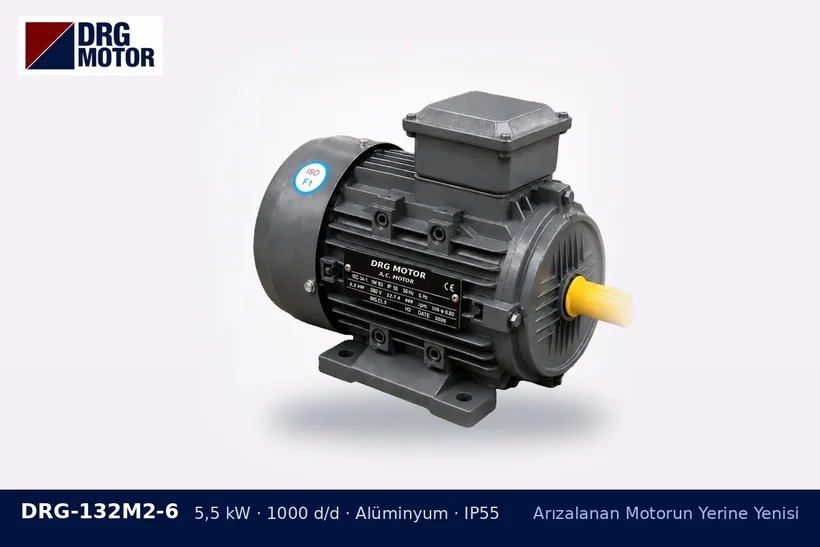
When switching to a motor of a different brand, IEC dimensions and nameplate values matter far more than the brand name. The order of priority is usually power and speed, supply voltage, mounting arrangement, frame size and shaft dimensions; if these line up the swap goes smoothly in most cases, but every item still needs to be verified on the old motor.
Order of priority
| Item | Why it matters | How to verify |
|---|---|---|
| Output and pole count | Machine speed and load are set up around them | The kW and rpm values on the nameplate |
| Voltage and connection | Must suit the panel's starting arrangement | Nameplate and check by qualified staff |
| Mounting arrangement | Foot, flange or both | Photo and flange size |
| IEC frame and shaft height | Pulley and coupling alignment | Measurement from floor to shaft centre |
| Shaft size and keyway | Fit of the pulley and coupling hub | Measurement with callipers |
Differences that are often missed
- Overall length: Even where the IEC frame matches, motor length and fan cover length can vary by maker; check rear clearance in tight spaces.
- Terminal box position: Top or side mounting affects cable length and entry.
- Foot hole spacing: The letters S, M and L change the longitudinal hole distance; a 132S and a 132M may not fit the same base.
- Starting behaviour: Starting torque and starting current are not fixed by the kW figure and differ between makers; on hard-starting machines compare these values in the catalogue.
If the old motor's nameplate is non-standard
On some machines the old motor may have a non-IEC frame, a special flange or a machine-specific shaft. In such cases a swap to a standard motor may call for an adapter flange, bush or base modification. Who will carry out that adaptation, and how, should be settled before ordering.
To compare dimensions with your old motor, use the motor comparison and technical drawing pages, and consider DRG models in the matching frame among the options in the shop.