 English
 Le français
 Türkçe

When a motor will not run after a lightning strike, the fault is not always inside the motor; the fuse, contactor coil, control circuit or drive may also have been hit. First have the supply and the panel checked by qualified electrical staff, then have the motor insulation tested; the decision on a new motor follows from the outcome of these two steps.
How does lightning reach the motor?
A direct hit is rare. More often, lightning striking nearby causes a sudden voltage surge on the line, in the ground or along a long cable. The surge can puncture the insulation at the weakest point of the winding, usually the first turns at the coil entry or where the coil leaves the slot. The puncture may be tiny; the motor can look fine from outside yet short-circuit when started.
Order of checks
- The site's main supply and the state of other equipment: is the fault on this machine only?
- Fuses, control transformer, contactor coil and, if fitted, the drive in the panel
- Burn or puncture marks on the motor cable
- Insulation test on the motor and comparison of winding resistances
These measurements and their interpretation are a job for qualified electrical staff; results are read together with the nameplate data and the maker's documentation. Forcing the motor to start several times “just to see” can turn a small insulation defect into a fully burnt winding.
Precautions for the future
Pumping stations in open ground, irrigation wells and sites fed by long overhead lines are more exposed to such surges. Have an electrical designer assess the earthing system and the overvoltage protection arrangement. Whether the failure is covered by the warranty is decided after technical inspection; for externally caused voltage damage, also check what your insurance policy covers.
If a new motor is needed
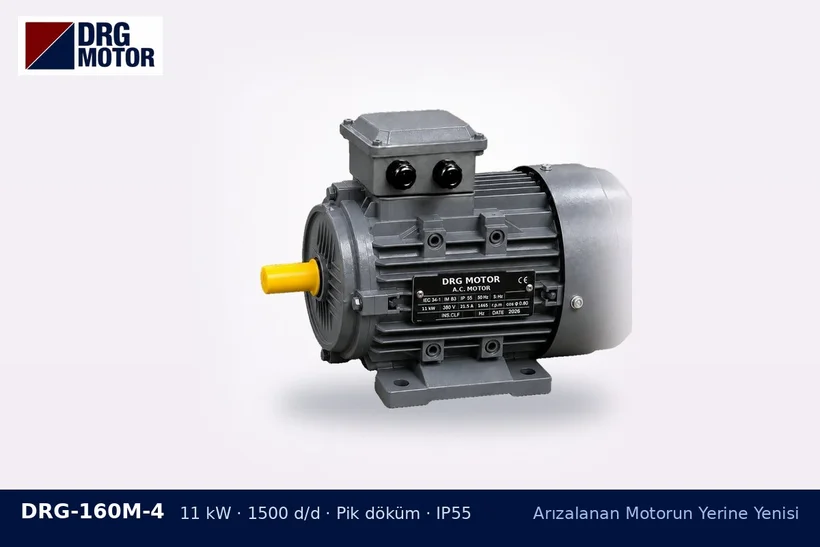
The old motor's nameplate data, mounting arrangement and shaft size are enough for a quick match. Connecting the new motor before the panel and cable have been found sound may pass the same defect on to it.
For outdoor applications see the irrigation pump motors page, and review models of the same power and speed in the three-phase motor shop.