 English
 Le français
 Türkçe

Fitting a higher-power motor temporarily is possible in most cases; a motor draws only as much power as the load demands, and being larger does not by itself harm the machine. However, the speed must stay the same, the frame and shaft size must suit the machine, and the protection in the panel must be reassessed for the new motor.
The real obstacle is usually dimensions
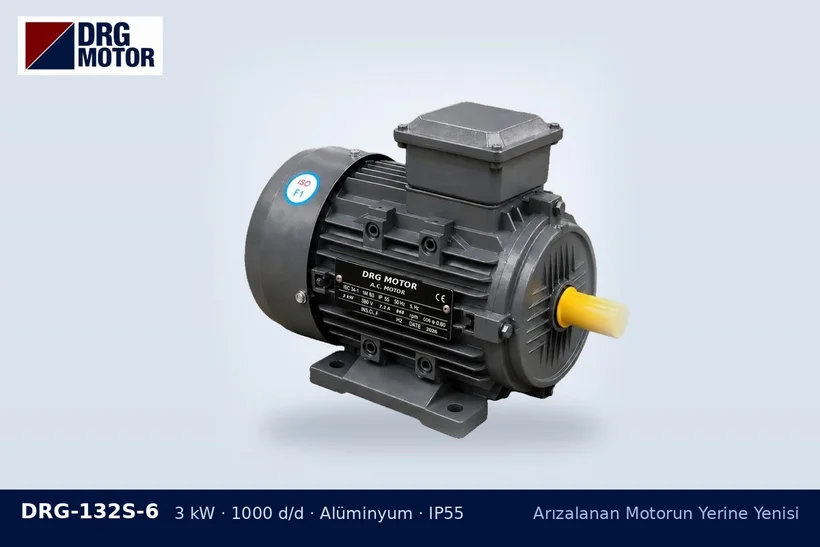
As power increases, the IEC frame may grow; shaft height, foot hole spacing and shaft diameter change. For example, in DRG's 1500 rpm aluminium frame range the 4 kW model comes in a 112M frame with a 28 mm shaft, while the 5.5 kW standard model (DRG-132S-4) comes in a 132S frame with a 38 mm shaft; the compact DRG-112M-4K of the same power stays in the 112M frame. When the frame changes, that difference means changing the pulley, coupling and base. If a higher rating within the existing frame is available, the stopgap is easier; if not, adaptations such as an adapter plate and bushes are needed.
Speed must be kept
If the larger motor to hand has a different number of poles, the machine speed changes. On a fan or pump, a speed increase raises the power demand roughly with the cube of speed; on a conveyor the product flow changes, on a crusher the impact speed. Even for a temporary swap, keep the pole count the same or recalculate the pulley ratio.
Panel and mechanical side
- A larger motor has a different starting current and rated current; qualified electrical staff should assess whether the fuse, contactor and protective device suit the new motor. Settings depend on the motor nameplate.
- Voltage and connection: up to 3 kW the nameplate reads 230/400 V, from 4 kW upwards 400/690 V; check compatibility with the panel's starting arrangement.
- Consider whether the belt, coupling and machine shaft can carry the larger motor's torque when the machine jams. A small motor stalls in a jam; a large motor keeps pushing and may break a machine part.
Before the stopgap becomes permanent
If the larger motor stays permanently at part load, its power factor drops and an unnecessarily large protection arrangement is required. It is best to plan the changeover for when the proper motor arrives and to record the temporary installation.
To compare frame dimensions, use the technical drawings page, and see the power options at the same speed side by side in the shop.