English
 Le français
 Türkçe


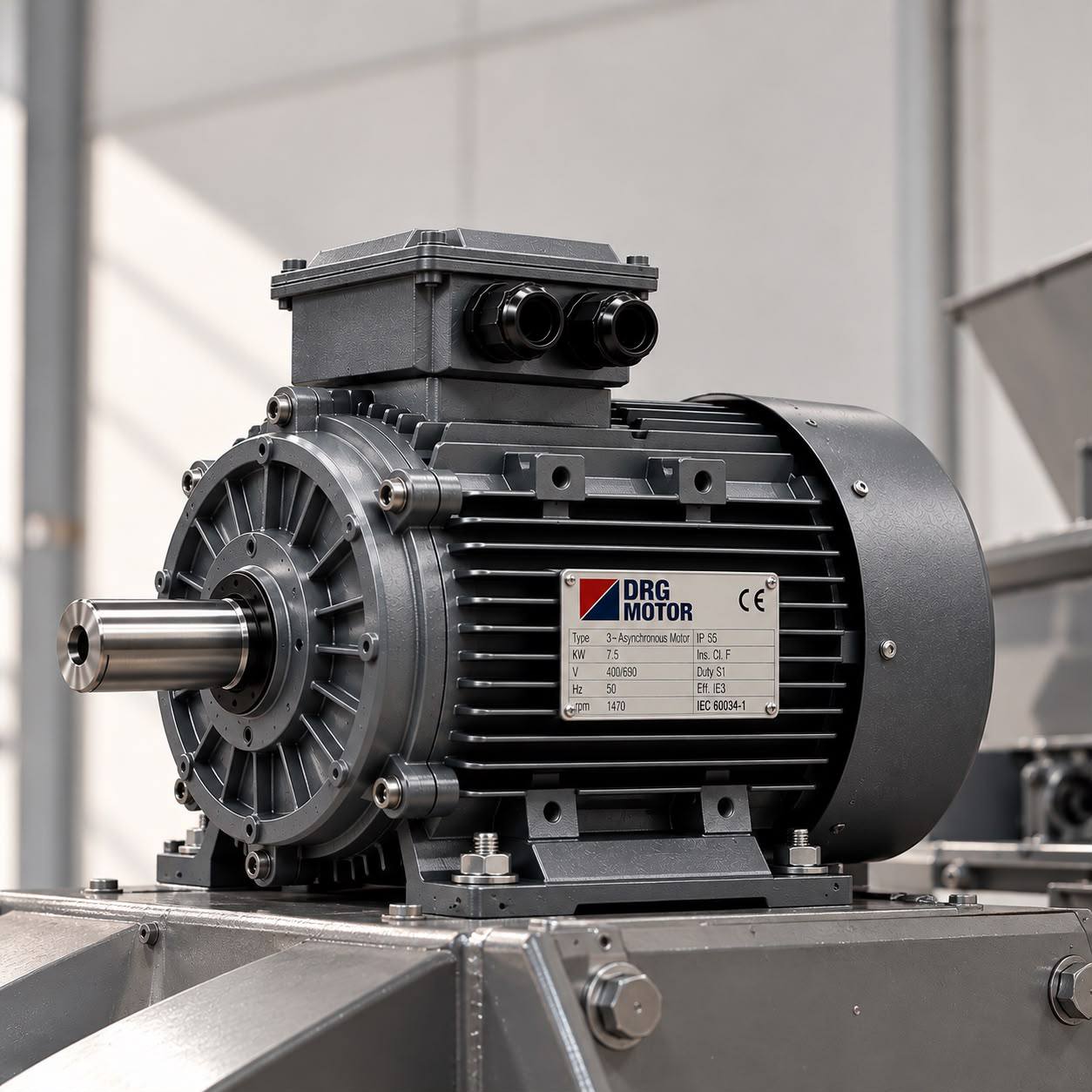

In a recycling workshop, an operator drops a thick-walled crate fragment into the hopper; the granulator chokes for a moment, the belts squeal, and the motor stops on a thermal trip. The owner says, “The motor is too weak, let’s go one size up.” Yet increasing power without looking at rotor mass, pulley ratio and protection settings usually just postpones the problem until the next thick part. Choosing a motor for a plastic crushing machine is not only about power; it is about deciding who absorbs the shock load: the motor, the flywheel, the belt, or the protection relay. In this article we answer that question with numbers, starting from the machine type.
Granulator or Shredder? Know the Machine First
On site, “plastic crushing machine” refers to two different machines with different motor requirements. A granulator runs a fast open-rotor knife drum with a screen; it cuts the part down to a size that passes the screen. A shredder tears large, bulky parts with slow, multi-knife shafts; it is often the pre-crusher in front of the granulator.
| Feature | Granulator | Shredder |
|---|---|---|
| Rotor speed | High, usually several hundred rpm | Low, tens of rpm |
| Drive | Belt and pulley, flywheel on the rotor | Gearbox, single or twin shaft |
| Load character | Short, frequent impacts; energy stored in the rotor | Sustained high torque, risk of jamming |
| Motor speed | Mostly 1500 rpm (4-pole) | 1500 or 1000 rpm + gearbox |
| Typical protection | Thermal + overcurrent, belt slip | Automatic reversing with current monitoring |
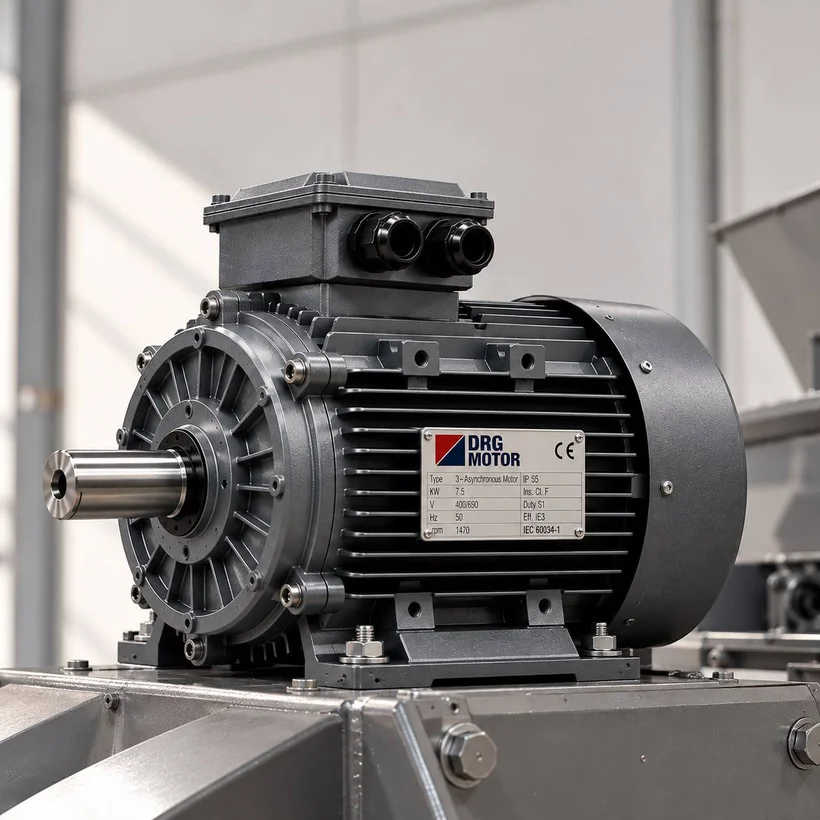
How Does Shock Load Stress the Motor?
In a granulator, every time a knife hits a part the rotor tries to slow down instantly. This momentary torque demand can reach several times the motor’s rated torque, but only for very short periods such as a tenth of a second. If the rotor and flywheel are heavy enough, this energy is supplied from stored kinetic energy; the motor only has to recover the lost speed. If the rotor is light, the whole load reaches the motor through the belt, the current peaks and the belts slip. That is why two motors of the same kW behave very differently on two machines with different rotor masses.
Simple diagnosis with a clamp meter
Before deciding to increase power, take three measurements with a clamp meter. The first is the current drawn while the machine idles; if this value is very close to the nameplate current, the belt may be over-tensioned, a bearing tight or the rotor rubbing. The second is the average current level during normal feeding; if it stays below the nameplate current, the motor power is sufficient and the problem lies in the momentary peaks. The third is the peak seen when a thick part is fed and the time it takes for the current to return to normal. If the peak is short and fades quickly, the flywheel and belt are doing their job; if the current stays high for seconds and rotor speed drops noticeably, either rotor inertia is insufficient or the feed exceeds the machine’s capacity. Recording these three values and passing them on when requesting a quote prevents buying an oversized motor and makes it easier to find the right step the first time.
Knife Speed and Pulley Ratio: A Worked Example
Example machine: 15 kW, 4-pole motor (rated speed about 1465 rpm, rated torque 97.8 Nm), motor pulley 160 mm, rotor pulley 450 mm, rotor knife circle diameter 400 mm.
- Rotor speed: nrotor = 1465 · 160 / 450 ≈ 521 rpm.
- Knife tip speed: v = π · 0.40 · 521 / 60 ≈ 10.9 m/s.
- Rated torque at the rotor: 97.8 · 450 / 160 ≈ 275 Nm (belt losses neglected).
- Belt speed: π · 0.16 · 1465 / 60 ≈ 12.3 m/s — a reasonable range for V-belts.
If you want to change the knife tip speed, changing the pulley ratio is usually more appropriate than changing the motor. When enlarging a pulley, also check whether the number and section of belts can carry the torque. You can try these speed, pulley and torque calculations with different values on the electric motor calculators page.
The Role of the Flywheel: The Difference in Numbers
On the machine above, let the total moment of inertia of rotor + flywheel be J = 6 kg·m². Rotor angular speed ω = 521 · 2π / 60 ≈ 54.5 rad/s, stored energy ½ · J · ω² ≈ 8926 J. Suppose a thick part demands 600 Nm at the rotor for 0.1 seconds. Subtracting the 275 Nm the motor can transmit, the deficit is (600 − 275) · 54.5 · 0.1 ≈ 1772 J. This energy is drawn from the rotor and speed drops from about 521 to 466 rpm; the motor easily recovers this short dip.
Now suppose the flywheel has been removed on the same machine and total inertia has fallen to 2 kg·m². The same impact pulls speed down to 331 rpm. With such a large dip the motor leaves its normal slip range and draws high current; after a few consecutive impacts it trips on thermal overload. The price is paid at start-up: the 6 kg·m² inertia is reflected to the motor shaft with the ratio (160/450)², i.e. about 0.76 kg·m²; assuming an average accelerating torque surplus of 100 Nm, start-up takes about 1.2 seconds, versus about 0.4 seconds at 2 kg·m². On a machine with a flywheel, the starting method and thermal setting must be chosen for this longer start.
1500 or 1000 rpm?
On granulators, a 4-pole (1500 rpm) motor with belt speed reduction is the most common solution: at the same kW the frame is smaller and the price more affordable. A 6-pole (1000 rpm) motor gives more torque at the same power; the catalogue shows 97.8 Nm at 1500 rpm and 146.5 Nm at 1000 rpm for 15 kW. 1000 rpm makes sense when a smaller pulley ratio is needed, when pulley diameter has reached its limit, or on large, slow-turning rotors.
On the shredder side, motor speed is reduced with a gearbox. For example, with a 22 kW 4-pole motor (142.9 Nm) and a gearbox ratio of 60, shaft speed is 1465 / 60 ≈ 24.4 rpm and, with a gearbox efficiency of 0.90, shaft torque is 142.9 · 60 · 0.90 ≈ 7717 Nm. This high torque also stresses mechanical parts during a jam, so on a shredder the protection scheme matters as much as motor selection.
Jam and Overcurrent Protection
- Thermal relay: set to the rated current on the motor nameplate (e.g. 27.3 A at 400 V for a 15 kW 4-pole motor). Raising the setting because it trips often leaves the winding unprotected.
- Overcurrent/jam relay: stops the feed conveyor if current exceeds a set value for a set time; on a shredder the controller briefly reverses the motor and tries again.
- Belt: a correctly tensioned belt slips on small jams and softens the impact; an over-tensioned belt transmits the impact directly to bearings and shaft.
- Starting: on large machines with flywheels, star-delta or a soft starter limits starting current; since torque is reduced in star connection, the machine must start empty.
- Thermistor: on a motor with thermistors in the winding, connecting them to a separate relay catches heating that current does not reveal, such as fins clogged with dust; state this in your order if you need it.
Dust, Fines and Cooling
Plastic crushing produces fine dust and fines that stick through static electricity. The motor is cooled by an external fan; when the fan cover grille and housing fins fill up, the motor runs hotter at the same load. IP55 protection is a suitable starting point against dust and water splashes, but it does not replace keeping the cooling path clean. Place the motor, if possible, on the side of the frame rather than directly below the hopper mouth and screen outlet; do not direct hot air from the cutting chamber into the fan inlet. A cast iron housing is preferred for robustness on vibrating frames and under shock loads. Ambient conditions for the other motors of a recycling line are also discussed in the article on electric motor selection in recycling plants.
Power Ranges and Store Models
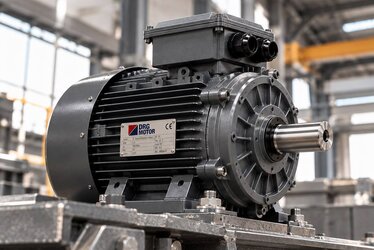
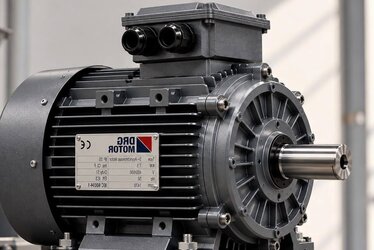
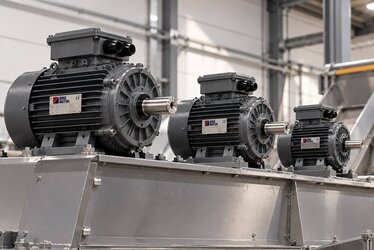
The required power depends on rotor width, screen hole size, material thickness and feeding method. The power and speed on your existing machine’s nameplate are the most reliable starting point. Below are example models in power steps frequently seen on crushing machines; you can see all steps on the buy electric motors online page.
| Model | Power (kW) | Speed (rpm) | Housing | IEC | Rated torque (Nm) | excl. VAT | incl. VAT |
|---|---|---|---|---|---|---|---|
| DRG-132M-4 | 7.5 | 1500 | Cast iron | 132M | 49.1 | 17,825.50 TRY | 21,390.60 TRY |
| DRG-160M-4 | 11 | 1500 | Cast iron | 160M | 71.7 | 25,674.00 TRY | 30,808.80 TRY |
| DRG-160L-4 | 15 | 1500 | Cast iron | 160L | 97.8 | 30,610.80 TRY | 36,732.96 TRY |
| DRG-180L-6 | 15 | 1000 | Cast iron | 180L | 146.5 | 37,680.50 TRY | 45,216.60 TRY |
| DRG-180L-4 | 22 | 1500 | Cast iron | 180L | 142.9 | 41,504.10 TRY | 49,804.92 TRY |
| DRG-200L-4 | 30 | 1500 | Cast iron | 200L | 194.2 | 55,748.00 TRY | 66,897.60 TRY |
Prices are taken from the DRG Motor online store list dated 24.09.2026; a 3% discount applies to bank transfer/EFT payments, shipping is not included in the price and is paid by the buyer.
For the 15 kW granulator in the example, the DRG-160L-4 is suitable; if higher torque and a smaller pulley ratio are wanted at the same power, the DRG-180L-6 can be considered. The 22 kW requirement in the shredder example is met by the DRG-180L-4. For heavier crusher and grinder applications, see the article on high-torque motor supply for crushers and grinders.
Motor Replacement and Pre-Order Checklist
- Photograph the power, speed, voltage and current on the old motor’s nameplate.
- Compare shaft diameter, shaft length and key size with the pulley hub.
- Measure the mounting type (foot-mounted B3, flanged) and foot hole spacing; frame holes must fit the new housing.
- Note whether there is a flywheel on the rotor and record the pulley diameters.
- State the starting method used (direct, star-delta, soft starter).
- Check the terminal box orientation and the position of the cable entry relative to dust.
- Update jam and overcurrent relay settings to the new motor’s nameplate current.
Frequently Asked Questions
My crusher motor trips often; should I go one size up?
First check belt tension, knife sharpness, screen clogging, whether the flywheel is in place, and the thermal setting. Dull knives and a clogged screen are among the most common causes that can be solved without more power. If the problem persists with these in order, a larger size is considered.
Can I couple the motor directly to the granulator rotor?
It is possible, but a belt drive gives flexibility in setting rotor speed and the advantage of slipping to soften impacts during a jam. With direct coupling, impacts are transmitted straight to the motor shaft and bearings.
Which motor speed is chosen for a shredder?
Since shaft speed is reduced by a gearbox, the motor is usually 1500 or 1000 rpm. The decision depends on the gearbox ratio, input flange and the shaft torque needed during a jam.
How often should I clean the motor in a dusty environment?
Rather than a fixed interval, visual inspection should be the rule: clean when deposits are visible on the fan grille and between the fins. When cleaning with compressed air, take care not to blow dust into the terminal box and bearing seals.
Send us your machine type, current motor nameplate, pulley diameters and starting method, and we will determine the right motor together: +90 (542) 666 11 11, [email protected] or our contact page.