English
 Le français
 Türkçe




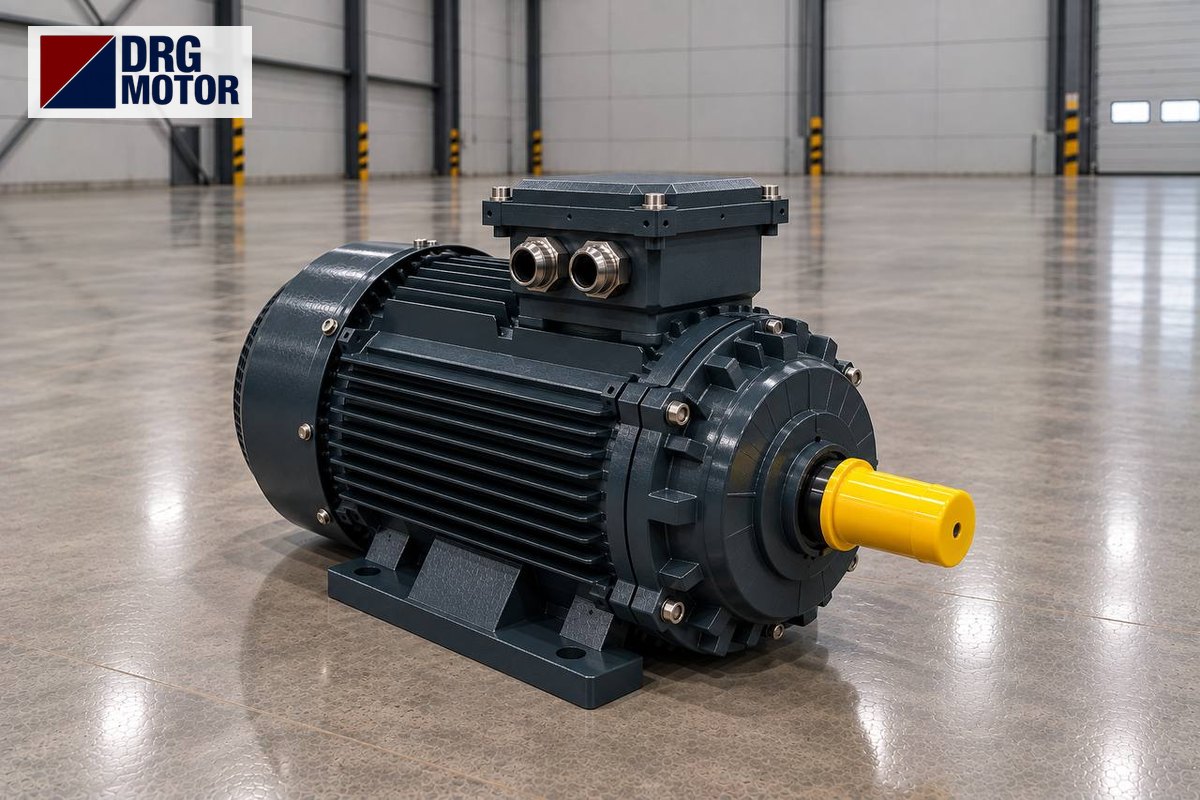

The motor of a metal swarf centrifuge brings a perforated basket full of chips up to the speed at which cutting oil and coolant are stripped from the swarf. What strains the motor in this machine is not steady running but starting: a full basket is a large inertia, and the motor draws high current for several seconds until it reaches operating speed. When replacing, power should be chosen according to basket mass and acceleration time, and the starting arrangement according to the supply line.
Swarf centrifuges are mostly vertical-shaft, belt-driven types: the motor stands upright or horizontal beside the body and the pulley ratio sets basket speed. A standard three-phase induction motor does the job. DRG Motor is a manufacturer, supplier and seller of electric motors; cast iron models suited to heavy starting are listed in the online motor store. For an overview of the different centrifuge types, the industrial centrifuge electric motors page is a good starting point.
What Does a Swarf Centrifuge Do, and Where Is the Motor?
Swarf from lathes, milling machines and automatic bar machines carries a large amount of cutting fluid relative to its own weight. As the basket spins, the fluid is thrown by centrifugal action through the basket holes into the outer casing and drains to the collecting tank. The recovered oil goes back to the machine tools; the dry swarf is briquetted or sold at a higher scrap value.
In batch machines the basket is loaded, spun, stopped and emptied; the motor starts once per cycle. In continuous-feed machines swarf flows in from above, the motor runs long cycles and starts are few. Before choosing the motor, establish which type you have: a motor started several times an hour does not have the same thermal situation as one started once a day.
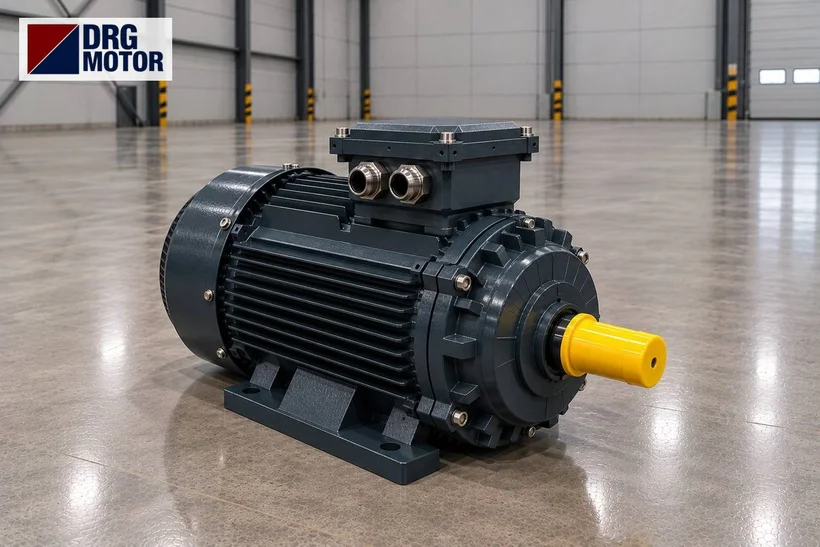
How the Full Basket's Inertia Lengthens Starting
In a belt drive, basket inertia is reflected onto the motor shaft by the square of the pulley ratio. If the basket turns slower than the motor, the inertia "seen" by the motor drops; that is the side of the belt ratio that eases starting. With basket speed and pulley ratio unchanged, anything that makes the basket heavier (overfilling, wet swarf, caked sludge) directly lengthens starting time.
Example / assumption: total basket and swarf inertia 12 kg·m², pulley ratio 1:2 (motor 1460 rpm, basket 730 rpm), average accelerating torque 1.5 times rated during starting. Under these assumptions a DRG-132M-4 (7.5 kW, 49.1 N·m) reaches operating speed in about 6.2 seconds, a DRG-160M-4 (11 kW, 71.7 N·m) in about 4.3 seconds. If inertia rises to 18 kg·m², times become 9.3 and 6.4 seconds. The actual value depends on basket size and charge mass; the machine builder's data is decisive.
During this time the motor draws several times its rated current (Is/In 7.5 on the DRG-132M-4; rated current 14.3 A at 400 V). If the overload relay is not of a class suited to the starting time, the motor trips on every start. More detailed calculation and braking are covered in the article on centrifugal dryer motor starting and braking.
Click to see current electric motor prices and order nowSEE PRICES →
Swarf Type and Uneven Loading
The swarf centrifuge's own particular problem is uneven filling. Long spiral steel swarf forms clumps in the basket and piles up on one side; as the basket turns, this pile behaves like an unbalanced mass. The bearings and suspension carry this load, but the vibration also passes to the motor via the belt.
| Swarf type | Behaviour in basket | Imbalance risk | Effect on the motor |
|---|---|---|---|
| Short broken chips (cast iron, brass) | Spreads evenly | Low | Predictable start time |
| Long spiral swarf (steel) | Forms clumps | High | Vibration, higher bearing load |
| Aluminium swarf | Light, bulky | Medium | Charge mass stays low |
| Grinding sludge | Wet, sticky | Medium–high | Builds up on basket wall |
Passing long swarf through a crusher first greatly reduces this problem. From the motor's point of view, what matters is not bypassing the protection on machines fitted with a vibration sensor or imbalance switch; repeated jerky starts tire the motor bearings and the shaft end on the pulley side.
Starting Method: Direct, Star-Delta or Soft Starter
Direct-on-line starting is common on small machines. As power increases, starting current strains the supply and star-delta is preferred. But in star the motor torque falls to one third; if the high-inertia basket switches to delta before it has gained enough speed, the current surge is large. Star time should be set to the point where the basket has really picked up speed. For a comparison of methods, see the motor starting methods and star-delta page.
DRG motors of 4 kW and above are wound for 400/690 V: connected in delta on a 400 V network and suitable for star-delta starting. Models of 3 kW and below are 230/400 V and connected in star on a 400 V network; star-delta is not used with them. If the old motor ran on star-delta, make sure the new one is also 400/690 V.
Stopping
A full basket left to coast keeps turning for a long time, and unloading is delayed accordingly. Some machines use a mechanical brake, others an inverter with braking resistor. DRG does not sell brake motors or inverters; the machine's braking arrangement stays in place and only the motor is changed.
Oil Mist, Emulsion and the Belt
The motor is IP55; it can run in an oil-mist atmosphere, but oil or emulsion should not run over it continuously. If oily dust builds up in the fan cowl air inlet, cooling drops, which speeds up heating in a frequently started motor. Clean the fan cowl and housing fins periodically.
Oil splashing onto the belt causes slip; a slipping belt lengthens starting and heats the motor needlessly. A sound, closed pulley guard matters for motor life too. In special plants where washing uses solvents and an explosive atmosphere is present, this duty cannot be met by a standard motor; a special motor is required.
Motor Replacement Checklist
- Old motor nameplate: kW, speed, voltage (230/400 V or 400/690 V?), current.
- Mounting: vertical (shaft down/up) or horizontal; foot or flange?
- Shaft diameter × length and pulley key size; e.g. DRG-160M-4: 42×110 mm, key 12 mm.
- Foot hole spacing (A × B) and shaft height H.
- Pulley diameters and basket operating speed.
- Starting method and overload relay class.
- Starts per hour and average charge mass.
DRG Motors for Swarf Centrifuges
These 4-pole cast iron models suit the long start of a high-inertia basket and the oily workshop environment; being above 4 kW they are wound for 400/690 V and suitable for star-delta starting.
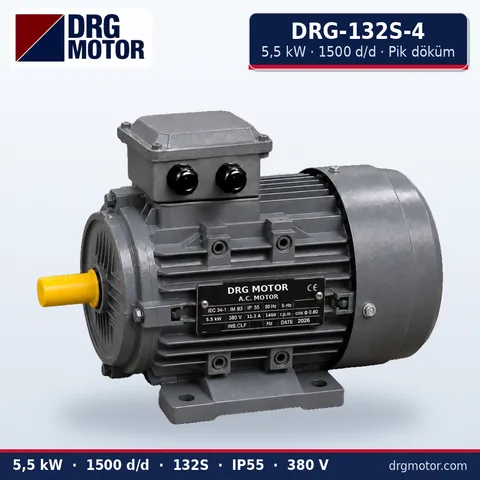
5.5 kW Three-Phase Motor 1500 rpm – DRG-132S-4 Cast Iron
- 5.5 kW · 1500 rpm (4 poles)
- Cast iron frame · IEC 132S
- Mounting: B3 · B5 · B14 · B35
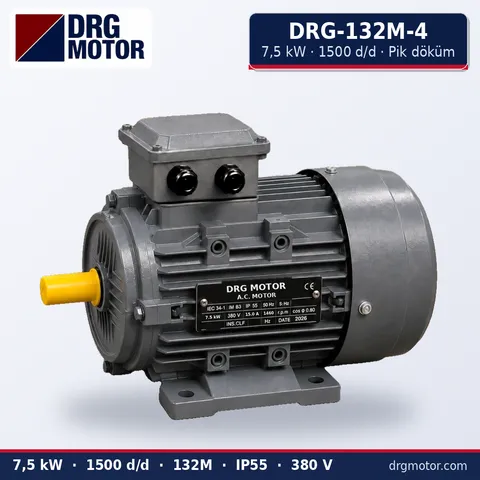
7.5 kW Three-Phase Motor 1500 rpm – DRG-132M-4 Cast Iron
- 7.5 kW · 1500 rpm (4 poles)
- Cast iron frame · IEC 132M
- Mounting: B3 · B5 · B14 · B35
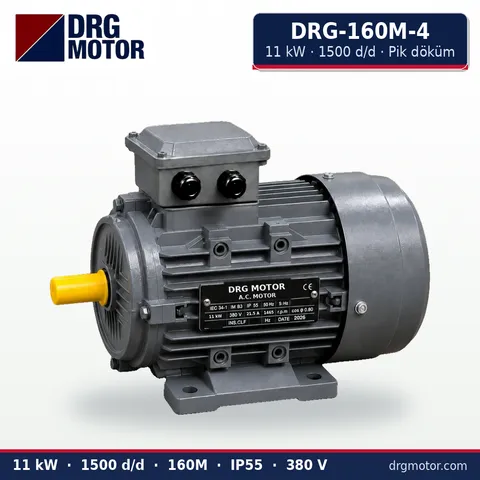
11 kW Three-Phase Motor 1500 rpm – DRG-160M-4 Cast Iron
- 11 kW · 1500 rpm (4 poles)
- Cast iron frame · IEC 160M
- Mounting: B3 · B5 · B14 · B35
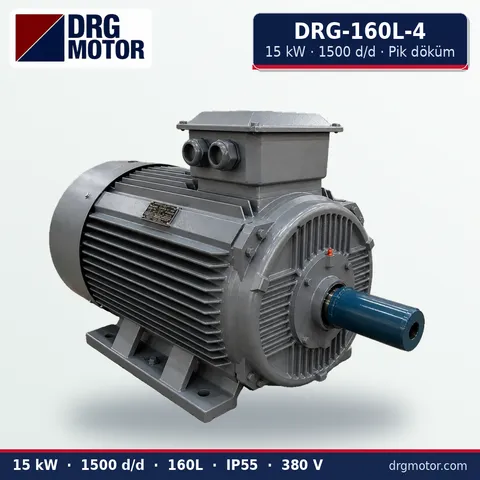
15 kW Three-Phase Motor 1500 rpm – DRG-160L-4 Cast Iron
- 15 kW · 1500 rpm (4 poles)
- Cast iron frame · IEC 160L
- Mounting: B3 · B5 · B14 · B35
Click to see current prices and order these motors nowSEE PRICES →
Swarf Centrifuge Motor: Frequently Asked Questions
Why does the swarf centrifuge motor trip on starting?
A full basket takes a long time to start and the motor draws high current throughout. If the overload relay is not of a suitable class for the starting time, the belt is slipping or the basket is overfilled, the relay trips. Check charge quantity and belt first, then the relay setting.
What happens if a more powerful motor is fitted to a swarf centrifuge?
Starting time shortens, but starting current rises too; the line and fuses must be checked accordingly. Shaft and foot dimensions may also change; the pulley and motor base must be adapted to the new frame.
Is a swarf centrifuge motor the same as a centrifugal dryer motor?
Both drive high-inertia loads, but in a swarf centrifuge the load is uneven, the environment oily and start frequency depends on the cycle. Motor selection follows the same principles, but imbalance and oil effects are specific to the swarf machine.
Can a standard motor be fitted to a vertical-shaft swarf centrifuge?
Yes, with vertical operation stated in the order; the suitable construction is confirmed according to mounting type and bearing load.
Send a photo of the motor nameplate, the mounting type (vertical/horizontal, foot/flange), shaft size, pulley diameters and a short note on the basket via WhatsApp, or add the models to the quote list. Phone: +90 (542) 666 11 11 · e-mail: info@drgmotor.com · contact page. All models and current prices are in the DRG online store.