English
 Le français
 Türkçe




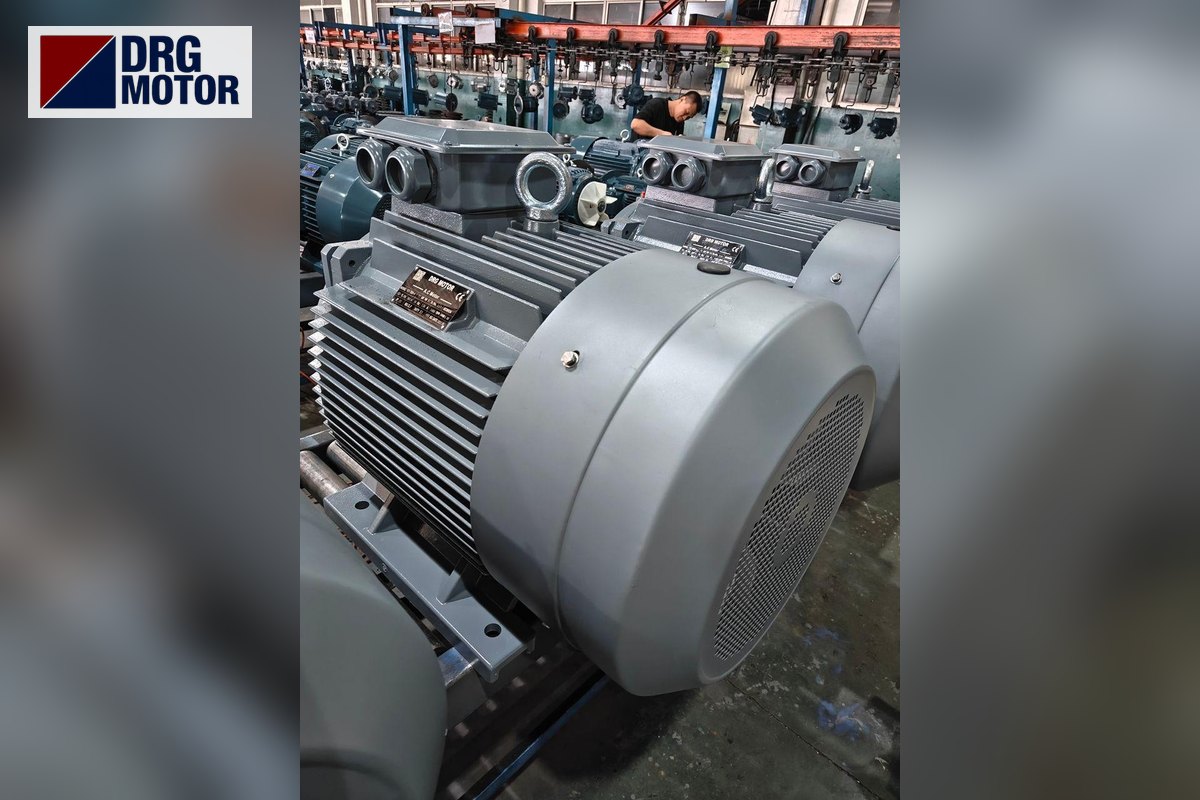

On a plate rolling machine the motor turns the rolls at only a few revolutions per minute, and in return thousands of Nm of torque are needed at the roll shaft. A high-ratio gearbox makes this conversion, and the motor is usually a 4- or 6-pole three-phase induction motor. In a correct selection, what matters is the torque at the gearbox output and the motor's tolerance of frequent reversing rather than the kW figure alone.
DRG Motor is a manufacturer, supplier and seller of electric motors. It does not sell gearboxes; it supplies the standard IEC motor to be fitted to the machine's existing gearbox or the gearbox chosen by the machine builder. Foot- and flange-mounted models are listed by power and speed in the DRG online electric motor shop.
Where Is the Drive Connected on Three- and Four-Roll Machines?
The three-roll pyramid type has one roll on top and two below; as the plate passes between them, the top roll is lowered to create curvature. In asymmetric three-roll and four-roll types, the top and bottom rolls pinch and drive the plate while the side rolls set the bending angle. In both cases the main motor turns the rolls that push the plate forward; on most machines the force bending the plate comes from a separate mechanism.
On small machines the position of the top or side rolls is set by a second motor with a worm mechanism; on large machines by hydraulic cylinders. A hydraulic machine has a separate motor driving the pump. When replacing a motor, first establish which one failed: the main drive motor, the positioning motor and the hydraulic unit motor have different power and speed.
How to Find Roll Speed and Gearbox Ratio
The plate's travel speed through the machine equals the peripheral speed of the driven roll: v = π·D·n/60. On workshop machines this is typically a few metres per minute, because the operator follows the shape of the plate by eye. Once roll speed is known, the gearbox ratio is i = motor speed / roll speed.
Assumption: driven roll diameter 200 mm, plate feed speed 5 m/min. Roll speed is 5/(π·0.2) ≈ 7.96 rpm. Motors with different pole numbers reach that roll speed with the following ratios; output torque is calculated as motor rated torque × ratio × 0.85 (assumed factor for gearbox losses):
| Motor | Rated speed | Required ratio | Output torque |
|---|---|---|---|
| DRG-132S-4 (5.5 kW) | 1460 rpm | ≈ 183 | ≈ 5614 Nm |
| DRG-132M2-6 (5.5 kW) | 968 rpm | ≈ 122 | ≈ 5614 Nm |
| DRG-132M-4 (7.5 kW) | 1460 rpm | ≈ 183 | ≈ 7657 Nm |
| DRG-160M-4 (11 kW) | 1465 rpm | ≈ 184 | ≈ 11220 Nm |
The table shows that 4- and 6-pole motors of the same power give the same torque at the gearbox output; the difference lies in the ratio. The 6-pole motor works with a lower-ratio and usually more compact gearbox, while the 4-pole motor has a smaller frame at the same power. If you keep the existing gearbox, do not change the old motor's pole number, otherwise plate speed changes. You can calculate ratio and torque with your own values using the gearbox output speed and torque calculator.
Click to see current electric motor prices and order nowSEE PRICES →
From Roll Torque to Motor Power: an Example
The torque needed at the roll depends on plate thickness, width, yield strength of the material and bending diameter; this value is given by the machine builder. A definite motor power cannot be derived by guessing from capacity. The example below only shows the method.
- Assumption: torque required at the roll shaft 4000 Nm, roll speed 7.96 rpm.
- Power at the roll: P = T·n/9550 = 4000·7.96/9550 ≈ 3.33 kW.
- Motor power with gearbox losses: 3.33/0.85 ≈ 3.92 kW. As 4 kW is borderline, the next step up, 5.5 kW, is chosen.
- Starting margin: DRG-132S-4 has Ts/Tn = 2.0; about 11228 Nm of starting torque at the gearbox output leaves margin to restart while the plate is clamped between the rolls.
On small workshop machines the main drive is a few kW, while large machines rolling thick plate can reach tens of kW. The definitive value is always the machine nameplate and the builder's catalogue.
Forward-Reverse Operation, Stopping and Starting
In plate rolling the plate is run back and forth between the rolls many times until it reaches the target diameter; the top roll is lowered a little on each pass. The motor therefore makes many starts and reversals per hour. Direction is changed by two contactors swapping two phases; the contactors must have electrical and mechanical interlocks.
Reversing the motor directly from full speed causes a brief but very high current and a shock in the gearbox. A short delay in the control circuit protects both motor and gears. Frequent starts heat the rotor and winding; even if the motor looks comfortable at nameplate power, a high cycle rate calls for one size up.
Some machines need a brake so that the plate stops at the required point. The DRG range does not include brake motors; braking is provided by a mechanical brake on the gearbox side or by the braking function of an inverter feeding the motor. An inverter also brings soft starting and adjustable plate speed; DRG does not sell inverters, and the motor is suitable for inverter supply.
Connection to the Gearbox: Foot or Flange?
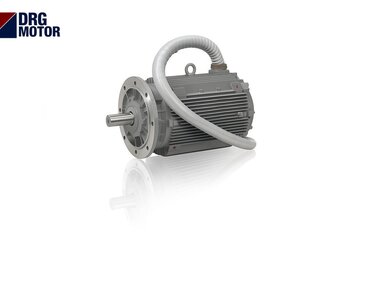
Two layouts are common on plate rolling machines. In one, the motor is bolted by its B5 flange to the gearbox's IEC input and its feet stay unused. In the other, the motor is bolted to the frame as B3 foot-mounted and drives the gearbox through a coupling or belt and pulley. Photograph the old motor's layout before removing it.
On the B5 flange, frame 132S/132M has a flange outer diameter of 300 mm, pitch circle 265 mm, spigot 230 mm and shaft 38×80 mm; frame 160M/160L has 350, 300 and 250 mm respectively and a 42×110 mm shaft. If a B14 small flange is needed, the dimension is confirmed with the order. Motors for gearbox inputs are also grouped on the electric motors for gearboxes page.
Workshop Environment and Signs of a Wrong Selection
In a sheet metal shop the motor meets grinding dust, welding spatter and metal chips. IP55 protection is adequate for this environment; however, if the frame fins and fan cover clog, cooling drops, so regular cleaning is needed. If oil or cutting fluid from the rolls drips onto the motor, it should be deflected with a guard plate.
An undersized motor stalls or trips on the first entry of thick plate, forcing the operator to lower the top roll in small steps. A motor with the wrong pole number changes plate speed; faster makes bending harder to control, slower lengthens the job. Star-delta starting cuts torque to roughly one third on a loaded start, so it may be insufficient when restarting with a clamped plate.
On section and pipe bending machines the roll drive looks similar but the load is distributed differently; motor and gearbox selection for those machines is explained in our article on section bending machine motor and gearbox selection.
Checklist before ordering the motor
- Role of the failed motor: main roll drive, roll positioning motor or hydraulic unit motor?
- Nameplate: kW, speed (pole number), voltage; motors of 4 kW and above are wound for 400/690 V.
- Gearbox nameplate: ratio, input flange size and input shaft bore.
- Mounting: B5 flange, B3 foot or B35; coupling or pulley diameters if present.
- Controls: forward-reverse contactors, star-delta or inverter, and any brake arrangement.
- Thickest and widest plate the machine rolls (from the machine nameplate).
DRG Motors Suited to Plate Rolling Machines
These cast iron frame models cover the power range for roll drives with frequent reversing and loaded starts, to be flange- or foot-connected to the gearbox input.
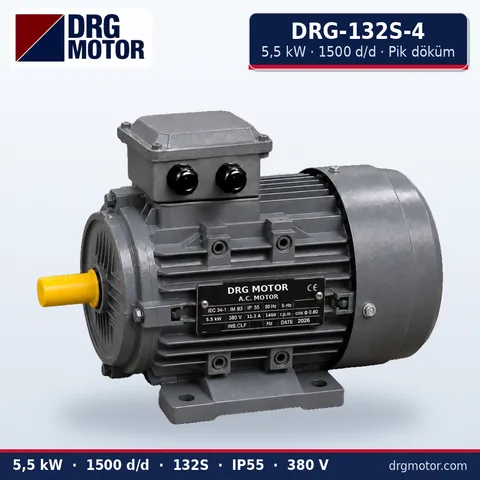
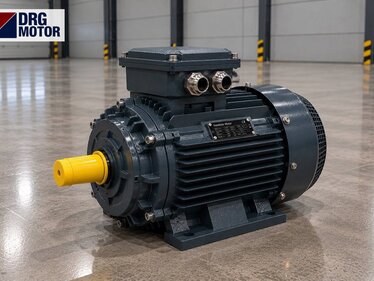
5.5 kW Three-Phase Motor 1500 rpm – DRG-132S-4 Cast Iron
- 5.5 kW · 1500 rpm (4 poles)
- Cast iron frame · IEC 132S
- Mounting: B3 · B5 · B14 · B35
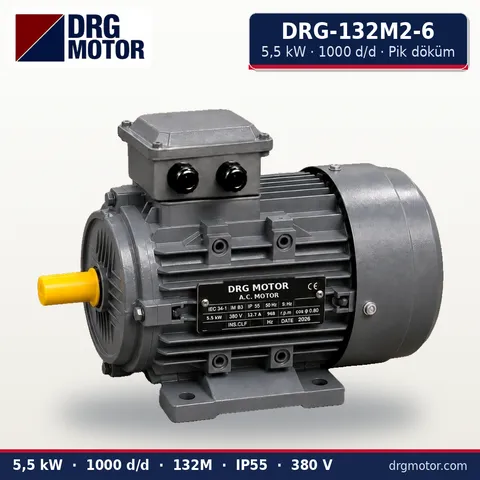
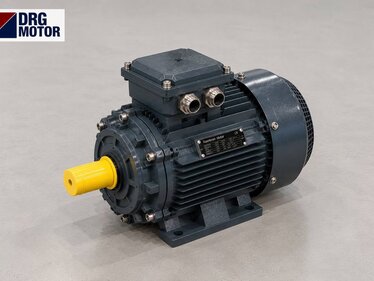
5.5 kW Three-Phase Motor 1000 rpm – DRG-132M2-6 Cast Iron
- 5.5 kW · 1000 rpm (6 poles)
- Cast iron frame · IEC 132M
- Mounting: B3 · B5 · B14 · B35
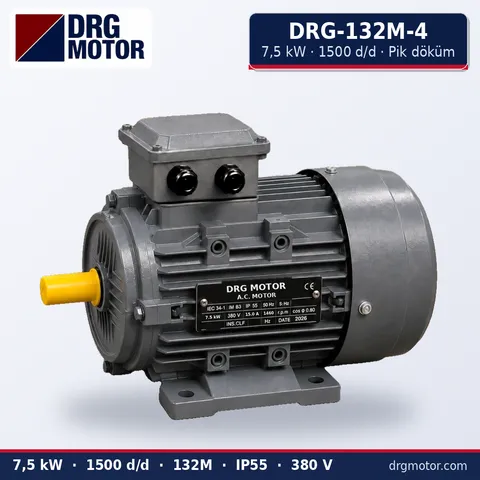
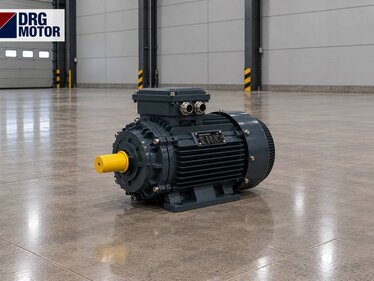
7.5 kW Three-Phase Motor 1500 rpm – DRG-132M-4 Cast Iron
- 7.5 kW · 1500 rpm (4 poles)
- Cast iron frame · IEC 132M
- Mounting: B3 · B5 · B14 · B35
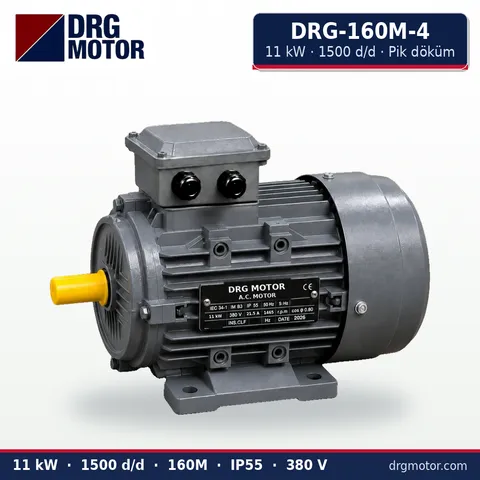
11 kW Three-Phase Motor 1500 rpm – DRG-160M-4 Cast Iron
- 11 kW · 1500 rpm (4 poles)
- Cast iron frame · IEC 160M
- Mounting: B3 · B5 · B14 · B35
Click to see current prices and order these motors nowSEE PRICES →
Plate Rolling Machine Motor: Frequently Asked Questions
How many kW should a plate rolling machine motor be?
It depends on plate thickness, width and material; small workshop machines use a few kW, machines rolling thick plate can need tens of kW. The machine nameplate is the definitive value. When replacing, keep the same power and speed as the old motor so that the gearbox ratio stays valid.
Is a 6-pole or a 4-pole motor used on plate rolls?
Both are used. At the same power the torque at the gearbox output is the same; the difference is the required ratio and the motor frame. If you change the pole number on an existing gearbox, roll speed changes too.
Why does the plate roll motor trip when reversing?
Sudden reversal at full speed and frequent loaded starts heat the motor. Add a short delay before reversing, allow for star-delta being insufficient with a clamped plate, and go one size up if the cycle rate is high.
Are the top roll positioning motor and the main motor the same?
No. The positioning motor sets the top or side roll and is generally smaller; on hydraulic machines this task belongs to the hydraulic unit motor. Check its nameplate separately.
Send a photo of the motor nameplate, its power, speed, mounting (foot or flange), shaft size and the gearbox nameplate via WhatsApp, or prepare a quote list to request a quotation. Phone: +90 (542) 666 11 11 · e-mail: info@drgmotor.com · contact. Visit the online shop for all models.