English
 Le français
 Türkçe




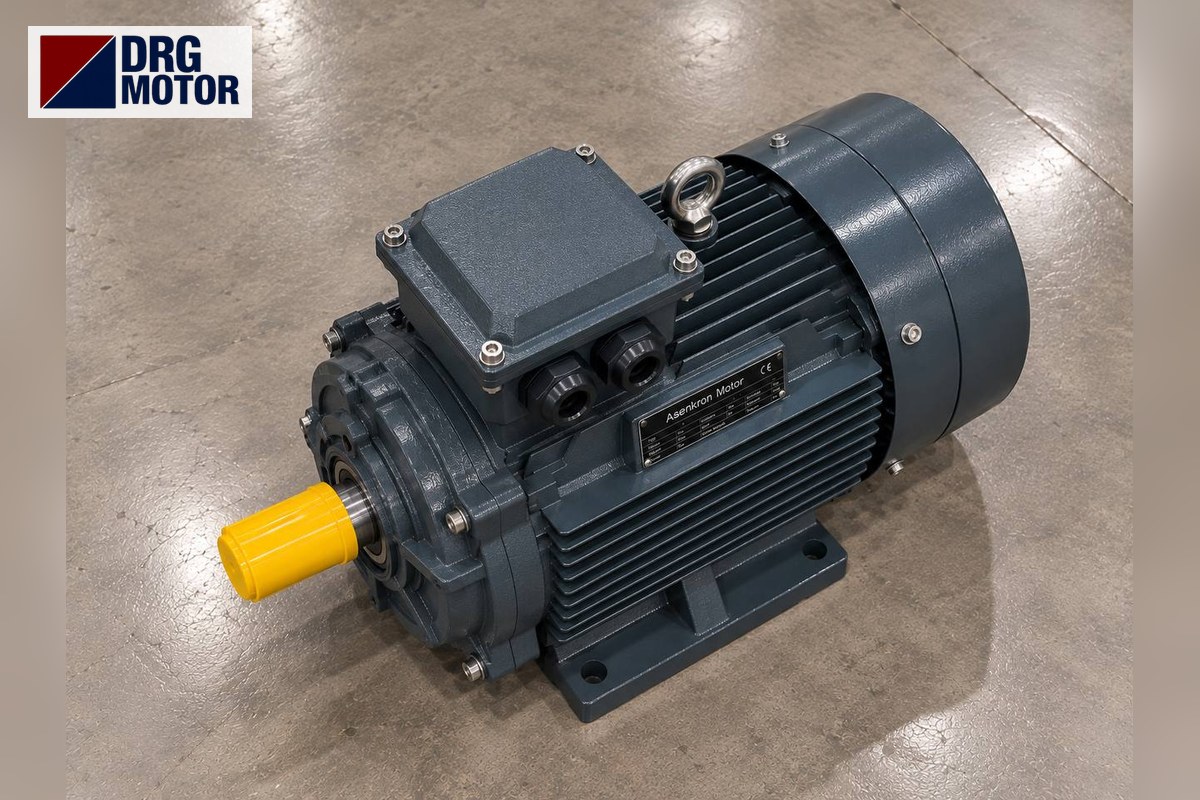

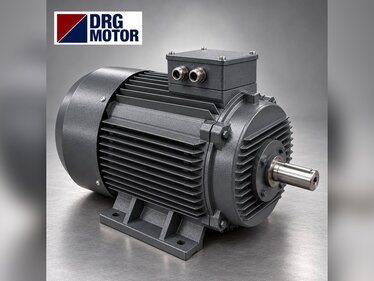
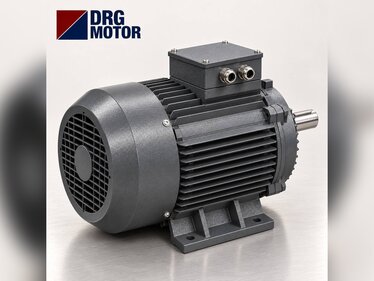
In an industrial centrifugal dryer, what sizes the motor is the kinetic energy stored by the rotating basket and how quickly you want to put that energy in and take it out again, because once drying speed is reached, the power needed to keep the basket turning is small. For example, a machine with 250 kg of wet load and a basket turning at 900 rpm with a 0.4 m radius stores about 177.7 kJ; the 15 kW 4-pole DRG-160L-4 (1465 rpm, 97.8 Nm, 27.3 A at 400 V), accelerated at rated torque by an inverter, reaches this speed in about 23.7 seconds. The power per machine varies with basket diameter, load mass and target speed; the exact value is the machine nameplate or the builder's data.
High inertia brings three problems: long starting, braking energy released when stopping, and vibration with an unbalanced load. Below we work through all three with calculations and explain the choice of inverter ramp, braking resistor and brake motor. The motor, inverter and lid lock must be connected by a qualified electrician. You can find the right motor among the 120 models on our Buy Electric Motors Online page using the power and speed filters.
Why Inertia Is What Really Loads a Centrifuge Motor
A centrifugal dryer spins a perforated basket at high speed and throws the liquid out by centrifugal force. For the motor, the basket and load are a large flywheel. While turning steadily at target speed, the motor only covers bearing friction, air drag and the energy carried away by the liquid; this is small compared with the power used during acceleration. The real load is bringing the basket from standstill to target speed and then stopping it again.
The G value is used to describe drying effect: G = ω² · r / g. In the example, angular speed ω = 94.2 rad/s and radius 0.4 m, so about 362 G acts at the basket wall. Raising speed even slightly increases G with the square of speed, and stored energy in the same proportion; the maximum speed given by the machine builder must therefore never be exceeded.
Kinetic Energy and Starting Time: The J·ω²/2 Calculation
Assumptions: effective mass of wet load and basket 250 kg, assumed concentrated near the wall at a 0.4 m radius, target speed 900 rpm, belt drive with a reduction ratio of 1465 / 900 ≈ 1.63. Friction and air drag are neglected, so real times will be somewhat longer.
- Inertia: J = m · r² = 250 × 0.4² = 40 kg·m²
- Kinetic energy: E = J · ω² / 2 = 40 × 94.2² / 2 ≈ 177,653 J ≈ 177.7 kJ
- Inertia referred to the motor shaft: J / i² = 40 / 1.63² ≈ 15.1 kg·m²
- Ramp time (at motor rated torque): t = Jm · ωm / Tn
| Motor | Rated torque | Ramp time | Average power |
|---|---|---|---|
| DRG-160M-4 | 71.7 Nm | ≈ 32.3 s | ≈ 5.5 kW |
| DRG-160L-4 | 97.8 Nm | ≈ 23.7 s | ≈ 7.5 kW |
| DRG-180M-4 | 120.2 Nm | ≈ 19.3 s | ≈ 9.2 kW |
The table shows the logic of the choice: the larger the motor, the shorter the start, but stored energy does not change. An 11 kW motor can do the job, the cycle simply gets longer; if production pace limits starting time, the next size up is chosen. For the belt ratio, with a 200 mm motor pulley the basket pulley is about 326 mm; you can check the dimensions with the Pulley and Belt Calculator.
Why the Rotor Heats Up with Direct-On-Line Starting
When an induction motor starts direct-on-line from a fixed-frequency supply and accelerates a purely inertial load, the energy turned into heat in the rotor is roughly equal to the kinetic energy stored in the load. So in the example, every start also leaves about 177.7 kJ of heat in the rotor, and throughout this time motor current is a multiple of rated current. With Is/In = 7.8 on the 15 kW motor, starting current rises to about 213 A, and starting torque with Ts/Tn = 2.2 is about 215 Nm.
Direct-on-line starting therefore causes two problems on a high-inertia centrifuge: the overload relay trips on the long start, and the rotor and winding heat up with frequent cycles. Star-delta starting lowers current, but since it also cuts torque to one third, the start gets longer and rotor heat does not decrease. You can compare what each method changes on the Motor Starting Methods and Star-Delta page.
Inverter Ramp: Controlling Start and Speed
A frequency inverter raises frequency slowly from zero, so the motor always runs with small slip. Current stays close to rated, the rotor heating seen with direct-on-line starting does not occur, and starting torque is delivered in a controlled way along the ramp. Starting time is set together with the motor's rated torque and the inverter's current limit; the table above represents this mode of operation.
The second benefit of an inverter on a centrifuge is a multi-step speed program. A typical cycle looks like this:
- Load distribution at low speed: a short slow spin so the load spreads evenly on the basket wall
- Intermediate speed: most of the free liquid is thrown off
- Drying speed: running at target speed for as long as the product allows
- Controlled deceleration and stop, then release of the lid lock
During the short low-speed steps the motor fan turns slowly, but because torque demand is small in these steps, extra cooling is usually not needed; if long loaded running at low speed is planned, this is assessed separately.
Braking Energy: Braking Resistor or Brake Motor?
Stopping the basket means transferring the stored 177.7 kJ somewhere. When decelerating with an inverter, the motor works as a generator and the energy returns to the inverter's DC bus. In the example, with a 30-second stop and constant deceleration torque, braking power averages 5.9 kW and is twice that at the start, about 11.8 kW. The braking resistor and chopper must withstand this peak. At 6 cycles per hour the resistor's average load is 6 × 177.7 kJ / 3600 s ≈ 0.30 kW; the resistor's continuous rating is chosen from this average and its short-time rating from the peak. For the detailed calculation, see Dynamic Braking and Braking Resistor in Frequency Inverters.
A brake motor (an electromagnetic disc brake at the rear of the motor) does a different job on a centrifuge: it holds and stops the basket when power is lost or in an emergency. Dissipating 177.7 kJ with a mechanical brake every cycle wears and heats the lining quickly; normal stopping is therefore done by the inverter, and the mechanical brake is for holding and emergencies. When a brake motor is needed is covered in When Is a Brake Electric Motor Needed?.
The safety rule does not change: the lid must not open until the basket has completely stopped. The lid lock is linked to the inverter's zero-speed signal or to a separate standstill detector, and it must not open on a power failure either.
Balance and Vibration: How an Unbalanced Load Affects the Motor
A wet load is never distributed perfectly evenly in the basket. The rotating force caused by unbalance is F = md · r · ω²: in the example, just 1 kg of excess load at the wall produces a rotating force of about 3,553 N at 900 rpm. This force is transmitted to the basket bearings, the frame and, through the belt, to the motor bearings.
That is why centrifuges have a load distribution step, a vibration sensor and a control that lowers speed or stops the machine when a vibration threshold is exceeded. On the motor side: keep belt tension at the builder's value (excess tension loads the motor bearing), periodically check motor foot bolts and pulley clamping, choose balanced pulleys and listen to bearing noise. If the motor sits on vibration mounts, leave a flexible cable run so that the cable and terminal box are not damaged by the movement.
Centrifugal Dryer Motor Selection Table and Checklist
The table below shows 4-pole cast iron DRG models in the power range commonly found on belt-driven industrial centrifuges. Currents are for 400 V; the overload relay is set to this value.
| Model | Power / speed | Frame | Current 400 V |
|---|---|---|---|
| DRG-132M-4 | 7.5 kW / 1460 rpm | 132M · cast iron | 14.3 A |
| DRG-160M-4 | 11 kW / 1465 rpm | 160M · cast iron | 20.4 A |
| DRG-160L-4 | 15 kW / 1465 rpm | 160L · cast iron | 27.3 A |
| DRG-180M-4 | 18.5 kW / 1470 rpm | 180M · cast iron | 33.5 A |
| DRG-180L-4 | 22 kW / 1470 rpm | 180L · cast iron | 39.7 A |
Technical data of the model selected in the example calculation:
- Power: 15 kW
- Rated speed: 1465 rpm
- Rated torque: 97.8 Nm
- Current 400 V: 27.3 A
- cos φ: 0.86
- Ts/Tn: 2.2
- Tmax/Tn: 2.3
- Is/In: 7.8
- Shaft D×E: 42 × 110 mm
- IEC frame: 160L · cast iron
Clarify the following before ordering a motor and drive:
- Basket diameter, maximum wet load mass and the builder's maximum speed
- Belt ratio: motor speed / basket speed, pulley diameters
- Required starting and stopping time, cycles per hour
- Inverter: current limit, multi-step speed program, braking chopper
- Braking resistor: peak and continuous power ratings
- Mechanical brake: for holding and emergencies only; lid lock opens at zero speed
- Vibration sensor and load distribution step
- Overload protection (Overload, Fuse and Contactor Selection), shaft D × E and pulley hub
Motors in This Power Range
- DRG-160M-4 – 11 kW – 1465 rpm – 160M cast iron
- DRG-160L-4 – 15 kW – 1465 rpm – 160L cast iron
- DRG-180M-4 – 18.5 kW – 1470 rpm – 180M cast iron
- DRG-180L-4 – 22 kW – 1470 rpm – 180L cast iron
Click to see current prices and order these motors nowSEE PRICES →
Frequently Asked Questions
What size motor does a centrifugal dryer need?
It depends on basket inertia and the required starting time. For the example basket with 40 kg·m² inertia at 900 rpm, an 11 kW motor reaches target speed in about 32.3 seconds and a 15 kW motor in about 23.7 seconds; the exact value is the machine nameplate.
Why does a centrifuge motor trip the overload when starting?
A high-inertia load accelerates for a long time with direct-on-line starting; during this time current is a multiple of rated current and the rotor heats up by as much as the stored energy. An inverter ramp or correctly set protection solves the problem.
Does a centrifuge need a braking resistor?
Yes, if you want to stop quickly with an inverter. In the example, peak braking power for a 30-second stop is about 11.8 kW; the resistor is chosen for this value and the number of cycles per hour.
How many amps does a 15 kW 4-pole motor draw?
At full load the DRG-160L-4 draws 27.3 A at 400 V and 28.8 A at 380 V; its cos φ is 0.86. With direct-on-line starting, starting current rises to 7.8 times rated current.
Send us your machine's basket size, load mass and speed and we will identify the right DRG model together; for current prices see Buy Electric Motors Online. Phone: +90 (542) 666 11 11 · E-mail: [email protected] · Contact