English
 Le français
 Türkçe




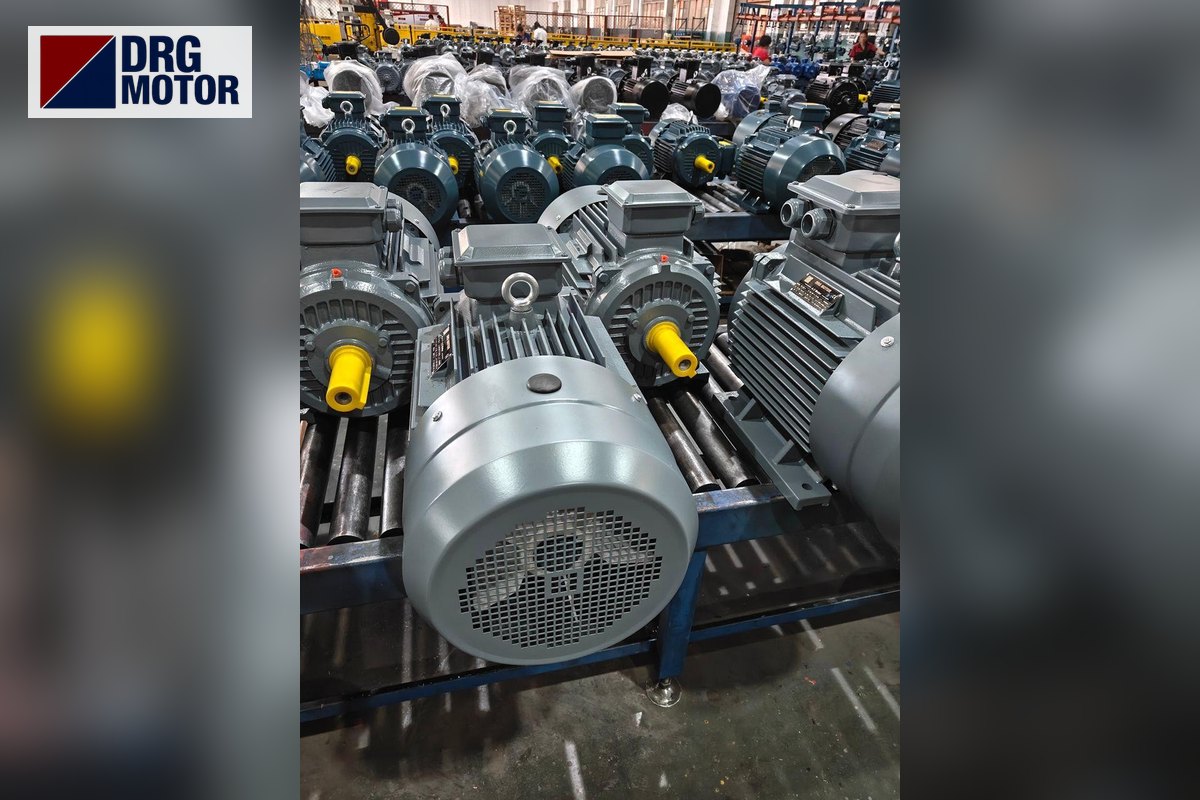

In a centrifugal (disc-type) deburring machine, the motor turns the rotating disc at the bottom of the bowl; it is this rotation that throws parts and abrasive media against the stationary bowl wall. Three things decide the motor: the target rim speed of the disc, the transmission ratio between motor and disc (gearbox or belt) and the torque needed to start the disc under a full bowl. On most machines disc speed is adjusted by inverter.
This arrangement differs from a vibratory bowl: there the whole bowl vibrates on springs; here the bowl stays still, only the disc turns and the media mass rolls in a ring-shaped (toroidal) flow. The motor is therefore mounted on a fixed frame, not on a vibrating body, and a standard three-phase induction motor does the job. DRG Motor is a manufacturer, supplier and seller of electric motors; models of suitable power and speed are listed in the online motor store.
The Disc Turns, the Bowl Stays: The Motor's Real Job
The disc runs in bearings with a very narrow gap to the bowl wall. As it turns, media and parts slide outwards under centrifugal action, climb the wall, lose speed and fall back towards the centre. What removes burrs is the rubbing of parts against the media and each other in this flow. Higher rim speed accelerates the rubbing and shortens cycle time, but also raises the risk of impact marks on delicate parts.
The load seen by the motor is largely constant-torque: the torque needed to drag the full bowl mass across the disc surface changes little with speed. This differs from fans or pumps, which get lighter as speed drops, and means that when speed is reduced the motor still runs close to rated torque.
Disc Speed Is Discussed as Rim Speed
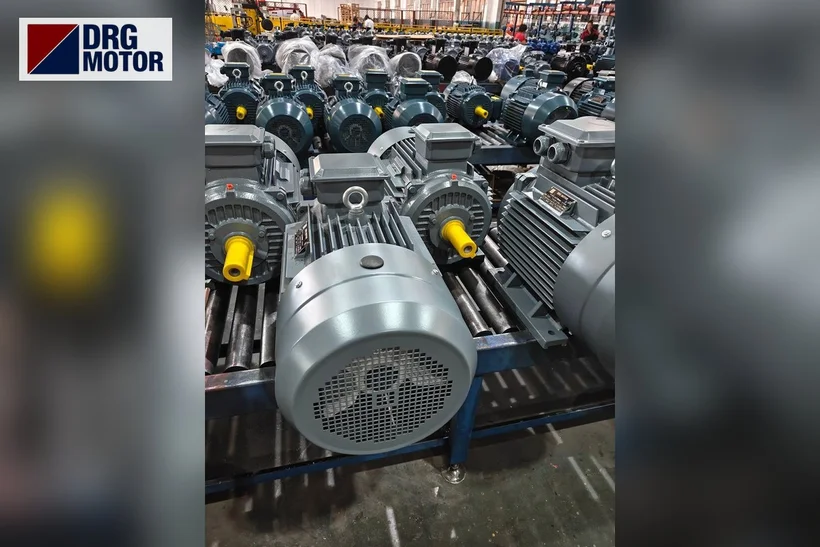
Machine builders often describe disc settings by rim speed rather than rpm, because the same rpm gives different results in bowls of different diameter. Rim speed is v = π·D·n/60. The table below is an example, calculated for a 600 mm disc, a motor with 1450 rpm rated speed and an assumed gearbox ratio of i = 7.25.
| Inverter frequency | Motor speed | Disc speed (i = 7.25) | Disc rim speed (Ø600) |
|---|---|---|---|
| 30 Hz | ≈ 870 rpm | ≈ 120 rpm | ≈ 3.77 m/s |
| 40 Hz | ≈ 1160 rpm | ≈ 160 rpm | ≈ 5.03 m/s |
| 50 Hz | 1450 rpm | 200 rpm | ≈ 6.28 m/s |
If a DRG-112M-4 (4 kW, rated torque 26.3 N·m) is used in the same example, with an assumed gearbox efficiency of 0.95 the torque on the disc shaft is about 26.3 × 7.25 × 0.95 ≈ 181 N·m. You can check output speed and torque for your own ratio with the gearbox output speed and torque calculator. Exact motor power depends on bowl volume and media load; take the value from the machine builder's nameplate.
Click to see current electric motor prices and order nowSEE PRICES →
Gearbox or Belt: The Transmission Under the Disc
The disc shaft is usually vertical. Two arrangements are common:
Bevel helical or worm gearbox
A horizontal motor turns the vertical disc shaft through a right-angle gearbox. The motor is connected to the gearbox with a B5 large flange, so flange and shaft dimensions must match exactly. DRG does not sell gearboxes; it supplies the motor that fits the input of the existing gearbox. For motors suited to gearbox inputs, see the electric motors for gearboxes page.
Vertical motor and belt
The motor is mounted upright beside the disc shaft and the pulley ratio reduces speed. In this arrangement, vertical operation (shaft down or up) must be stated in the order; mounting type and bearing load are confirmed accordingly.
Example dimensions: DRG-112M-4 with B5 flange M 215, N 180, P 250 mm, shaft 28×60 mm; DRG-132S-4 and DRG-132M-4 with B5 flange M 265, N 230, P 300 mm, shaft 38×80 mm.
Disc Gap and Sudden Jamming
As the gap between disc and bowl wall wears, or as fine media debris and small parts enter it, the disc may lock briefly. At that moment the motor is pushed up to its breakdown torque; on the four DRG models in this article breakdown torque is 2.3 times rated. To keep jamming from damaging the gearbox, the inverter current or torque limit should be set to a reasonable value and the motor protection relay chosen according to nameplate current.
Frequent overload trips usually stem not from an undersized motor but from a worn disc edge, an overfilled bowl or the wrong media size. Check these three points before upsizing the motor.
Cooling at Low Speed on an Inverter
DRG motors are IC411 cooled: cooling air comes from the fan on their own shaft. If the disc runs around 30 Hz for long periods, the fan slows too, while the constant-torque load keeps motor current almost unchanged. In this mode the motor reaches its rated temperature sooner. If long low-speed cycles are planned, choose one power size up or consult the machine builder about separate fan cooling.
DRG does not sell inverters; the existing drive's motor parameters must be re-entered from the new motor's nameplate (current, speed, voltage, cos φ). In the wet process, keep the motor away from the media-water discharge; the motor is IP55 and not suitable for pressure washing.
What to Put on the Order Form
- Old motor nameplate values: kW, speed, voltage, current.
- Connection type: B5 flange to a gearbox, or foot-mounted (B3) with belt?
- Flange dimensions (M, N, P) and shaft diameter × length; key width.
- Motor operating position: horizontal or vertical.
- Gearbox ratio or pulley diameters.
- Is an inverter used, and over what frequency range?
- Bowl volume and disc diameter.
DRG Motors for Centrifugal Disc Deburring Machines
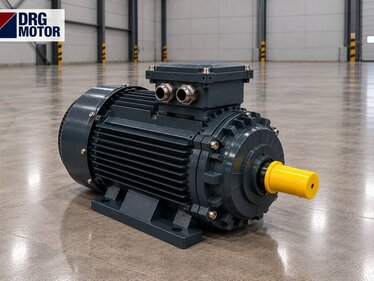
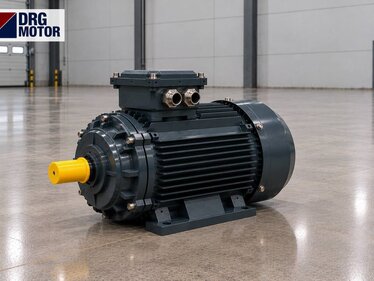
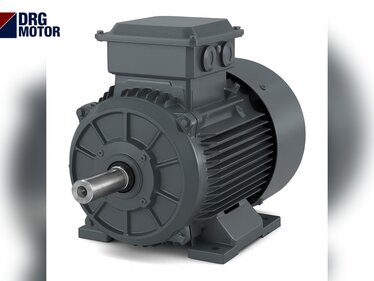
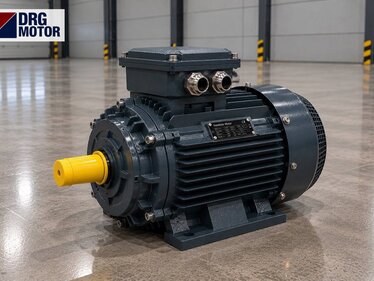
These 4-pole aluminium-housing models can be connected to a gearbox input by B5 flange or foot-mounted in a belt arrangement; power is chosen according to bowl volume and media load.
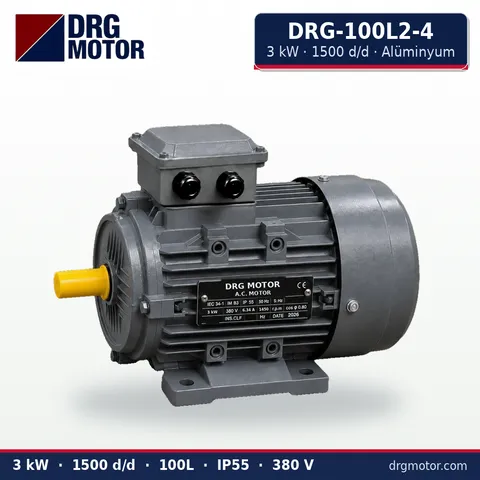
3 kW Three-Phase Motor 1500 rpm – DRG-100L2-4 Aluminium
- 3 kW · 1500 rpm (4 poles)
- Aluminium frame · IEC 100L
- Mounting: B3 · B5 · B14 · B35
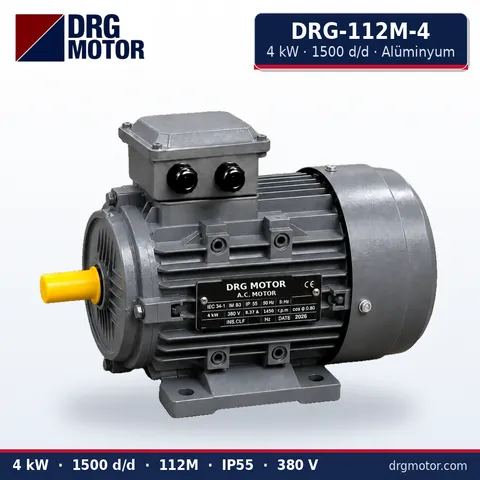
4 kW Three-Phase Motor 1500 rpm – DRG-112M-4 Aluminium
- 4 kW · 1500 rpm (4 poles)
- Aluminium frame · IEC 112M
- Mounting: B3 · B5 · B14 · B35
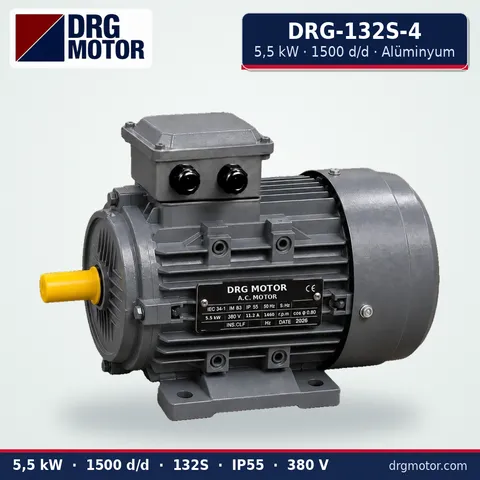
5.5 kW Three-Phase Motor 1500 rpm – DRG-132S-4 Aluminium
- 5.5 kW · 1500 rpm (4 poles)
- Aluminium frame · IEC 132S
- Mounting: B3 · B5 · B14 · B35
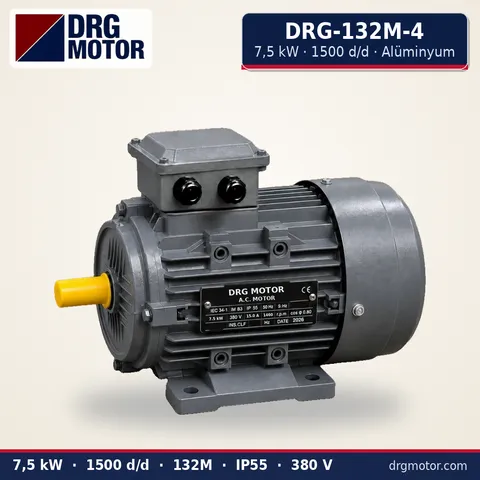
7.5 kW Three-Phase Motor 1500 rpm – DRG-132M-4 Aluminium
- 7.5 kW · 1500 rpm (4 poles)
- Aluminium frame · IEC 132M
- Mounting: B3 · B5 · B14 · B35
Click to see current prices and order these motors nowSEE PRICES →
Questions About Centrifugal Deburring Motors
What speed should the motor of a centrifugal disc finishing machine have?
The motor is usually 4-pole (about 1450 rpm); disc speed is reduced by gearbox or pulleys and fine-tuned by inverter. Keeping the motor speed and transmission ratio the same as before preserves the disc speed when replacing.
Is a centrifugal deburring motor the same as a vibratory deburring motor?
No. In a vibratory bowl, vibration is generated and the motor is often a special vibration motor. In the disc type, the bowl is stationary and a standard motor turns the disc.
Why does the gearbox break rather than the motor burning out when the disc jams?
The motor can deliver torque up to its breakdown torque; this torque is multiplied by the gearbox ratio on the disc shaft. Without a torque limit, the weakest link becomes the gearbox teeth or the key. An inverter current limit and suitable overload protection reduce this risk.
How do I check the flange of a motor fitted to a gearbox?
Measure the flange bolt circle diameter (M), spigot diameter (N), flange outer diameter (P) and shaft size. B5 values are compared against the catalogue table; for the B14 small flange, dimensions are confirmed at order.
Send a photo of the motor nameplate, the flange and shaft dimensions, the gearbox ratio and a short description of the machine via WhatsApp, or add the models to the quote list. Phone: +90 (542) 666 11 11 · e-mail: info@drgmotor.com · contact. For helical gearbox inputs see the helical gearbox electric motor page, and browse all models in the DRG online store.