English
 Le français
 Türkçe




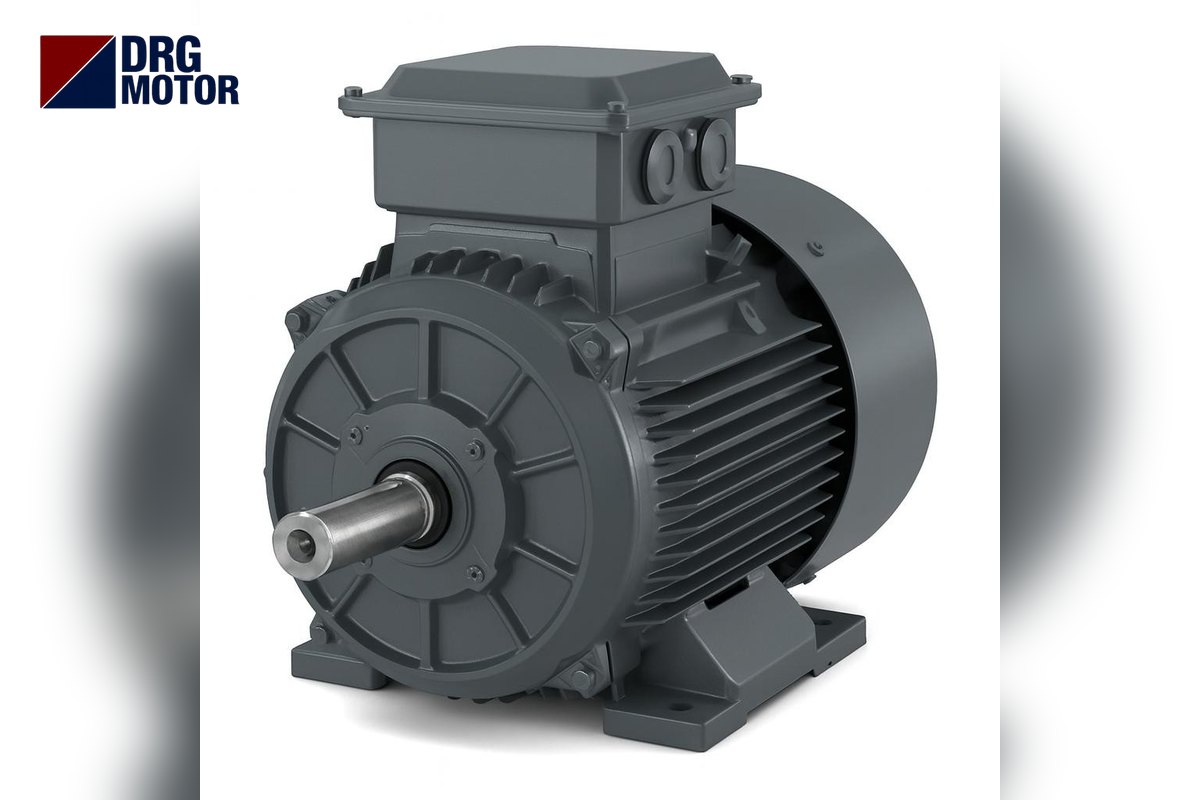

In a scrap shear the electric motor does not produce the cutting force itself; it drives the hydraulic pump, and the cylinder and pressure produce the force. What decides the motor size is not the peak power at the moment of cutting but the equivalent (RMS) power, which governs how hot the motor gets over a full cycle. The peak power is then checked against the motor’s breakdown torque.
This article covers the hydraulic unit of alligator shears and of baling and cutting shears. Small alligator shears may use anything from a few kW up to around fifteen kW, while large baling shears and cutting lines use tens of kW, sometimes with more than one pump motor. The exact figure is on the machine builder’s nameplate. 4-pole cast iron models are listed by power on the buy electric motors online page.
DRG Motor is a manufacturer, supplier and seller of electric motors. The main drive of rotary-knife or shaft shredders is a separate subject, covered on the scrap metal shredder motors page. This article deals only with the hydraulic side of the shear.
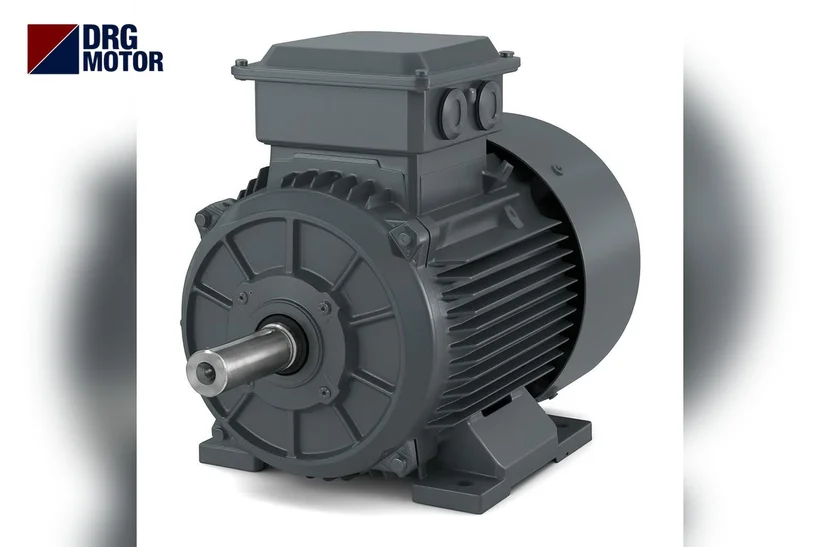
One Cut, Four Different Loads on the Motor
A shear cycle has roughly four phases: the blade approaching the material, cutting, return stroke, and the operator placing the next piece. During approach and return the pump delivers high flow at low pressure. During cutting the pressure rises up to the relief valve setting and, on most units, the flow drops (double pump or variable displacement pump).
The power drawn by the motor is proportional to flow multiplied by pressure. So even though the cutting phase is short, it is when the motor is most heavily loaded. While waiting, the pump circulates oil back to the tank at low pressure and the motor runs unloaded. The motor does not stop and start for every piece; it keeps turning through the shift.
The material changes the load. Thin sheet and sections are cut before the pressure reaches its ceiling. When solid bar, rail pieces or thick plate go in, pressure climbs until the relief valve opens and the motor stays at peak power for several seconds. That is what we mean by a heavy cycle.
Equivalent (RMS) Power: Example Cycle Calculation
Under varying load, motor heating is determined by the time average of power squared: PRMS = √(Σ P²·t / Σ t). The method is valid when the cycle is shorter than the motor’s thermal time constant (minutes). Pump power is calculated with P = Q·p/(600·η) (Q in l/min, p in bar, result in kW).
Example / assumptions: pump efficiency 0.85; 18-second cycle. Approach 3 s, 120 l/min, 40 bar → 9.41 kW. Cutting 5 s, 60 l/min, 240 bar → 28.24 kW. Return 4 s, 120 l/min, 30 bar → 7.06 kW. Waiting 6 s, about 1.5 kW unloaded. With these values the arithmetic mean is 11.48 kW, the equivalent power 15.75 kW and the peak power 28.24 kW. With a 1470 rpm motor, 120 l/min needs a pump displacement of about 81.6 cm³/rev.
Choosing 11 kW from the average burns the motor; choosing 30 kW from the peak is oversizing. The right range lies between the equivalent power and the peak power. The table below applies the same cycle to three motors using DRG data. The peak power ratio must stay below the motor’s breakdown torque ratio (Tmax/Tn = 2.3).
| Motor | Peak power / Pn | RMS / Pn | Assessment |
|---|---|---|---|
| DRG-160L-4 (15 kW) | 1.88 | 1.05 | Overheats; may stall on voltage dip |
| DRG-180M-4 (18.5 kW) | 1.53 | 0.85 | Adequate on paper, thin margin |
| DRG-180L-4 (22 kW) | 1.28 | 0.72 | Comfortable in dust and heat |
With the 15 kW motor the equivalent power is above rated; the motor ends every shift overheated. Torque also falls with the square of voltage: when the supply drops by 10%, the breakdown torque ratio falls to 2.3 × 0.81 ≈ 1.86, below the 1.88 peak load. On a thick piece the motor comes close to stalling. In this example 22 kW is the choice that still leaves margin on a hot, dusty yard in summer.
Click to see current electric motor prices and order nowSEE PRICES →
Starting at High Power: Star-Delta and the Unloading Valve
The DRG-180L-4 has a rated current of 39.7 A at 400 V and a starting current ratio of 7.8. Direct-on-line starting draws about 310 A. In star-delta this falls to roughly one third, around 103 A. DRG motors from 4 kW upwards are 400/690 V and suitable for star-delta starting on a 400 V supply.
The price is torque: in star the starting torque also falls to one third. The 22 kW motor has a rated torque of 142.9 Nm and a starting torque ratio of 2.0; in star about 95.3 Nm remains. So the pump must not build pressure during starting. On scrap shear units an unloading valve or the centre position of the directional valve returns oil freely to the tank; pressure is applied only after the motor has switched to delta.
Set the changeover timer for when the motor approaches rated speed; switching too early creates a second current surge. You can check contactor and overload relay selection with the tables on the star-delta starting page. The overload relay is set to the phase current in the delta branch.
Pump Connection: Bell Housing, Coupling and Flange Dimensions
On scrap shear units the motor and pump are usually joined by a bell housing and a flexible coupling. The motor either hangs from its B5 flange on the bell housing or is held as B35 by both feet and flange. With large frames, a long overhang supported only by the flange can vibrate; a foot support is recommended.
DRG catalogue B5 dimensions: on frames 160 and 180 the flange bolt circle (M) is 300 mm, spigot (N) 250 mm and flange outer diameter (P) 350 mm. The shaft is 42×110 mm on frame 160 and 48×110 mm on frame 180. Frame 200L has M 350, N 300, P 400 mm and a 55×110 mm shaft. The bell housing is machined to these dimensions; if the shaft diameter changes, the coupling hub changes too.
The second problem with more power is a bigger frame. Going from 18.5 kW to 30 kW moves the frame from 180 to 200 and the shaft from 48 to 55 mm. It may not fit the existing bell housing. Check the bell housing and coupling before increasing power; for several models in suitable sizes see the hydraulic power unit electric motors page.
Scrap Yard Conditions
The shear usually works in an open or semi-open yard, in metal dust, rust, oil mist and rain. DRG motors are IP55, insulation class F and frame-fan cooled (IC411); they are rated for −15…+40 °C ambient and altitudes up to 1000 m. On a unit standing in the midday summer sun the ambient can exceed this limit; shade the motor or choose one rating higher as margin.
Oily dust stuck to the fan cover cuts off cooling air. A cast iron frame withstands knocks from grabs and cranes better than aluminium; DRG supplies cast iron in this power class anyway. Oil temperature affects the motor indirectly: on a unit with a clogged cooler pump efficiency drops and the motor stays under load longer for the same cut.
Field Signs of Wrong Sizing
- Overload tripping mid-shift: the equivalent power exceeds motor power; look at the cycle, not the peak.
- Motor note dropping and stalling on thick pieces: peak load is near breakdown torque; measure supply voltage at the moment of cutting.
- Fuse blowing at star-delta changeover: the pump is loaded during starting or changeover is too early.
- Coupling rubber breaking often: motor/pump misalignment or vibration of a heavy motor hanging on its flange.
- Darkening winding colour: long holding at pressure, dumping oil through the relief valve.
Before replacing the motor, check:
- Old motor nameplate: kW, rpm, voltage (400/690 V?), frame size
- Pump type and displacement (cm³/rev), relief valve setting
- Cycle times: approach, cut, return, wait (with a stopwatch)
- Starting: direct, star-delta or soft starter; is there an unloading valve?
- Mounting: B5 or B35; flange M-N-P dimensions, shaft diameter and length
- Bell housing and coupling hub size, direction of rotation
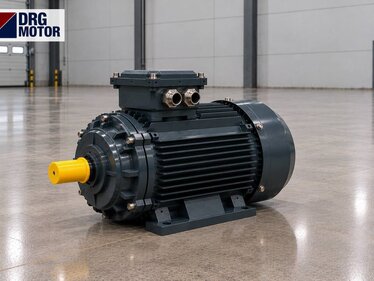
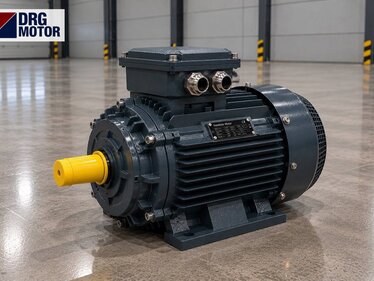
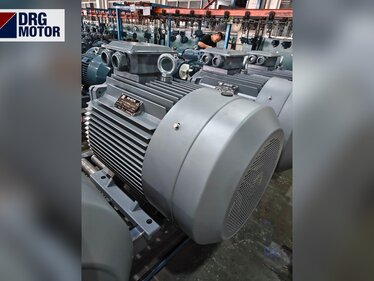
DRG Motors for Scrap Shear Hydraulic Units
4-pole cast iron 400/690 V models (suitable for star-delta) that cover the equivalent and peak power of the example cycle; the final choice must follow the cycle of your own machine.
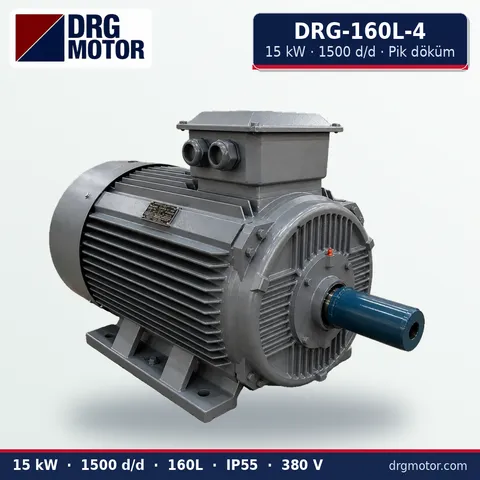
15 kW Three-Phase Motor 1500 rpm – DRG-160L-4 Cast Iron
- 15 kW · 1500 rpm (4 poles)
- Cast iron frame · IEC 160L
- Mounting: B3 · B5 · B14 · B35
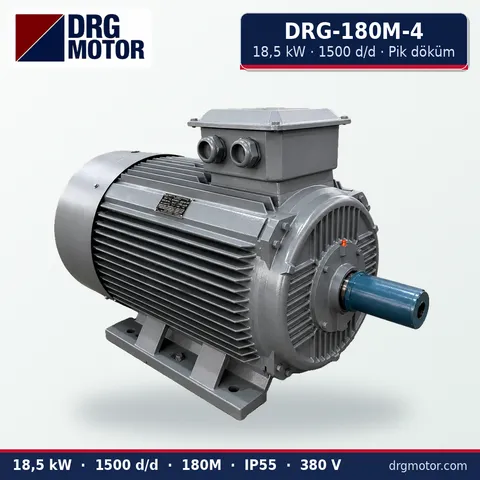
18.5 kW Three-Phase Motor 1500 rpm – DRG-180M-4 Cast Iron
- 18.5 kW · 1500 rpm (4 poles)
- Cast iron frame · IEC 180M
- Mounting: B3 · B5 · B14 · B35
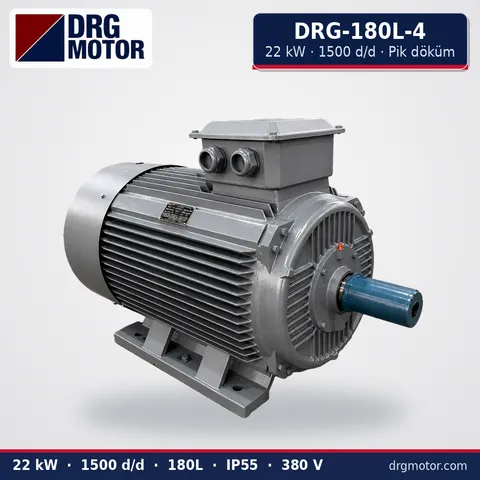
22 kW Three-Phase Motor 1500 rpm – DRG-180L-4 Cast Iron
- 22 kW · 1500 rpm (4 poles)
- Cast iron frame · IEC 180L
- Mounting: B3 · B5 · B14 · B35
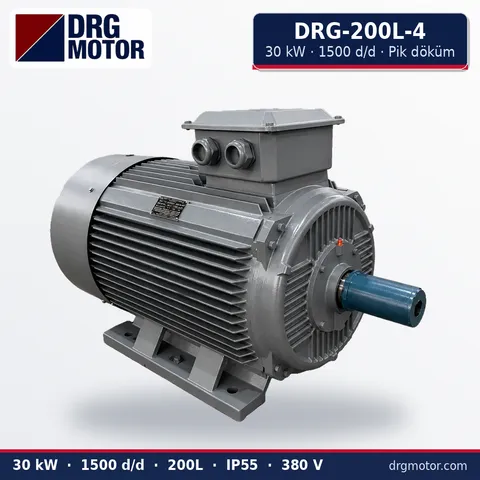
30 kW Three-Phase Motor 1500 rpm – DRG-200L-4 Cast Iron
- 30 kW · 1500 rpm (4 poles)
- Cast iron frame · IEC 200L
- Mounting: B3 · B5 · B14 · B35
Click to see current prices and order these motors nowSEE PRICES →
Scrap Shear Motor: Frequently Asked Questions
How many kW is an alligator shear motor?
It varies widely with machine size: from a few kW up to around fifteen kW on small alligator shears, rising to tens of kW on large baling shears. The correct value is on the builder’s nameplate; if there is none, the equivalent power is calculated from cycle times and relief valve pressure.
Why does the scrap shear motor keep tripping the overload?
The most common reason is that the equivalent power of the cycle exceeds motor power: thick material is cut often, or the operator holds the blade at pressure. Raising the overload setting is not a fix. Measure the cycle first, then assess the motor and cooling.
Can a 2-pole motor be fitted to a scrap shear?
Pump speed changes. A 2-pole motor turns the pump about twice as fast; flow and power demand rise in the same proportion and the pump’s permitted speed may be exceeded. Unless the pump maker approves it, stay with the pole number of the old motor.
Star-delta or soft starter on a large shear?
If the pump can be unloaded during starting, star-delta is sufficient and common. If the supply is weak or the changeover surge is unwanted, a soft starter can be considered. In both cases the motor must be a 400/690 V type running in delta at 400 V.
For a quotation, send a photo of the old motor’s nameplate, its power, speed, mounting type (foot, flange or both), shaft size and shear type (alligator, baling, cutting line) via WhatsApp, or add the models to the quote list. Phone: +90 (542) 666 11 11 · e-mail: info@drgmotor.com · contact. You can compare all power ratings in the online shop.