English
 Le français
 Türkçe




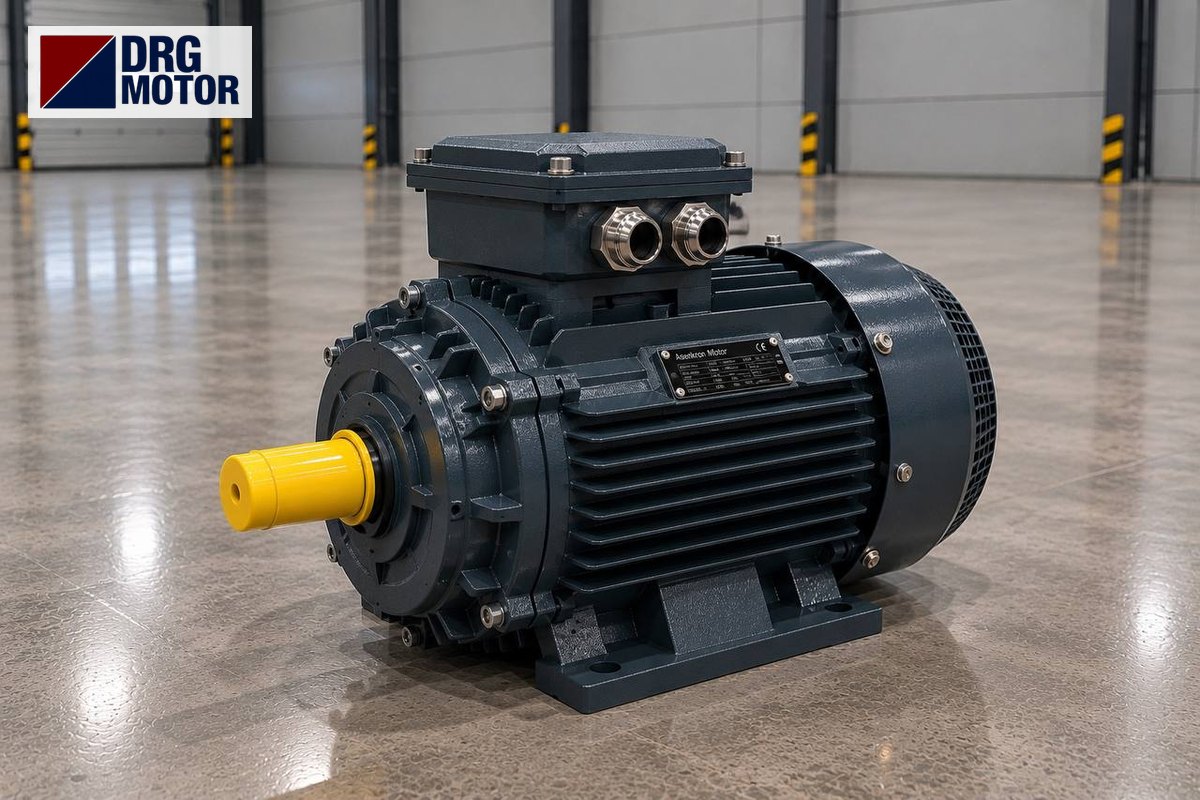

In a sheet levelling (straightening) machine the motor turns a large number of small-diameter rolls at the same speed through a gear distribution box and sets the line speed. Speed is adjusted by a frequency inverter, so the right motor is a 4-pole three-phase induction motor suitable for inverter supply. Its power is decided by line speed together with the torque demanded by the thickest, hardest sheet being levelled.
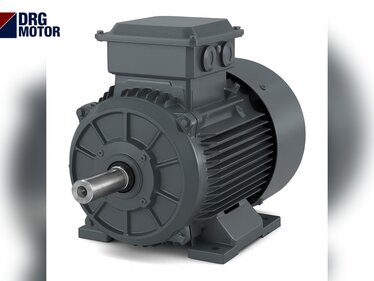
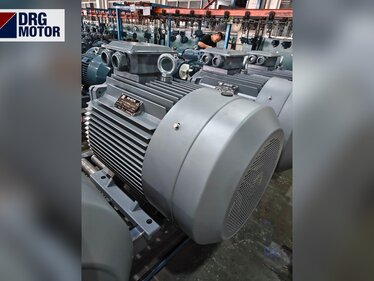
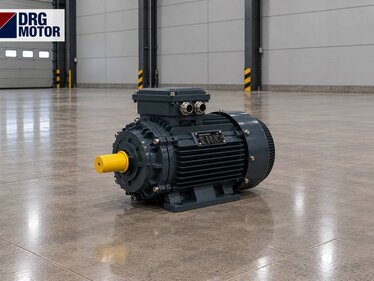
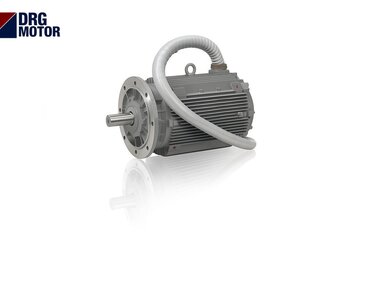
DRG Motor is a manufacturer, supplier and seller of electric motors; it supplies the standard IEC motor that drives the leveller, not the machine, gearbox or inverter. Models by frame, power and speed are listed on the DRG online motor sales page.
How Do Levelling Rolls Straighten the Sheet?
Sheet uncoiled from the coil passes between rolls staggered above and below. On the entry side the top rolls are pressed deeper; the sheet is bent in alternate directions at each roll, enough to exceed its yield point. Towards the exit the penetration decreases and the bending amplitude dies out; coil set, waviness and edge stresses are removed this way.
The more rolls and the smaller their diameter, the better thin sheet is levelled; thick sheet needs fewer rolls of larger diameter. When all rolls are driven, the drive usually runs from one motor and gearbox to a distribution gearbox and from there through cardan shafts to each roll. Separate small motors or a handwheel may also be fitted for back-up rolls and position adjustment.
Nature of the Load: Torque Set by Sheet Thickness, Not Speed
The torque the rolls spend to bend the sheet plastically depends mainly on sheet thickness, width, yield strength and roll pitch; it hardly changes with line speed. In this respect the load is constant-torque. Power, however, rises in proportion to line speed since P = T·n/9550.
The practical consequence is this: on most lines thick, hard sheet is levelled at low speed, and the motor runs at low frequency close to full torque. As the frame fan turns with the motor shaft, cooling air drops at low speed. The motor's hardest moment is not when the line runs fastest but the long cycle when thick sheet passes slowly.
Example: Gearbox Ratio and Motor Power from Line Speed
The values below are assumptions; real torque and speed values must come from the machine builder's catalogue.
- Assumption: levelling roll diameter 60 mm, maximum line speed 25 m/min, total torque at the rolls for the heaviest sheet 450 Nm, gearbox efficiency 0.95.
- Roll speed: n = v/(π·D) = 25/(π·0.06) ≈ 132.6 rpm.
- Gearbox ratio: with a 4-pole 1460 rpm motor, i = 1460/132.6 ≈ 11.
- Power at the rolls: 450·132.6/9550 ≈ 6.25 kW; with gearbox losses ≈ 6.58 kW. Selection: 7.5 kW, e.g. DRG-132M-4 (rated torque 49.1 Nm).
When the inverter reduces speed on the same drive, the values change as follows (assuming constant torque of 450 Nm):
| Line speed | Roll speed | Motor frequency | Power at the rolls |
|---|---|---|---|
| 25 m/min | 132.6 rpm | ≈ 50 Hz | ≈ 6.25 kW |
| 20 m/min | 106.1 rpm | ≈ 40 Hz | ≈ 5.0 kW |
| 12 m/min | 63.7 rpm | ≈ 24 Hz | ≈ 3.0 kW |
| 6 m/min | 31.8 rpm | ≈ 12 Hz | ≈ 1.5 kW |
Power drops but torque does not; at 12 Hz the motor still draws current close to full load while its cooling air is reduced. If the line will run thick sheet below 20 Hz for long periods, choosing one size up keeps the motor at a lower thermal load. Standard DRG motors are frame-fan cooled (IC411); motors with an independent cooling fan are not in the standard range.
Click to see current electric motor prices and order nowSEE PRICES →
Speed Control by Inverter: Settings and Limits
In a leveller the inverter does three jobs: it sets line speed, limits current on a loaded start and stops the motor via current limit if the sheet jams. For a constant-torque load the inverter should be set to constant torque (heavy duty) mode and parameterised with the motor nameplate values. Vector control helps maintain torque at low frequency. DRG does not sell inverters; the motor is a standard induction motor suitable for inverter supply.
Above 50 Hz the motor enters the constant-power region and torque falls in inverse proportion. This region can be used to raise line speed on thin sheet, but the speed limits of cardan shafts, distribution gears and roll bearings should be checked with the machine builder. For long cables between inverter and motor, you can check cross-section and voltage drop with the motor cable size calculator.
Speed Matching with the Uncoiler and the Cutting Line
The leveller does not work alone: there is an uncoiler in front and usually a feeder and shear behind. The uncoiler's load changes as coil diameter shrinks, while the leveller's load depends on sheet thickness. The motor requirements of these two machines therefore differ. Diameter calculation and tension control on the uncoiler side are covered in our article on uncoiler motor and inverter selection.
Speeds are generally matched through a loop pit between leveller and shear feeder: a sensor measuring the sheet sag gives a speed reference to the leveller's inverter. While the shear feeder starts and stops, the leveller keeps turning; the main motor thus runs at an adjustable steady speed rather than with frequent starts. On compact lines without a loop the leveller also starts and stops, and the motor sees one loaded start per cycle; this must be considered separately when selecting the motor.
Mounting, Connection Dimensions and Environment
In leveller drives the motor is mostly flange-connected to the gearbox input as B5, or stands on the base frame on B3 feet with a coupling to the gearbox. Take flange and shaft dimensions before removing the old motor. According to the DRG B5 catalogue, frame 112M has a flange outer diameter of 250 mm, spigot 180 mm and shaft 28×60 mm; frame 132M 300 mm, 230 mm, shaft 38×80 mm; frame 160M/160L 350 mm, 250 mm, shaft 42×110 mm. The B14 small flange dimension is confirmed with the order.
On sheet lines the motor sees oily sheet dust, lubricating oil mist and occasionally cutting burrs. IP55 protection suits this environment; keeping the fan cover and cooling fins clean matters especially for a motor running at low frequency. Suitable motors for this kind of line drive are also found on the general purpose electric motors page.
What to Check Before Replacing the Motor
- Motor nameplate: kW, speed, voltage; 4 kW and above with 400/690 V winding is delta-connected on a 400 V supply.
- Inverter nameplate and settings: rated current, motor parameters, minimum and maximum frequency.
- The sheet thickness at which the line runs slowest and how long it stays at that speed.
- Gearbox ratio and input connection (B5 flange, B3 foot, coupling).
- Whether the leveller runs continuously or stop-start; whether there is a loop sensor.
- Number and diameter of rolls, thickness and width of the thickest sheet (from the machine nameplate).
DRG Motors for Sheet Levelling Machines
These 4-pole models cover the power range used in inverter-controlled roll drives, from thin sheet lines to levellers processing medium-thickness sheet.
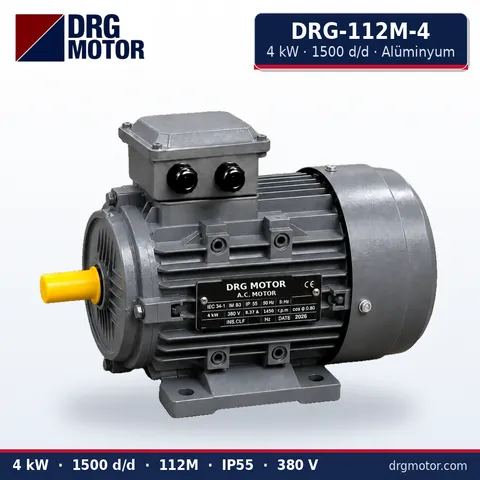
4 kW Three-Phase Motor 1500 rpm – DRG-112M-4 Aluminium
- 4 kW · 1500 rpm (4 poles)
- Aluminium frame · IEC 112M
- Mounting: B3 · B5 · B14 · B35
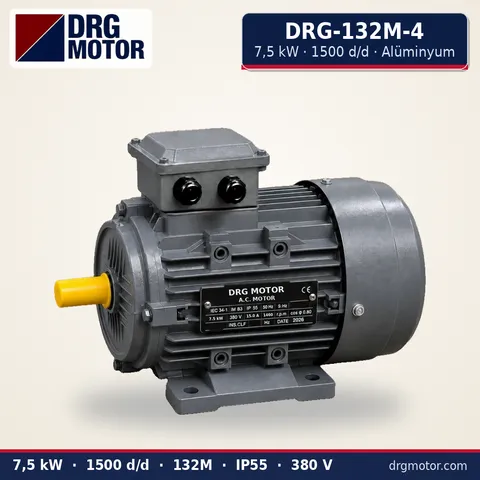
7.5 kW Three-Phase Motor 1500 rpm – DRG-132M-4 Aluminium
- 7.5 kW · 1500 rpm (4 poles)
- Aluminium frame · IEC 132M
- Mounting: B3 · B5 · B14 · B35
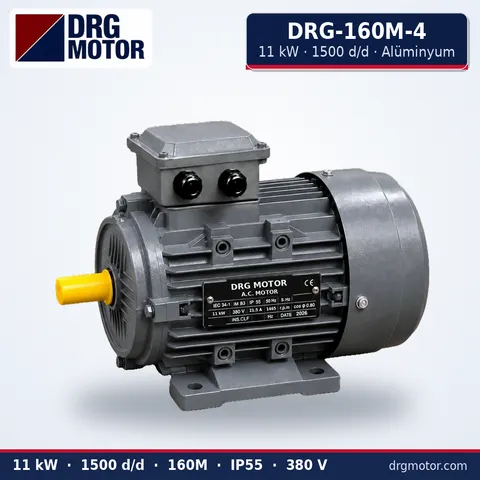
11 kW Three-Phase Motor 1500 rpm – DRG-160M-4 Aluminium
- 11 kW · 1500 rpm (4 poles)
- Aluminium frame · IEC 160M
- Mounting: B3 · B5 · B14 · B35
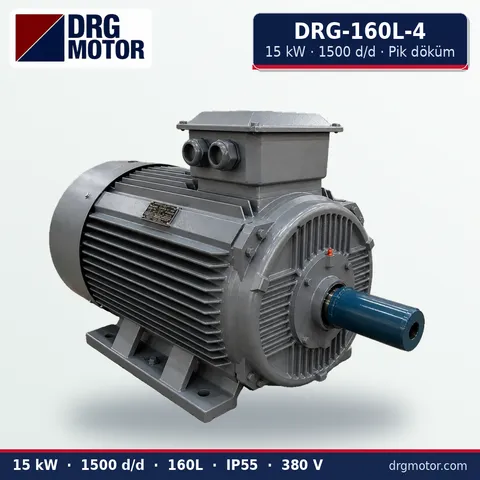
15 kW Three-Phase Motor 1500 rpm – DRG-160L-4 Cast Iron
- 15 kW · 1500 rpm (4 poles)
- Cast iron frame · IEC 160L
- Mounting: B3 · B5 · B14 · B35
Click to see current prices and order these motors nowSEE PRICES →
Sheet Levelling Machine Motor: Frequently Asked Questions
Is an inverter essential on a sheet levelling machine?
It is not mandatory, but in practice it is used on almost every line to set line speed to sheet thickness, soften loaded starts and match speed with the uncoiler and cutting unit.
Why does the leveller motor heat up at low speed?
When thick sheet passes slowly, the motor runs close to full torque, but the shaft-mounted fan slows down and cooling drops. On lines that stay at low frequency for long periods, one size up should be selected and the fan cover kept clean.
How many kW should a straightening machine motor be?
It depends on sheet thickness, width, material and line speed; thin sheet lines use a few kW, thick plate levellers can need tens of kW. When replacing, use the power and speed on the machine nameplate.
Can line speed be raised by running above 50 Hz?
It is possible to a limited extent for the motor, but torque falls and is insufficient for thick sheet. Confirm the speed limits of the gearbox, cardan shafts and roll bearings with the machine builder.
To determine the right motor, send a photo of the motor nameplate, its power, speed, mounting (foot or flange), shaft size and the line's sheet thickness and speed via WhatsApp, or request a quotation through the quote list. Phone: +90 (542) 666 11 11 · e-mail: info@drgmotor.com · contact page. All models are in the online shop.