English
 Le français
 Türkçe




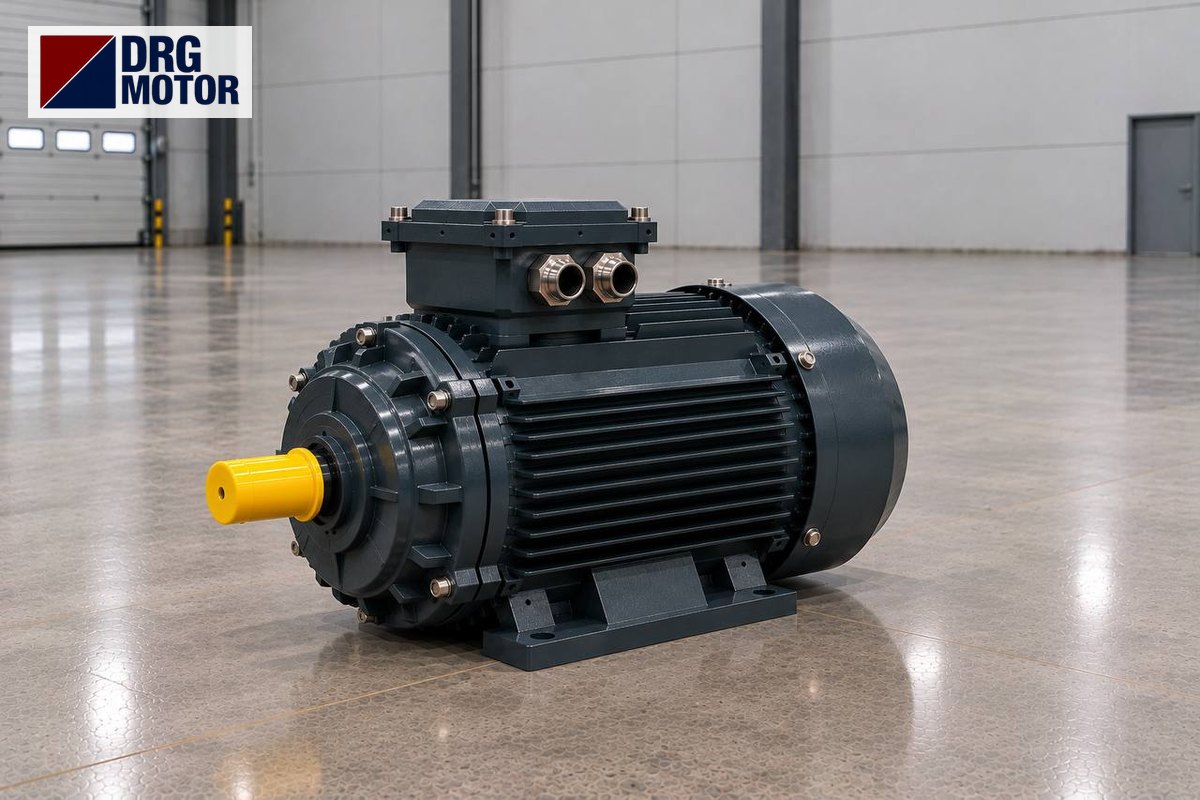

A vibratory deburring machine gets its vibration from one of two arrangements, and the motor choice depends entirely on which one you have. A vibration motor bolted directly under the bowl, carrying unbalanced weights on both shaft ends, is a special motor type; DRG Motor does not sell vibration motors, so in such a machine the old unit must be replaced with the same kind of vibration motor. If the vibration comes from an eccentric (unbalanced-mass) shaft driven by belt from a standard motor on a fixed frame, that motor is an ordinary three-phase induction motor and a DRG motor is suitable for the job.
This article covers the second arrangement: how power, speed, pulley ratio and mounting dimensions are determined for belt-driven eccentric-shaft bowls. DRG Motor is a manufacturer, supplier and seller of electric motors; all three-phase IEC motors are listed with their technical data in our online electric motor store.
For motors used in workshop polishing and grinding applications, the metal belt grinder and polishing machine motors page also gives a general overview.
Look Under the Bowl: Which Drive Arrangement Is It?
Opening the drive compartment under the machine is enough to tell them apart. With a vibration motor, the motor housing is rigidly fixed to the centre column or base of the bowl, has covered weight housings at both ends and no pulley. In the belt arrangement, the motor sits on a fixed foot or bracket separate from the spring-mounted bowl; under the bowl you see a vertical or horizontal shaft turning in bearing housings with adjustable weight plates attached.
If the motor nameplate mentions "vibration", a weight adjustment scale or a force value in kN, the motor is a special type. If it shows only kW, speed, voltage and an IEC frame number, it is most likely a standard motor and its replacement can be chosen with the criteria below.
The Unbalanced Mass, Not the Motor, Sets the Vibration Force
In an eccentric-shaft bowl, what moves the parts and abrasive media (ceramic, plastic or steel) around the ring-shaped channel is the centrifugal force of the rotating unbalanced mass: F = m·r·ω². Here m·r is the static moment of the weight plates, which the machine builder adjusts. The motor does not "produce" this force; it only holds the shaft at a given speed. So fitting a more powerful motor does not make the bowl vibrate harder.
Force varies with the square of speed, so a small change in pulley ratio changes the vibration noticeably. The table below is an example, calculated with an assumed m·r = 0.1 kg·m, a DRG-90L-4 motor with a rated speed of 1445 rpm and different shaft pulleys.
| Pulley (motor/shaft, mm) | Exciter shaft speed | Vibration frequency | Centrifugal force |
|---|---|---|---|
| 100 / 100 | 1445 rpm | 24.1 Hz | ≈ 2290 N |
| 100 / 112 | 1290 rpm | 21.5 Hz | ≈ 1825 N |
| 100 / 125 | 1156 rpm | 19.3 Hz | ≈ 1465 N |
| 100 / 150 | 963 rpm | 16.1 Hz | ≈ 1018 N |
Enlarging the shaft pulley from 100 mm to 150 mm cuts the frequency by a third and the force to less than half. Lower frequency is preferred for delicate, thin-walled parts; higher frequency for heavy burrs on castings. That is why keeping the original pulley ratio matters more than motor power when replacing; you can check the ratio with the pulley and belt calculator.
Click to see current electric motor prices and order nowSEE PRICES →
Where Does the Motor Power Go?
In steady running the motor's output goes to three places: friction in the eccentric shaft bearings under heavy radial load, damping of the vibration by the media-water mix and the springs, and belt losses. As the bowl fills and the media gets heavier, damping increases and current rises with it. Small workshop bowls run on a few kW, large trough-type machines on higher ratings; the exact value is on the machine builder's nameplate or catalogue.
Passing through resonance at start and stop
The natural frequency of the spring-mounted bowl is set below the operating frequency. When the motor starts and stops, the shaft passes through it; for that short moment the amplitude grows, the bowl rocks and the motor is loaded. Fast acceleration shortens the time spent in this zone. On the DRG-90L-4 the starting torque is 2.3 times rated torque (rated torque 9.91 N·m), a sufficient margin to get through resonance quickly. To shorten oscillation on stopping, a mechanical brake or DC braking by inverter is used; DRG does not offer brake motors, so if braking is needed the machine's existing solution should be kept.
Pulley, Frequency and Direction of Rotation Belong Together
In round bowls, the direction of media flow (whether the spiral advances clockwise or anticlockwise in the bowl) is set by the shaft's direction of rotation. In bowls with a separation flap and screen deck, unloading is designed around this flow direction; a motor turning the wrong way will not carry parts to the screen. After connecting the new motor, check the flow direction with a short test run and swap two phases if necessary.
Setting speed with a 4-pole motor and pulleys is the most common route. On machines requiring a lower frequency, a 6-pole motor (DRG-100L-6, 949 rpm) with a 1:1 pulley can also be used. In both cases belt tension matters: because the centre distance between the fixed motor and the spring-mounted bowl moves with the vibration, the motor usually sits on a slide-rail base.
Wet Process and Vibrating Frame: Where the Motor Goes
Deburring is done with water and a compound solution. The motor is IP55 protected: suitable for splashing water and humid surroundings, but not designed for pressure washing or solution constantly running over it. Do not place the motor under the bowl discharge or overflow pipe; position the terminal box cable entry facing downwards.
In some designs a standard motor is fixed directly to the vibrating body. The motor bearings, terminal connections and foot bolts are then under constant vibration, a use the standard motor is not intended for. On such a machine, the motor should be moved to the fixed frame or the builder's recommendation obtained.
What to Measure Before Replacing the Motor
- Old motor nameplate: kW, speed, voltage and connection (230/400 V star-delta).
- Foot hole spacing (A × B), shaft height H and shaft diameter × length (D × E); e.g. DRG-90L-4: A 140, B 125, H 90, D×E 24×50 mm.
- Motor pulley diameter, number of grooves and key width; shaft pulley diameter.
- Shaft direction of rotation and the current media flow direction.
- Whether the motor is on the fixed frame or on the vibrating body.
- Bowl volume and media type (ceramic, plastic, steel).
- Slide-rail adjustment and belt type.
DRG Motors for Eccentric-Shaft Deburring Bowls
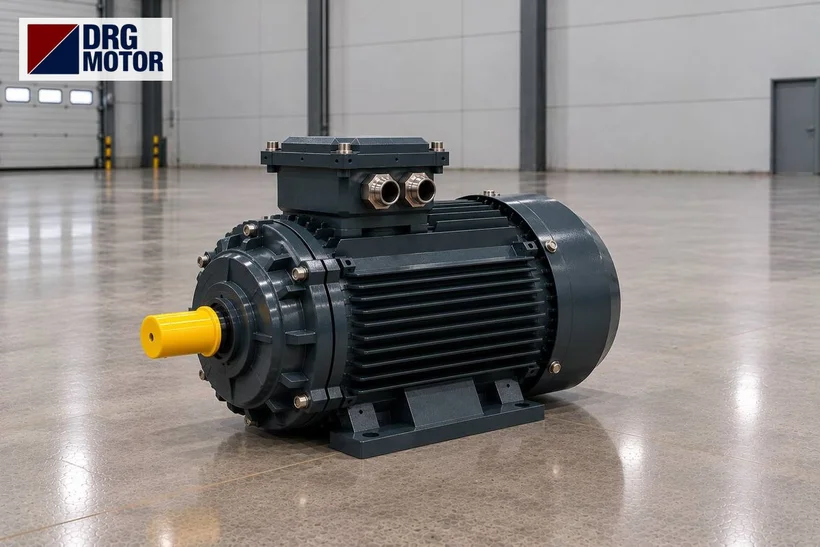
These models suit arrangements where a foot-mounted (B3) motor on a fixed frame drives the eccentric shaft by belt; the 4-pole speed is brought down to the required vibration frequency through the pulleys. A cast iron housing option is available for heavier duty.
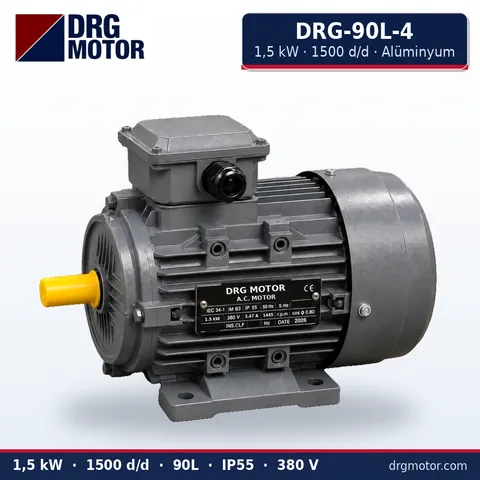
1.5 kW Three-Phase Motor 1500 rpm – DRG-90L-4 Aluminium
- 1.5 kW · 1500 rpm (4 poles)
- Aluminium frame · IEC 90L
- Mounting: B3 · B5 · B14 · B35
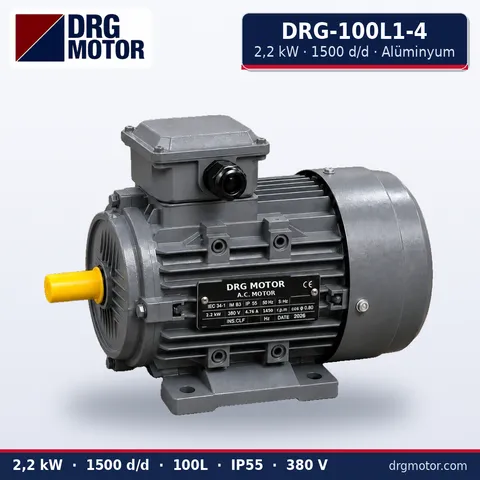
2.2 kW Three-Phase Motor 1500 rpm – DRG-100L1-4 Aluminium
- 2.2 kW · 1500 rpm (4 poles)
- Aluminium frame · IEC 100L
- Mounting: B3 · B5 · B14 · B35
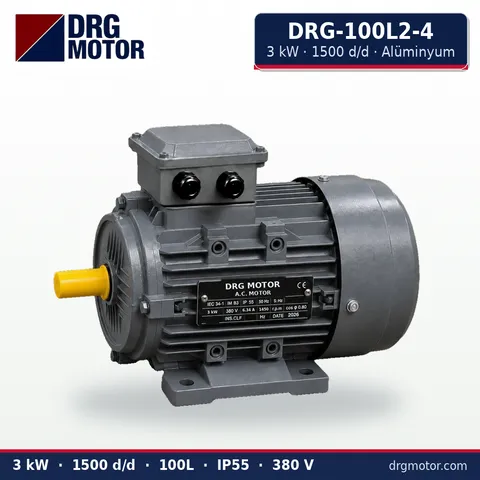
3 kW Three-Phase Motor 1500 rpm – DRG-100L2-4 Aluminium
- 3 kW · 1500 rpm (4 poles)
- Aluminium frame · IEC 100L
- Mounting: B3 · B5 · B14 · B35
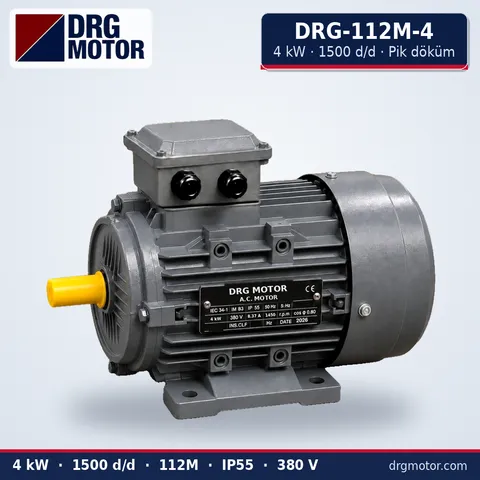
4 kW Three-Phase Motor 1500 rpm – DRG-112M-4 Cast Iron
- 4 kW · 1500 rpm (4 poles)
- Cast iron frame · IEC 112M
- Mounting: B3 · B5 · B14 · B35
Click to see current prices and order these motors nowSEE PRICES →
Vibratory Deburring Motor: Frequently Asked Questions
Can a standard motor replace the vibration motor on a deburring bowl?
Not directly. A vibration motor is rigidly fixed to the bowl and carries its weights on its own shaft; a standard motor cannot produce the force in this role and is not built to withstand constant vibration. Converting the machine to a belt-driven eccentric shaft is a design change and should be planned with the machine builder.
The bowl vibrates weakly; is a bigger motor the answer?
Usually not. Vibration force is set by the weight plate adjustment and shaft speed. First check belt slip, pulley ratio, weight setting and spring condition; if motor current is below the nameplate value, the problem is not the motor.
What speed should a vibratory deburring motor have?
The motor itself is mostly 4-pole (about 1450 rpm); the eccentric shaft speed is set by the pulley ratio. What matters is keeping the shaft speed of the original arrangement, not the motor speed.
Why does the motor shake the bowl when starting?
As the shaft passes the natural frequency of the spring system, amplitude grows briefly. If the motor accelerates slowly (low voltage, slack belt, long time in star) it stays longer in this zone. Check supply voltage and belt tension.
Send a photo of the motor nameplate, the pulley diameters, the foot and shaft dimensions and a short description of the bowl via WhatsApp, or add the models to the quote list, and we will narrow down the right motor together. Phone: +90 (542) 666 11 11 · e-mail: info@drgmotor.com · contact page. All models and current prices are in the DRG online store; for similar duties see also the general purpose industrial motors page.