English
 Le français
 Türkçe




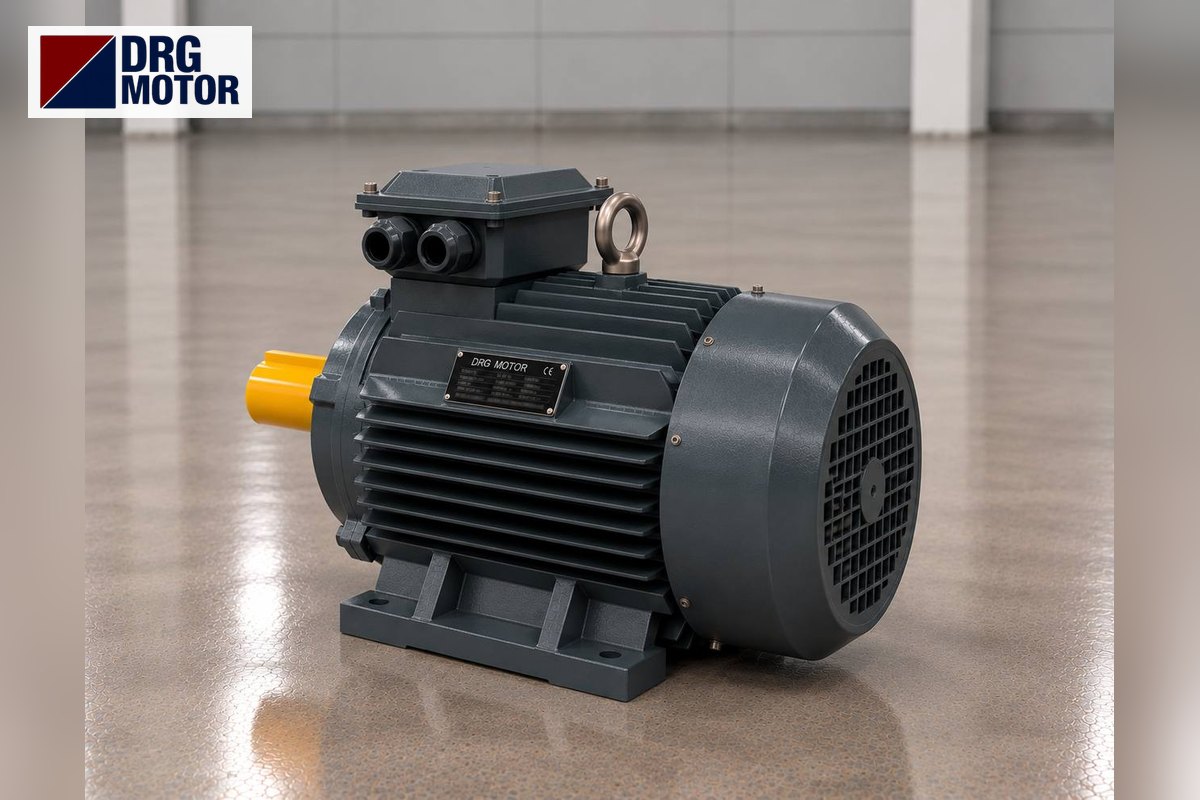

When choosing a fan motor for a fruit drying cabinet, the first question is not power but where the motor will sit. Cabinet air is held between 40 and 70 °C depending on the product, such as apricots, apples, figs or tomatoes, whereas DRG motors are designed for ambient air of at most +40 °C. The motor must therefore sit outside the cabinet wall, not inside the hot air stream, and drive the fan through an extended shaft or a belt and pulley.
If the motor stays outside in cool air, the job is covered by a standard 4- or 6-pole three-phase asynchronous motor. The aluminium-housing models in the 0.75–3 kW range often used on drying cabinets are listed in our online motor store.
Why Is Air Circulated Inside the Cabinet?
Most of the weight of fresh fruit is water. As an example, if 500 kg of fresh apricots are dried from 80 percent to 20 percent moisture on a wet basis, the dry matter is 100 kg and the final product weighs 125 kg; 375 kg must leave the cabinet as water vapour. Heated air picks this water up from the trays, and the fan is what carries that air between them.
The fan pushes air over the heater battery, blows it horizontally between the tray racks and draws most of it back in. Part of the humid air leaves through the exhaust damper and fresh air replaces it. If air speed is not evenly spread over the trays, the front row dries while the back row stays wet; this is why some cabinets reverse the fan direction at set intervals.
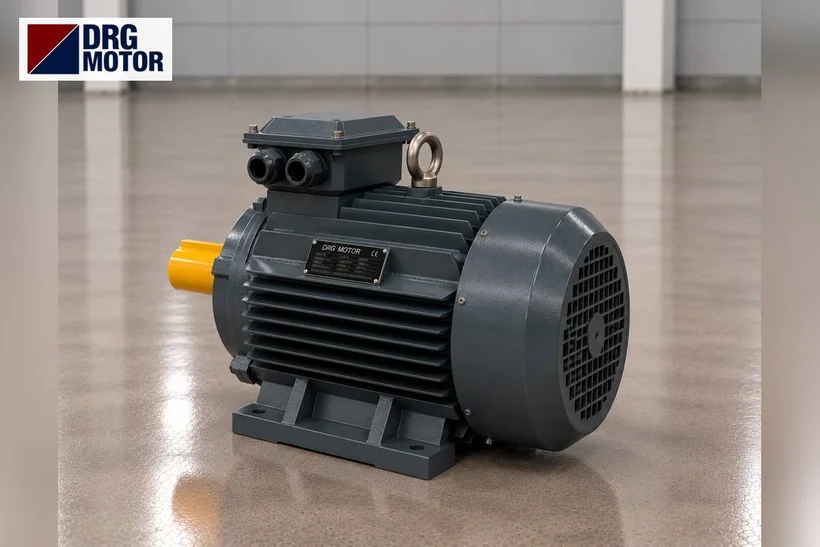
The +40 °C Limit: Where the Motor Sits
Small workshop cabinets sometimes place the motor with the fan directly in the air duct. A motor sitting in 60 °C air draws hot air with its own fan, and its winding runs hotter than the nameplate assumes. A DRG motor is not used in this layout; even heat-pump cabinets working at 45–55 °C still exceed the limit.
Depending on the cabinet layout, the motor position and the point to watch are as follows:
| Cabinet layout | Fan type | Motor position | Watch out for |
|---|---|---|---|
| Tray rack cabinet | Side-wall axial | Outside wall, bearing shaft | Sealing at wall passage |
| Trolley tunnel dryer | Roof-mounted radial | On the roof, belt drive | Sun and rain protection |
| Heat-pump cabinet | Axial or plug fan | Separate plant room | Measure room temperature |
| Solar-assisted hybrid | Axial | At collector inlet | Midday ambient heat |
When the motor is moved outside the wall, its flange is fixed to a support plate and its shaft is coupled to a bearing-mounted intermediate shaft or straight to the fan. If the wall passage is poorly insulated, cabinet air leaks around the motor; before replacement, read the air temperature next to the motor with a thermometer while the cabinet is at full temperature.
Click to see current electric motor prices and order nowSEE PRICES →
Sulphur, Sugar Vapour and Night-Time Condensation
Apricots and some other fruits are sulphured before drying. In the first hours of drying the product releases sulphur dioxide; combined with moisture in the exhaust air, this gas attacks copper terminals, terminal screws and cable entries. Placing the motor on the fresh-air side rather than next to the exhaust outlet reduces the effect.
When the cabinet is shut down at night, the humid air inside cools and condenses on surfaces. An IP55 housing is protected against water jets and dust, but moisture can still collect inside a cooling motor. Whatever the motor's mounting position, vertical or horizontal, confirm at order where condensate will drain. Sticky vapour from sweet fruit gradually narrows the grille of the fan cover, so cleaning it belongs on the maintenance list.
Fan Power: From Air Flow to Motor
Fan power is calculated from air flow and the pressure loss the fan overcomes: P = Q·Δp/η. The exact value comes from the fan maker's curve; the calculation below only shows the method.
Example / assumption: in a two-trolley cabinet, let the flow section between trays be 1.6 m² and the target air speed 2 m/s. The flow is 3.2 m³/s, or 11,520 m³/h. Let tray racks, heater battery and filter add up to a 300 Pa pressure loss and take a fan efficiency of 0.55. Shaft power works out at 3.2 × 300 / 0.55 ≈ 1.75 kW. While the cabinet is cold the air is denser, so at the same speed this briefly rises to about 1.98 kW. A 2.2 kW DRG-100L1-4 (1450 rpm, 4.52 A at 400 V) leaves enough margin.
To get a rough power figure from the flow and pressure of your own cabinet, use the pump and fan motor power calculator.
Air demand in the last stage of drying
At the start of drying the product surface is wet, and the more moisture the air carries away the faster it dries. In the final stage water moves slowly from inside the fruit to the surface; high air speed no longer shortens drying and can harden the surface into a skin. On fans driven by an inverter, lowering speed to 0.8 times cuts fan power to about half (0.51 times); the 1.75 kW in the example drops to 0.89 kW. Cold starting and the fan laws are covered in detail in our article on drying oven circulation fans.
Dimension and Connection Checks at Replacement
Motors flange-mounted outside the wall commonly use a B5 large flange. Catalogue values for the 100L-frame DRG-100L1-4:
- Power: 2.2 kW – 1450 rpm – cos φ 0.81
- Voltage: 230/400 V; star connection on a 400 V supply
- B5 flange: M 215 mm, N 180 mm, P 250 mm, S 14.5 mm, T 4 mm
- Shaft: 28 × 60 mm, key width 8 mm
- Bearing: 6206-ZZ-C3
Clarify the following before ordering:
- Is the air temperature measured next to the motor, with the cabinet at full temperature, below 40 °C?
- Old motor nameplate: kW, speed, voltage, current.
- Mounting: wall flange (B5), foot base (B3) or both (B35)?
- Shaft diameter and length; does the fan hub or pulley bore match?
- Is the motor vertical, with the shaft pointing up or down?
- Is the fan direction reversed periodically; is there an inverter or a reversing contactor?
- Distance of the motor from the exhaust outlet and sulphur-laden air.
In cabinets where airflow is reversed, direction should be changed with the motor at rest. A motor reversed while running suffers twice the starting stress; contactor systems need a pause between the two directions, and inverter systems should change direction on a ramp. Large, slow axial fans may use a 6-pole motor; keep the pole count the same as the old motor.
DRG Motors for Fruit Drying Cabinet Fans
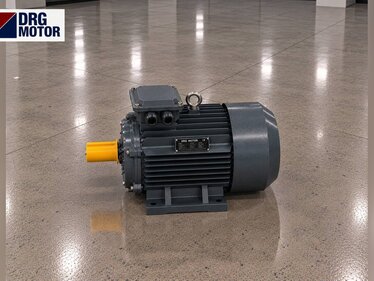
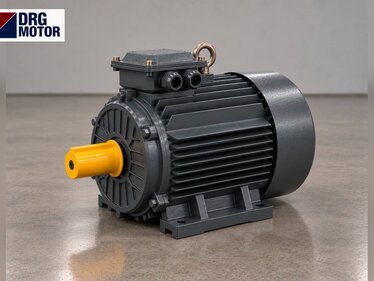
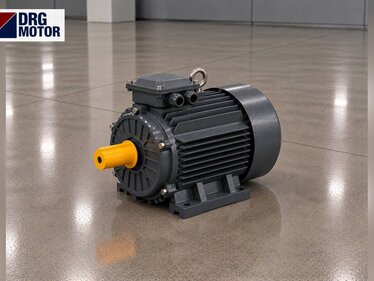
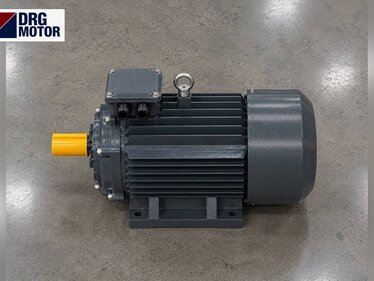
Aluminium-housing IP55 models available with B3/B5/B35 mounting, for fan motors placed outside the cabinet where air stays below 40 °C; they cover the power range from small rack cabinets to trolley tunnels.
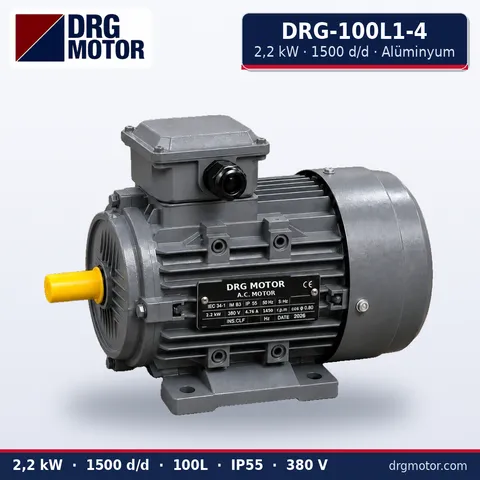
2.2 kW Three-Phase Motor 1500 rpm – DRG-100L1-4 Aluminium
- 2.2 kW · 1500 rpm (4 poles)
- Aluminium frame · IEC 100L
- Mounting: B3 · B5 · B14 · B35
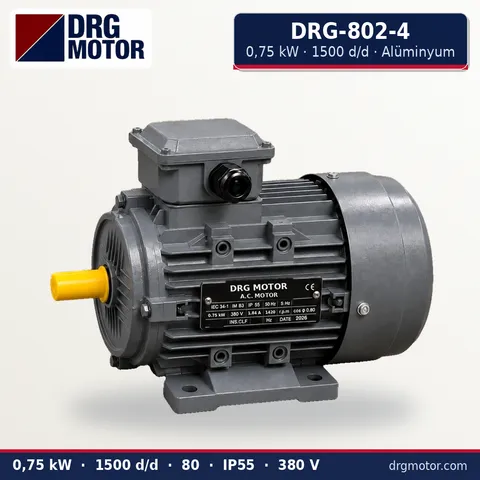
0.75 kW Three-Phase Motor 1500 rpm – DRG-802-4 Aluminium
- 0.75 kW · 1500 rpm (4 poles)
- Aluminium frame · IEC 80
- Mounting: B3 · B5 · B14 · B35
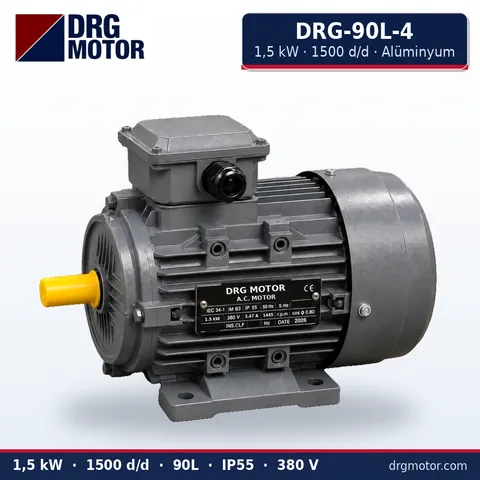
1.5 kW Three-Phase Motor 1500 rpm – DRG-90L-4 Aluminium
- 1.5 kW · 1500 rpm (4 poles)
- Aluminium frame · IEC 90L
- Mounting: B3 · B5 · B14 · B35
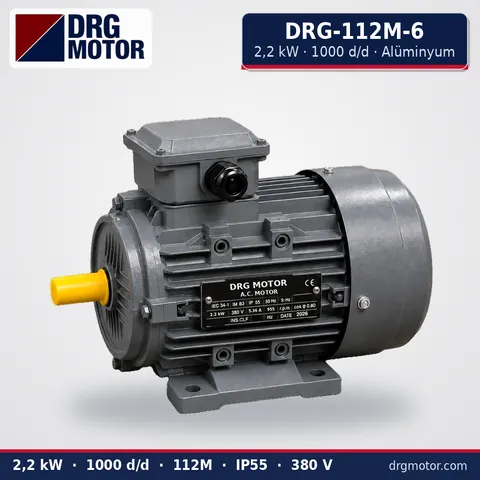
2.2 kW Three-Phase Motor 1000 rpm – DRG-112M-6 Aluminium
- 2.2 kW · 1000 rpm (6 poles)
- Aluminium frame · IEC 112M
- Mounting: B3 · B5 · B14 · B35
Click to see current prices and order these motors nowSEE PRICES →
Drying Cabinet Fan Motor: Frequently Asked Questions
Why does the fan motor of a fruit dryer burn out quickly?
The most common cause is a motor sitting inside the hot cabinet air or too close to the cabinet wall. Sulphur-laden humid exhaust air, a clogged fan cover and a fan reversed while still turning also wear the winding. Measure the temperature around the motor first.
Can the fan motor be placed inside the drying cabinet?
If cabinet air exceeds 40 °C, a DRG motor cannot be used inside. A motor built for high ambient temperature is a special motor and is not in the DRG range; the standard motor must be moved outside the wall.
What kW motor does a fruit drying fan need?
Small rack cabinets typically use from below 1 kW to a few kW, and large tunnel dryers higher values. The exact power is read from the cabinet maker's nameplate and fan curve; the calculation above shows the method.
Is motor selection different for a heat-pump dryer?
Although air temperature is lower, the 45–55 °C band is still above the +40 °C limit. If the motor sits in the plant room with the compressor and fans, the temperature of that room must be measured.
DRG Motor is a manufacturer, supplier and seller of electric motors. To get a motor quotation for your drying cabinet, send a photo of the old motor's label, its power and speed, whether it is foot- or flange-mounted, the shaft size and the motor's position relative to the cabinet via WhatsApp, or add the chosen models to the quote list. You can reach us by phone at +90 (542) 666 11 11 or by e-mail at info@drgmotor.com; further details are on the contact page. Motor groups suitable for drying fans are on the industrial dryer motors page, and all models are in the electric motor store.