English
 Le français
 Türkçe

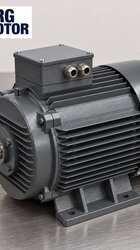

When the blower motor of a plastic vacuum loader fails, the first thing to check is not the kW rating but the blower type. On most side channel blowers the impeller sits directly on the motor shaft and the motor is part of the blower housing; on these, a standard IEC motor usually cannot be fitted as a direct replacement. In central systems with a Roots (lobe) blower, the motor is connected by belt and pulley or coupling and can be replaced with a standard three-phase motor.
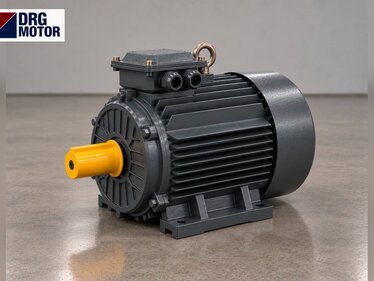
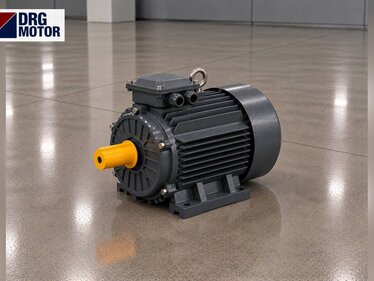
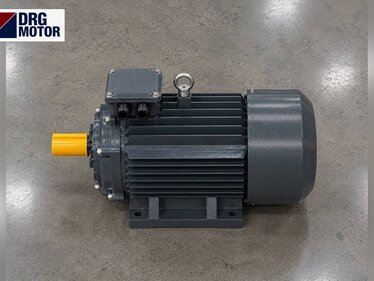
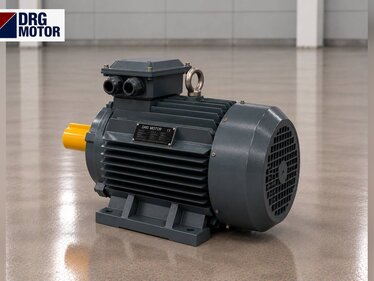
DRG Motor is an electric motor manufacturer, supplier and seller; it does not sell blowers or loaders, but supplies the standard IEC motor fitted to belt-driven or coupled blowers. Suitable 2- and 4-pole models are listed by power and speed in the DRG online motor shop.
What the Blower Does in a Vacuum Loading Line
In a central conveying system, granules are drawn by vacuum from a silo or dryer to receiver hoppers on the machines. The blower pulls air from behind the filter at the end of the line; each receiver's vacuum valve opens in turn, closes when the hopper is full and the sequence moves on to the next. Dust carried with the air is caught in the filter or cyclone.
For the motor, this cycle means two things. First, the line is briefly closed while switching between valves; if the blower works against a closed suction, vacuum deepens and absorbed power rises. Second, when the system is idle, the blower is either stopped or run unloaded with a by-pass valve venting to atmosphere. Unloaded running instead of frequent stop-start protects the motor and contactor.
Identify the Blower Type First
The distinction below drives the replacement decision. The blower plate and housing layout show the type; if no coupling, pulley or separate bearing housing is visible between motor and blower, the impeller is most likely on the motor shaft.
| Blower type | Motor connection | Standard motor swap | Watch for |
|---|---|---|---|
| Side channel, compact | Impeller on motor shaft | Usually no | Special shaft and flange |
| Side channel, coupled | Own bearings, coupling | Yes, if sizes match | Flange and shaft length |
| Roots (lobe) | Belt-pulley or coupling | Yes | Pulley ratio, belt tension |
| Claw type | Usually close-coupled | Ask the maker | Integrated shaft |
If the motor of an integrated-shaft side channel blower has burned out, the solution is usually the blower maker's spare motor unit; DRG does not offer special-shaft motors for this duty. General selection for Roots drives that accept a standard motor is explained in our Roots blower electric motor selection article; here we cover points specific to plastic conveying lines.
Click to see current electric motor prices and order nowSEE PRICES →
Vacuum Level and Motor Power
On a positive displacement (Roots) blower, absorbed power is roughly proportional to air flow and pressure difference. As the line gets longer, the filter clogs or a receiver valve fails to open, vacuum deepens and motor current rises. Side channel blowers follow the same trend; with suction fully closed, power reaches its maximum. That is why the line has a vacuum relief valve.
Example (assumption): 150 m³/h suction flow, 250 mbar (25 kPa) working vacuum, overall blower efficiency 0.45. P = Q·Δp/η = (150/3600)·25,000/0.45 ≈ 2.3 kW. A 3 kW DRG-100L-2 is then a reasonable candidate. If vacuum rises to 400 mbar at the same flow, power climbs to about 3.7 kW and the 4 kW DRG-112M-2 is needed. The real value is the blower maker's curve; a dirty filter easily exceeds the estimate.
2-Pole or 4-Pole?
Roots blowers are mostly belt-driven from a 2-pole motor, with blower speed set by the pulley ratio. The 4-pole DRG-100L2-4 (1450 rpm) is preferred for larger, slower blowers or where a small pulley ratio is wanted. If the pole count changes, recalculate the pulley diameters; otherwise flow and vacuum will change.
Frequent Starts, Overload Setting and Heat
Some small systems stop and restart the blower on every loading cycle. At each start the motor draws several times its rated current: per the catalogue, the DRG-100L-2 has Is/In = 7.8 and a rated current of 5.71 A at 400 V, so starting current is about 44.5 A. Many starts per hour heat the winding and wear contactor contacts. On such a line, switch to by-pass (unloaded) operation or arrange the number of starts to the blower maker's limit.
Set the overload relay to the rated current on the motor plate; setting it high on a line with frequent starts and no unloading only hides the problem. You can check contactor and fuse sizing with the overload, fuse and contactor selection tool. Hot air leaving the blower can heat the motor flange and frame; keep the area in front of the fan cover clear so the motor gets cooling air. Motor ambient temperature must stay within −15…+40 °C.
Replacement Day Checklist
- Type on the blower plate: side channel, Roots or claw
- Is the impeller on the motor shaft, or is there a coupling/pulley?
- Power, speed, voltage and frequency (50/60 Hz) of the old motor
- Mounting (B3 foot, B5 flange, B35) and frame size
- Shaft diameter and length; for belt drives, both pulley diameters
- Condition of the vacuum relief valve and filter (a dirty filter overloads a new motor too)
- Starting method and number of starts per hour
For B5-mounted Roots drives, the DRG catalogue gives frame 90 a flange outside diameter of 200 mm, bolt circle 165 mm, spigot 130 mm and shaft 24×50 mm; frames 100L and 112M have 250, 215 and 180 mm respectively with a 28×60 mm shaft. Models up to 3 kW are wound 230/400 V, 4 kW and above 400/690 V; on a 400 V supply a 4 kW motor is connected in delta. Small flange (B14) dimensions are confirmed at order.
Signs of the Wrong Choice
A motor sized at the limit trips as the filter clogs, and when the line is extended, distant receivers do not get enough material. Fitting a 50 Hz motor to a pulley arrangement set up for 60 Hz lowers blower speed, flow drops and hoppers fill late. Too much speed exceeds the blower's permitted speed and temperature. Trying to connect a standard motor to an integrated-shaft blower with an adaptor upsets impeller clearances and risks rubbing on the housing.
Other options for belt-driven and coupled blower drives are on our air blower electric motors page.
DRG Motors Suited to Vacuum Loader Blowers
2-pole models covering the power range common on Roots and coupled side channel blowers, plus one 4-pole option for keeping the pulley ratio small.
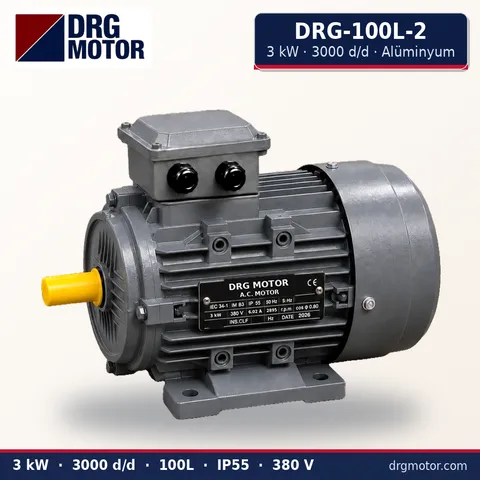
3 kW Three-Phase Motor 3000 rpm – DRG-100L-2 Aluminium
- 3 kW · 3000 rpm (2 poles)
- Aluminium frame · IEC 100L
- Mounting: B3 · B5 · B14 · B35
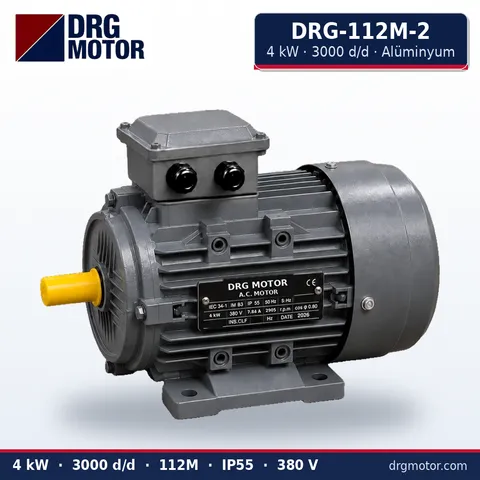
4 kW Three-Phase Motor 3000 rpm – DRG-112M-2 Aluminium
- 4 kW · 3000 rpm (2 poles)
- Aluminium frame · IEC 112M
- Mounting: B3 · B5 · B14 · B35
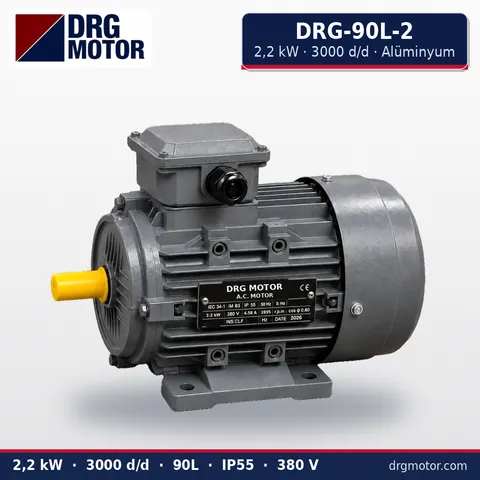
2.2 kW Three-Phase Motor 3000 rpm – DRG-90L-2 Aluminium
- 2.2 kW · 3000 rpm (2 poles)
- Aluminium frame · IEC 90L
- Mounting: B3 · B5 · B14 · B35
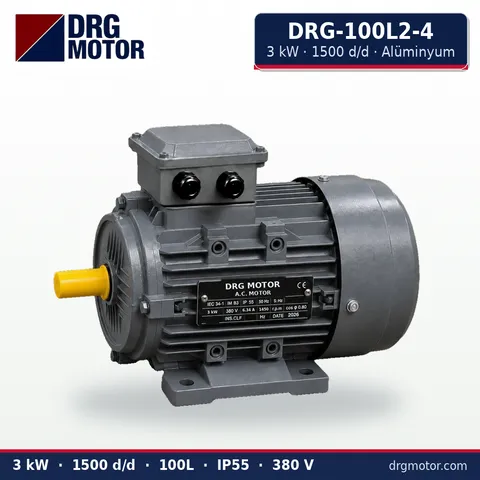
3 kW Three-Phase Motor 1500 rpm – DRG-100L2-4 Aluminium
- 3 kW · 1500 rpm (4 poles)
- Aluminium frame · IEC 100L
- Mounting: B3 · B5 · B14 · B35
Click to see current prices and order these motors nowSEE PRICES →
Vacuum Loader Blower Motor: Frequently Asked Questions
Can a standard motor replace a side channel blower motor?
Usually not if the impeller sits directly on the motor shaft; shaft and flange are specific to the blower. If the blower has its own bearings and the motor is connected by a coupling, a standard IEC motor with matching dimensions can be used.
Why does the vacuum loader blower motor trip?
The most common causes are a dirty filter, a closed suction, an extended line and frequent starts. Check the filter, relief valve and starting arrangement before increasing motor power.
Should a Roots blower motor be 2-pole?
A 2-pole motor with pulleys is most common. If you move to a 4-pole motor, recalculate the pulley ratio to keep the same blower speed.
What happens if the blower motor runs all the time?
A motor run unloaded through a by-pass valve heats up less than one that stops and starts frequently. For long running periods it is enough that the motor's cooling air is not obstructed.
For a quotation, send photos of the blower plate and the old motor nameplate, the mounting (foot/flange), shaft size and pulley diameters via WhatsApp, or add the models to the quote list. Phone: +90 (542) 666 11 11 · E-mail: info@drgmotor.com · Contact page. All models are in the online shop.