English
 Le français
 Türkçe




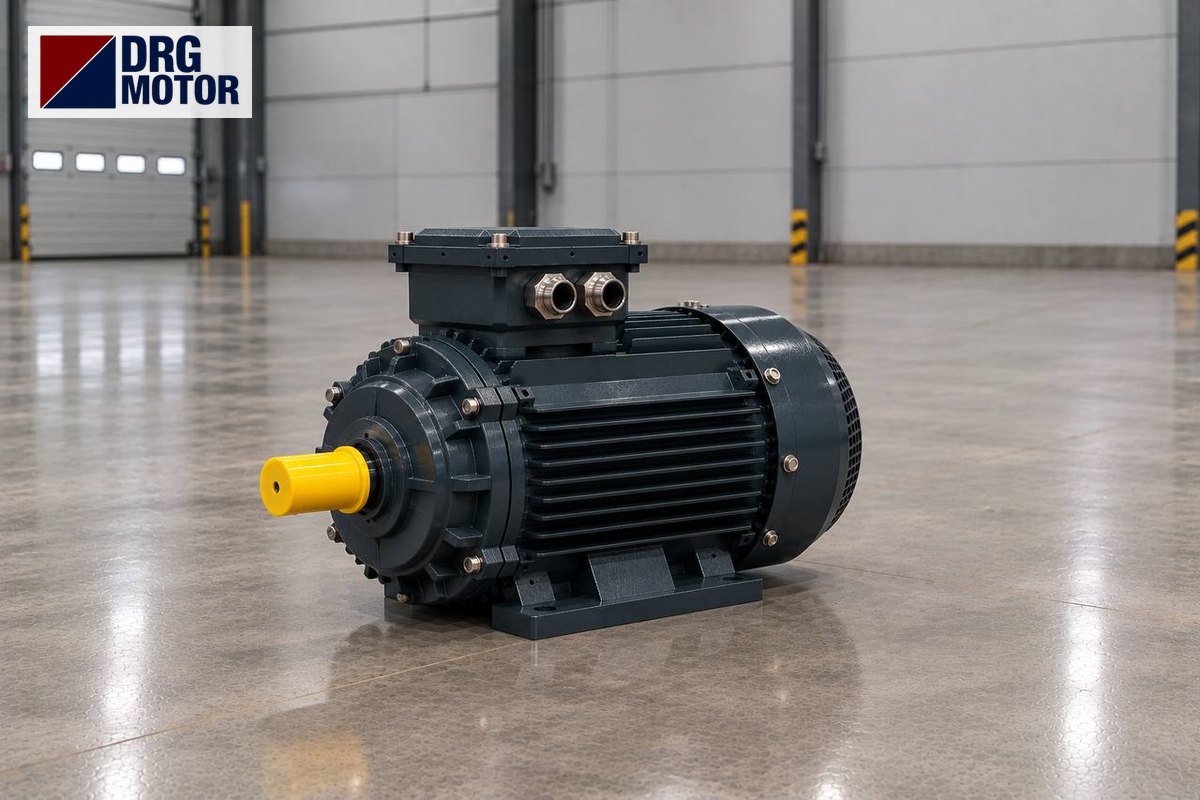

On a hydraulic scissor lift table the motor runs only while the platform rises; lowering happens under the load’s own weight through a flow control valve. Two things therefore decide the pump motor: the pressure in the first few centimetres of lift, which is the heaviest moment, and how many times per hour the motor starts. What is needed is not a motor that carries load for long periods but one that runs briefly and often.
On dock levellers of the scissor type, goods lift tables between floors and production line lift tables, the power unit motor is usually a 4-pole flange motor of between 1.5 and 5.5 kW; heavy, large tables may use more. The exact value is on the lift builder’s label. You can filter suitable models by power and frame type on the buy electric motors online page.
DRG Motor is a manufacturer, supplier and seller of electric motors. The lift’s pump, valve block, cylinders and safety equipment belong to the machine; DRG supplies the standard three-phase asynchronous motor of the unit. For hoists, conveyors and similar equipment see also the lifting and handling machine motors page.
Scissor Geometry: Why the First Seconds Are the Hardest
On a scissor lift the cylinder raises the table by pushing the crossed arms. When the arms are fully closed, with the table at the bottom, most of the cylinder force goes into opening the arms and the vertical component is small. To lift the same load the cylinder needs its highest force, and therefore its highest pressure, in this position.
As the table rises the arms become steeper and the required pressure falls. With a fixed displacement pump the flow is constant, so power falls with pressure. The result: the moment the button is pressed, the motor both draws its starting current and meets the heaviest hydraulic load of the cycle. This overlap must not be overlooked when choosing the motor.
Example: Pressure and Power During the Lift
Example / assumptions: single-pump unit, 1450 rpm motor, 8.28 cm³/rev gear pump (about 12 l/min), pump efficiency 0.85. Starting pressure with a loaded table is taken as 160 bar and 90 bar at full height. Power is calculated with P = Q·p/(600·η). Real pressures depend on the scissor angle, the cylinder mounting point and the load.
| Table position | Pressure (example) | Pump power | Note |
|---|---|---|---|
| Bottom (arms closed) | 160 bar | 3.76 kW | Coincides with starting current |
| One quarter of travel | 140 bar | 3.29 kW | Power drops quickly |
| Half height | 120 bar | 2.82 kW | |
| Three quarters | 105 bar | 2.47 kW | |
| Top | 90 bar | 2.12 kW | Motor stops, valve holds |
The equivalent (RMS) power of this lift is about 2.98 kW. Because the first instant is 3.76 kW, 4 kW comes to mind. But this load lasts a few seconds and DRG motors have a breakdown torque ratio of 2.3; for the DRG-100L2-4 (3 kW) the peak load is 1.25 times rated. For the lift alone, 3 kW is enough. The real question is how many times per hour the motor performs this cycle.
Click to see current electric motor prices and order nowSEE PRICES →
Frequent Starts and Short Running: What Governs Heating?
If a lift takes 25 seconds and the platform rises 30 times an hour, the motor runs only 20.8% of the hour. Spread over the hour at that ratio, the equivalent power during lifting comes to about 1.36 kW. On paper a 3 kW motor is comfortable in this duty.
What the calculation leaves out is starting. At each start the motor draws 7–8 times rated current for a few hundred milliseconds; the 3 kW DRG model has In 6.02 A and Is/In 7.6, so starting current is about 45.8 A. This heat builds up in the winding and rotor. A few dozen starts per hour is a load a standard motor can carry; hundreds of starts (such as an operator inching the table level with short presses of the button) heat the rotor.
In practice: if a dock table is raised in short bursts to line up with a lorry bed, choose a motor one size larger or do the levelling with a slow-speed valve. The overload relay is set to the rated current on the motor nameplate; the overload relay, fuse and contactor selection table can be used for selection. At this power, direct-on-line starting is normal and star-delta is not needed.
The Motor Does Not Run When Lowering, but Lowering Affects the Motor
The table descends under its own weight when the lowering solenoid valve opens. A pressure-compensated flow control valve keeps the lowering speed independent of load. The motor is stopped during this time and uses no energy. So lowering time changes with valve setting, not motor power. The idea of fitting a bigger motor so the table comes down faster is wrong.
The indirect effect is oil temperature. The potential energy of the descending table turns into heat in the valve, and on units with a small tank the oil warms up. Warm oil has lower viscosity and pump leakage rises; lifting takes longer and the motor stays loaded longer. On a busy dock, look at tank volume and cooling as well as the motor.
On some platforms lowering is also powered (double-acting cylinder, power-down). In that case the cycle doubles and the duty ratio must be recalculated with the same formula.
Unit Motor: Flange, Shaft and Vertical Mounting
In compact power packs the motor is usually mounted vertically, by its flange, on the unit body or on a bell housing in the tank lid; the pump sits inside the tank. The flange may be B5 (large flange, through holes) or B14 (small flange, tapped holes). B14 dimensions vary by frame and are confirmed when ordering.
DRG catalogue B5 dimensions in this power band are: frame 90, M 165, N 130, P 200 mm with a 24×50 mm shaft; frames 100L and 112M, M 215, N 180, P 250 mm with a 28×60 mm shaft; frame 132, M 265, N 230, P 300 mm with a 38×80 mm shaft. Moving from 3 kW to 4 kW changes the frame from 100L to 112M but the flange and shaft stay the same, which makes upsizing easier. Other flange models are listed on the hydraulic power unit electric motors page.
In vertical mounting the shaft end points down, and oil mist and condensation head towards the underside of the frame rather than the terminal box. If the platform is on an open dock, IP55 protection and frame-fan cooling are sufficient; a simple canopy to stop rainwater collecting on top of the motor helps. DRG motors are rated for −15…+40 °C ambient.
Does the Symptom Point to the Motor or the Hydraulics?
- Loaded table will not lift from the bottom, empty table will: the initial pressure hits the relief valve setting or the motor torque limit; check the valve setting first, then the motor voltage.
- Motor hums at start but does not turn: a missing phase or low voltage; even a new motor cannot start under this load.
- Lifting gets slower towards the end of the day: the oil is hot; a tank and cooling issue, not the motor.
- Overload trips only at busy hours: the number of starts has risen; count the duty ratio and the short bursts.
- Table creeps down by itself: the lowering valve or cylinder seal is leaking; nothing to do with the motor.
Gather the following before ordering:
- Motor label: kW, rpm, voltage; note it if it says single phase (a standard DRG three-phase motor will not fit directly)
- Mounting: vertical or horizontal, B5 or B14; flange outer diameter and bolt circle
- Shaft diameter, length, key; coupled to the pump or direct
- Lifts per hour and the duration of one lift
- Lowering by gravity or powered
- Tank volume and oil temperature at the end of the day
DRG Motors for Scissor Lift Power Units
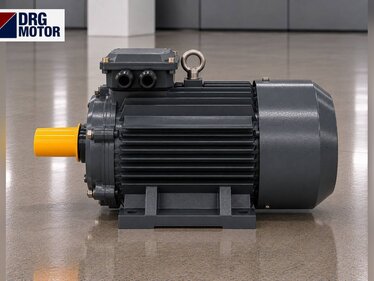
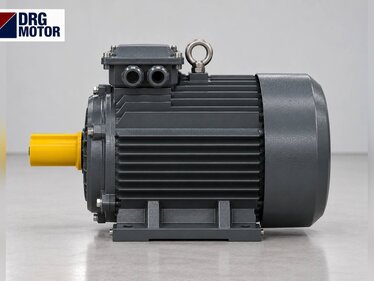
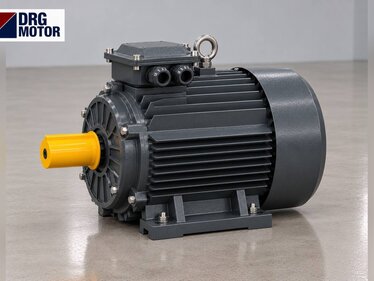
4-pole aluminium frame models suited to short, frequent running and available for flange mounting; the power rating depends on the platform load and the number of lifts per hour.
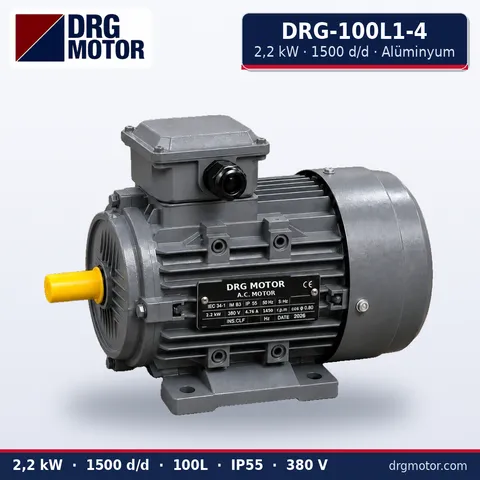
2.2 kW Three-Phase Motor 1500 rpm – DRG-100L1-4 Aluminium
- 2.2 kW · 1500 rpm (4 poles)
- Aluminium frame · IEC 100L
- Mounting: B3 · B5 · B14 · B35
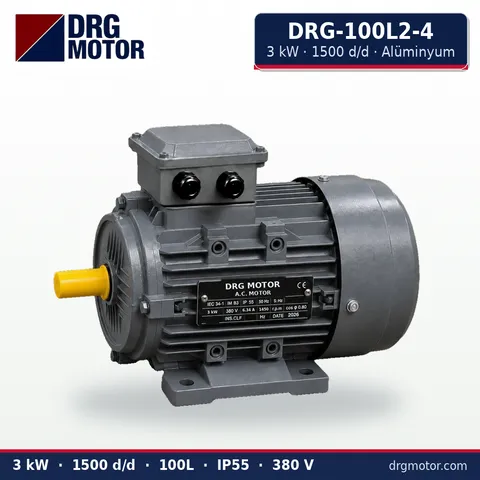
3 kW Three-Phase Motor 1500 rpm – DRG-100L2-4 Aluminium
- 3 kW · 1500 rpm (4 poles)
- Aluminium frame · IEC 100L
- Mounting: B3 · B5 · B14 · B35

4 kW Three-Phase Motor 1500 rpm – DRG-112M-4 Aluminium
- 4 kW · 1500 rpm (4 poles)
- Aluminium frame · IEC 112M
- Mounting: B3 · B5 · B14 · B35
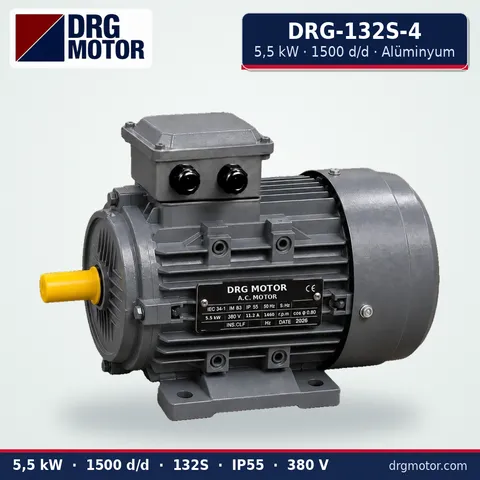
5.5 kW Three-Phase Motor 1500 rpm – DRG-132S-4 Aluminium
- 5.5 kW · 1500 rpm (4 poles)
- Aluminium frame · IEC 132S
- Mounting: B3 · B5 · B14 · B35
Click to see current prices and order these motors nowSEE PRICES →
Scissor Lift Pump Motor: Frequently Asked Questions
How many kW should a scissor lift table motor be?
On dock and floor-to-floor tables it is usually between 1.5 and 5.5 kW. The correct value is on the label; without a label it is calculated from pump displacement, lifting pressure at the bottom and lifts per hour. In the example above 3 kW proved sufficient.
The motor struggles while the platform rises but lowering is fine; why?
The motor does not run during lowering at all. The first seconds of lifting demand the highest pressure because of the scissor geometry. If the strain is only at the start this is normal; if it lasts the whole travel, check voltage and pump leakage.
Will frequent starting on a loading dock burn the motor?
A few dozen full lifts per hour are no problem for a standard motor. Inching the table level with short presses multiplies the number of starts and heats the rotor. For this use a motor one size larger or a slow levelling valve is recommended.
Does a bigger motor make the table lower faster?
No. Lowering speed is set by the lowering valve and the flow control valve. The motor affects only lifting speed, and only together with pump displacement and speed.
To settle on the right motor together, send a photo of the existing motor’s label, its power, speed, mounting (vertical/horizontal, flange/foot), shaft size and the platform’s rated capacity to our WhatsApp line, or submit the models you have chosen through the quote list. Phone +90 (542) 666 11 11, e-mail info@drgmotor.com; other channels are on the contact page. Other ratings in the same frame are listed in the DRG online shop.