English
 Le français
 Türkçe




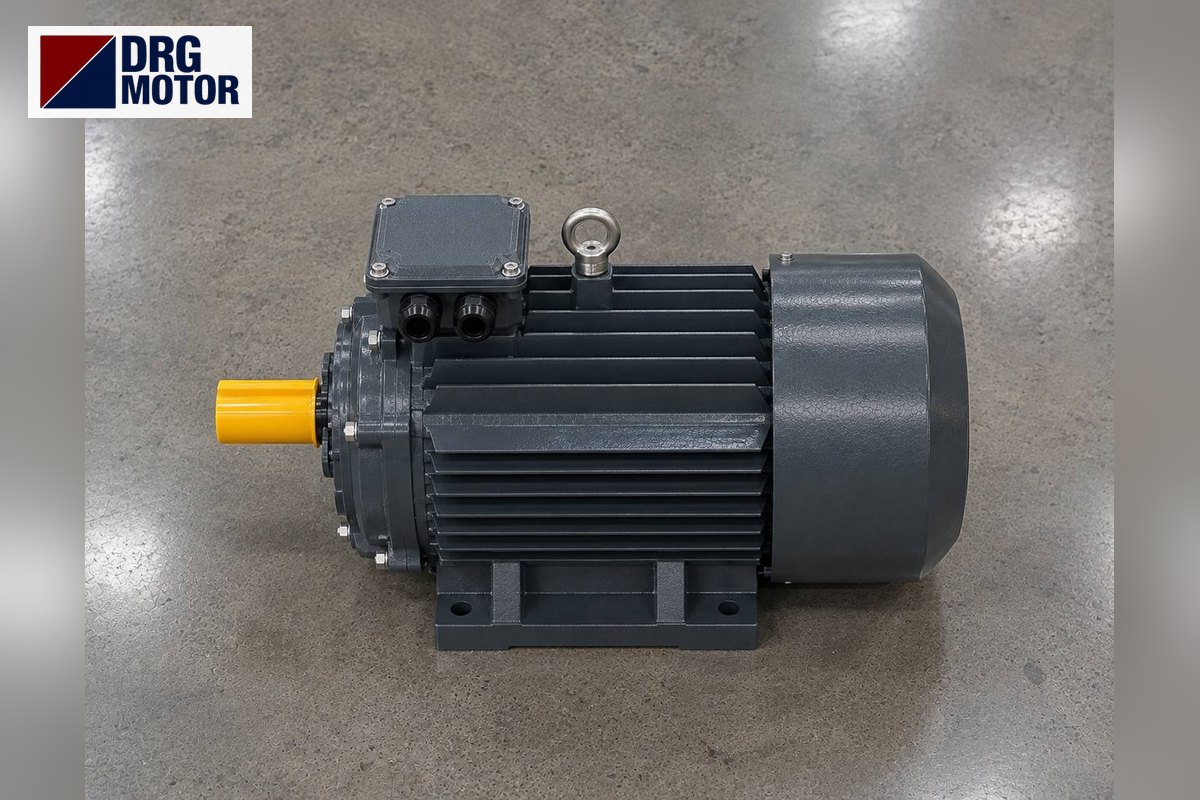

The circulation pump of a fabric dyeing machine is the main drive: it pushes the dye liquor through the heat exchanger and the nozzle and keeps the fabric moving through the machine. Its motor is usually a 4-pole three-phase induction motor, coupled on a baseplate or flange-mounted; its power can be a few kW on sample machines and tens of kW on large batch machines. Three things decide the right motor: the pump's flow–pressure point, the density difference between cold and hot liquor, and the heat that travels from the pump casing into the motor.
If the power and speed on the nameplate stay the same as the old motor, you can pick the replacement directly on our buy electric motors online page. If you are equipping a machine for the first time, the calculation and checks below help you size the motor to the pump.
DRG Motor is a manufacturer, supplier and seller of electric motors; it does not supply the pump, its mechanical seal or the machine's inverter. This article only covers the standard IEC motor that turns the pump.
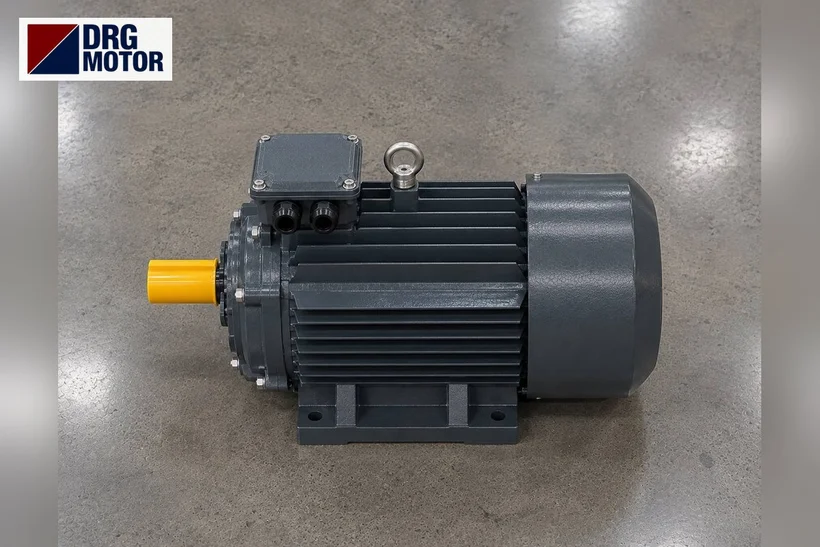
What the Pump Does in a Jet or Overflow Machine
In jet and overflow machines the fabric is sewn into an endless rope. The pump draws liquor from the bottom of the machine, sends it through the heating–cooling exchanger and delivers it to the jet nozzle or overflow channel. It is this liquid stream that drives the fabric forward; the lifter reel only assists.
In high-temperature machines the bath sits in a closed, pressurised vessel and reaches 130–140 °C. The pump runs for hours at the same point during each batch, followed by short cycles for rinsing and draining. The load is a quadratic centrifugal pump load: when speed drops, required power falls with the cube of speed.
The operator sets the nozzle pressure and the fabric cycle time according to the fabric type, nowadays mostly with an inverter that changes pump speed. Delicate knits need low pressure, heavy wovens need high pressure; the motor must run safely at both ends.
From Flow and Pressure to Motor Power: the Cold Bath Calculation
Pump shaft power can be estimated with P = Q·p/(600·η) (Q in l/min, p in bar, P in kW). The figures below are an example and an assumption; the exact value comes from the pump maker's curve.
Example: with a flow of 3000 l/min, 2.4 bar in front of the nozzle and an assumed pump efficiency of 0.72, shaft power is 3000·2.4/(600·0.72) ≈ 16.7 kW. If that value was worked out for liquor at 130 °C, the picture changes at the start of a batch when the machine is filled with water at 20 °C. Water at 20 °C is about 1.068 times denser than at 130 °C; at the same speed pressure and power rise by that ratio and shaft power climbs to about 17.8 kW.
So the motor is chosen for the power at cold filling, not for the hot running power. In this example an 18.5 kW motor is enough; if the pump curve shifts to the right (enlarged nozzle, cleaned exchanger) the next size up, 22 kW, is considered. With an inverter, reducing speed slightly during cold filling keeps the same motor in a safe zone: the same pump at 80 percent speed in a hot bath draws about 8.5 kW.
For a rough calculation with your own flow and pressure values you can use our pump and fan motor power calculator.
Click to see current electric motor prices and order nowSEE PRICES →
Heat Travelling from the Pump Casing to the Motor
On a dyeing machine the motor sits a few tens of centimetres from a pump casing that is in contact with hot liquor. Heat reaches the motor in three ways: by conduction through the pump shaft and coupling, by contact through the flange or bearing housing, and from the hot, steamy air around the vessel. DRG motors are built for an ambient of −15…+40 °C; they are IC411 cooled and rely on the air drawn in by their own fan.
If the air where the motor stands is above 40 °C, the standard nameplate ratings no longer apply. In that case the surroundings are fixed first: the vessel insulation is renewed, a bearing-frame pump with a spacer coupling is used between pump and motor, and fresh air is brought to the motor. A close-coupled (monobloc) design that sits directly on the pump casing and takes heat through the flange needs a special shaft and cannot be covered by a standard IEC motor.
Humidity is another issue in dyehouses. An IP55 housing protects against splashing water and dust; water or steam should not be aimed directly at the motor with a hose, and the terminal box cover and cable gland must be closed tightly.
Mounting Arrangement and Dimensions When Replacing
Two layouts are common on these machines. In the first, pump and motor share a baseplate; the motor is B3 foot-mounted and connected by a flexible coupling. In the second, the motor sits on the pump bearing housing with a large B5 flange. When replacing, the shaft height, flange dimensions and shaft end of the old motor must match exactly.
| Model | Power and speed | B5 flange M / N / P | Shaft D × E |
|---|---|---|---|
| DRG-160L-4 | 15 kW – 1465 rpm | 300 / 250 / 350 mm | 42 × 110 mm |
| DRG-180M-4 | 18.5 kW – 1470 rpm | 300 / 250 / 350 mm | 48 × 110 mm |
| DRG-180L-4 | 22 kW – 1470 rpm | 300 / 250 / 350 mm | 48 × 110 mm |
| DRG-160L-2 | 18.5 kW – 2940 rpm | 300 / 250 / 350 mm | 42 × 110 mm |
The dimensions in the table are the B5 flange rows of the DRG catalogue. Frames 160 and 180 share the same flange but have different shaft diameters; moving from 160 to 180 means the coupling hub has to be re-machined or replaced. For foot mounting, compare the foot hole spacing and shaft height as well.
Speed: 4 poles or 2 poles?
Dyeing pumps mostly run with a 4-pole motor (about 1470 rpm). Designs that need high flow at low head sometimes use a 2-pole motor (about 2940 rpm). The pole count is set by the pump impeller: fitting a 2-pole motor in place of a 4-pole one raises power roughly eightfold and puts both pump and motor at risk. Stay with the speed on the nameplate.
Inverter Operation and Signs of a Wrong Selection
The dyeing machine's inverter usually drives the pump between 25 and 50 Hz. With a quadratic load, the torque required at low speed also falls, so the slower shaft-mounted fan is not a problem. Going above 50 Hz, however, raises pump power quickly; the limit allowed by motor and pump must be confirmed with the machine maker.
On site, these signs show that the motor does not match the pump:
- The overload relay trips at cold filling but not in a hot bath: the motor was sized for hot running power.
- Bearing noise and grease leakage start on the pump side: the motor front end shield runs too hot or the coupling is misaligned.
- Fabric cycle time cannot be reached and the inverter sits at 50 Hz: pump or nozzle is worn and the motor runs at its limit.
- Water marks inside the terminal box: steam or wash water enters through the cable entry.
Checklist Before Ordering the Motor
- Old motor nameplate: kW, rpm, voltage (400/690 V Δ/Y), current and mounting (B3 / B5 / B35).
- The pump's flow and pressure point, and whether it runs with the same nozzle at cold filling.
- Shaft diameter and length, key width; for B5, the flange dimensions M, N, P.
- Air temperature measured where the motor stands, with the machine at full temperature.
- Inverter output frequency range and cable length to the motor.
- Coupling type, spacer length and foot hole spacing on the baseplate.
DRG Motors Suited to Fabric Dyeing Pumps
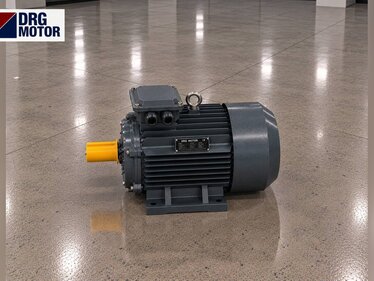
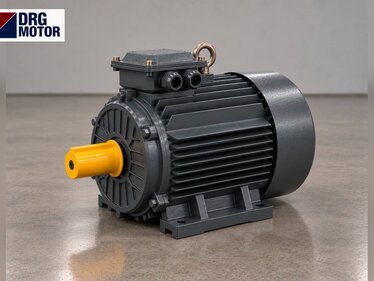
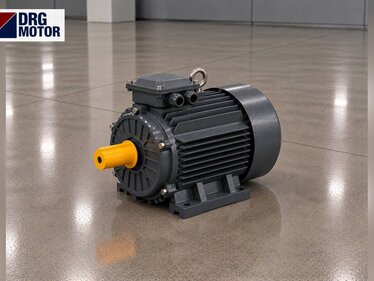
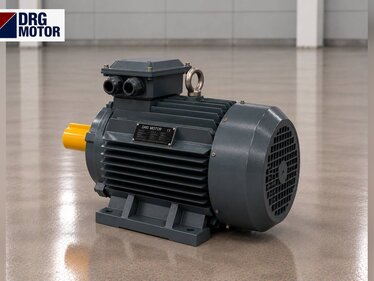
4-pole models covering the 18.5 kW of the example plus one size below (15 kW) and above (22 kW), and a 2-pole 18.5 kW for low-head pumps; all cast iron and suited to B3/B5 layouts.
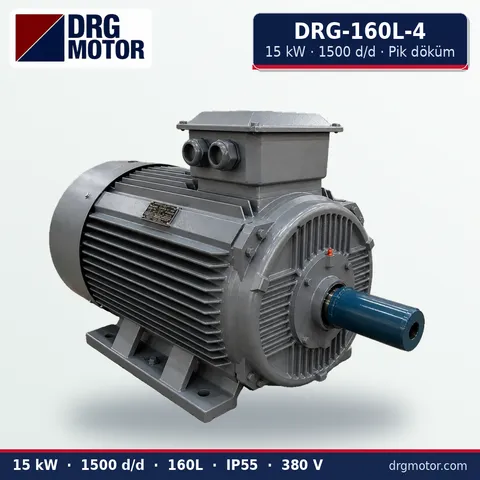
15 kW Three-Phase Motor 1500 rpm – DRG-160L-4 Cast Iron
- 15 kW · 1500 rpm (4 poles)
- Cast iron frame · IEC 160L
- Mounting: B3 · B5 · B14 · B35
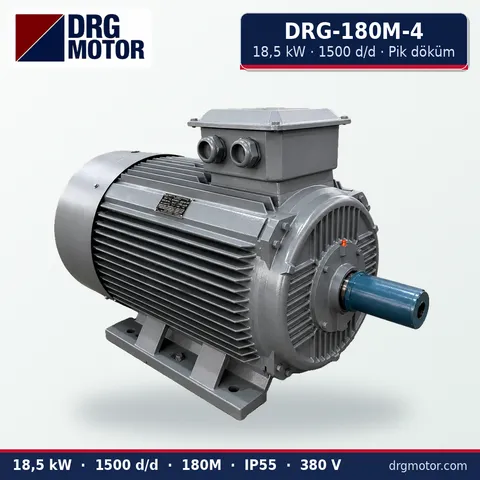
18.5 kW Three-Phase Motor 1500 rpm – DRG-180M-4 Cast Iron
- 18.5 kW · 1500 rpm (4 poles)
- Cast iron frame · IEC 180M
- Mounting: B3 · B5 · B14 · B35
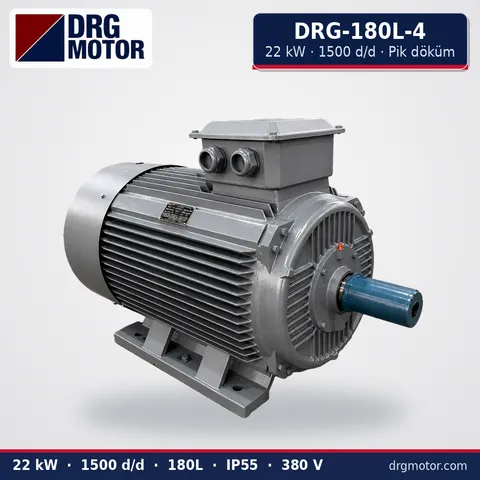
22 kW Three-Phase Motor 1500 rpm – DRG-180L-4 Cast Iron
- 22 kW · 1500 rpm (4 poles)
- Cast iron frame · IEC 180L
- Mounting: B3 · B5 · B14 · B35
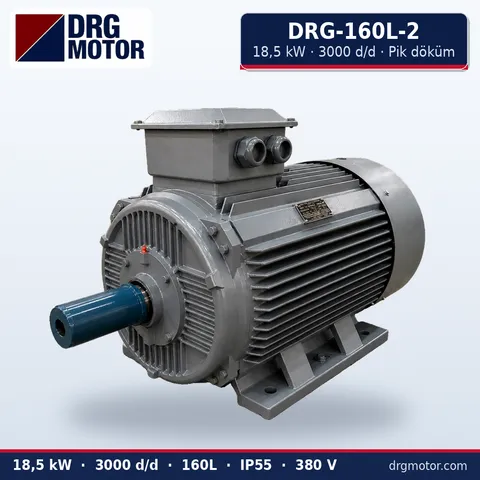
18.5 kW Three-Phase Motor 3000 rpm – DRG-160L-2 Cast Iron
- 18.5 kW · 3000 rpm (2 poles)
- Cast iron frame · IEC 160L
- Mounting: B3 · B5 · B14 · B35
Click to see current prices and order these motors nowSEE PRICES →
Dyeing Machine Pump Motor: Frequently Asked Questions
What kW should a dyeing machine pump motor be?
It depends on machine capacity and nozzle layout. Small sample machines use a few kW, large batch jet machines can use tens of kW. The exact value is the machine maker's nameplate or the pump curve; selection is based on power at cold filling.
Why does hot liquor wear out the motor?
The liquor itself does not heat the motor directly; heat comes from the pump casing, the shaft and the air around the vessel. If the air where the motor stands exceeds 40 °C, the winding runs hotter. A spacer coupling and good ventilation cut that path.
Can I run the pump motor at 60 Hz with an inverter?
Since centrifugal pump power rises with the cube of speed, power demand at 60 Hz is about 1.73 times the 50 Hz value. If the motor is not large enough to cover that, it will be overloaded. The pump and seal maker's approval is also needed.
The old motor was foot-mounted; can I fit a flange motor?
Yes, but the mounting arrangement changes. A B35 (foot + flange) motor can be used in either layout; shaft height and coupling alignment must still be set again.
For motor selection, send a photo of the old motor's nameplate, its power, speed, mounting (foot/flange), shaft size and the pump's flow–pressure data via WhatsApp, or request a quotation through the quote list. Phone: +90 (542) 666 11 11 · e-mail: info@drgmotor.com · contact. All ready models are listed in our online store; general information on circulation duty is collected on the circulation pump motor page.