English
 Le français
 Türkçe




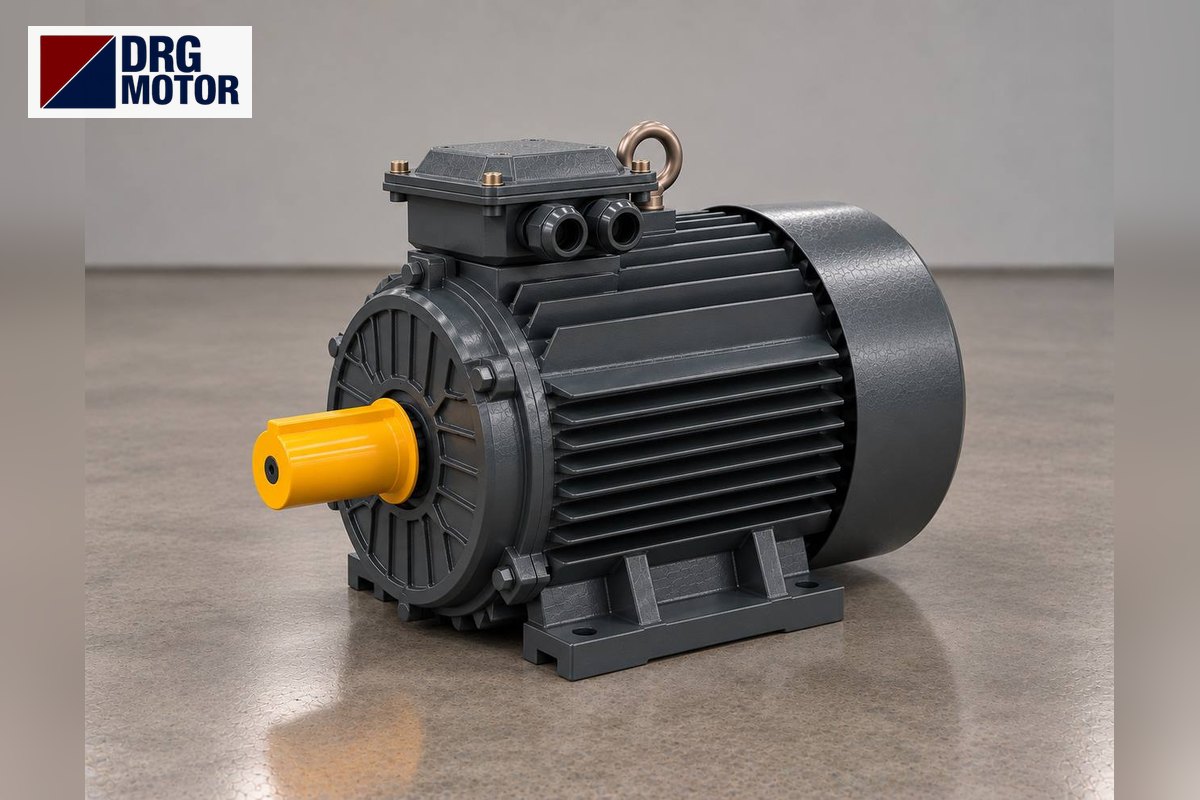

On an extrusion blow moulding machine the hydraulic pump motor does not melt the plastic; it closes the mould, moves the mould carriage under the head and back, lowers the blow pin and feeds the parison wall-thickness cylinder. Motor power is set by the moment these movements demand the most oil. On a machine with an accumulator, the pump covers the average flow over the cycle rather than that peak, and the motor can be one or two sizes smaller.
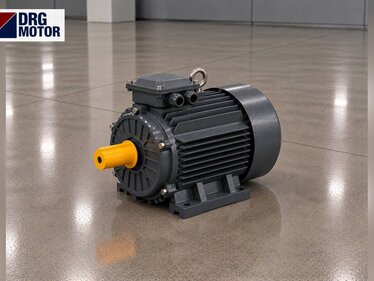
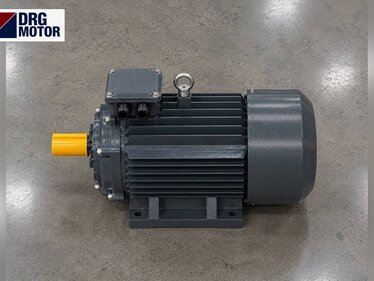
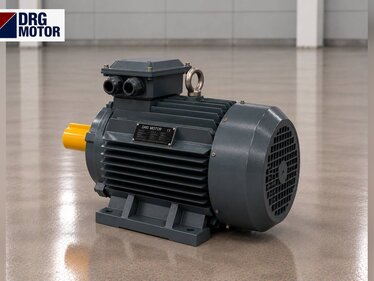
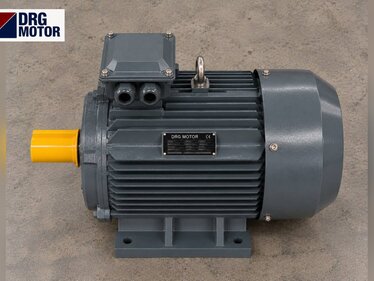
DRG Motor is a manufacturer, supplier and seller of electric motors; the 4-pole cast iron three-phase asynchronous motors used on hydraulic units are listed by power on the buy electric motors online page. Pumps, valves and accumulators are outside DRG's product range; DRG supplies the unit's electric motor.
Nameplate matching, bell housing and coupling details for the pump motor of a plastic injection machine are explained in the injection machine hydraulic pump motor article. Here we focus on the load pattern that separates blow moulding from injection.
What Does the Hydraulic System Do and What Does the Extruder Do?
In extrusion blow moulding (EBM) the screw turns continuously with its own electric motor and gearbox and extrudes a tube-shaped parison downwards from the head. The screw is not turned hydraulically, so the hydraulic unit's load is not the injection-machine pattern of "turn the screw, then inject at high flow".
The hydraulic unit's tasks are: mould closing and locking, horizontal or angled carriage movement, the parison cutting knife, the blow pin and calibration, the deflashing unit and, where fitted, the parison wall-thickness programming cylinder. The last one needs stable pressure; if the pump motor drops speed or fluctuates, the wall distribution of the bottle can suffer.
How Oil Demand Changes Within One Cycle
A long part of the blow moulding cycle is cooling: the mould is closed, internal air pressure presses the bottle against the mould surface and the hydraulics hold little more than the locking pressure. Movements are short, but flow demand rises during them.
| Cycle step | Hydraulic movement | Flow demand | Motor load |
|---|---|---|---|
| Carriage to head | Carriage cylinder | High, short | Peak |
| Mould closes, cut | Clamp + knife | High, short | Peak |
| Carriage back, pin down | Carriage + blow pin | Medium | Medium |
| Blowing and cooling | Lock pressure held | Low | Low (idling) |
| Mould opens, eject | Opening + deflashing | Medium | Medium |
On a machine with a fixed-displacement pump and no accumulator, the pump is sized for the highest movement flow, and during cooling the oil is dumped to tank at high pressure and turns into heat. With an accumulator, the pump charges the accumulator during cooling and the accumulator assists during movements; pump and motor can be sized for the average flow. With a variable-displacement pump, motor load rises and falls with the movements on its own.
Click to see current electric motor prices and order nowSEE PRICES →
Motor Power from Flow and Pressure: Example Scenarios
The calculation is P = Q · p / (600 · η) (Q in l/min, p in bar, P in kW). In the table below, total pump efficiency is assumed at 0.85; the values are examples. The machine's real flow and pressure are in the hydraulic diagram, on the pump label or in the builder's catalogue.
| Scenario (example) | Q / p | Calculated power | Selected model |
|---|---|---|---|
| Small machine, accumulator | 25 l/min / 140 bar | 6.86 kW | DRG-132M-4 (7.5 kW) |
| Medium, no accumulator | 40 l/min / 140 bar | 10.98 kW | DRG-160M-4 (11 kW) |
| Double-station machine | 50 l/min / 120 bar | 11.76 kW | DRG-160L-4 (15 kW) |
| Large-volume container | 60 l/min / 140 bar | 16.47 kW | DRG-180M-4 (18.5 kW) |
In the second row the result is 10.98 kW, right at the 11 kW limit. If that machine has no accumulator, peak movements take up much of the cycle and oil temperature runs high, 15 kW is safer. With an accumulator, the short peak can be covered by the motor's overload capability. To calculate with your own values, use the pump and fan motor power calculator.
Pump speed is part of the choice too: a 4-pole motor runs at about 1465 rpm, and for 40 l/min the pump needs a displacement of about 27.3 cm³/rev. Switching to a 2-pole motor almost doubles the flow, and with it the power at the same pressure; the pump may not suit that speed either.
Oil Temperature, Mould Heat and the Motor's Surroundings
On a blow moulding machine the hydraulic tank is usually close to the extruder head and heater bands. When the oil cooler fouls or cooling water drops, the oil heats up; hot oil thins, internal pump leakage rises and the pump has to work longer for the same movement. The motor is cooled by that same warm air.
DRG motors are rated for −15…+40 °C ambient and altitudes up to 1000 m. The front of the motor's fan cover should not face hot air from the heater cabinet or a wall. PE and PP granule dust building up on the fan cover also reduces cooling. If the ambient regularly exceeds 40 °C, state it with the order; the power can be taken one step larger.
Starting, Star-Delta and the Pump Connection
On a hydraulic unit the motor is started with the pump unloading valve open, that is, without pressure. Starting torque is then low, and star-delta starting is common from 11 kW upwards. DRG motors of 4 kW and above are wound 400/690 V; they run in delta on a 400 V network and suit star-delta starting. If the motor starts against pressure (failed unloading valve), it cannot accelerate in star and the overload trips.
The motor usually connects to the pump through a bell housing (pump carrier) and a flexible coupling; machines with a vertical motor on top of the tank use a B5 flange with the shaft pointing down. Dimensions to check when replacing:
- Frame 132S/132M: shaft 38 × 80 mm, B5 flange M 265 / N 230 / P 300 mm.
- Frame 160M/160L: shaft 42 × 110 mm, B5 flange M 300 / N 250 / P 350 mm.
- Frame 180M: shaft 48 × 110 mm, flange the same as frame 160 (M 300 / N 250 / P 350 mm).
The last point matters: moving from 15 kW to 18.5 kW may leave the bell housing unchanged, but because the shaft goes from 42 to 48 mm the coupling hub changes. On a foot-and-flange (B35) motor, the foot hole dimensions are checked as well.
Symptoms of a Wrongly Chosen Pump Motor
- Carriage movement slows towards the end of the cycle: the motor loses speed during peak movements; power is short on a machine without accumulator.
- Bottle wall thickness drifts during the shift: the oil heats up and pressure becomes unstable; motor and cooler must be assessed together.
- The overload trips in the afternoon, not the morning: together with ambient and oil temperature, the motor runs at its limit.
- Coupling wear and noise: misalignment between motor and pump shafts, or the wrong hub.
- Large current surge at the star-to-delta changeover: the motor does not accelerate enough in star; the pump starts loaded.
Checklist before replacement or order:
- Photo of the motor nameplate (kW, rpm, voltage, connection).
- Pump type (fixed/variable displacement) and the displacement on its label (cm³/rev).
- Machine working pressure and whether there is an accumulator.
- Mounting: horizontal foot + bell housing (B35) or vertical flange on the tank (B5).
- Shaft diameter and coupling hub size.
- Starting method (direct or star-delta) and supply voltage.
DRG Motors Suited to a Blow Moulding Hydraulic Unit
These are 4-pole cast iron motors covering the power steps in the example scenarios, from a small machine with accumulator to a large container machine; they can be ordered foot, flange or foot-and-flange mounted.
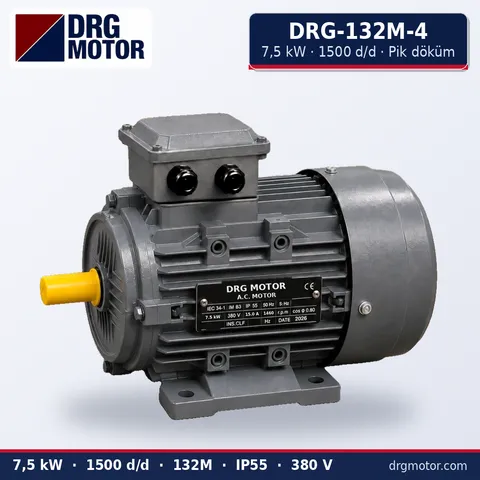
7.5 kW Three-Phase Motor 1500 rpm – DRG-132M-4 Cast Iron
- 7.5 kW · 1500 rpm (4 poles)
- Cast iron frame · IEC 132M
- Mounting: B3 · B5 · B14 · B35
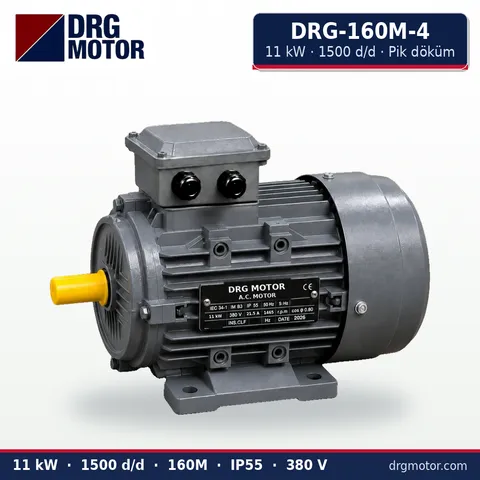
11 kW Three-Phase Motor 1500 rpm – DRG-160M-4 Cast Iron
- 11 kW · 1500 rpm (4 poles)
- Cast iron frame · IEC 160M
- Mounting: B3 · B5 · B14 · B35
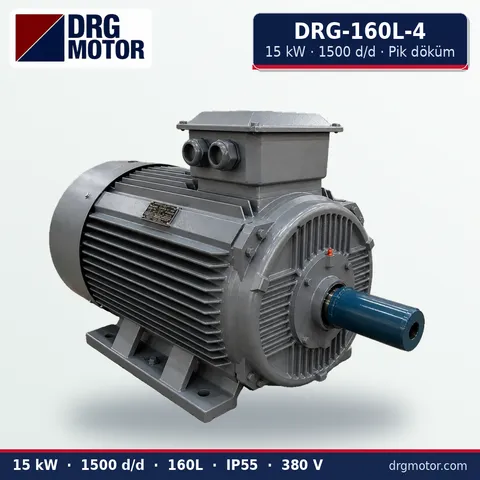
15 kW Three-Phase Motor 1500 rpm – DRG-160L-4 Cast Iron
- 15 kW · 1500 rpm (4 poles)
- Cast iron frame · IEC 160L
- Mounting: B3 · B5 · B14 · B35
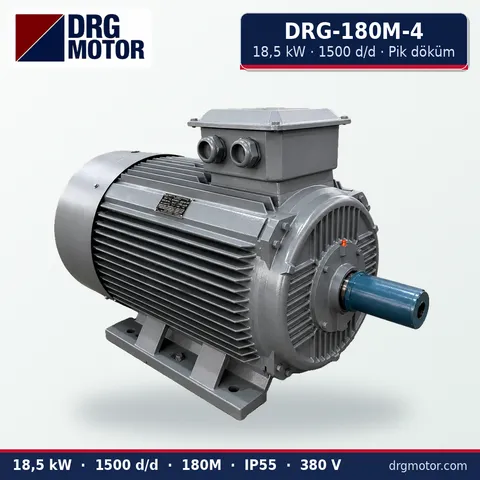
18.5 kW Three-Phase Motor 1500 rpm – DRG-180M-4 Cast Iron
- 18.5 kW · 1500 rpm (4 poles)
- Cast iron frame · IEC 180M
- Mounting: B3 · B5 · B14 · B35
Click to see current prices and order these motors nowSEE PRICES →
Blow Moulding Machine Pump Motor: Frequently Asked Questions
Is the hydraulic motor the same on PET bottle and container blow moulders?
No. This article covers extrusion blow moulding (containers, shampoo and oil bottles). PET bottles are usually made from preforms on stretch blow moulders; there part of the movements is pneumatic or electric and the load pattern is different.
Why does the pump motor on a blow moulder run all the time?
On machines with a fixed-displacement pump the motor turns throughout the cycle; during cooling the oil returns to tank through the unloading or relief valve. For the motor this is a light load, but it heats the oil.
If I add an accumulator, can I use a smaller motor?
Because the accumulator covers the peak flow, pump and motor can be sized for the average flow. This conversion requires recalculating the hydraulic circuit; it should be done by the machine builder or a hydraulics company.
How many amps does an 11 kW pump motor draw?
The DRG-160M-4 draws 20.4 A at 400 V at rated load. Current changes with load; during cooling it stays well below that.
For a quote, send a photo of the motor nameplate, its power, speed, mounting (foot, flange or vertical), shaft size and the blow moulder's pump details via WhatsApp, or add the models to the quote list. Phone: +90 (542) 666 11 11 · e-mail: info@drgmotor.com · contact. All hydraulic unit motors are on the hydraulic power unit electric motors page, and all models in the online store.