English
 Le français
 Türkçe




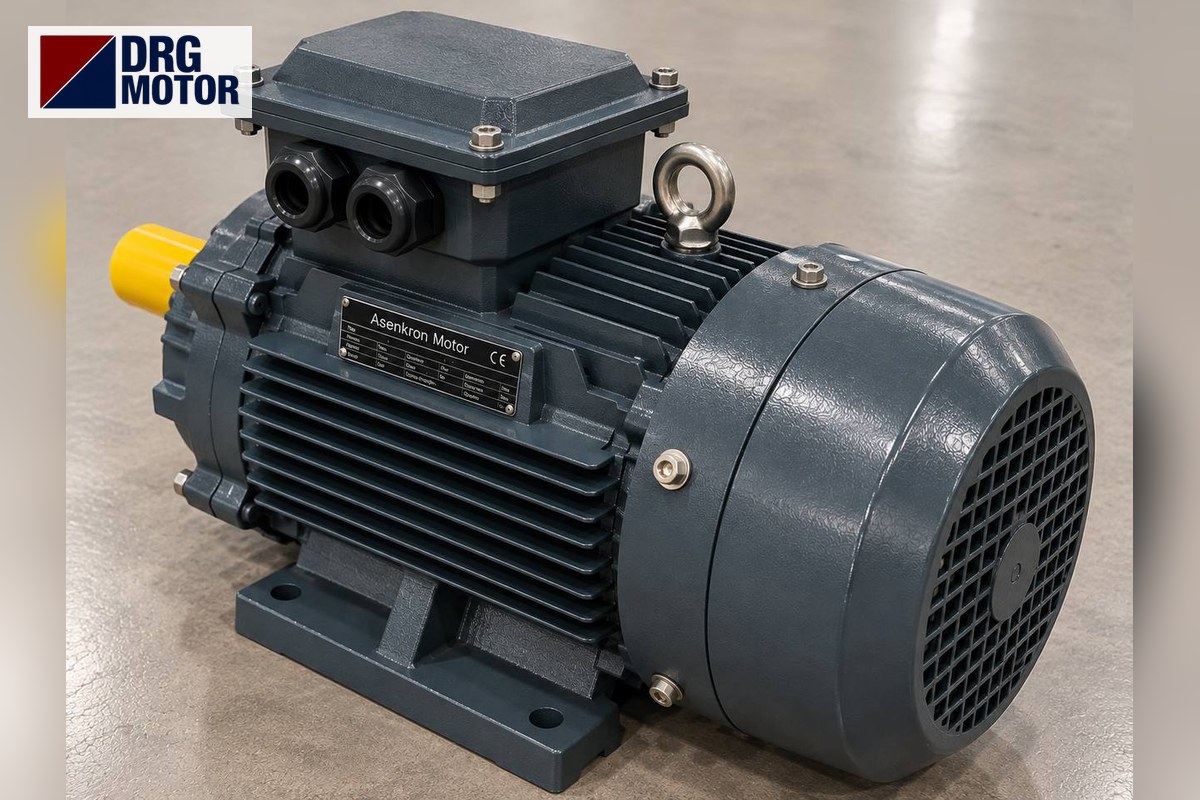

A drying oven fan motor is sized not for the power the fan draws in hot oven air, but for the power it draws when the oven is started cold. Example: a circulation fan absorbing 3.4 kW at 180 °C needs about 5.26 kW at the same speed when the oven is cold (20 °C). So either a 5.5 kW motor (DRG-132S-4) is chosen, or a 4 kW motor (DRG-112M-4, 1450 rpm, 7.95 A at 400 V) is run with a VFD at limited speed during cold start. In both cases the motor stays outside the oven and reaches the fan wheel through a long shaft.
The 3.4 kW in the example is an assumption; the real value is in the fan maker's data or on the fan nameplate, and you should always ask at which air temperature it was measured. The temperature-dependent load difference is the most common reason a fan motor trips its overload on cold mornings. Panel, overload and VFD connections must be done by a qualified electrician. You can filter suitable models by power and speed in Buy Electric Motors Online.
Why a Cold Start Strains the Motor: Air Density and Fan Power
Fan power is proportional to the density of the air it moves (at the same speed and the same duct resistance). As air heats up, its density falls in inverse proportion to absolute temperature: ρ = 1.204 × 293.15 / (273.15 + T). The power demand of a fan designed for 180 °C changes with oven temperature as follows:
| Oven air | Air density | Fan power (50 Hz) | 4 kW motor |
|---|---|---|---|
| 20 °C | 1.204 kg/m³ | 5.26 kW | overloaded |
| 60 °C | 1.059 kg/m³ | 4.62 kW | overloaded |
| 100 °C | 0.946 kg/m³ | 4.13 kW | overloaded |
| 140 °C | 0.854 kg/m³ | 3.73 kW | sufficient |
| 180 °C | 0.779 kg/m³ | 3.40 kW | sufficient |
At 20 °C the power ratio is (273.15 + 180) / (273.15 + 20) ≈ 1.55; 3.4 × 1.55 ≈ 5.26 kW. On the shaft this means ≈ 22.4 Nm hot and ≈ 34.6 Nm cold; the rated torque of the 4 kW motor is 26.3 Nm. Until the oven air reaches about 110 °C, the 4 kW motor is loaded above rating. For the general framework of motor selection and derating in hot surroundings, see our article on motor derating at high altitude and in hot environments.
Fan Laws: A Small Change in Speed, a Big Change in Power
For the same fan and the same air, flow changes with speed, pressure with the square of speed and power with the cube of speed: P2 = P1 × (n2 / n1)³. That is why handling the extra cold-air load by lowering speed with a VFD works well. Power demand of the same fan in 20 °C air by frequency:
| Frequency | Motor speed | Fan power (20 °C air) | Status |
|---|---|---|---|
| 50 Hz | ≈ 1450 rpm | 5.26 kW | above 4 kW |
| 47 Hz | ≈ 1363 rpm | 4.37 kW | above 4 kW |
| 45 Hz | ≈ 1305 rpm | 3.83 kW | below 4 kW |
| 40 Hz | ≈ 1160 rpm | 2.69 kW | below 4 kW |
The frequency needed to come down to the 4 kW limit is 50 × (4 / 5.26)^(1/3) ≈ 45.7 Hz. In practice two settings go into the drive: an upper frequency limit around 45 Hz while oven temperature is below a set value, and 50 Hz once it has warmed up. Since fan load is variable torque, the drive can be set to "fan/pump" (variable torque) mode; because fan load also falls quickly at low speed, the motor's own fan is usually sufficient for cooling in this application. For detailed calculations use the pump and fan motor power calculator and the VFD frequency-torque-power calculator.
Motor Outside the Oven: Long Shaft, Cooling Disc and Bearings
The circulation fan wheel is inside the oven and its motor outside. The shaft passes through the oven wall and heat travels along it toward the motor. Solutions used to protect the motor:
- Separately supported fan shaft: the fan wheel turns on a long shaft carried by its own bearing housing; the motor drives this shaft through a coupling or belt. Oven heat and wheel weight do not load the motor bearing.
- Cooling disc (heat slinger): a finned disc mounted on the shaft between oven wall and bearing/motor throws shaft heat into the air as it turns.
- Air gap between wall and motor: the motor flange should not sit directly on the hot wall; use an insulated spacer or bracket.
- Motor cooling air: if the motor fan draws hot air from around the oven, the motor heats from inside; provide a clean outside air inlet to the motor compartment.
In small ovens where the wheel is mounted directly on the motor shaft, wheel weight and heat from the shaft end go straight to the motor's drive-end bearing. In this design, motor shaft size and wheel hub size must match exactly. Mounting-relevant data of the 4 kW 4-pole DRG-112M-4:
- Power: 4 kW (5.5 HP)
- Rated speed: 1450 rpm
- Current 380 V / 400 V: 8.37 A / 7.95 A
- Rated torque: 26.3 Nm
- Voltage: 400/690 V (Δ/Y)
- IEC frame: 112M
- Shaft D×E: 28 × 60 mm
- Overall length L: 394 mm
- Bearing: 6206-ZZ-C3
Ambient Temperature and Class F Insulation
The winding of DRG motors is specified in the catalogue with class F insulation. Class F indicates the highest temperature class the winding can withstand, while the motor's rated values are given for standard ambient temperature. If the ambient in the motor compartment next to the oven rises above that, the motor runs hotter at the same load and has to be derated. Practical rule: measure the temperature in the motor compartment with a thermometer; if it is high, fix ventilation first, then choose the next power rating if needed. The relation between insulation class and temperature rise is explained in our article on motor temperature rise and insulation class.
4-Pole or 2-Pole? Wheel Tip Speed
Circulation fans mostly use 4-pole motors. The reason is wheel tip speed: v = π · D · n / 60. A 560 mm wheel (assumption) runs at about 42.5 m/s with a 4-pole motor (1450 rpm) and about 85.2 m/s with a 2-pole motor (2905 rpm). When tip speed doubles, power approaches eight times as much under the fan laws and the wheel's strength limit may be exceeded; the maximum allowed speed is the wheel maker's data. On large, slow fans a 6-pole motor (e.g. DRG-132M1-6, 968 rpm) may be preferred.
Checklist: Replacing a Drying Oven Fan Motor
- Find out at which air temperature the power on the fan plate is stated; calculate cold-start load with the ratio above.
- Do not order a new motor before noting the old motor's power, speed, frame, shaft D × E and mounting arrangement (B3, B5, B35).
- If the wheel is mounted on the motor shaft, check the wheel hub against shaft diameter and key width (F = 8 mm on frame 112M).
- Confirm the cooling disc is in place and intact and that the motor does not touch the hot wall.
- Check the clean air inlet to the motor compartment; the motor fan must not draw hot air.
- Set the overload relay to the motor nameplate current (DRG-112M-4: 7.95 A at 400 V, 8.37 A at 380 V); the overload, fuse and contactor selection tool helps.
- If there is a VFD, enter the upper frequency limit for a cold oven and the ramp times.
- Compare rotation with the arrow on the wheel; a centrifugal fan running backwards still moves air, but flow and pressure drop and drying takes longer.
- Make the first start with the oven cold and measure current; if it is above nameplate, limit speed or close the damper.
Motors in This Power Range: DRG Models for Drying Oven Fans
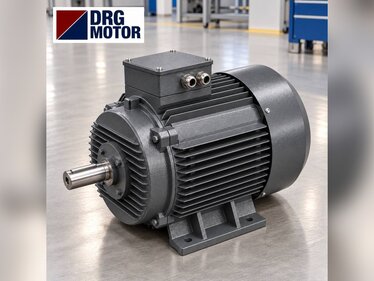
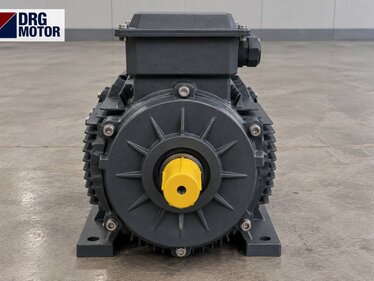
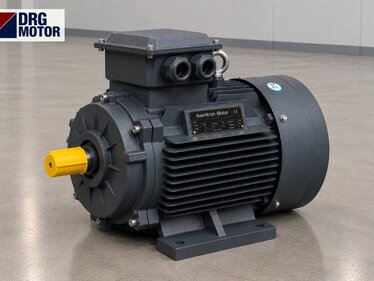
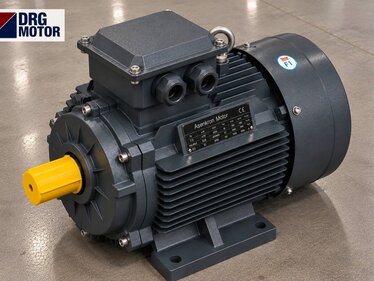
DRG Motor is a manufacturer, supplier and seller of electric motors. The models below cover the power range common on circulation fans; the table shows cast iron versions, and aluminium-frame options up to 11 kW are also in the store.
| Model | Power / speed | Frame | Current 400 V |
|---|---|---|---|
| DRG-90L-4 | 1.5 kW / 1445 rpm | IEC 90L cast iron | 3.3 A |
| DRG-100L1-4 | 2.2 kW / 1450 rpm | IEC 100L cast iron | 4.52 A |
| DRG-100L2-4 | 3 kW / 1450 rpm | IEC 100L cast iron | 6.02 A |
| DRG-112M-4 | 4 kW / 1450 rpm | IEC 112M cast iron | 7.95 A |
| DRG-132S-4 | 5.5 kW / 1460 rpm | IEC 132S cast iron | 10.7 A |
| DRG-132M-4 | 7.5 kW / 1460 rpm | IEC 132M cast iron | 14.3 A |
| DRG-112M-2 | 4 kW / 2905 rpm | IEC 112M cast iron | 7.45 A |
| DRG-132M1-6 | 4 kW / 968 rpm | IEC 132M cast iron | 8.99 A |
| DRG-132M2-6 | 5.5 kW / 968 rpm | IEC 132M cast iron | 12 A |
- DRG-100L2-4 – 3 kW – 1500 rpm – IEC 100L cast iron
- DRG-112M-4 – 4 kW – 1500 rpm – IEC 112M cast iron
- DRG-132S-4 – 5.5 kW – 1500 rpm – IEC 132S cast iron
- DRG-132M-4 – 7.5 kW – 1500 rpm – IEC 132M cast iron
- DRG-132M1-6 – 4 kW – 1000 rpm – IEC 132M cast iron
- DRG-112M-2 – 4 kW – 3000 rpm – IEC 112M cast iron
Click to see current prices and order these motors nowSEE PRICES →
Frequently Asked Questions
What size motor does a drying oven fan need?
You need the fan's hot-air power × the cold/hot density ratio. For a fan absorbing 3.4 kW at 180 °C, cold power is ≈ 5.26 kW: either a 5.5 kW motor or a 4 kW motor with a VFD.
Why does the oven fan motor trip when the oven is cold?
Cold air is denser and the fan draws more power at the same speed. At 20 °C power is about 1.55 times the value at 180 °C; the motor is loaded above rating during that time.
Is a VFD necessary on an oven fan?
Not mandatory, but it is the easiest way to handle cold-start load. Since fan power falls with the cube of speed, about 45.7 Hz instead of 50 Hz is enough to come down to the 4 kW limit.
How many amps does a 4 kW fan motor draw?
The 4-pole DRG-112M-4 draws 7.95 A at 400 V and 8.37 A at 380 V at full load. For other ratings see the motor current chart.
Send us the power, speed and shaft size from your machine's nameplate and we will help you pick the matching DRG model: phone +90 (542) 666 11 11, e-mail [email protected], contact page drgmotor.com/en/contact. To browse the models directly, go to Buy Electric Motors Online.