English
 Le français
 Türkçe




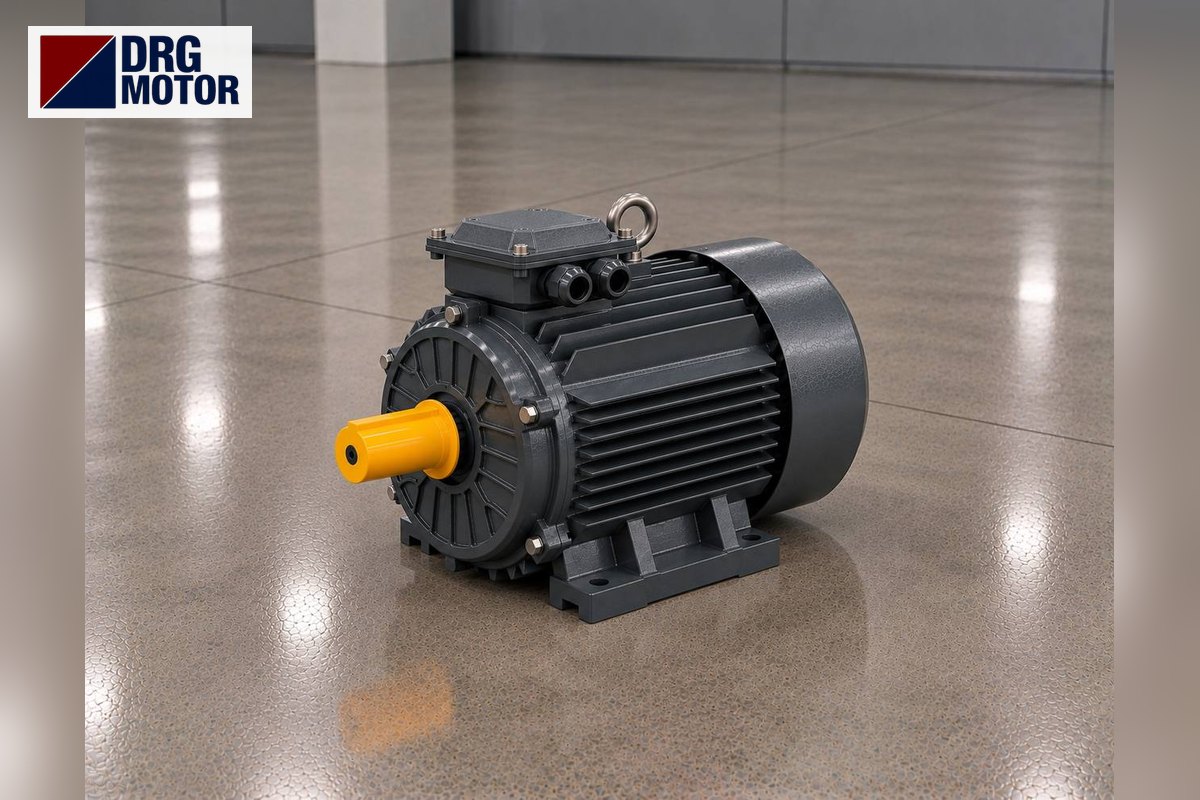

A fibre transport fan is the radial fan that carries fibre through a duct by air between opening and blending machines; its motor is usually 2-pole and turns the impeller directly or by belt. In these fans the fibre either passes through the impeller or is separated from the air in a condenser ahead of it. Three things decide the motor: the airflow and pressure the line needs, the imbalance fibre causes on the impeller, and the lint-laden environment the motor works in.
You can compare suitable 2-pole three-phase motors by power and frame in our online motor store. The general features of fans that pass material through the impeller are covered separately on our straight radial blade fan page.
Does Fibre Pass Through the Fan or in Front of It?
Two layouts are common in spinning and fibre plants. In the first, fibre passes through an open impeller with straight or slightly inclined blades, called a material fan; the fan both sucks and pushes. These impellers are robust, but fibre can wrap on the blades and upset the balance.
In the second, the fan runs on clean air: fibre is separated from the air on a condenser drum or a filter screen, and the fan only draws filtered air. This layout can use quieter backward-curved impellers; the load on the motor is smoother, but the fan's operating point shifts as the filter clogs.
Establish which layout you have before removing the motor. With a material fan, vibration and bearing life are the main issues; with a clean-air fan, filter resistance and airflow. For filtered extraction systems you can also look at our dust collection and filter fan page.
From Airflow and Pressure to Motor Power
Fan shaft power follows P = Q · Δp / η, with Q in m³/s, Δp in Pa and the result in W. In fibre conveying, air speed is kept high enough that the fibre does not settle and choke in the duct, so the pressure loss is larger than in clean-air ducts.
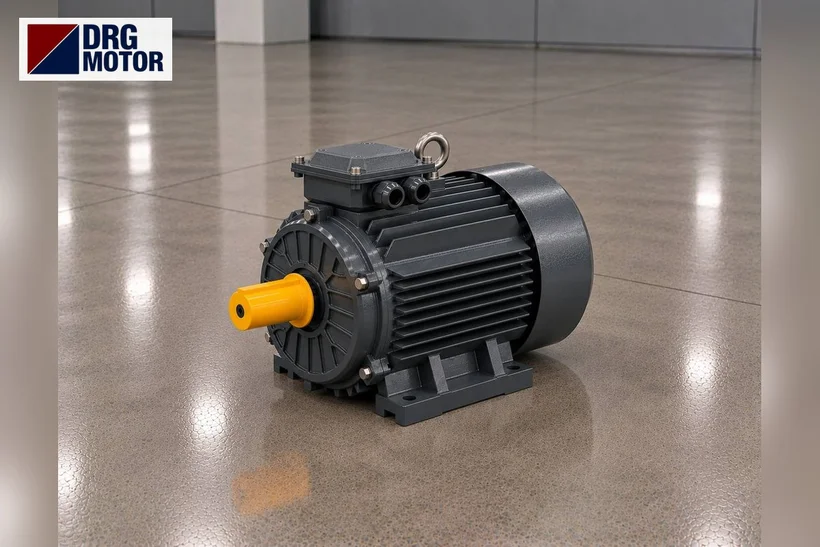
Example (assumption): for 1.2 m³/s airflow, 3000 Pa total pressure and a fan efficiency of 0.6, shaft power is 6.0 kW. Air speed in a 280 mm duct is 19.5 m/s. Leaving a margin for fibre load and filter clogging, the next standard rating of 7.5 kW is chosen; at this rating the DRG-132S2-2 runs at 2930 rpm and draws 13.7 A at 400 V. The exact value is the fan builder's curve; for a rough estimate use our pump and fan motor power calculator.
Airflow, pressure and power change with speed at different rates. The table below compares three operating cases of the same fan; the values come from the example above and the fan affinity laws.
| Case | Duct air speed | Shaft power | Result |
|---|---|---|---|
| 2-pole, 50 Hz | 19.5 m/s | 6.0 kW | Design point |
| Inverter at 45 Hz | 17.5 m/s | 4.37 kW | Settling risk with heavy fibre |
| 4-pole motor | 9.7 m/s | 0.74 kW | Duct chokes |
The last row shows a frequent mistake: someone with a 4-pole motor on hand fits it to the fan, the motor runs easily, but air speed halves and fibre stays in the duct. On a transport fan the pole number must match the old motor.
Click to see current electric motor prices and order nowSEE PRICES →
Impeller Imbalance and Bearings
Fibre sticking to the blades of a material fan is never evenly spread. A few hundred grams of lint on one blade put a large rotating force on the bearings at 2930 rpm. This force wears the motor bearing first and the shaft next.
On direct-drive fans the impeller is often mounted on the end of the motor shaft, so its weight and imbalance bear directly on the motor's drive-end bearing. The DRG-132S2-2 has a 6208-ZZ-C3 drive-end bearing, the DRG-160M2-2 a 6309-C3. If bearing noise rises and vibration is felt on the frame, clean the impeller and have its balance checked first; a new motor wears just as fast with a dirty impeller.
On belt-driven fans the impeller runs in its own bearings and the motor bearing carries only belt tension. Avoid over-tensioning the belt in this layout, and fit the motor pulley as close to the shaft shoulder as possible.
Start-Up: Fan Damper and Current
2-pole motors draw high current at start; the catalogue ratio for the DRG-132S2-2 is Is/In = 7.9. If the fan inertia is large and the duct is open at start, the motor draws this current for a long time. DRG motors from 4 kW upwards are wound for 400/690 V and are suitable for star-delta starting.
Radial fan power rises with airflow. Keeping the suction damper closed at start lowers airflow and power, so the motor comes up to speed sooner. Measure the current when the damper opens: if it is above the nameplate current, either the pressure loss is lower than calculated and the fan is moving too much air, or fibre has built up on the blades.
With an inverter, fan speed can be set to suit the fibre type. As the table shows, though, air speed must not drop below the limit at which fibre settles; that limit is set by the plant builder.
Lint, Cotton and the Explosive Atmosphere Question
The motor of a fibre transport fan often sits right next to the fan casing, in an area where lint floats in the air. If its fins and fan cowl clog, the motor heats up; regular cleaning matters as much as the motor itself. IP55 protection keeps lint out of the motor.
Dust from cotton and some synthetic fibres is combustible. If the site risk assessment classifies the zone where the fan or motor stands as an explosive dust atmosphere, a standard IEC motor is not used; an Ex-protected special motor is needed and such motors are not in the DRG range. In unclassified areas, with the motor outside the fibre stream and kept clean, an IP55 three-phase motor is used.
What usually carries a spark or hot-surface risk from the fan casing to the motor is the impeller rubbing the casing. Shaft growth, a loose hub or a damaged bearing causes this rubbing, and it belongs in the maintenance plan.
Dimensions to Check for a Spare Motor
On direct-drive fans the motor is usually foot-mounted (B3) or flanged to the fan casing (B5, B35). As the impeller hub is machined to the shaft, shaft diameter and length must match exactly. Catalogue values of the DRG-132S2-2 as an example:
- Power: 7.5 kW, 2930 rpm, rated torque 24.4 Nm
- Current and cos φ: 13.7 A at 400 V, 0.88
- Frame: IEC 132S aluminium, H = 132 mm
- Shaft: D = 38 mm, E = 80 mm, key 10 mm
- B5 flange: M = 265 mm, N = 230 mm, P = 300 mm
- Drive-end bearing: 6208-ZZ-C3
Before ordering, check:
- The fan layout: does fibre pass through the impeller, or does the fan run on clean air after a condenser or filter?
- Motor nameplate: kW, rpm (pole number), voltage, connection; the shaft diameter and length the impeller hub sits on.
- Mounting: foot, flange, or foot plus flange; for flanges, the M, N and P dimensions.
- If belt-driven, both pulley diameters and the belt section.
- Starting: direct, star-delta or inverter; is the damper closed at start?
- How the site risk assessment classifies the area where the motor stands.
DRG Motors Suited to Fibre Transport Fans
2-pole models from 5.5 to 15 kW in aluminium and cast iron frames. Pole number and shaft size must match the removed motor.
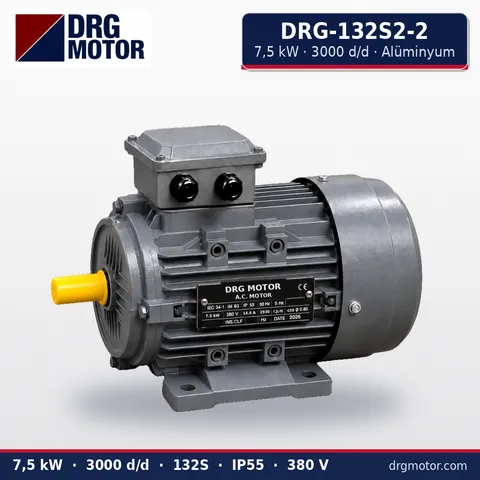
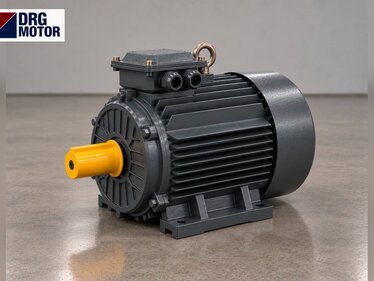
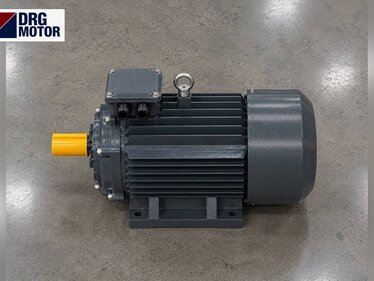
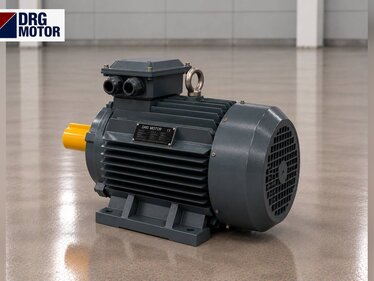
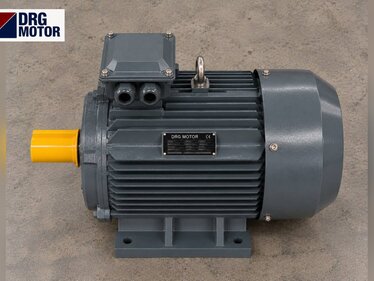
7.5 kW Three-Phase Motor 3000 rpm – DRG-132S2-2 Aluminium
- 7.5 kW · 3000 rpm (2 poles)
- Aluminium frame · IEC 132S
- Mounting: B3 · B5 · B14 · B35
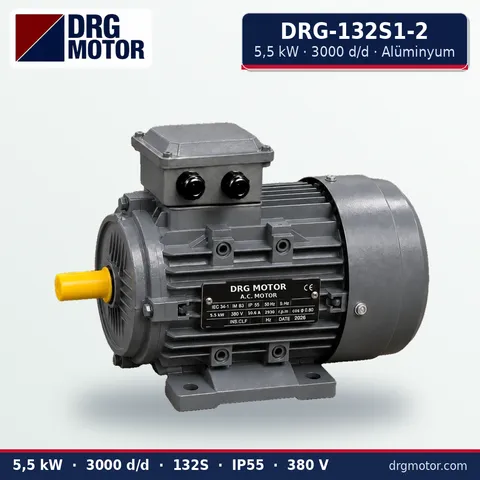
5.5 kW Three-Phase Motor 3000 rpm – DRG-132S1-2 Aluminium
- 5.5 kW · 3000 rpm (2 poles)
- Aluminium frame · IEC 132S
- Mounting: B3 · B5 · B14 · B35
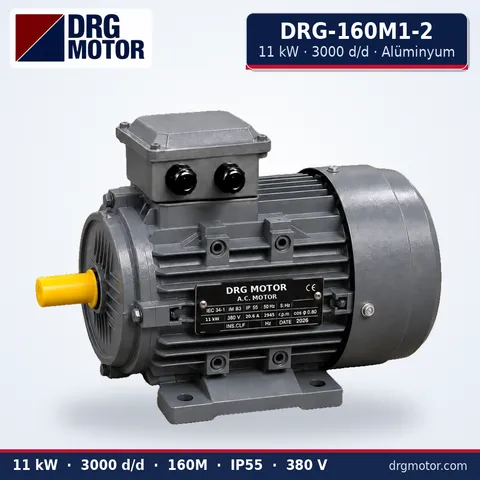
11 kW Three-Phase Motor 3000 rpm – DRG-160M1-2 Aluminium
- 11 kW · 3000 rpm (2 poles)
- Aluminium frame · IEC 160M
- Mounting: B3 · B5 · B14 · B35
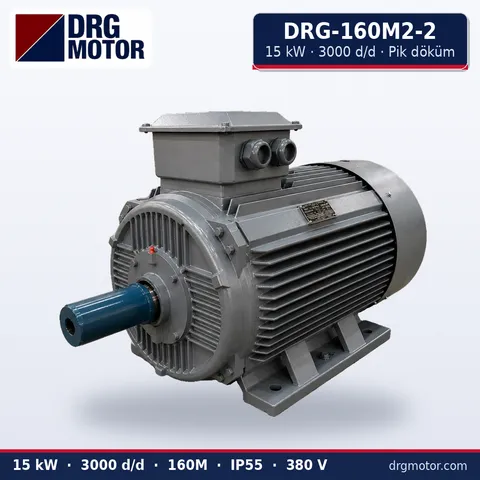
15 kW Three-Phase Motor 3000 rpm – DRG-160M2-2 Cast Iron
- 15 kW · 3000 rpm (2 poles)
- Cast iron frame · IEC 160M
- Mounting: B3 · B5 · B14 · B35
Click to see current prices and order these motors nowSEE PRICES →
Fibre Transport Fan Motor: Frequently Asked Questions
Why is a fibre transport fan motor 2-pole?
Fibre needs high air speed so that it does not settle in the duct, which means high pressure from a compact impeller. A 2-pole motor (about 2900 rpm) delivers this without enlarging the impeller. Larger belt-driven fans can also use 4-pole motors; what decides is the impeller speed set by the fan builder.
Why does the fan motor current drop over time?
On a radial fan, falling current usually means falling airflow: the filter or condenser is clogged, fibre has built up in the duct, or the damper is throttled. The motor is relieved but conveying weakens. Measuring and logging current regularly reveals clogging early.
The fibre fan motor vibrates; is the motor faulty?
Check the impeller first. Lint stuck to the blades creates imbalance and the vibration is felt at the motor. If vibration remains after the impeller is cleaned and balanced, look at the bearings and the motor foot fixing.
Can a standard motor be used in a cotton plant?
In areas the site risk assessment does not classify as an explosive dust atmosphere, an IP55 standard three-phase motor is used. Classified areas need an Ex-protected special motor, which DRG does not supply.
DRG Motor is a manufacturer, supplier and seller of electric motors. So that we can quote the right motor for your fibre transport fan, a photo of the motor nameplate, its power and speed, foot or flange mounting, shaft size and whether fibre passes through the impeller are enough. Write to us on WhatsApp or send the models through the quote list. Phone: +90 (542) 666 11 11; e-mail: info@drgmotor.com; other details are on our contact page. Current motor prices are shown in our online motor store.