 English
 Le français
 Türkçe

It may be mechanically possible, but the pump will no longer do the job it was designed for. When speed is halved, flow drops to about half, head to a quarter and the power demand to an eighth. This only makes sense if the system genuinely needs much lower pressure and flow and the pump manufacturer accepts this speed.
How does performance change?
A pump delivering 40 metres of head produces only around 10 metres at 1450 rpm. In an installation that has to send water to the upper floors of a building, a distant field or an elevated tank, this pressure is usually not enough and the pump may deliver no water at all. Some self-priming pumps cannot maintain suction at low speed. These values are approximate; the real result can only be seen by redrawing the pump curve for the lower speed and comparing it with the system curve.
Dimensions do not always match
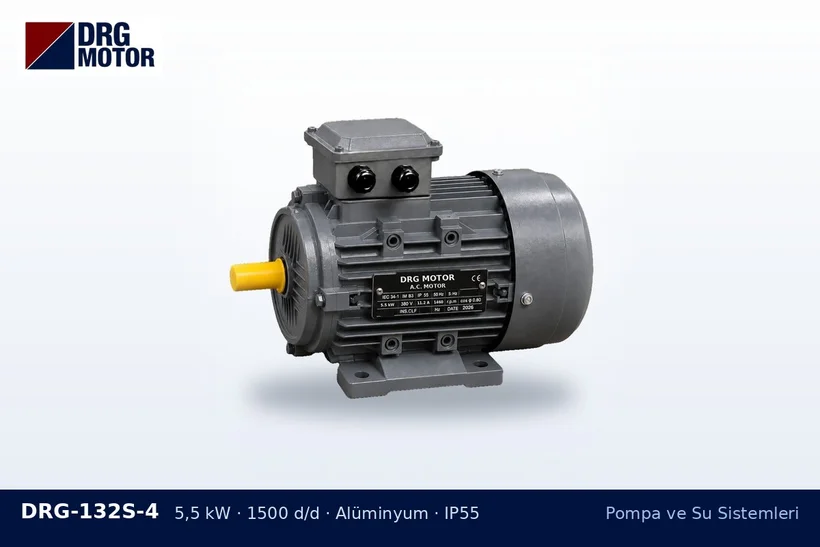
At the same power, 2-pole and 4-pole motors differ in frame size, shaft diameter and overall length at some ratings. Examples from the DRG list:
| Power | 3000 rpm model | 1500 rpm model | Difference |
|---|---|---|---|
| 7.5 kW | 132S, shaft 38×80, L 438 | 132M, shaft 38×80, L 476 | Longer frame |
| 45 kW | 225M, shaft 55×110 | 225M, shaft 60×140 | Different shaft diameter and length |
In addition, since a pump running at half speed needs much less power, a smaller motor is usually sufficient; this too can mean a different frame size.
When can it be considered?
- If the plant has been scaled down and the pressure requirement has also dropped to around a quarter
- If the pump manufacturer can supply the low-speed curve
- If the coupling, baseplate and flange can be adapted to the new motor
If the requirement is different, a pump designed for the appropriate speed or speed control is the better solution.
Motor selection for horizontal end-suction pumps is described on the end-suction pump motor page. Based on the newly calculated power, you can compare 1500 rpm models in the shop.