 English
 Le français
 Türkçe

On a dryer, the fan and the drum have opposite load characteristics: the fan is light at start and its load rises steeply with speed during running, while the drum is heavy at start and a relatively steady load while running. The two motors should therefore be selected separately, each with its own data; the power of one is not a reference for the other.
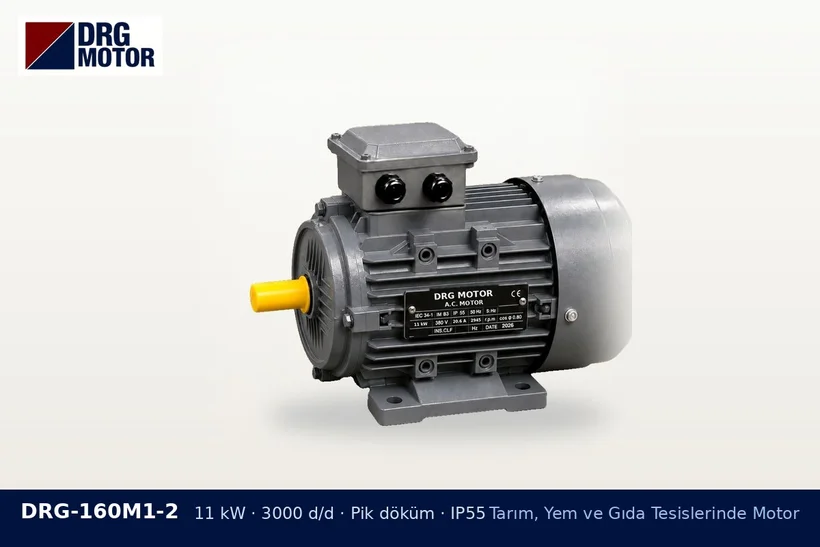
Fan motor
The power drawn by a fan rises roughly with the cube of speed; if speed goes up by ten per cent, power rises by roughly one third. This relationship is approximate and depends on impeller type and the system curve. When selecting a fan motor, airflow, static pressure, fan efficiency and the density of the hot air are decisive. Because hot air is lighter, the fan can draw more power when run with cold air; this should be kept in mind during commissioning and trial runs. The fan motor’s proximity to the heat source should also be checked.
Drum motor
In a rotary drum dryer, the motor turns the heavy drum full of product through a gearbox and a girth gear or chain. At start it has to lift an unbalanced load; during running, speed is low and the load fairly even. If the drum stops full during a power cut, hot product piles up on one side, and restarting is the hardest moment for the motor. This is why some plants never stop the drum without emptying it.
Comparison
| Criterion | Fan | Drum |
|---|---|---|
| Starting load | Low, rises with speed | High, full start |
| What sets the power | Airflow, pressure, speed | Drum weight, fill ratio |
| Typical connection | Belt or direct | Through a gearbox |
| Effect of a speed change | Power changes considerably | Drying time changes |
You can estimate fan power with the pump and fan motor power calculator. Explanations specific to farm dryers are on the grain dryer motor page; the power ratings determined separately for the two motors can be matched in the three-phase motor shop.