English
 Le français
 Türkçe




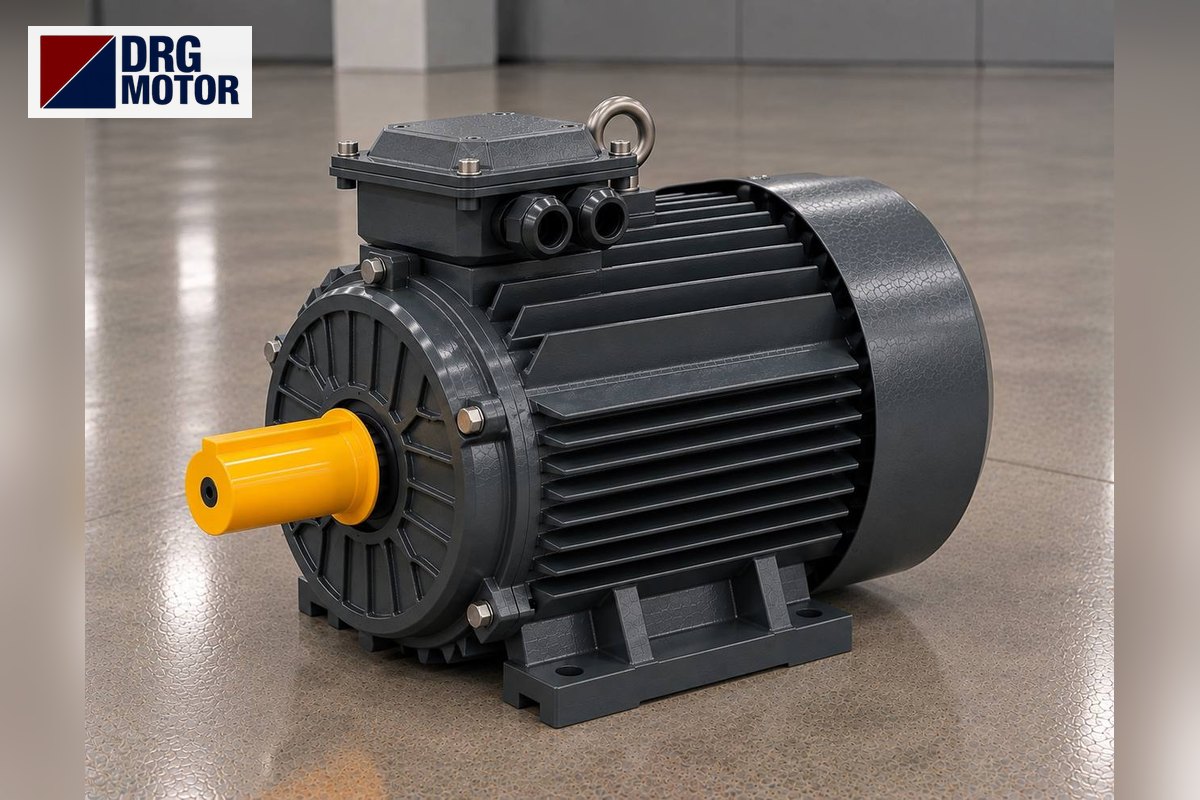

On a yarn twisting machine, the main drive motor turns hundreds of spindles at once by driving a tangential belt or a drum shaft from a pulley at one end of the machine. The motor is not sized by the yarn count; it is sized by the number of spindles, the target spindle speed and the losses of the belt system. When replacing it, keep the old motor's number of poles and pulley diameter and take the power from the nameplate. The 4-pole three-phase motors used for this job are listed by power and housing in our online electric motor shop.
Below we explain what the motor does on two-for-one (TFO) and ring twisting machines, the link between speed and twist, speed adjustment with an inverter and the effect of lint on the motor.
Two-for-One vs Ring Twisting: How the Spindle Turns
On a two-for-one twister, two plies are drawn from a stationary package, pass through the rotating spindle and leave it forming a balloon around the spindle. Each spindle revolution inserts two turns of twist. For the same delivery speed, the spindle therefore turns at half the speed of a ring machine.
On a ring twister, the yarn passes through a traveller running on a ring and is wound onto the rotating bobbin. Each spindle revolution gives one turn of twist. The spindles are usually driven from a long drum or tape.
Both types share one feature: a single main motor drives a belt line running along the machine. The take-up rolls and the traverse are driven through a gearbox from the main motor on some machines and by separate small motors on others.
Twist Level, Spindle Speed and Delivery Speed
On a two-for-one twister, delivery speed equals twice the spindle speed divided by the twist per metre: v = 2·n / T. The higher the twist, the less yarn leaves at the same spindle speed. Operators therefore like to raise spindle speed for high-twist lots, and that request goes straight onto the main motor's load.
| Spindle speed (rpm) | Twist (turns/m) | Delivery speed (m/min) |
|---|---|---|
| 8000 | 500 | 32.0 |
| 10000 | 500 | 40.0 |
| 10000 | 800 | 25.0 |
| 12000 | 800 | 30.0 |
The values in the table come from the formula; they are not machine capacities. The real spindle speed limit is set by the spindle, balloon control and yarn breakage; the motor has to carry the set speed through the belt.
Click to see current electric motor prices and order nowSEE PRICES →
Nature of the Load on the Main Drive
The twister motor does not cut or crush a heavy material. Its load is the friction in the spindle bearings, the belt pressing on every spindle whorl and the air drag of the spinning yarn balloon. The sum of these losses grows markedly with spindle speed; a small speed increase can raise power by more than the same proportion.
Start-up brings another problem: hundreds of spindles, a long belt and drums add up to considerable inertia. With direct-on-line starting the belt may slip and yarns may break. On most machines the main motor is therefore started by an inverter with a long ramp.
The machine runs in long uninterrupted cycles; the only stops in a shift are doffing and break repair. The motor thus turns for hours at a steady load close to its rated current. The nameplate power was chosen for this duty; keep the same rating.
About the power range
Main motor power depends on spindle count and speed. Short machines have main motors of a few kW, long multi-spindle machines 15–20 kW and above. The exact value is on the machine builder's nameplate or catalogue; do not downsize by guesswork.
Pulley Ratio and Running Above 50 Hz
The diameter ratio between the motor pulley and the spindle whorl converts motor speed into spindle speed. Example / assumption: if a spindle with a 40 mm whorl is to run at 10000 rpm, belt speed is about 20.9 m/s. For a motor running at 1465 rpm this needs a drive pulley of about 273 mm. You can check the ratio with our pulley and belt calculator.
Raising the inverter above 50 Hz to gain speed is a common habit. At 55 Hz the same pulley lifts spindle speed from 10000 to 11000 rpm. Above 50 Hz, however, the motor enters its constant power range: the torque it can deliver falls in inverse proportion to frequency while the torque demanded by the spindles rises. If current exceeds the nameplate value, the problem is the speed, not the motor.
Changing the number of poles also upsets the pulley ratio. Fitting a 2-pole motor instead of a 4-pole one roughly doubles spindle speed; a 6-pole motor slows the machine down and the target speed cannot be reached without a new pulley.
Lint, Humidified Rooms and Cooling
The air in a twisting room carries fibre fly (lint). The IP55 housing protects the inside of the motor, but lint sticks to the fan cowl grille and between the housing fins, cutting off the cooling air. The motor then runs hotter at the same load and the winding insulation ages.
Clean the fan cowl and fins periodically with compressed air or a brush. The room is usually humidified; the motor is designed for −15…+40 °C ambient and altitudes up to 1000 m. If the room exceeds 40 °C when air conditioning fails, consider the next power step.
Symptoms of the Wrong Motor on a Twister
- The belt squeals or slips at start-up: ramp too short or motor torque insufficient.
- The overload trips as the machine speeds up: power too small or inverter set above 50 Hz.
- Twist values drift from lot to lot: motor speed or pulley ratio differs from the old one.
- The housing is too hot to touch: fan cowl clogged with lint.
Checklist before replacement
- Old nameplate: kW, rpm, voltage and connection (star or delta at 400 V).
- Mounting: foot (B3) or flange; foot hole spacing A and B.
- Shaft diameter and length, key width; pulley bore.
- Belt tensioning: is the motor on slide rails or a pivoting base?
- Is there an inverter, and what is the highest operating frequency?
- Do separate motors drive the traverse and take-up roll, and are they servo/stepper motors?
The last point matters: servo or stepper motors on the traverse or take-up side cannot be replaced by a standard IEC induction motor. DRG Motor is a manufacturer, supplier and seller of electric motors; our range consists of three-phase asynchronous IEC motors and covers the main drive and auxiliary drives such as fans and suction on a twister. All motors of this type are also grouped on our general purpose electric motors page.
DRG Motors Suited to the Main Drive of a Yarn Twisting Machine
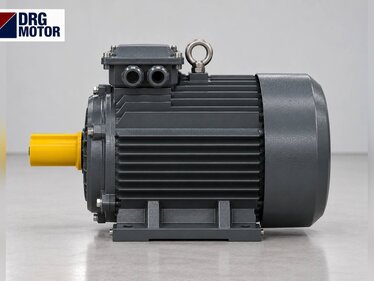
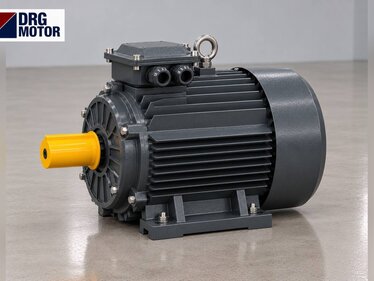
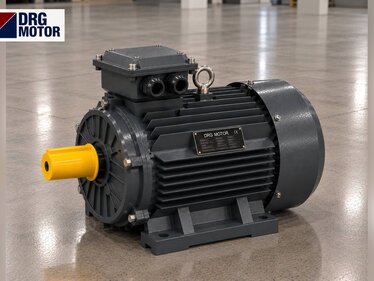
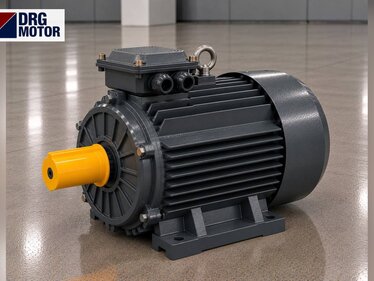
All four models are 4-pole, so they replace older 1500 rpm class motors without changing the pulley ratio. Cast iron housings at 15 and 18.5 kW are recommended for the heavy belt load of long machines.
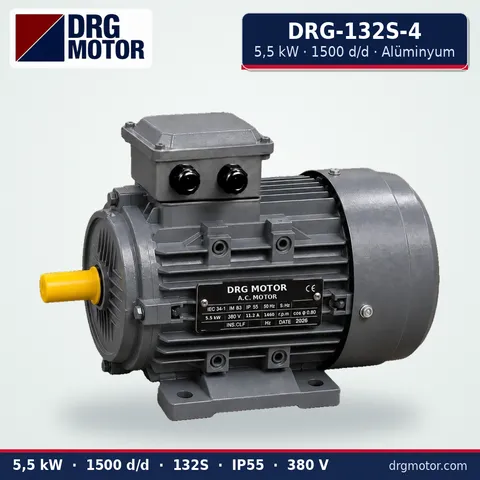
5.5 kW Three-Phase Motor 1500 rpm – DRG-132S-4 Aluminium
- 5.5 kW · 1500 rpm (4 poles)
- Aluminium frame · IEC 132S
- Mounting: B3 · B5 · B14 · B35
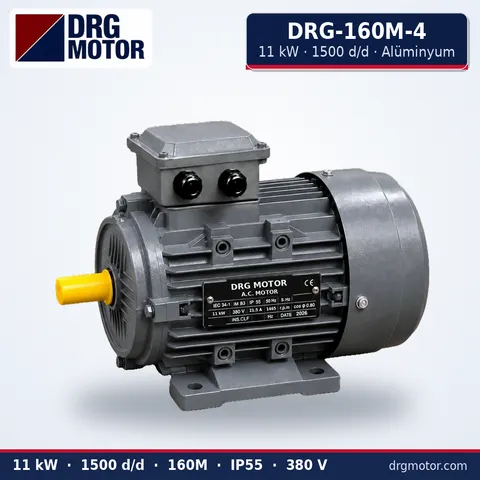
11 kW Three-Phase Motor 1500 rpm – DRG-160M-4 Aluminium
- 11 kW · 1500 rpm (4 poles)
- Aluminium frame · IEC 160M
- Mounting: B3 · B5 · B14 · B35
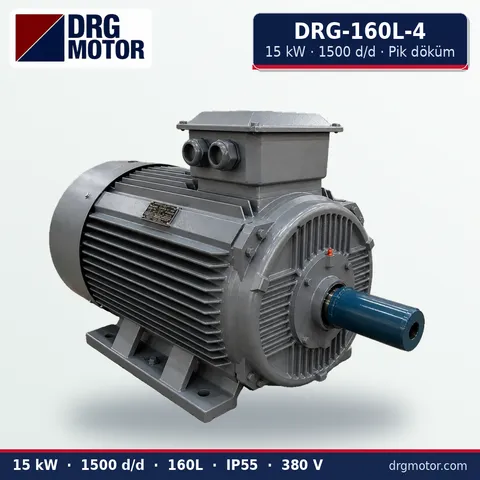
15 kW Three-Phase Motor 1500 rpm – DRG-160L-4 Cast Iron
- 15 kW · 1500 rpm (4 poles)
- Cast iron frame · IEC 160L
- Mounting: B3 · B5 · B14 · B35
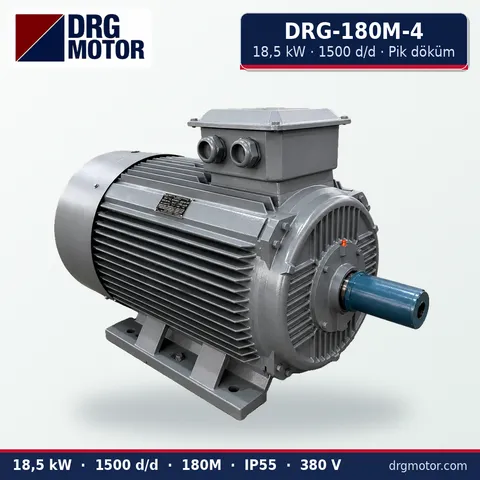
18.5 kW Three-Phase Motor 1500 rpm – DRG-180M-4 Cast Iron
- 18.5 kW · 1500 rpm (4 poles)
- Cast iron frame · IEC 180M
- Mounting: B3 · B5 · B14 · B35
Click to see current prices and order these motors nowSEE PRICES →
Twister Motor: Frequently Asked Questions
How does motor speed set spindle speed on a two-for-one twister?
Spindle speed is motor speed multiplied by the motor pulley / spindle whorl diameter ratio (minus slip). As long as the number of poles and the pulley stay the same, spindle speed changes only with inverter frequency.
Why does the twister main motor overheat quickly?
There are two common causes: a fan cowl clogged with lint and an operating frequency set above 50 Hz. Clean first, then compare the current with the nameplate value.
Does running a twister inverter at 55–60 Hz harm the motor?
The motor withstands these speeds mechanically, but above 50 Hz the torque it can deliver drops. Because spindle torque rises with speed, current goes up. If current stays below the nameplate value, there is no objection.
Do ring twisters and two-for-one twisters use the same motor?
Both mostly use a 4-pole three-phase main motor. The difference lies in spindle speed and drive arrangement; power and pulley are chosen from each machine's own nameplate.
To replace the motor, send us a photo of the old motor's label, its power and speed, whether it is foot or flange mounted, the shaft diameter, the machine's spindle count and the highest frequency you use via WhatsApp, or submit your chosen models through the quote list. Phone: +90 (542) 666 11 11 · e-mail: info@drgmotor.com · full contact details on our contact page. Browse the online shop for other 4-pole ratings.