English
 Le français
 Türkçe




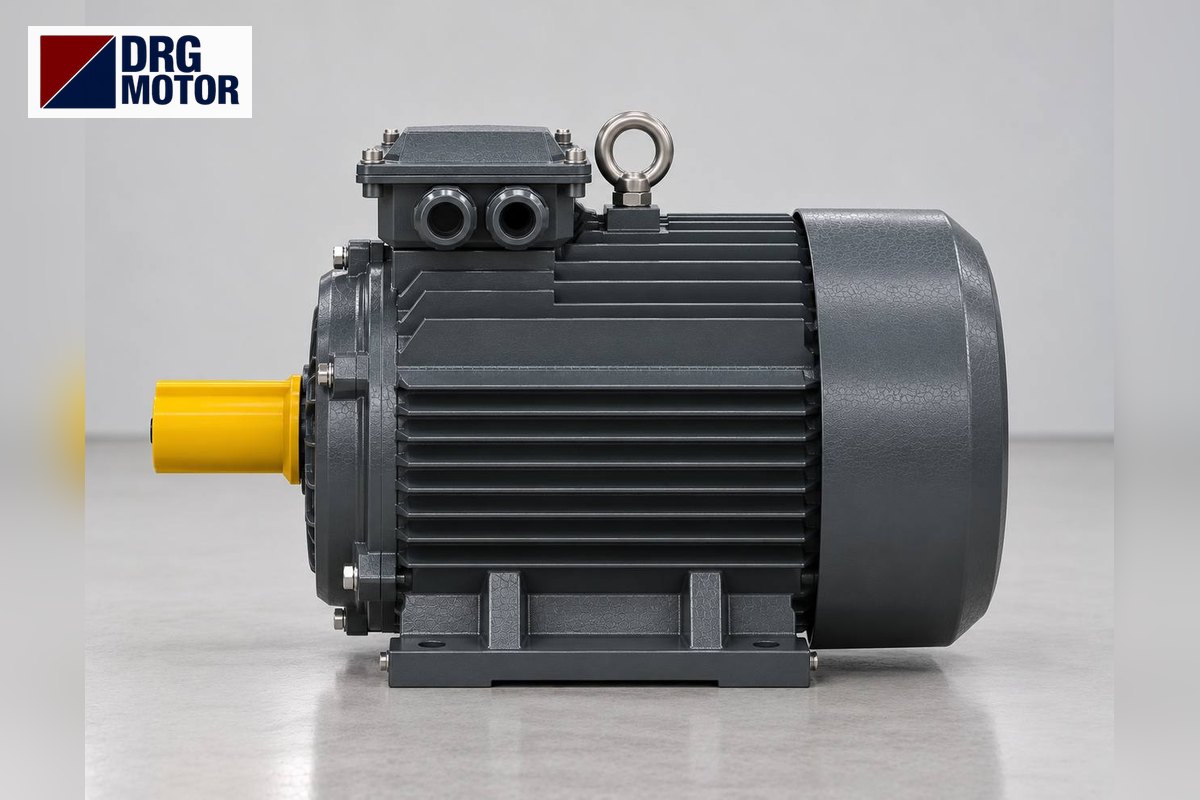

On a PVC pipe haul-off, the motor's job is to grip the pipe that leaves the extruder and solidifies in the cooling tank between the tracks, and pull it forward at a steady speed. The deciding factor is not power but stable torque at low speed and a gearbox ratio that fits the line speed band. If the haul-off speed fluctuates, the wall thickness and weight per metre fluctuate with it.
DRG Motor is a manufacturer, supplier and seller of electric motors; the 4-pole three-phase asynchronous motors that connect to a haul-off gearbox are listed by power and frame type on the buy electric motors online page. DRG does not sell gearboxes; it supplies the motor that fits the input flange of your existing gearbox.
For the other drives on the extrusion line (main screw, cutter, stacker), see the plastic extruder and pelletizing machine motors page. PVC profile cutting and welding machines are covered separately on the PVC and aluminium profile machine motors page; this article deals only with the haul-off.
Why Does Haul-Off Speed Set the Wall Thickness?
The extruder pushes a given mass of melt through the die every minute. The faster the haul-off stretches that mass, the less material ends up in each metre: higher speed means a thinner wall, lower speed a thicker one. Operators therefore usually trim the weight per metre with the haul-off speed, and the haul-off must not lose speed while the extruder screw speed stays constant.
A typical haul-off has two tracks, upper and lower, and three or more on large diameters. Rubber pads on the tracks clamp the pipe by pneumatic cylinders. The drive usually runs from one motor into a gearbox and from there by chain or cardan shaft to the track sprockets; some machines have one motor per track.
The load is constant torque: pulling force does not depend on speed, so the motor must deliver the same torque even at half speed. There is no heavy acceleration load at start, but when the line is first threaded and the pipe is tight in the calibration sleeve, the force rises for a short time.
From Pulling Force to Motor Torque: Worked Example
The values below are an example / assumption; real pulling force depends on pipe diameter, vacuum and friction in the calibration tank and pad pressure. The definitive figure is the machine builder's nameplate or catalogue.
Example: pulling force 5000 N, track speed 6 m/min (0.1 m/s), track drive sprocket diameter 200 mm, total gearbox and chain efficiency assumed at 0.7.
- Power at the track: 5000 × 0.1 = 500 W; with drive efficiency about 0.71 kW at the motor shaft.
- Sprocket torque: 5000 × 0.1 m = 500 Nm; for 6 m/min the sprocket turns at about 9.55 rpm.
- With a gearbox ratio i = 150, the torque needed at the motor shaft is 500 / (150 × 0.7) ≈ 4.8 Nm.
For this load the DRG-90S-4 (1.1 kW, 1445 rpm, rated torque 7.27 Nm) leaves about 1.5 times torque margin. On a line running high pad pressure or a thicker pipe, the next size up, DRG-90L-4 (1.5 kW, 9.91 Nm), is more comfortable. Use the gearbox output speed and torque calculator for ratio and torque.
Small-diameter pipe haul-offs usually stay around 1 kW; on large-diameter pipe lines pulling force multiplies and the motor may reach a few kW, or more on very large lines.
Click to see current electric motor prices and order nowSEE PRICES →
Consider Gearbox Ratio and Inverter Frequency Band Together
Haul-off speed is almost always set by a frequency inverter (DRG does not sell inverters; the drive is chosen on the line's automation side). The key point is that at the most-used line speed the motor should turn near 50 Hz. With the same i = 150 ratio and a 200 mm sprocket, approximate values are:
| Line speed (m/min) | Sprocket speed (rpm) | Motor speed (rpm) | Approx. frequency (Hz) |
|---|---|---|---|
| 0.5 | 0.8 | 119 | 4.1 |
| 1 | 1.59 | 239 | 8.3 |
| 2 | 3.18 | 477 | 16.5 |
| 4 | 6.37 | 955 | 33 |
| 6 | 9.55 | 1432 | 49.6 |
If the line mostly pulls thick pipe at 1–2 m/min, the motor runs for long periods between 8 and 17 Hz. On a shaft-fan cooled (IC411) motor the fan also slows down and cooling drops; in that case either a higher-ratio gearbox is chosen or the motor is taken one size larger. Going above 50 Hz means losing torque; for fast thin pipe it is more correct to reduce the ratio instead.
The speed of an asynchronous motor slips by a few percent with load. Where tight synchronisation with the extruder is required, the drive's slip compensation or closed-loop control is used; on the motor side, the job is to enter the rated speed from the nameplate correctly into the drive.
Flange and Shaft Dimensions at the Gearbox Input
Haul-off gearboxes are mostly fitted with an IEC motor adapter and the motor connects with a B5 large flange. When replacing the motor, the gearbox input bore (shaft diameter and key), spigot diameter and bolt circle must match the old motor. B5 dimensions from the DRG catalogue:
| Frame | Flange M / N / P (mm) | Shaft D × E (mm) | Example model |
|---|---|---|---|
| 90S / 90L | 165 / 130 / 200 | 24 × 50 | DRG-90S-4, DRG-90L-4 |
| 100L | 215 / 180 / 250 | 28 × 60 | DRG-100L2-4 |
| 112M | 215 / 180 / 250 | 28 × 60 | DRG-112M-4 |
Frames 100L and 112M use the same flange and the same 28 mm shaft, so moving from 3 kW to 4 kW usually leaves the gearbox adapter unchanged; only the motor length (406 mm and 394 mm) and terminal box position are checked. If the gearbox has a small flange (B14), the dimensions are confirmed with the order. If the motor is foot-mounted and belt driven, B3 or B35 is chosen.
Conditions After the Cooling Tank and Heating at Low Speed
The haul-off sits right after the vacuum calibration and spray cooling tanks. The pipe arrives wet, water drips under the tracks and the floor is damp. IP55 protection is enough against splashing water; still, place the motor beside or above the drip line rather than below it, and point the cable entry downwards.
The planetary or band saw that follows the haul-off produces PVC chips and dust. If this dust sticks to the motor fins and fan cover, cooling that is already weak at low speed drops further. Regular cleaning of the fan cover matters especially on this line. Ambient temperature must stay within −15…+40 °C.
What the Line Shows When Motor or Ratio Is Wrong
- Weight per metre oscillates: the motor works at its torque limit and every change in pad pressure pulls the speed down.
- Motor frame overheats at low speed: the ratio is too small and the motor runs for long periods at 5–10 Hz.
- Not enough speed on thin pipe: the ratio is too large, speed requires going above 50 Hz and torque falls.
- Speed difference between tracks: motors of different power or speed were used on separately driven tracks.
- Knocking at the gearbox coupling: the new motor's shaft diameter or key differs from the old one.
Checklist before replacement or order:
- Photo of the old motor nameplate: kW, rpm, voltage and current.
- Gearbox ratio and input type (IEC adapter B5 / B14 or foot-mounted belt drive).
- Shaft diameter × length and key width.
- Lowest and most-used haul-off speed of the line (m/min).
- Whether the tracks are driven by one motor or by separate motors.
- Rating of the inverter in use and the motor connection to the drive (Δ / Y).
DRG Motors Suited to a PVC Pipe Haul-Off
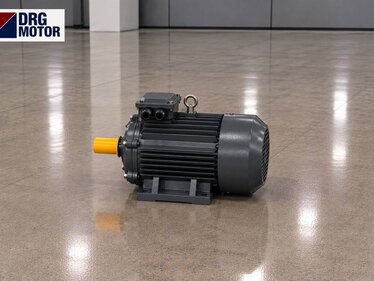
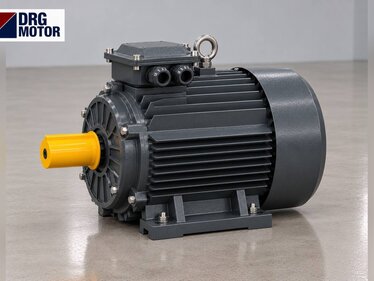
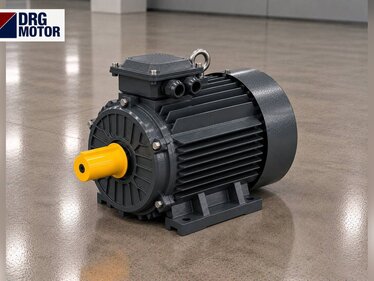
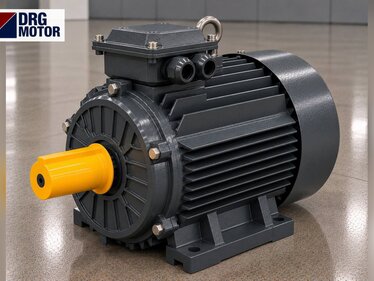
These are 4-pole aluminium-frame motors that can connect to a gearbox input with a B5 flange; they cover the power steps from small-diameter haul-offs to medium-diameter lines.
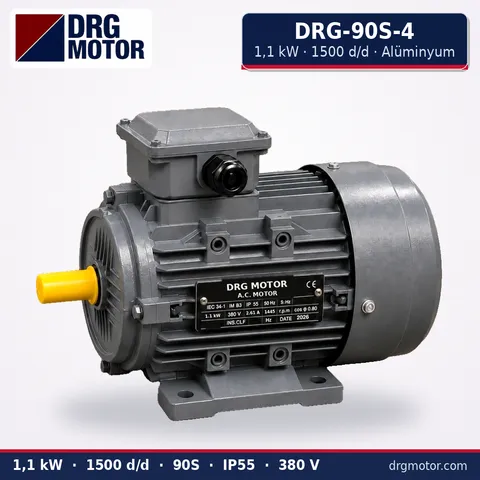
1.1 kW Three-Phase Motor 1500 rpm – DRG-90S-4 Aluminium
- 1.1 kW · 1500 rpm (4 poles)
- Aluminium frame · IEC 90S
- Mounting: B3 · B5 · B14 · B35
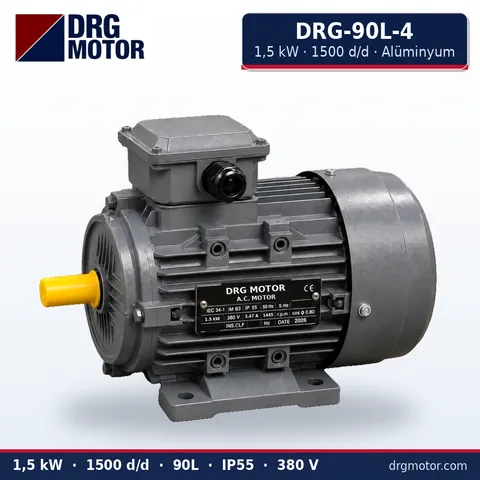
1.5 kW Three-Phase Motor 1500 rpm – DRG-90L-4 Aluminium
- 1.5 kW · 1500 rpm (4 poles)
- Aluminium frame · IEC 90L
- Mounting: B3 · B5 · B14 · B35
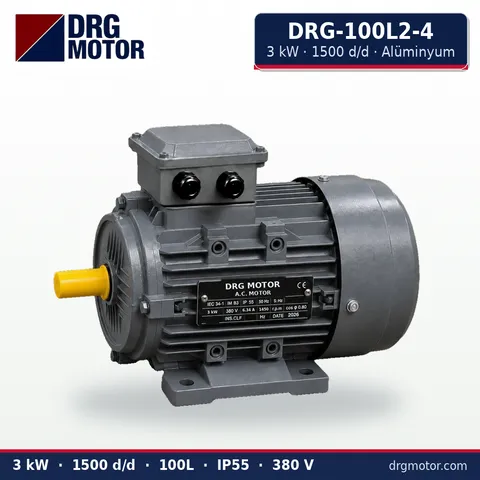
3 kW Three-Phase Motor 1500 rpm – DRG-100L2-4 Aluminium
- 3 kW · 1500 rpm (4 poles)
- Aluminium frame · IEC 100L
- Mounting: B3 · B5 · B14 · B35

4 kW Three-Phase Motor 1500 rpm – DRG-112M-4 Aluminium
- 4 kW · 1500 rpm (4 poles)
- Aluminium frame · IEC 112M
- Mounting: B3 · B5 · B14 · B35
Click to see current prices and order these motors nowSEE PRICES →
PVC Pipe Haul-Off Motor: Frequently Asked Questions
How many poles does a PVC pipe haul-off motor have?
The common arrangement is a 4-pole (1500 rpm synchronous) motor with a high-ratio gearbox. A 2-pole motor would need twice the ratio; a 6-pole motor moves to a larger frame for the same power.
How low can the haul-off motor go in Hz on an inverter?
On a constant-torque load the motor still delivers torque at low frequency; the limit is heating. If the line runs for long periods below 10 Hz, enlarge the gearbox ratio or choose the motor one size larger.
Should I size the haul-off motor from the extruder power?
No. Extruder power is for producing melt; haul-off power comes from pulling force and track speed and on most lines is a small fraction of the extruder motor.
Can I increase motor power without changing the gearbox?
Yes, if the new motor's flange and shaft fit the gearbox adapter; frames 100L and 112M share the same B5 flange. The permitted input power and output torque of the gearbox must be checked separately.
For a quote, send a photo of the old motor nameplate, its power, speed, mounting (foot or flange), shaft size and the haul-off gearbox ratio and line speed via WhatsApp, or add the models to the quote list. Phone: +90 (542) 666 11 11 · e-mail: info@drgmotor.com · contact. All power and speed options are in the online store.