English
 Le français
 Türkçe




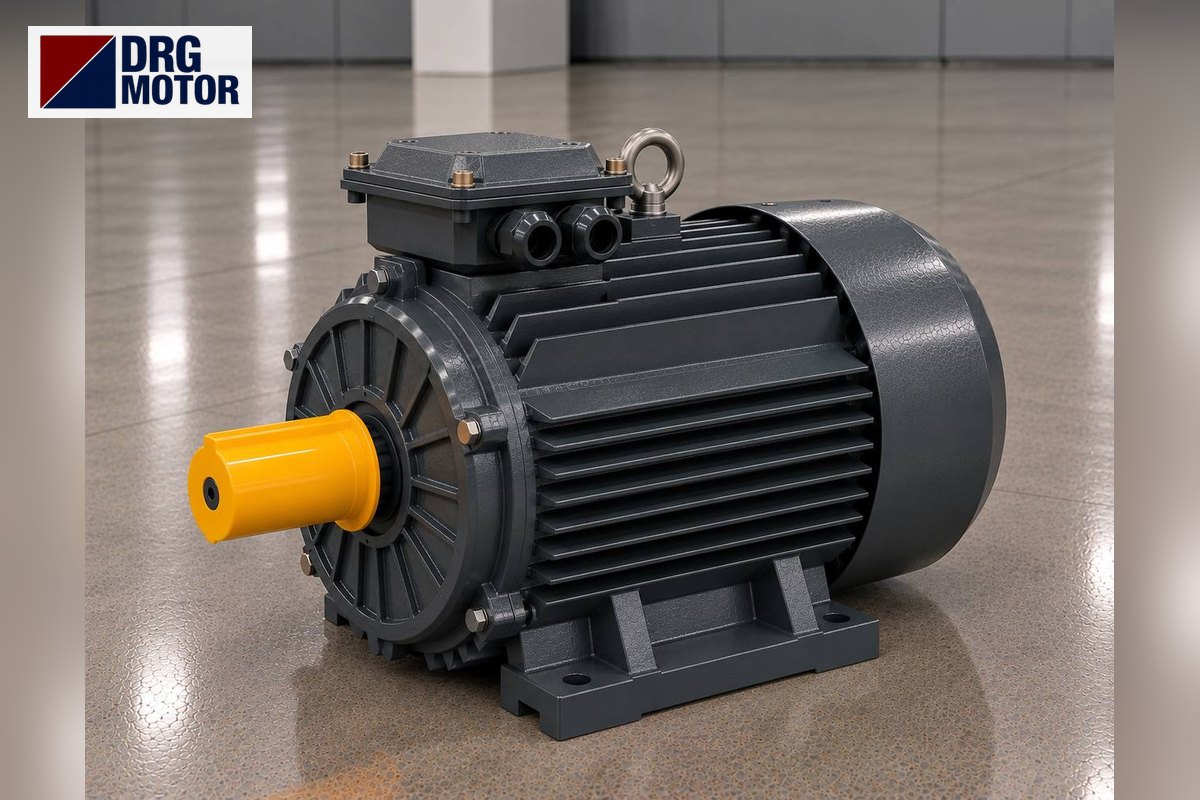

A sanforising machine (compactor or compressive shrinkage range) has no single main motor; the moistening unit, the rubber belt unit, the felt calender and the exit are each driven by their own three-phase motor, usually through an inverter and a gearbox. The job of these motors is to carry the fabric with a defined speed difference between units: the fabric's shrinkage allowance is created exactly by that difference. Motor selection on a sanforiser therefore rests on two questions: which drive turns for hours at which torque, and how precisely must the motor speeds be tied to one another?
To replace a motor with a known nameplate, you can compare 4-pole models on our buy electric motors online page. For a new line or a drive upgrade, the example below shows how to check motor power and speed matching.
How Fabric Is Shrunk on a Sanforiser
The fabric is first moistened with steam or water so that the fibres can slide. It is then fed onto a thick rubber belt. As the belt is squeezed between a pressure roller and a heated cylinder, its outer surface stretches; when it leaves the nip, the surface returns to its original length and compresses the fabric lying on it lengthwise. The fabric leaves the belt shorter than it came in.
The compressed fabric then passes to the felt calender. Here a large heated cylinder and a thick felt wrapped around it dry the fabric and set it at its new length. The felt calender turns slower than the rubber belt; the ratio between them is the desired shrinkage. Depending on the fabric, this ratio is set from a few percent to a little over ten percent.
Drives on the Line and Their Speed Ratios
The table below summarises a typical line. The number of units varies with the maker; some lines have a second compressive unit or an edge opener after the rubber belt unit.
| Unit | Duty | Speed relation | Example speed |
|---|---|---|---|
| Entry / moistening | Feeds and moistens fabric | Equal to belt speed | 50 m/min |
| Rubber belt unit | Compresses fabric lengthwise | Reference speed | 50 m/min |
| Felt calender | Dries, sets the length | Belt × (1 − shrinkage) | 46 m/min |
| Exit / winder | Collects the fabric | Follows the felt | 46 m/min |
Let line speed be 50 m/min with a target shrinkage of 8 percent (assumption). If the rubber belt unit takes the fabric at 50 m/min, the felt calender must run at 50 × (1 − 0.08) = 46 m/min. The more stable the difference between these two speeds, the more consistent the fabric's shrinkage value.
Click to see current electric motor prices and order nowSEE PRICES →
Why Slip Matters: Speed Accuracy of an Induction Motor
A three-phase induction motor slows slightly under load; this is called slip. For example, the DRG-112M-4 runs at 1450 rpm at full load; compared with the synchronous speed of 1500 rpm, slip is about 3.3 percent. The DRG-132S-4 slips about 2.7 percent at 1460 rpm.
These figures look small, but with a target shrinkage of 8 percent, a 1–2 percent speed swing on one motor when its load changes spoils the shrinkage value directly. As rubber belt temperature, fabric moisture and thickness change, the motor load changes too. That is why motors on a sanforiser are not left in open loop with frequency setting alone.
Three methods are used in practice: the inverter's slip compensation, closed-loop speed control with an encoder on the motor or cylinder shaft, and a master–slave arrangement with a dancer or tension measurement between units. Which one is chosen depends on the line maker's automation design. On the motor side, if an encoder is to be fitted, confirm at the order stage that suitable mounting is possible at the rear of the motor; the standard motor has no encoder.
Power Selection for Uninterrupted Operation: an Example
Sanforising lines run without stopping through shifts. The motor must be judged not in an hour's trial but while running for hours at the same load, in a hot environment next to heated cylinders. The values below are an example; the real torque comes from the maker's data.
Example: let the drive cylinder of the rubber belt unit be 600 mm in diameter. At 50 m/min the cylinder turns at 50 / (π × 0.6) ≈ 26.5 rpm. Assuming 1200 N·m is needed at the cylinder, power is P = T·n/9550 = 1200 × 26.5 / 9550 ≈ 3.33 kW. With a gearbox efficiency of 0.95, about 3.5 kW is needed from the motor shaft.
The 4 kW DRG-112M-4 is loaded to about 88 percent at this point. If the motor stands in a humid, steamy spot next to the line with an ambient close to 40 °C, the 5.5 kW DRG-132S-4 brings the load ratio down to about 64 percent and the winding runs cooler. The gearbox ratio is chosen around 1450 / 26.5 ≈ 55; with that ratio motor shaft torque is about 23.1 N·m.
Felt calender and belt grinding
The felt calender is large and heavy, with high inertia. At start-up the line is accelerated slowly and the motor delivers its starting torque through the inverter ramp. Over time the rubber belt surface is ground; this is done with a separate grinding motor while the line is stopped. The grinding motor is small and usually 2- or 4-pole.
Heat, Steam and Where the Motor Sits
The heated cylinders of a sanforiser are fed with steam or thermal oil. The motors stand beside the machine frame, just behind the gearbox, where the air is hot and humid. DRG motors are built for an ambient of −15…+40 °C and have IP55 housings. If the air where the motor stands exceeds 40 °C, fresh air should be brought to the motor and the insulation between heated cylinder and motor checked.
Long cable runs are also common on sanforising lines; when the inverter is in a panel room, tens of metres of cable run to the motor. You can check cable size and voltage drop with our motor cable size calculator.
What to Check Before Replacing a Drive Motor
- The motor's place on the line: moistening, rubber belt, felt calender, exit or grinding.
- Old motor nameplate: kW, rpm, voltage (230/400 V or 400/690 V), current, mounting.
- Gearbox type and ratio, B5 flange (M, N, P) or foot hole spacing, shaft diameter.
- Speed control method: slip compensation, encoder or dancer.
- Inverter frequency range and cable length between motor and panel.
- Air temperature where the motor stands, with the line at full temperature.
Details of matching motors to parallel shaft and helical gearboxes are on our electric motors for parallel shaft gearboxes page. DRG does not sell gearboxes; it supplies the motor that connects to the gearbox.
DRG Motors Suited to Sanforising Line Drives
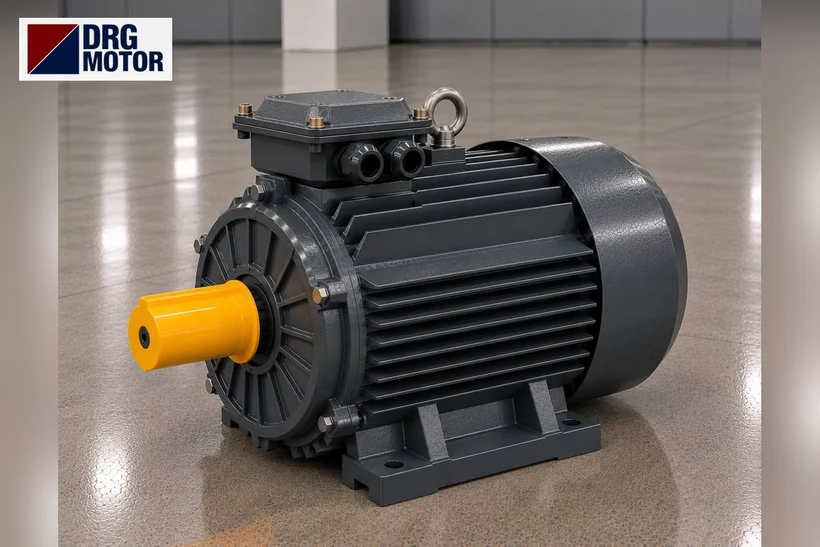
4 and 5.5 kW for the 3.5 kW drive of the example, 3 kW for entry and exit units, 11 kW for the felt calender of wide lines; all 4-pole, cast iron and able to fit a gearbox with a B5 flange.
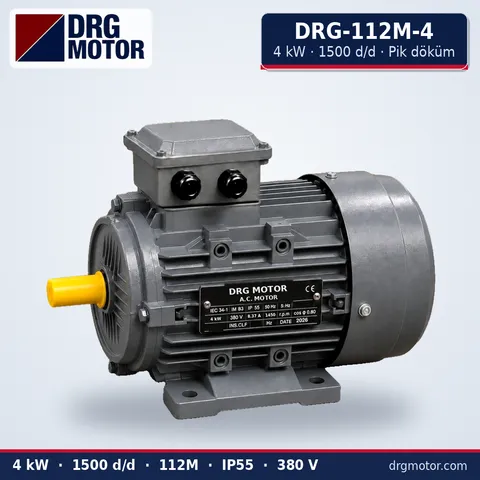
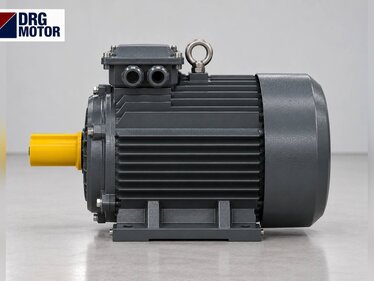
4 kW Three-Phase Motor 1500 rpm – DRG-112M-4 Cast Iron
- 4 kW · 1500 rpm (4 poles)
- Cast iron frame · IEC 112M
- Mounting: B3 · B5 · B14 · B35
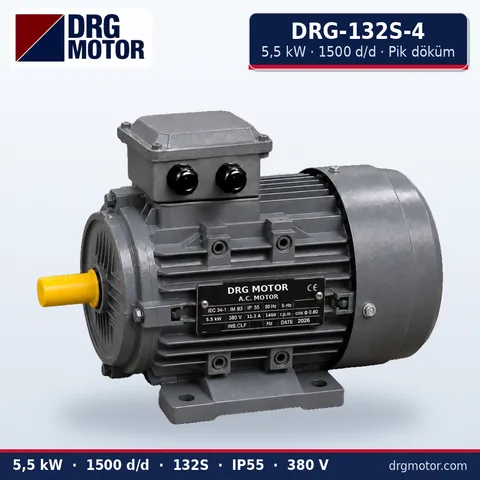
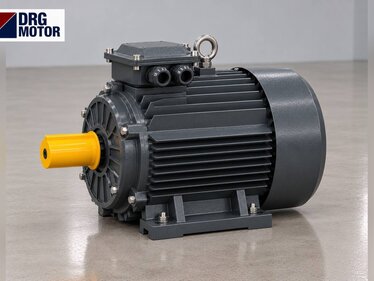
5.5 kW Three-Phase Motor 1500 rpm – DRG-132S-4 Cast Iron
- 5.5 kW · 1500 rpm (4 poles)
- Cast iron frame · IEC 132S
- Mounting: B3 · B5 · B14 · B35
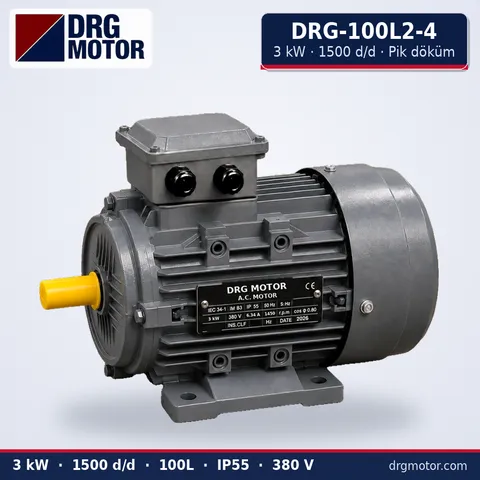
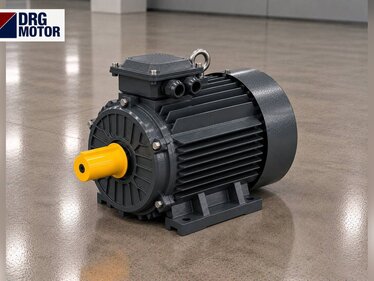
3 kW Three-Phase Motor 1500 rpm – DRG-100L2-4 Cast Iron
- 3 kW · 1500 rpm (4 poles)
- Cast iron frame · IEC 100L
- Mounting: B3 · B5 · B14 · B35
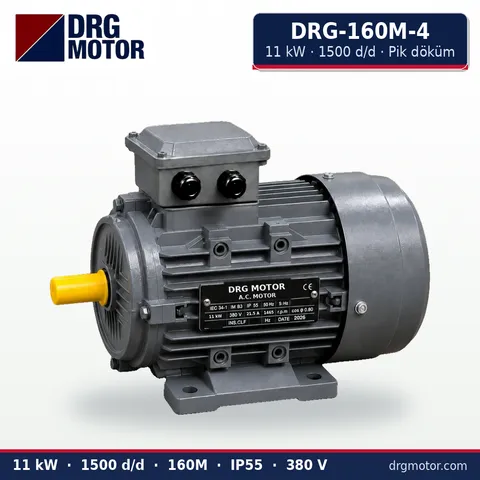
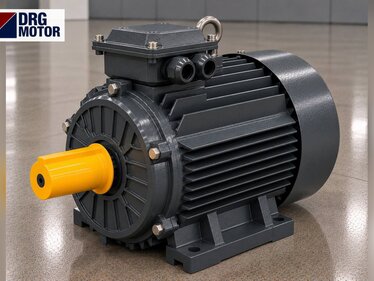
11 kW Three-Phase Motor 1500 rpm – DRG-160M-4 Cast Iron
- 11 kW · 1500 rpm (4 poles)
- Cast iron frame · IEC 160M
- Mounting: B3 · B5 · B14 · B35
Click to see current prices and order these motors nowSEE PRICES →
Sanforising Machine Motor: Frequently Asked Questions
Why does the shrinkage value drift on the sanforiser?
One of the most common causes is the speed ratio between the rubber belt and the felt calender shifting as load changes. Because induction motor slip varies with load, this ratio moves in open loop. Slip compensation or encoder-based closed-loop control solves the problem.
Can I connect the motors of a sanforising line to one inverter?
Because each unit turns at a different speed and the ratio between them has to be adjustable, each drive is run by its own inverter. Motors on a single inverter all turn at the same frequency and the speed ratio cannot be set.
What kW should the rubber belt motor be?
It depends on belt width, nip pressure and line speed. Narrow lines use a few kW, wide and fast lines larger ratings. The exact value is the maker's nameplate or drive calculation; the example above shows how to check it.
Can I move from 4 poles to 6 poles when replacing a motor?
You can, but the gearbox ratio or the inverter frequency must be reset and the speeds recalibrated. Flange and shaft dimensions may also change. On a line built on speed ratios, the lowest-risk route is to stay with the same pole count as the old motor.
To start the selection, a photo of the old motor's nameplate, its power, speed, mounting (foot/flange), shaft size and its duty on the line are enough; send them via WhatsApp or request a quotation through the quote list. Phone +90 (542) 666 11 11 · info@drgmotor.com · contact. DRG Motor is a manufacturer, supplier and seller of electric motors; you can browse all models in the online store.