English
 Le français
 Türkçe




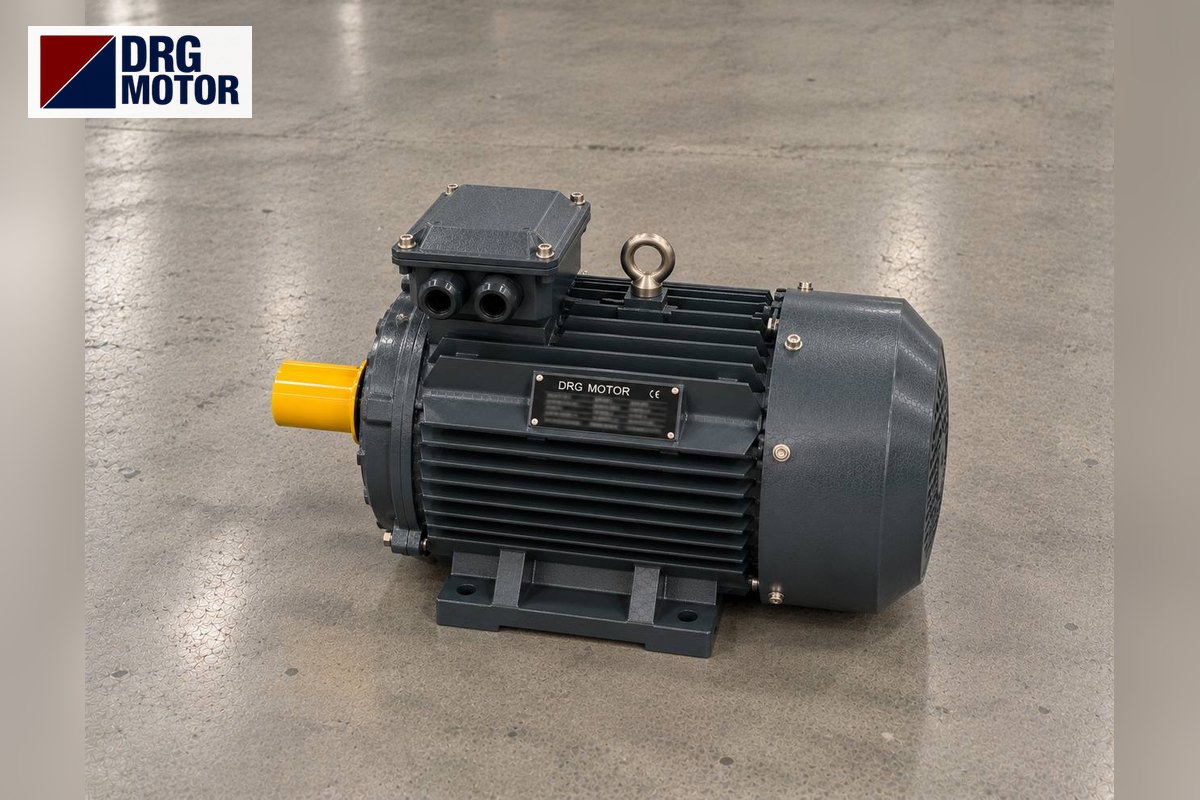

In a cotton gin the electric motor drives the part that separates lint from seed: the saw cylinder on a saw gin, or the roller that pulls the fibre under the knife on a roller gin. The drive is mostly by belt and pulley; feeder rolls and the seed conveyor turn slowly and are therefore connected through a gearbox. What decides the choice is that the separating element stays at the speed the machine builder intended, and that the motor can recover without stalling when the seed cotton thickens.
A ginning plant runs many machines of the same type side by side, so keeping the same frame size across the plant matters as much as choosing a single motor correctly. You can browse suitable three-phase motors in our online motor store, and for other machines processing farm produce see our agricultural machine electric motors page.
What the Motor Turns on Saw Gins and Roller Gins
On a saw gin, circular saws spaced along a shaft enter the seed cotton chamber between narrow steel grates called ribs. The saw teeth catch the fibres and pull them through the ribs; the seed cannot pass the gap and drops down. A fast brush cylinder or an air blast strips the lint off the saws and sends it into the lint duct.
On a roller gin, a roller with a special covering grips the fibres by friction and pulls them under a stationary knife pressed against the roller. The seed cannot pass the knife; a second rotary or oscillating knife knocks it off the fibre. Roller machines stress the fibre less, but capacity per machine is lower, so a plant lines up dozens of them.
On a saw gin the load comes from the saw shaft turning inside the seed roll and grows as feed increases. On a roller gin, knife pressure and the friction between roller and knife set the load. With either type, uneven feed makes the current fluctuate.
A Map of the Motors in a Ginning Plant
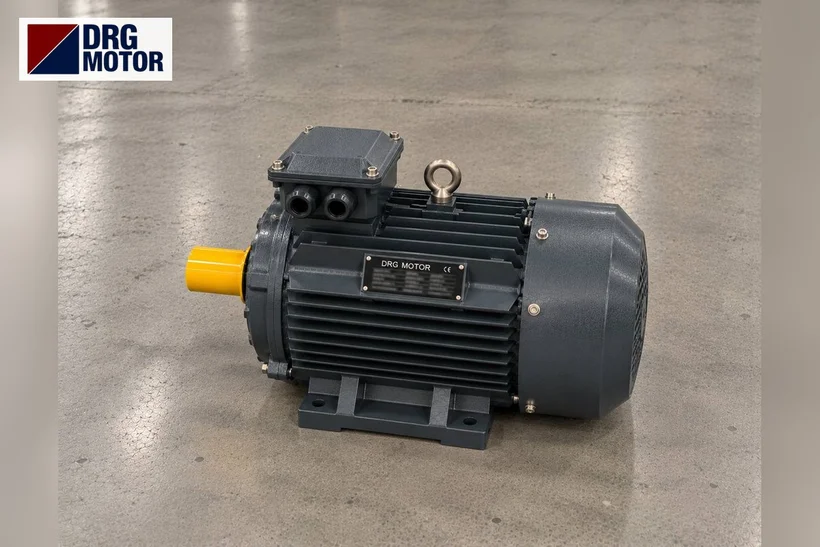
When a motor burns out, the first question is which machine it belongs to, because load characteristics differ widely across the plant. The table below summarises the main drives on a typical line; which arrangement is used on which machine depends on the builder.
| Unit | Motor task | Load type | Connection |
|---|---|---|---|
| Feeder | Deliver seed cotton evenly | Light, low speed | Gearbox + motor |
| Saw cylinder | Separate lint from seed | Rises with feed, may choke | Belt and pulley |
| Brush cylinder | Strip lint off the saws | High speed, high inertia | Belt and pulley |
| Roller gin | Turn roller and knife | Frictional, set by knife force | Belt or gearbox |
| Conveying fan | Move cotton and lint by air | Rises with square of speed | Belt or direct |
| Seed auger | Carry seed out | Constant torque | Gearbox + motor |
For geared drives DRG supplies the motor that connects to the gearbox, not the gearbox itself; the gearbox input flange and shaft bore must be stated in the order. The inverter used on speed-controlled feeders is also sourced separately.
Click to see current electric motor prices and order nowSEE PRICES →
Saw Cylinder: a Pulley, Speed and Torque Example
Saw shaft speed follows n2 = n1 · d1 / d2 and tooth tip speed v = π · D · n / 60. As an example, assume these values: a 4-pole 7.5 kW motor at 1460 rpm, a 125 mm motor pulley, a 261 mm saw shaft pulley and 305 mm saws. The saw shaft turns at 699.2 rpm and the tooth tip moves at 11.17 m/s. The real saw speed is given in the machine catalogue.
A pulley ratio that lowers speed raises torque. The rated torque of 49.1 Nm at the motor shaft (catalogue value of the DRG-132M-4) becomes about 102.4 Nm at the saw shaft from P = T · n / 9550, ignoring losses. That is the torque that overcomes the resistance of the seed roll.
Fit a 6-pole motor (968 rpm) with the same pulleys and the saw shaft drops to 463.6 rpm. The teeth pull lint more slowly, the seed roll tightens, output falls and the motor now struggles against the denser roll. Do not change the pole count of a spare motor; if you must, have the pulleys recalculated.
Seed Roll, Choking and Starting
The mass of seed cotton rotating in front of the saws is called the seed roll. With too much feed or damp seed cotton the roll densifies, torque on the saw shaft rises and the stand heads towards choking. On most gins the breast is pulled back to take the saws out of the seed cotton, and motor load drops at once. If the current keeps hovering at the limit, the remedy is not a larger motor but regulating the feed rate and the moisture of the seed cotton.
Start the machine empty: breast retracted and feeder stopped. On brush-cylinder machines the hard part is accelerating the heavy cylinder, and the motor draws high current throughout. In the catalogue the DRG-160M-4 has a starting torque ratio Ts/Tn = 2.2 and a starting current ratio Is/In = 7.7; rated current is 20.4 A at 400 V.
A long start can trip an overload relay of a class chosen for quick starts. Check relay and fuse selection against motor power and starting conditions with our overload, fuse and contactor selection tool. DRG motors of 4 kW and above are wound for 400/690 V, so they run in delta on a 400 V network and suit star-delta starting.
Lint Fly and Fire Risk: a Maintenance Routine for the Motor
Fine lint floats in the air of a gin hall. It sticks to the motor's cooling fins and to the grille of the fan cowl, forming a felt-like layer. The motor can no longer draw its own air and runs hotter at the same load, and cotton fibre collecting on a hot surface is a fire risk.
IP55 protection keeps lint out of the motor interior and terminal box, but it does not keep the outside clean. Clean the fins and fan cowl regularly throughout the season, never cover the motor and do not let lint pile up in the belt guard. A slipping belt heats up, so check tension and pulley alignment.
If the plant's risk assessment classifies an area as an explosive dust atmosphere, a standard IEC motor is not used there; an Ex-protected special motor is required, and such motors are not in the DRG range. In unclassified halls an IP55 three-phase motor is sufficient.
Many Machines, One Spare Type
When identical gins work side by side, keeping their motors at the same power, speed and frame is the most practical way to get a stand turning again quickly if a motor burns out mid-season. Within the same IEC frame number, foot holes, shaft height and shaft end stay the same. Catalogue dimensions of the DRG-160M-4:
- Power: 11 kW – 1465 rpm
- IEC frame: 160M, shaft height H = 160 mm
- Foot holes (A × B): 254 × 210 mm, 4–Φ14.5
- Shaft (D × E): 42 × 110 mm, key width 12 mm
- Current (400 V): 20.4 A
- Voltage: 400/690 V (Δ/Y)
Note the following before ordering a spare or new motor:
- Which unit the motor drives: saws, brush, roller, fan, feeder or auger.
- Plate data: kW, rpm, voltage, connection; if lint hides the plate, clean it and take a photo.
- For belt drives, both pulley diameters and the belt profile; for geared drives, the gearbox input flange.
- Mounting: foot (B3), flange (B5) or foot + flange (B35).
- Shaft diameter, shaft length and key width.
- How many machines of the same type there are; will a spare motor be kept for the plant?
- The class given to the motor's area in the plant risk assessment.
DRG Motors Suited to Cotton Gin Plants
4-pole cast iron models for saw and brush drives, plus a 6-pole option for feeder gearboxes. The model should follow the plate of the removed motor.
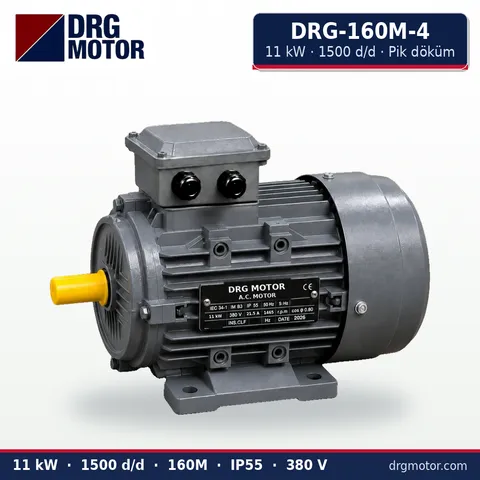
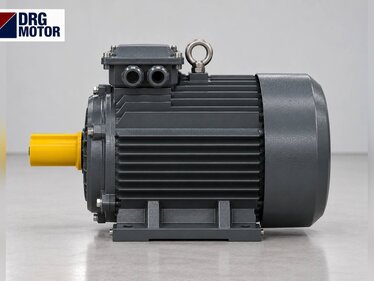
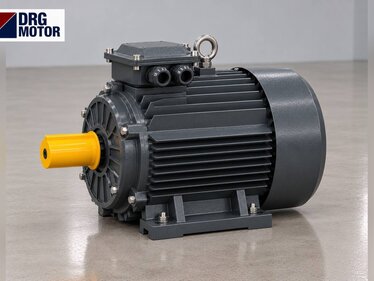
11 kW Three-Phase Motor 1500 rpm – DRG-160M-4 Cast Iron
- 11 kW · 1500 rpm (4 poles)
- Cast iron frame · IEC 160M
- Mounting: B3 · B5 · B14 · B35
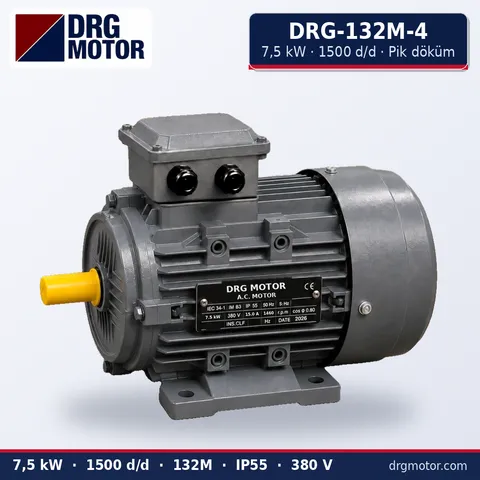
7.5 kW Three-Phase Motor 1500 rpm – DRG-132M-4 Cast Iron
- 7.5 kW · 1500 rpm (4 poles)
- Cast iron frame · IEC 132M
- Mounting: B3 · B5 · B14 · B35
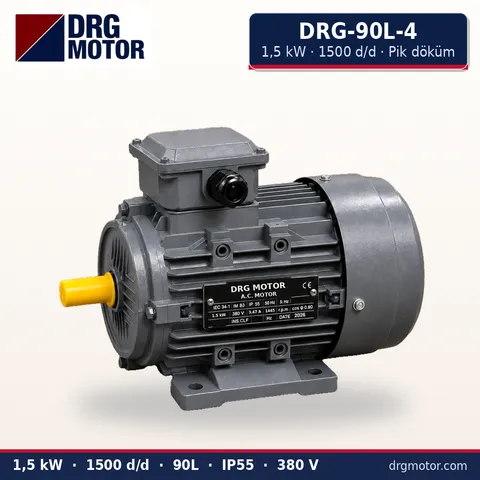
1.5 kW Three-Phase Motor 1500 rpm – DRG-90L-4 Cast Iron
- 1.5 kW · 1500 rpm (4 poles)
- Cast iron frame · IEC 90L
- Mounting: B3 · B5 · B14 · B35
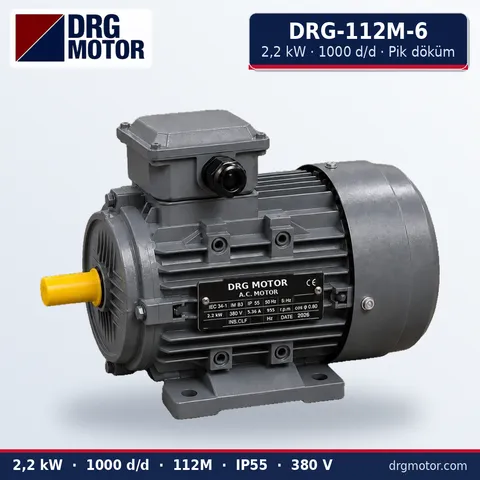
2.2 kW Three-Phase Motor 1000 rpm – DRG-112M-6 Cast Iron
- 2.2 kW · 1000 rpm (6 poles)
- Cast iron frame · IEC 112M
- Mounting: B3 · B5 · B14 · B35
Click to see current prices and order these motors nowSEE PRICES →
Cotton Gin Motor: Frequently Asked Questions
What kW is a cotton gin motor?
It varies with machine type and capacity. A few kW per machine is common on roller gins; on saw gins power can reach tens of kW as the number of saws increases. The correct value is the machine plate or the builder's catalogue.
Why does the gin motor keep tripping the overload?
The usual causes are excessive or uneven feed, a seed roll densified by damp seed cotton, cooling fins clogged with lint and a slipping belt. The overload relay must be set to nameplate current; for example 14.3 A at 400 V for the 7.5 kW DRG-132M-4.
What happens if motor speed changes on a roller gin?
The surface speed of the roller changes. A faster roller generates more heat at the knife and wears its covering quickly; a slower roller lowers output. Stay with the same pole count as the old motor.
Why is a 6-pole motor preferred for the feeder?
Feeder rolls turn slowly. A 6-pole motor (e.g. DRG-112M-6, 955 rpm) gives the gearbox a lower input speed, so a smaller ratio is enough for the same output speed. This choice should follow the gearbox builder's input speed recommendation.
DRG Motor is a manufacturer, supplier and seller of electric motors. To prepare a quotation for your gin plant, these help us: a photo of the motor label, its power and speed, whether it is foot- or flange-mounted, the shaft diameter, the unit it drives and how many machines of the same type you have. Send the details to our WhatsApp line or add the models to the quote list. Phone +90 (542) 666 11 11, e-mail info@drgmotor.com; address and other channels are on the contact page. For current prices visit our online motor store.