English
 Le français
 Türkçe




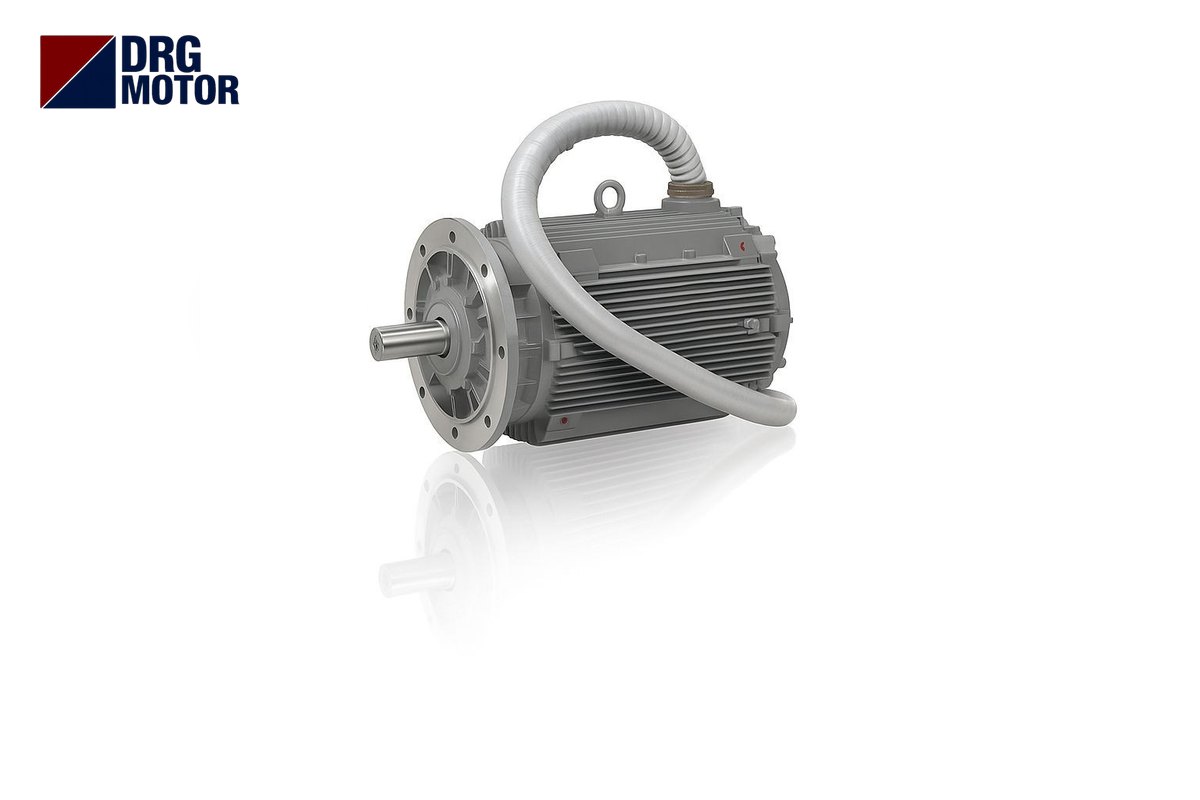

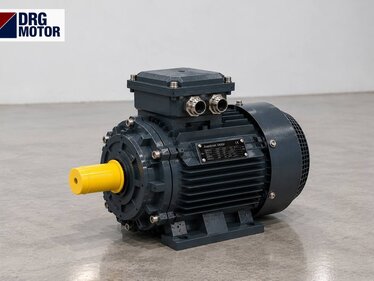
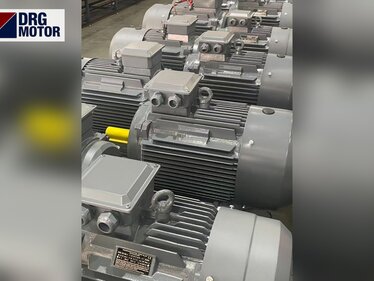
In a plastic raw material mixer, motor power is set not by the mixing itself but by the breakaway torque the full hopper demands on the first turn and by the mass of granules being moved. Granules and masterbatch form a dry, free-flowing load, so the load is fairly steady while running; the hard moment is starting from rest with a full hopper or vessel. Starting torque is therefore checked as carefully as rated power.
DRG Motor is a manufacturer, supplier and seller of electric motors; three-phase asynchronous IEC motors used on raw material mixers are listed by power, speed and frame type on the buy electric motors online page.
This article covers only machines that dry-blend granules, masterbatch and regrind. An agglomerator, which melts and densifies plastic, is a different load type; for that see the plastic agglomerator motor article.
What the Motor Does in Vertical Screw and Vessel Mixers
A vertical screw mixer has a screw turning inside a tube at the centre of a conical or cylindrical hopper. The screw lifts granules from the bottom and showers them from the top; material slides down along the hopper wall and re-enters the screw. Mixing comes from this circulation; the motor usually sits below or above the hopper and drives the screw by belt and pulley or through a gearbox.
In a vessel (paddle) mixer, blades or paddles turn inside a horizontal or vertical vessel and keep tumbling the material. Fill level and blade area matter more here; the mixer usually keeps running while the discharge gate under the vessel opens.
Mixing Load: Granules, Masterbatch, Regrind
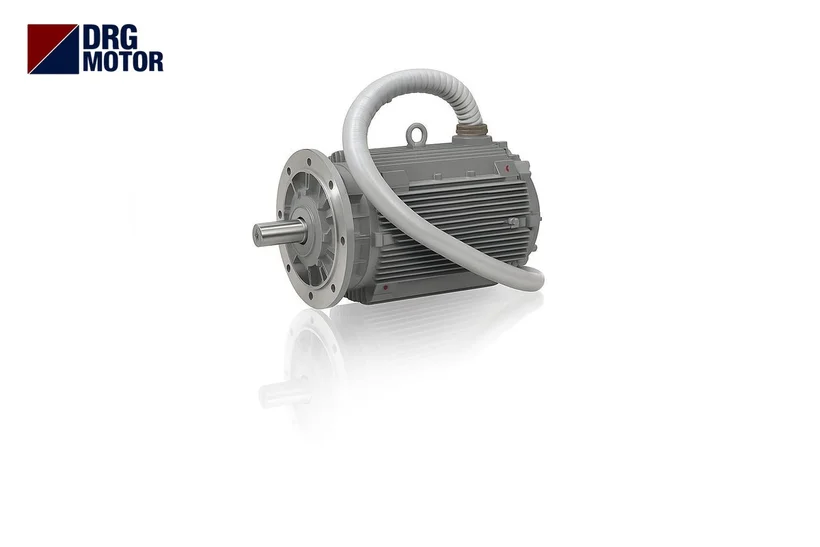
With granules, the load depends on bulk density and hopper height. Masterbatch is usually added in small proportions and does not change the load markedly; but powder additives, regrind and flakes mixed with granules disturb flow and load the screw more. Wet or damp regrind can cause bridging and raises breakaway torque.
| Mixer type | Drive arrangement | Load character | Critical moment |
|---|---|---|---|
| Vertical screw | Belt-pulley / gearbox | Steady, screw full | Start with full hopper |
| Paddle vessel | Gearbox | Depends on fill level | Overfilling |
| Rotating drum | Gearbox + chain | Unbalanced mass | Starting and stopping |
Small workshop mixers typically use motors of a few kW, while vertical silo mixers of several tonnes may need more; the exact power is on the machine builder's nameplate and catalogue. Extending the hopper to gain capacity directly increases motor load.
Click to see current electric motor prices and order nowSEE PRICES →
Worked Example: Screw Torque, Motor Power and Start Check
The values below are purely an example and do not replace the real machine data. Assumption: the screw shaft needs 110 Nm while running, a full hopper needs twice that (220 Nm) as breakaway torque on the first start; motor pulley 100 mm, screw pulley 400 mm, belt losses ignored.
- Screw speed: 1460 · 100 / 400 = 365 rpm
- Running power: P = T · n / 9550 = 110 · 365 / 9550 ≈ 4.2 kW → next standard size 5.5 kW
- Motor choice: DRG-132S-4, 5.5 kW, 1460 rpm, rated torque 36.0 Nm, Ts/Tn 2.0
- Rated torque at the screw: 36.0 · 4 = 144 Nm (above the 110 Nm need)
- Direct-on-line starting torque at the screw: 36.0 · 2.0 · 4 = 288 Nm (above the 220 Nm breakaway torque)
If the same motor starts in star-delta, starting torque falls to one third: 288 / 3 = 96 Nm. That is below the 220 Nm breakaway torque, so in this example a star start with a full hopper fails. The fix is to start the mixer empty and then fill it, start direct-on-line, or use a soft-start drive. Check pulley ratios for your own machine with the pulley and belt calculator.
Drive Connection and Mounting Dimensions
On a belt-driven vertical screw mixer the motor is mostly B3 foot-mounted on a tensioning slide. Shaft diameter and key size define the pulley hub: according to DRG catalogue data, frame 112 has a 28×60 mm shaft, frame 132 has 38×80 mm and frame 160 has 42×110 mm. Foot hole spacing is A 190 mm, B 140 mm on frame 112 and A 216 mm, B 178 mm on frame 132M.
On a gearbox-driven vessel mixer, the motor connects to the gearbox input with a B5 flange; compare flange P, M, N values and shaft length with the old motor. Even if the frame changes, if shaft height H is not the same the pulley alignment shifts and the belt wears on its side.
Plastic Dust, Dryer Heat and Dust Explosion Risk
The most common problem in granule mixing is the fan cover clogging with fine plastic dust and regrind fragments. An IP55 frame is protected against dust ingress, but dust piling on the cover blocks cooling air and the motor heats up. On lines running with a dryer, hot air from the hopper can warm the motor's surroundings; ambient temperature should not exceed +40 °C.
Granule and masterbatch mixing is in most cases not an explosive atmosphere. But if very fine plastic dust is heavily airborne, the plant should carry out a dust explosion assessment; such a zone needs a special Ex-protected motor, a duty not met by a standard IEC motor.
From symptom to cause
- Motor hums but does not turn at the first morning start: insufficient starting torque with a full hopper, or starting in star.
- Belt slips and smells: low belt tension or a pulley ratio overloading the screw.
- Colour distribution is not uniform: screw speed too low or mixing time too short; may be a process issue, not the motor.
- Motor frame very hot: fan cover blocked with dust or hopper capacity increased.
Measure and Note Before Ordering the Motor
- Old motor nameplate: kW, rpm, voltage, connection
- Mounting: B3 foot or B5 flange; foot hole spacings A and B
- Shaft diameter and length, pulley diameters or gearbox ratio
- Hopper capacity and material mixed (granules, regrind, powder additive)
- Starting method and whether starts are made with a full hopper
For general duties such as mixers, feeders and screws, options are also shown on the general purpose electric motors page.
DRG Motors Suited to Plastic Raw Material Mixers
These 4-pole models cover small workshop mixers up to silo-type vertical screw mixers; they suit belt reduction to screw speed as well as gearbox inputs.
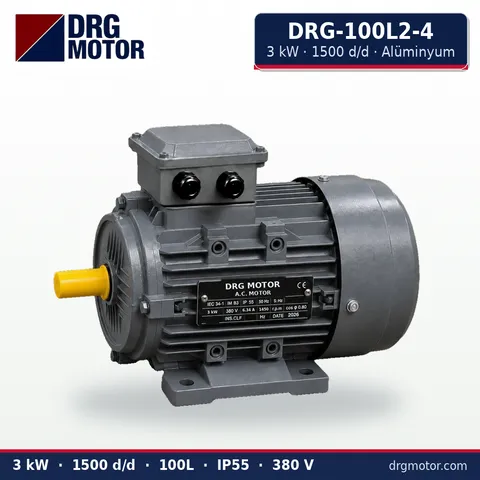
3 kW Three-Phase Motor 1500 rpm – DRG-100L2-4 Aluminium
- 3 kW · 1500 rpm (4 poles)
- Aluminium frame · IEC 100L
- Mounting: B3 · B5 · B14 · B35
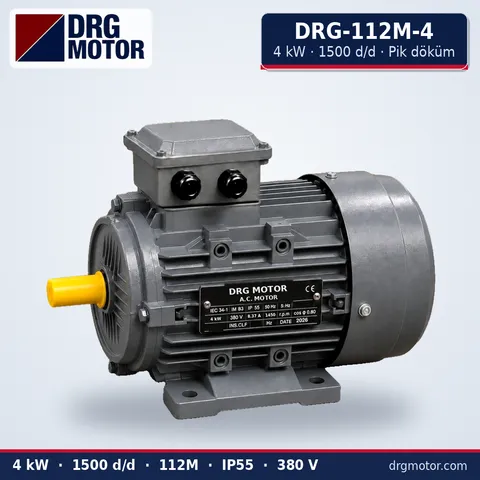
4 kW Three-Phase Motor 1500 rpm – DRG-112M-4 Cast Iron
- 4 kW · 1500 rpm (4 poles)
- Cast iron frame · IEC 112M
- Mounting: B3 · B5 · B14 · B35
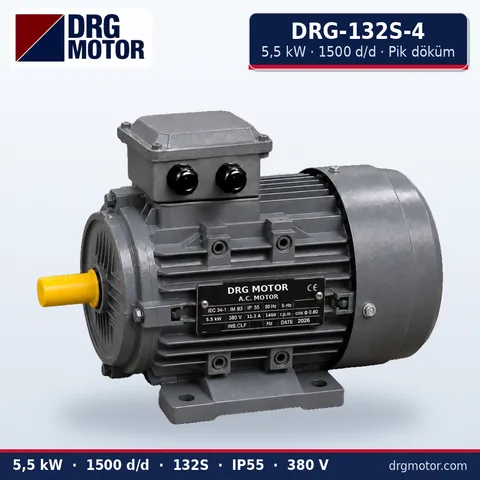
5.5 kW Three-Phase Motor 1500 rpm – DRG-132S-4 Cast Iron
- 5.5 kW · 1500 rpm (4 poles)
- Cast iron frame · IEC 132S
- Mounting: B3 · B5 · B14 · B35
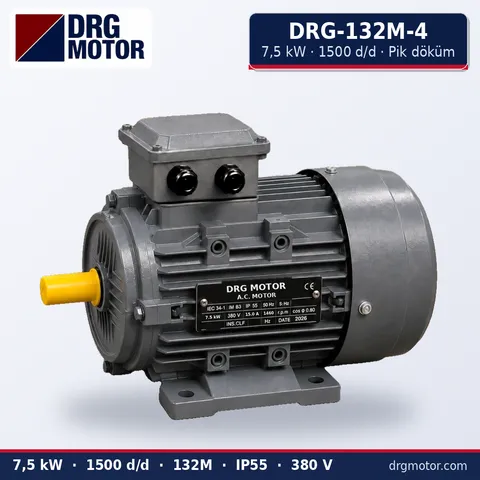
7.5 kW Three-Phase Motor 1500 rpm – DRG-132M-4 Cast Iron
- 7.5 kW · 1500 rpm (4 poles)
- Cast iron frame · IEC 132M
- Mounting: B3 · B5 · B14 · B35
Click to see current prices and order these motors nowSEE PRICES →
Plastic Mixer Motor FAQ
How many kW should a vertical screw plastic mixer motor have?
Power depends on hopper capacity, screw diameter and speed. A few kW is common on small workshop mixers; the exact value is on the machine nameplate. When replacing, stay at the same power as the old motor or one size up.
Why won't the mixer start when it is full?
With a full hopper the screw's breakaway torque is far above its running torque. In star-delta starting the motor torque drops to one third and may not overcome it.
Does the masterbatch ratio change motor load?
Masterbatch at low ratios does not change the load markedly. The real difference comes from regrind, flakes or powder additives, which disturb flow and load the screw.
Can a 2-pole motor be used on a mixer?
Because screw and paddle speeds are low, a 4-pole motor with belt or gearbox is the most common arrangement. A 2-pole motor needs a larger reduction ratio and gives less torque at the screw during starting.
For a quote, share the mixer hopper capacity, a picture of the old motor plate, its kW and rpm, foot or flange connection and shaft diameter via WhatsApp, or request a quote through the quote list. Phone: +90 (542) 666 11 11 · e-mail: info@drgmotor.com · contact. All power options are in the online store.