English
 Le français
 Türkçe

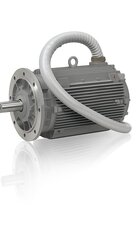

A mono pump, i.e. a progressive cavity (eccentric screw) pump, is not driven directly by a fast-running motor: its rotor must turn slowly, and at breakaway the pump asks for far more torque than it needs while running. The drive is therefore almost always a 4- or 6-pole three-phase motor plus a gearbox. What decides the motor is not its kW rating but the torque available at the gearbox output at the moment of starting.
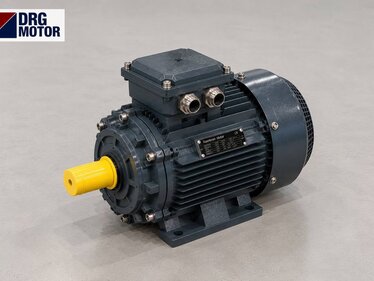
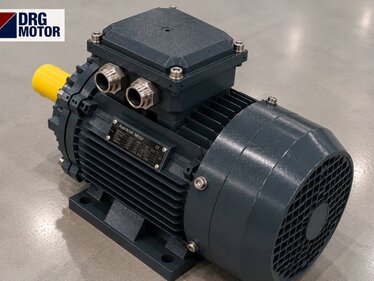
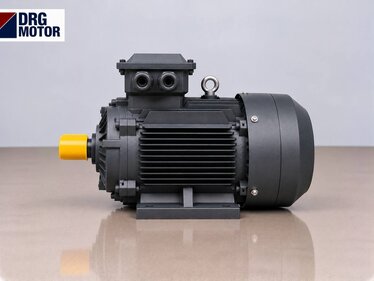
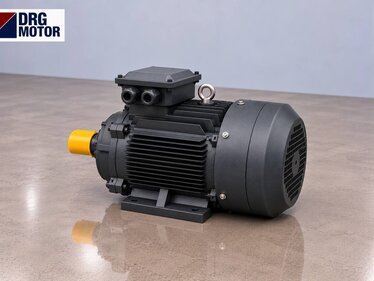
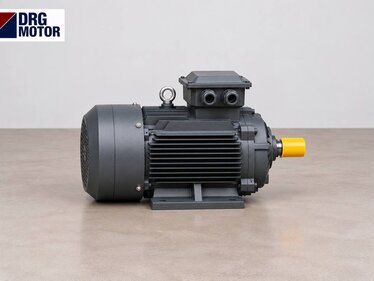
DRG Motor is a manufacturer, supplier and seller of electric motors; it does not sell gearboxes or pumps, but supplies the standard IEC motor that mounts on the input of the gearbox driving the pump. Foot-mounted (B3), flange-mounted (B5) and foot+flange (B35) versions are listed by power and speed in the DRG online motor shop.
What Load Does the Rotor–Stator Interference Put on the Motor?
Inside the pump, a chrome-plated single-start helical rotor turns eccentrically within the double-start helical cavity of a rubber (elastomer) stator. There is a deliberate interference fit between rotor and stator; the sealed cavities between them travel from suction to discharge and move the fluid without pulsation. A cardan or pin joint links the rotor to the drive shaft and converts the eccentric motion into the rotation of a straight shaft.
This interference fit has three consequences for the motor. First, when the pump stops, the elastomer settles onto the rotor and any sludge or paste left inside also settles. The torque needed to break this friction at the first movement can be clearly above the running torque. Second, flow is almost proportional to speed and torque rises with pressure; the load is constant-torque and does not fall with the square of speed as in a centrifugal pump. Third, a pump running against a closed valve raises pressure without limit; the motor either cannot start or strains until something breaks.
In a lobe pump the two rotors turn without touching, so starting friction is far less dominant; motor and gearbox selection for that type is covered separately in our article on lobe pump motor and gearbox selection.
Rotor Speed and Motor Poles by Fluid Type
In a progressive cavity pump, rotor speed is set by the viscosity and abrasiveness of the fluid. A stator running in sludge with sand or lime wears quickly at high speed, while a thick paste cannot fill the cavities at high speed. The exact speed limit is given by the pump maker's curve. The table below only shows the general trend.
| Fluid | Rotor speed trend | Drive arrangement | Motor watch-point |
|---|---|---|---|
| Clean, thin liquid | Relatively high | 4-pole + low-ratio gearbox | Current at higher pressure |
| Sewage sludge, slurry | Low | 4-pole + high-ratio gearbox | Starting torque, moisture |
| Thick paste, glue | Very low | 6-pole + gearbox | Heating at low speed |
| Mortar, plaster, sandy mix | Low | 4-pole + gearbox | Dust, frequent stop-start |
The 4-pole motor (1500 rpm class) is the most common choice because gearbox size and motor frame are well balanced. A 6-pole motor (1000 rpm class) reaches the same rotor speed with a lower-ratio gearbox, but its frame is one size larger at the same power. A 2-pole motor only makes sense in this pump with special very-low-ratio drives.
Worked Example: From Flow and Pressure to Gearbox Output Torque
The values below are assumptions; the real figure is the pump maker's nameplate and curve. Example: 50 l/min flow, 6 bar discharge pressure, assumed overall pump efficiency 0.60.
- Hydraulic power: P = Q·p/(600·η) = 50·6/(600·0.60) ≈ 0.83 kW.
- Rotor speed: with DRG-90S-4 (1445 rpm) and a gearbox ratio of 5, n2 = 1445/5 = 289 rpm.
- Torque required at the pump shaft: T = 9550·0.83/289 ≈ 27.5 Nm.
- Motor torque at the gearbox output: 7.27 Nm × 5 × 0.95 (assumed factor for gearbox losses) ≈ 34.5 Nm.
- Torque available at start: with Ts/Tn = 2.3, about 79.4 Nm, roughly 2.9 times the running torque.
In this example 1.1 kW looks sufficient; however, in a pump standing in sludge, fitted with a new stator or left in a cold place, breakaway torque can be much higher. In such cases choose one size up (1.5 kW) or ask the pump maker for the starting value. You can repeat the calculation with your own data in the pump and fan motor power calculator.
Click to see current electric motor prices and order nowSEE PRICES →
Gearbox Input, Flange and Shaft Dimensions
In mono pump drives the motor usually sits as B5 on the IEC input flange of the gearbox; on base-frame layouts with a coupling a B3 foot-mounted motor is used. Measure flange and shaft before removing the old motor, as the flange can differ even with the same frame size. B5 flange values to check (DRG catalogue):
- Frame 90S/90L: flange outer diameter P 200 mm, pitch circle M 165 mm, spigot N 130 mm, shaft 24×50 mm.
- Frame 100L/112M: P 250 mm, M 215 mm, N 180 mm, shaft 28×60 mm.
- Frame 132S/132M: P 300 mm, M 265 mm, N 230 mm, shaft 38×80 mm.
If a small-flange (B14) connection is required, the dimension is confirmed with the order. DRG motors for gearbox inputs on pumps are also grouped on the pump motors page.
Dry Running, Reverse Rotation and Overpressure: What the Motor Cannot Protect
The stator rubber is both lubricated and cooled by the fluid. When the suction side runs empty, the rotor rubs on dry rubber and the stator heats up and burns quickly. Motor current may not change noticeably meanwhile; the thermal overload relay does not detect dry running. This needs a stator temperature sensor, a flow switch or a level switch, and that equipment belongs to the pump side.
Overpressure is the opposite case: when a valve on the discharge line is left closed, torque rises quickly and motor current increases. The overload relay trips after a while, but the cardan joint or gearbox may be damaged in the meantime. A pressure switch or safety bypass on the discharge side also protects the motor.
A progressive cavity pump can pump in both directions, but in most models the mechanical seal and joint arrangement are laid out for one direction. If phase sequence is mixed up after a motor change, the pump delivers backwards and the seal sees discharge pressure instead of suction pressure. Check direction of rotation with a short jog at first start.
Flow Control by Inverter and the Operating Environment
In dosing and wastewater applications, flow is adjusted by feeding the motor from a frequency inverter and changing rotor speed. Drives are not part of the DRG offer; the induction motor supplied can be fed from a frequency inverter. As the load is constant-torque, the motor works close to full torque at low frequency, but its own fan turns slower too, so less air reaches the frame. For drives that stay at very low speed for long periods, one size up or external cooling should be considered.
In wastewater plants, slurry pits and food plants, the motor sees humidity, washing water and corrosive vapour. DRG motors are IP55 with class F insulation, suitable for −15…+40 °C ambient and altitudes up to 1000 m. Hygienic areas washed with pressurised water need a stainless-steel motor, and explosive atmospheres such as biogas need a special Ex-protected motor; these duties are not covered by a standard IEC motor.
Checklist Before Replacing the Motor
- Old motor nameplate: kW, speed, voltage and connection (up to 3 kW 230/400 V, 4 kW and above 400/690 V).
- Mounting: flange-mounted on the gearbox (B5) or foot-mounted on a base (B3)?
- Flange outer diameter, spigot diameter and shaft diameter×length; key width.
- Gearbox ratio and the input speed on the gearbox nameplate.
- Pump discharge pressure, flow and fluid type (sludge, paste, liquid).
- Starting: DOL starter, soft starter or inverter; if star-delta is used, allow for the reduced starting torque.
- Check that dry-running and pressure protection work, and verify the new motor's direction of rotation.
DRG Motors Suited to Mono Pump Drives
These 4-pole models cover the power range most often seen at gearbox inputs, from small dosing pumps to sewage sludge pumps; the cast iron frame stands out in humid, heavy-duty environments.
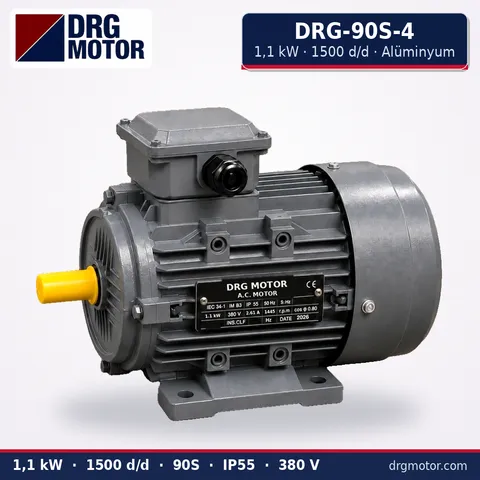
1.1 kW Three-Phase Motor 1500 rpm – DRG-90S-4 Aluminium
- 1.1 kW · 1500 rpm (4 poles)
- Aluminium frame · IEC 90S
- Mounting: B3 · B5 · B14 · B35
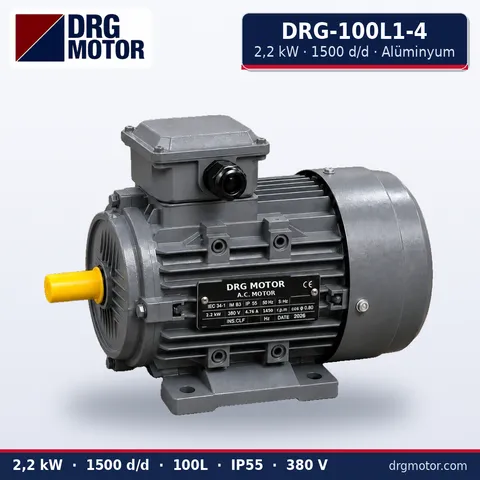
2.2 kW Three-Phase Motor 1500 rpm – DRG-100L1-4 Aluminium
- 2.2 kW · 1500 rpm (4 poles)
- Aluminium frame · IEC 100L
- Mounting: B3 · B5 · B14 · B35
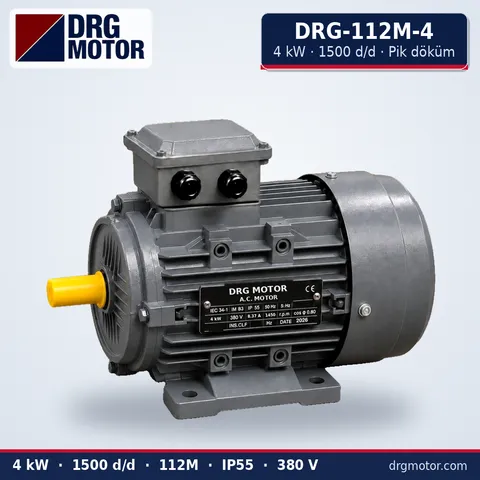
4 kW Three-Phase Motor 1500 rpm – DRG-112M-4 Cast Iron
- 4 kW · 1500 rpm (4 poles)
- Cast iron frame · IEC 112M
- Mounting: B3 · B5 · B14 · B35
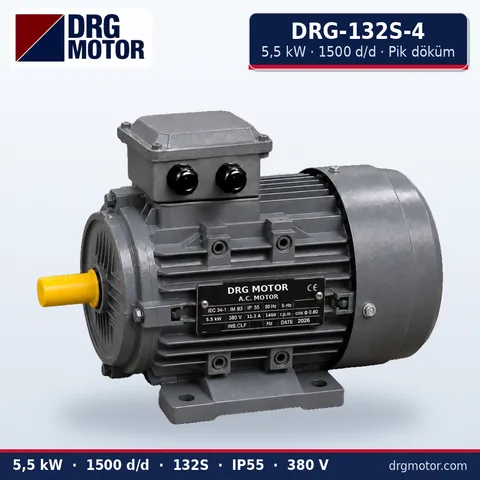
5.5 kW Three-Phase Motor 1500 rpm – DRG-132S-4 Cast Iron
- 5.5 kW · 1500 rpm (4 poles)
- Cast iron frame · IEC 132S
- Mounting: B3 · B5 · B14 · B35
Click to see current prices and order these motors nowSEE PRICES →
Mono Pump Motor: Frequently Asked Questions
What speed should a mono pump motor be?
The motor is usually 4-pole (about 1450 rpm) or 6-pole; rotor speed is reduced by the gearbox. The required rotor speed is set by the fluid and the pump maker's curve; motor speed only means something together with the gearbox ratio.
Why does a mono pump struggle or trip the overload at start-up?
In a standing pump the stator settles onto the rotor and sludge inside settles; breakaway torque rises well above running torque. Star-delta starting also reduces torque. Check motor power and starting method against the starting value, and make sure discharge valves are open.
Does the motor detect it if a mono pump runs dry?
Usually not; the stator heats up and fails quickly without a clear change in current. Dry-running protection uses a stator temperature sensor, flow switch or level switch; the motor's thermal protection does not do this job.
What happens if a mono pump motor runs in reverse?
The pump delivers in the opposite direction; if the seal and joint are laid out for one direction, the seal is overloaded and the suction line sees pressure. After a motor change, swap two phases to correct direction and keep the first run short.
To identify the right motor, send a photo of the old motor's nameplate, its power, speed, mounting (foot or flange), shaft size and the pump's flow and pressure via WhatsApp, or build a quote list. Phone: +90 (542) 666 11 11 · e-mail: info@drgmotor.com · contact page. All models are listed in the DRG online shop.