English
 Le français
 Türkçe




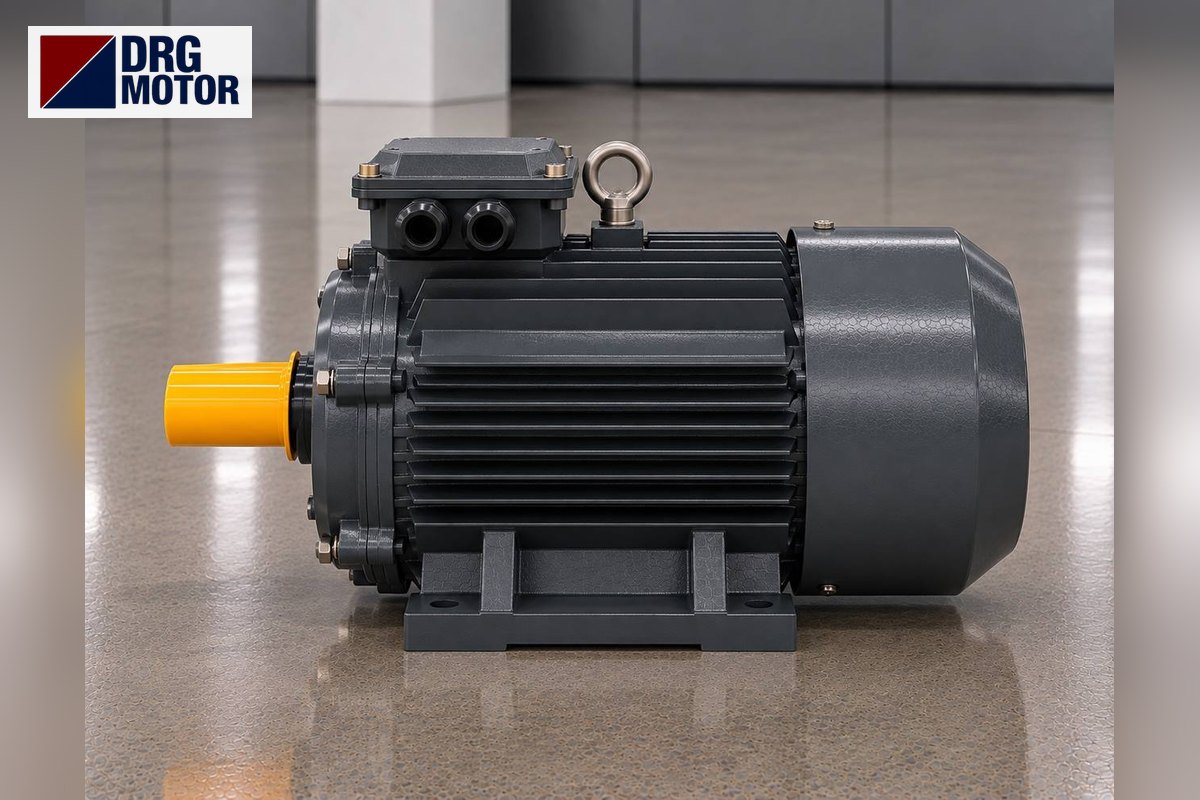

A tyre retread buffing machine has two separate motors, and they are selected in completely different ways: the motor turning the rasp head runs at high speed, is usually 2-pole and carries a fluctuating cutting load; the motor rotating the tyre on its axis is small, works through a gearbox and is often speed-controlled by an inverter. For the rasp motor, peripheral rasp speed comes before the kW figure; for the rotation drive, gearbox ratio and torque held at low speed are what matter.
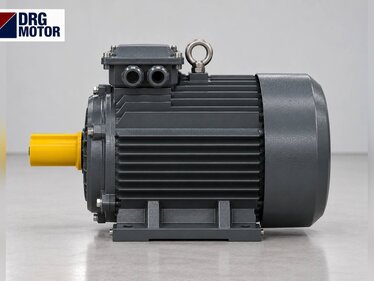
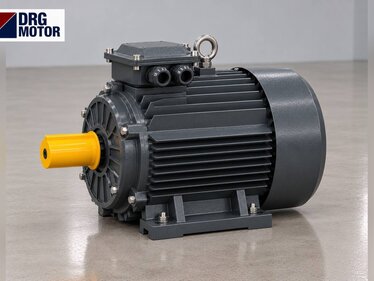
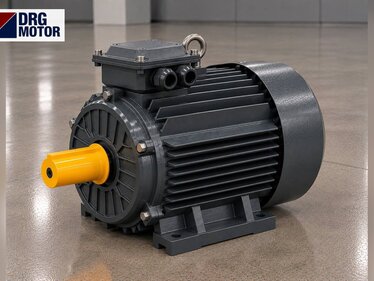
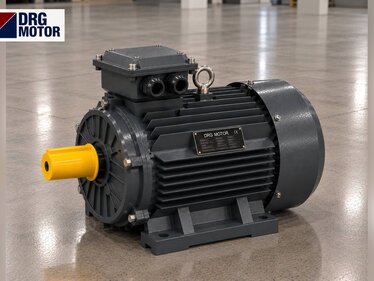
DRG Motor is an electric motor manufacturer, supplier and seller; it does not sell buffing machines or gearboxes, but supplies the standard three-phase IEC motor fitted to these machines. You can compare suitable power and speed ratings for the rasp and rotation drives in the DRG online motor shop.
Rasp Head and Tyre Rotation: Who Does What
The casing whose old tread is to be removed is mounted on an expanding rim hub and inflated to a set internal pressure. The rasp hub is a cylinder of stacked toothed blades; pressed against the tyre, it scrapes the rubber off as crumbs and fine dust. The operator or an automatic axis moves the head across the tread and towards the shoulders to give the required profile and surface texture.
Meanwhile the tyre turns slowly. The cutting force of the rasp blades acts tangentially on the tyre, and the rotation drive must hold speed against it. As cutting depth increases, the rasp motor draws more current while the rotation motor is loaded in a braking or pushing direction. Large automatic machines add axis motors and a separate dust extraction fan.
Other motor duties in the rubber industry (mixer, calender, extruder) are covered in general terms in our article on electric motors in the tyre and rubber industry; here we focus only on the buffing machine.
Rasp Motor: The Peripheral Speed Limit Comes First
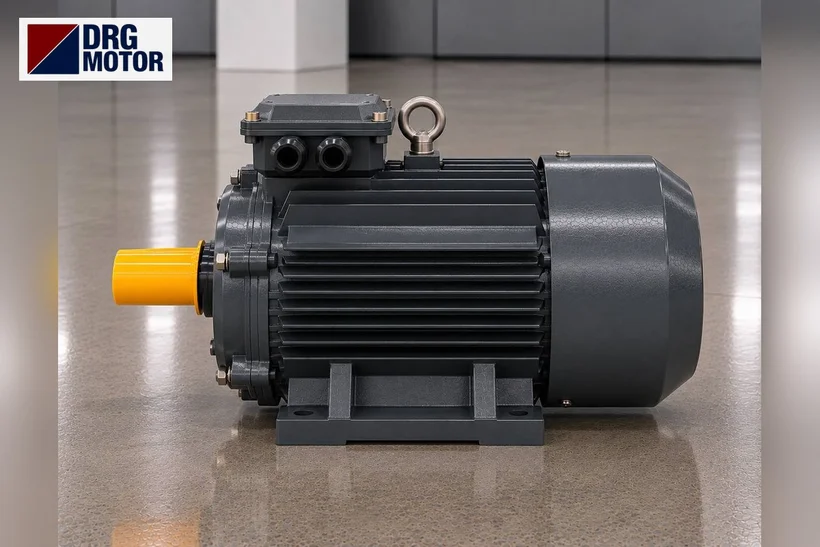
Every rasp hub and blade set has a maximum speed stated by its maker. Motor selection starts there: in direct drive the motor speed, and in belt drive the speed multiplied by the pulley ratio, must not exceed this value. If peripheral speed is too low, the blades crush the rubber instead of cutting it, the surface heats up and a sticky texture forms.
Example (assumption): a 230 mm rasp hub driven directly by the DRG-132S1-2, rated speed 2930 rpm. Peripheral speed is v = π·D·n/60 = π·0.23·2930/60 ≈ 35.3 m/s. If this is within the rasp maker's limit, direct coupling is fine; if not, a pulley reduces it.
Speed Difference on Imported 60 Hz Machines
On machines from 60 Hz countries, the rasp motor plate shows about 3400–3500 rpm. A 2-pole motor on a 50 Hz supply gives about 2900 rpm. Example: if the plate reads 3500 rpm and a 2930 rpm motor is fitted, the motor pulley must be 3500/2930 ≈ 1.19 times larger relative to the driven pulley to return to the same rasp speed. You can check the ratio with the pulley and belt calculator; again confirm that the higher speed stays within the rasp limit.
Power Range and Candidate Models
Rasp motor power depends on machine size, cutting depth and operator pressure. Small machines for car and light commercial tyres use a few kW, while automatic machines for truck and earthmover tyres use higher ratings. The exact figure is the machine maker's nameplate; the table below only gives catalogue values for 2-pole DRG candidates.
| Model | Power | Rated speed | Current (400 V) |
|---|---|---|---|
| DRG-112M-2 | 4 kW | 2905 rpm | 7.45 A |
| DRG-132S1-2 | 5.5 kW | 2930 rpm | 10.1 A |
| DRG-132S2-2 | 7.5 kW | 2930 rpm | 13.7 A |
| DRG-160M1-2 | 11 kW | 2945 rpm | 19.6 A |
Click to see current electric motor prices and order nowSEE PRICES →
Rotation Drive: Gearbox Ratio and Torque at Low Speed
The tyre rotation motor is small, but the load is awkward: the drive must hold speed while the rasp blades push the tyre tangentially. A 4-pole motor, a high-ratio gearbox and an inverter for speed adjustment are therefore common. A worm gearbox, with its resistance to back-driving, limits the tyre running ahead under the rasp force.
- Example output speed: DRG-801-4 (1400 rpm) with an 80:1 gearbox gives n2 = 1400/80 = 17.5 rpm.
- Tyre surface speed: for a 1000 mm outside diameter, v = π·1.0·17.5/60 ≈ 0.92 m/s.
- Heavier tyres: if casing and rim inertia are larger, the DRG-90S-4 (1.1 kW, 7.27 Nm) is the next option up.
These values are examples; the real ratio is read from the gearbox plate. When an inverter lowers speed, the motor's own fan slows too; for a drive that will run at very low frequency for long periods, a larger ratio that keeps the motor near rated frequency is healthier. DRG does not sell gearboxes or inverters; it supplies the motor that fits the existing gearbox input flange.
Rubber Dust, Heat and Motor Cooling
Rubber dust from buffing is hot and slightly sticky. IP55 protection limits dust and water ingress into the motor, but dust packed on the frame fins and fan cover weakens external cooling. With IC411 cooling, the motor is cooled by air blown over the fins by its own fan; if the fins clog, winding temperature rises.
- Place the rasp motor on the side where dust from the suction hood is not aimed straight at it.
- Clean the fan cover grille and fins regularly with compressed air.
- Start the dust extraction fan together with the rasp motor; do not buff for long with extraction off.
- Keep in mind class F insulation and the −15…+40 °C ambient range; ventilate if the machine sits in a hot enclosure.
Mounting and Shaft Checks When Replacing the Motor
On some machines the rasp motor is foot-mounted (B3) on a slide with a belt; on others it is flange-mounted (B5) on the head housing. Where the rasp hub sits directly on the motor shaft, shaft length, thread and shoulder are machine-specific; a standard IEC shaft will not fit and a special-shaft motor is needed. DRG does not supply special shafts; on such a machine, switching to a standard motor via an intermediate spindle with its own bearings and a belt or coupling is one option, but assess that conversion together with the machine maker.
Pre-replacement checklist:
- Power, speed, frequency (50/60 Hz) and voltage on the old motor's nameplate
- Mounting (B3, B5, B35) and frame size; for B5, flange outside diameter, bolt circle and spigot diameter
- Shaft diameter and length; is the rasp hub fitted directly to the shaft, or is there a pulley?
- Maximum speed of the rasp hub and blades
- For the rotation drive, gearbox type, ratio and input flange
- If there is an inverter, parameters matching the motor nameplate
According to the DRG catalogue, B5 flange values for frame 132S are: flange outside diameter 300 mm, bolt circle 265 mm, spigot diameter 230 mm, shaft 38×80 mm. For frame 80 they are 200, 165 and 130 mm respectively, with a 19×40 mm shaft. Small flange (B14) dimensions are confirmed at order.
Symptoms of the Wrong Motor
Fitting a low-speed (4-pole) motor on the rasp side is the most common mistake: the hub turns slowly, the rubber burns instead of being cut, and as the operator presses harder the motor draws excess current. Too high a speed is a safety risk for blades and hub. On the rotation side, a drive that reaches low speed through a small gearbox ratio and low frequency runs hot, the tyre chatters under the rasp and the surface texture comes out wavy. An undersized rasp motor trips its overload relay frequently as cutting depth increases.
Other motor options for rubber machinery are collected on our rubber processing machine electric motors page.
DRG Motors Suited to Tyre Buffing Machines
The first two models are 2-pole power options for the rasp head; the last two are small 4-pole motors for the tyre rotation gearbox.
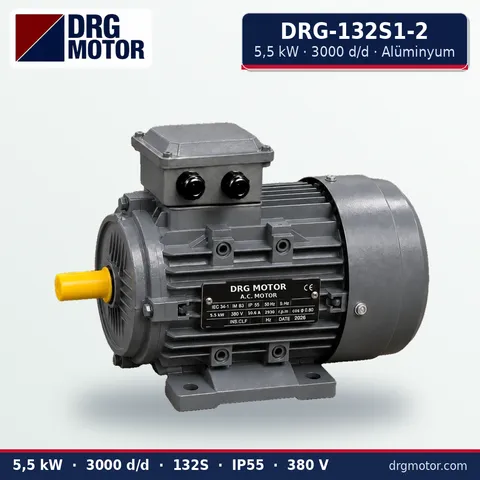
5.5 kW Three-Phase Motor 3000 rpm – DRG-132S1-2 Aluminium
- 5.5 kW · 3000 rpm (2 poles)
- Aluminium frame · IEC 132S
- Mounting: B3 · B5 · B14 · B35
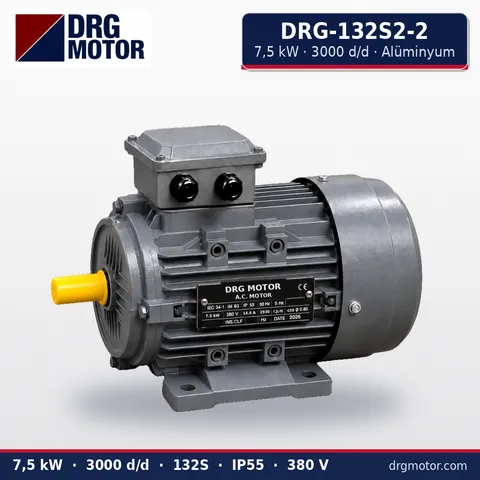
7.5 kW Three-Phase Motor 3000 rpm – DRG-132S2-2 Aluminium
- 7.5 kW · 3000 rpm (2 poles)
- Aluminium frame · IEC 132S
- Mounting: B3 · B5 · B14 · B35
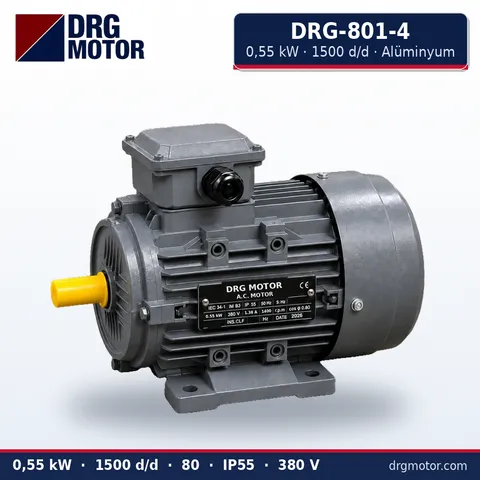
0.55 kW Three-Phase Motor 1500 rpm – DRG-801-4 Aluminium
- 0.55 kW · 1500 rpm (4 poles)
- Aluminium frame · IEC 80
- Mounting: B3 · B5 · B14 · B35
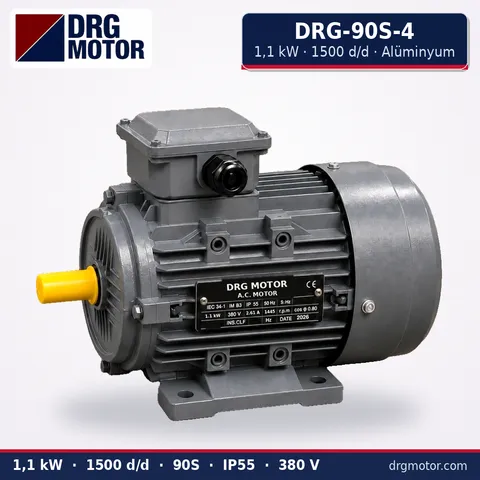
1.1 kW Three-Phase Motor 1500 rpm – DRG-90S-4 Aluminium
- 1.1 kW · 1500 rpm (4 poles)
- Aluminium frame · IEC 90S
- Mounting: B3 · B5 · B14 · B35
Click to see current prices and order these motors nowSEE PRICES →
Tyre Buffing Motor: Frequently Asked Questions
What speed should a tyre rasp motor run at?
A 2-pole motor (about 2900 rpm) is usually used, provided it does not exceed the rasp hub's maximum speed. With a pulley drive, rasp speed is motor speed multiplied by the pulley ratio; the hub's marking sets the limit.
Can a 4-pole motor replace the rasp motor on a buffer?
Not without recalculating the pulley ratio. With the same pulleys, rasp speed drops to roughly half, the rubber is not cut and it overheats.
Is an inverter required for the tyre rotation motor?
Not required, but widely used to adjust surface speed for different tyre diameters. If the drive will run at very low frequency for long periods, a larger gearbox ratio protects motor cooling.
Does rubber dust damage the motor?
IP55 limits dust entering the motor; the usual problem is clogged fins and impaired cooling. Regular cleaning and a working dust extraction system are needed.
For a quotation, send a photo of the old motor's nameplate, whether it is the rasp or rotation motor, foot or flange mounting, shaft size and the tyre type the machine handles via WhatsApp, or add the models to the quote list. Phone: +90 (542) 666 11 11 · E-mail: info@drgmotor.com · Contact page. All models are listed in the online shop.