English
 Le français
 Türkçe




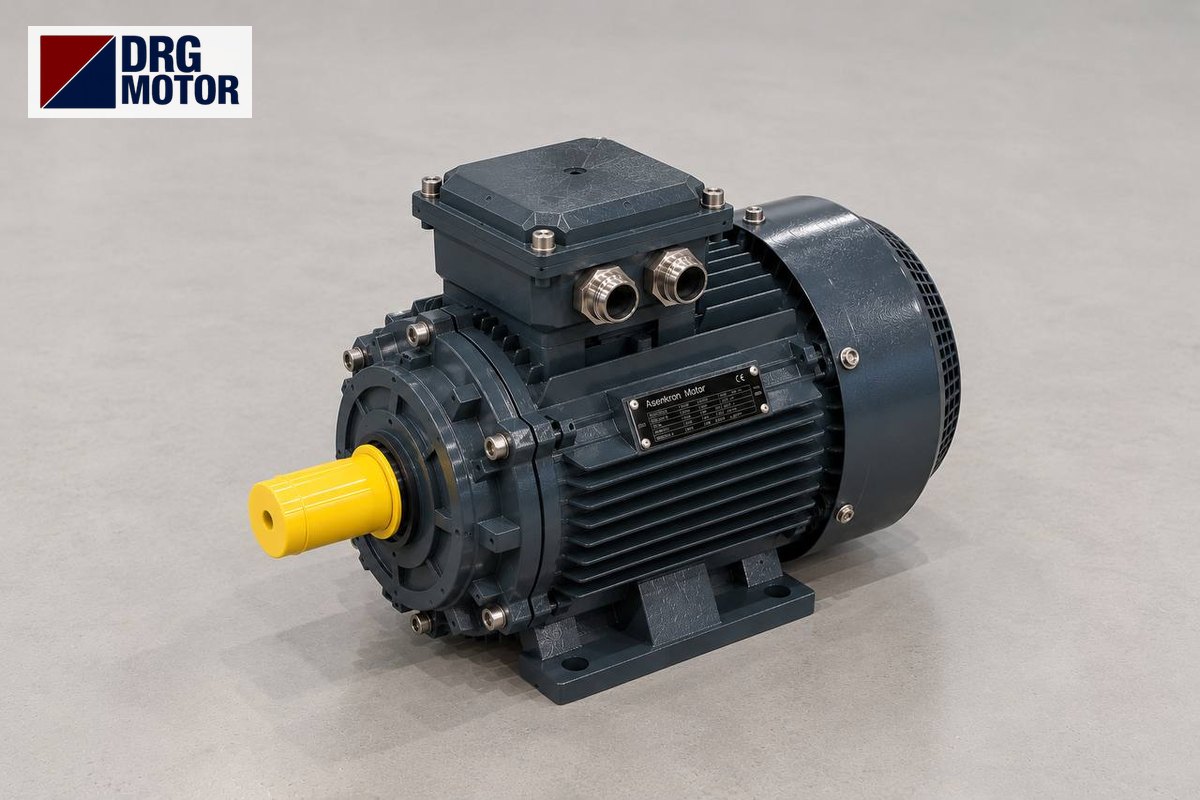

On a stenter, the impeller of the circulation fan turns inside the drying and heat-setting chamber at 150–220 °C, but its motor is not built to withstand that temperature: the motor sits outside the oven compartment, usually on the roof or the side wall, and drives the impeller through a long shaft. So two things decide the replacement motor: the power, speed and flange size on the nameplate, and the real air temperature where the motor stands.
To be clear: DRG motors are built for −15…+40 °C ambient. A high-temperature motor to go inside the oven or into a compartment above 40 °C is not part of the DRG range. If the motor stands outside the oven in cool air, standard 4-pole models are on our buy electric motors online page.
How Does Air Circulate in a Stenter Oven?
A stenter is a fabric drying and tentering line. The fabric is held at both edges on pin or clip chains and passes through a row of oven compartments. In each compartment one or two circulation fans push air heated by a burner or thermal oil exchanger into upper and lower nozzle ducts; the air is blown on both faces of the fabric and returns to the fan inlet.
The same air is recirculated many times; part of the humid air is discharged by a separate exhaust fan. The circulation fan is therefore usually a radial impeller inside the compartment. In a typical layout the motor stands vertically on top of the compartment roof, bolted by its flange to a support hub, and the shaft passes through the compartment wall to the impeller.
The load is a fan load: power varies with the cube of speed and, at a given speed, in proportion to air density. That density difference is what sets a stenter fan apart from a fan moving cool air. General features of fan loads are gathered on our fan motors page.
The Temperature Limit: Where Can the Motor Stand?
Heat from the oven reaches the motor by three routes. Who takes care of each must be clear from the start; the table below sums it up.
| Heat path | Measure | Whose job |
|---|---|---|
| Conduction along the shaft | Long shaft, cooling disc | Fan and machine builder |
| Radiation from the roof | Insulation, heat shield | Machine builder |
| Hot air drawn by the motor | Fresh air, ventilation | Plant operator |
| Heat through the flange | Insulated spacer hub | Fan and machine builder |
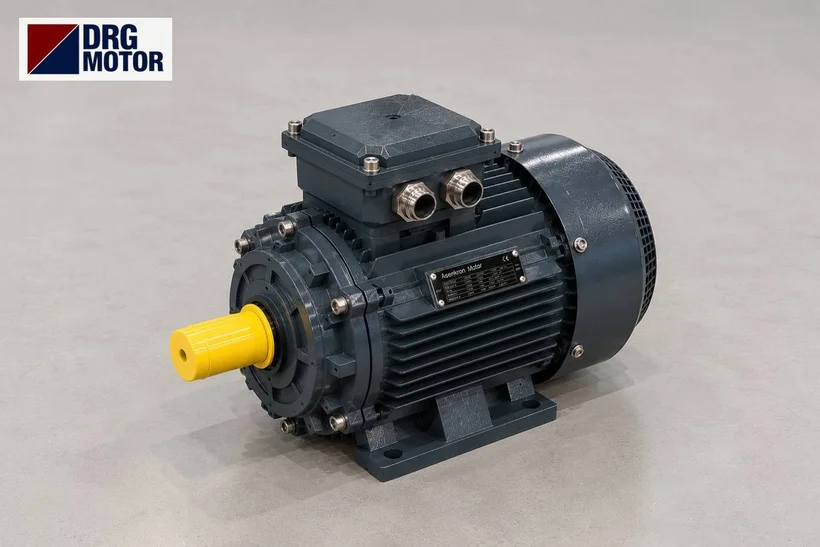
The motor is IC411 cooled: its own rear fan blows surrounding air over the frame fins. If the air above the stenter roof is hot, the motor is cooled with hot air and the winding runs hotter at the same load. So before replacing the motor, measure the air temperature where it stands while the line is at full temperature.
If the reading exceeds 40 °C, the standard motor nameplate is not valid for that condition. The options are: bring a fresh-air duct to the motor, renew the roof insulation, or use a special motor built for high ambient temperature. The last option cannot be met by a standard IEC motor and is not offered by DRG.
Heat coming through the shaft and flange is explained in detail on our high-temperature fan motor page; selecting the fan and shaft arrangement is the fan builder's responsibility.
Click to see current electric motor prices and order nowSEE PRICES →
From Heat-Setting Temperature to a Cold Morning: Power and Speed
The impeller is sized for hot air. At 180 °C air is about 1.546 times lighter than at 20 °C. When the same fan turns at the same speed in a cold oven, shaft power rises by that ratio.
Example (assumption): a fan taking 5.5 kW of shaft power at 180 °C needs about 8.5 kW at the same speed when the oven is cold. A 5.5 kW motor is overloaded in that case. If the fan runs on an inverter, the solution is to reduce speed until heat-up is complete: at 80 percent speed the same fan takes about 4.35 kW in cold air, staying below the motor's limit.
Without an inverter, either the motor is sized for the cold-start power or the fan damper is throttled during heat-up. Which applies depends on the machine's automation. For a rough estimate of fan power from airflow and pressure, use our pump and fan motor power calculator; the exact value is the fan builder's curve.
On speed the rule is simple: keep the same number of poles as the old motor. Replacing a 4-pole motor with a 2-pole one raises fan power about eightfold, endangering motor and impeller at once.
Replacing a Vertical Flange Motor: Dimensions
Roof-mounted stenter motors are mostly fixed with a B5 large flange. On replacement the flange size, shaft diameter and shaft length must match exactly; the support hub and coupling are machined to them. Catalogue values for the DRG-132S-4, for example:
- Power: 5.5 kW – 1460 rpm – 10.7 A (400 V)
- Frame: 132S aluminium, IP55, class F insulation
- B5 flange: pitch circle M = 265 mm, spigot N = 230 mm, outer diameter P = 300 mm
- Flange holes: S = 14.5 mm, spigot depth T = 4 mm
- Shaft (D × E): 38 × 80 mm, key 10 mm
- Bearing: 6208-ZZ-C3
Check before ordering:
- Air temperature measured where the motor stands, with the line at full temperature (40 °C limit).
- Old motor nameplate: kW, rpm, voltage, connection and mounting.
- Flange dimensions M, N, P, S and shaft diameter and length; do the support hub and coupling match?
- Is the motor vertical with the shaft pointing down? State the mounting position in the order.
- Is the fan inverter-driven, and is speed reduced during heat-up?
- Are insulation and the heat shield between motor and roof in place?
- Does lint from the fabric clog the fan cover; what is the cleaning interval?
Lint, Ignition and Maintenance Intervals
The stenter roof gets dirty with fibre lint and finishing vapours. Lint settles on the motor fan cover and fins and weakens cooling. The IP55 frame keeps this dust out, but cleaning the outer surface is the maintenance team's job.
Accumulated lint can ignite on a hot surface, so keeping the motor surface clean matters for line safety, not only for the motor. If some finishing or coating processes generate solvent vapour, the area may need hazardous-area classification; an Ex-protected motor would then be required, and that is not in the DRG range.
Bearings age faster with heat. On a motor receiving heat through the shaft, check the noise and temperature of the drive-end bearing periodically; if the sound changes, plan a stop.
DRG Motors Suitable for Stenter Circulation Fans
4-pole aluminium frame models that can be ordered with a B5 flange, for fan motors standing outside the oven at a point not exceeding 40 °C.
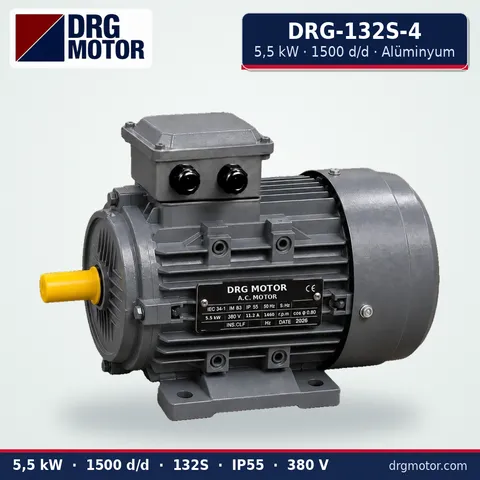
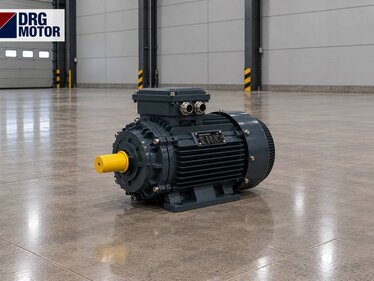
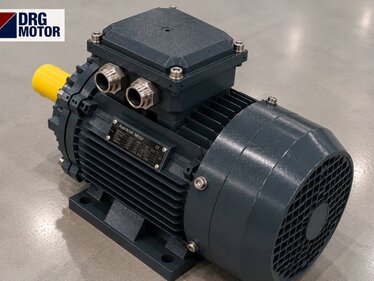
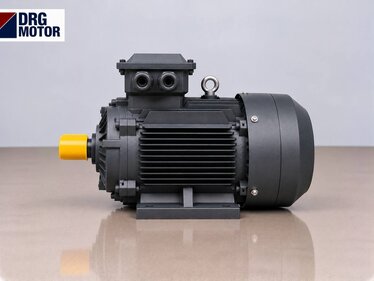
5.5 kW Three-Phase Motor 1500 rpm – DRG-132S-4 Aluminium
- 5.5 kW · 1500 rpm (4 poles)
- Aluminium frame · IEC 132S
- Mounting: B3 · B5 · B14 · B35
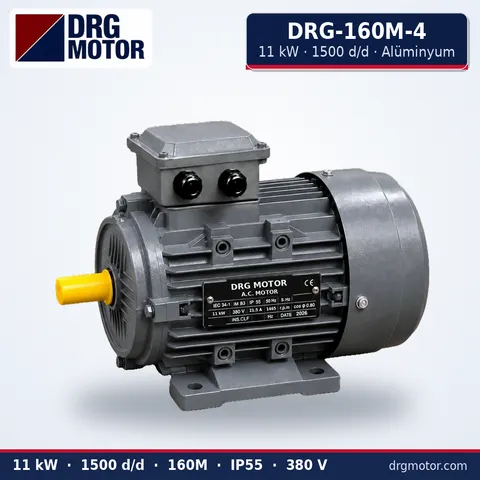
11 kW Three-Phase Motor 1500 rpm – DRG-160M-4 Aluminium
- 11 kW · 1500 rpm (4 poles)
- Aluminium frame · IEC 160M
- Mounting: B3 · B5 · B14 · B35

4 kW Three-Phase Motor 1500 rpm – DRG-112M-4 Aluminium
- 4 kW · 1500 rpm (4 poles)
- Aluminium frame · IEC 112M
- Mounting: B3 · B5 · B14 · B35
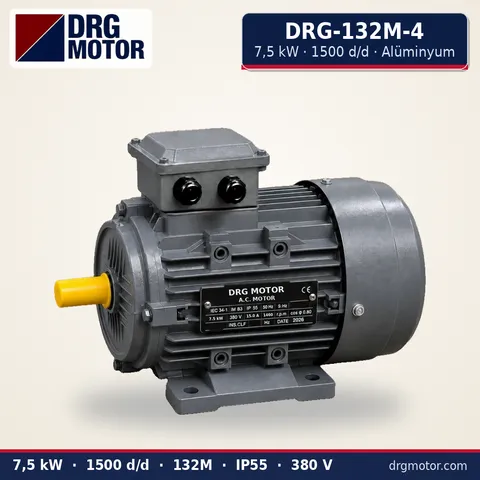
7.5 kW Three-Phase Motor 1500 rpm – DRG-132M-4 Aluminium
- 7.5 kW · 1500 rpm (4 poles)
- Aluminium frame · IEC 132M
- Mounting: B3 · B5 · B14 · B35
Click to see current prices and order these motors nowSEE PRICES →
Stenter Fan Motor: Frequently Asked Questions
Why does the stenter fan motor burn out often?
The usual causes are cooling the motor with hot air, starting the fan at full speed in a cold oven, lint-clogged fins and drive-end bearing fatigue from heat along the shaft. Measuring the temperature around the motor before replacing it often reveals why the failure keeps returning.
Can a DRG motor be installed inside the stenter oven?
No. DRG motors suit a maximum ambient of +40 °C. A motor working inside the oven or in a hot compartment is a special high-temperature motor and is not part of the DRG range.
What kW motor does a stenter fan need?
It depends on compartment length, impeller and airflow, so a single figure would be misleading. The exact power is on the machine builder's nameplate and fan curve. Also allow for the extra power at cold start.
Can a stenter fan motor be run on an inverter?
Yes, a standard three-phase induction motor can be inverter-driven. In this application the inverter is also used to reduce speed during heat-up, limiting the extra load in cold air. DRG does not sell inverters; inverter settings should be made by a qualified electrician.
DRG Motor is a manufacturer, supplier and seller of electric motors. To work out the right quotation for a stenter fan motor, we need a nameplate photo of the roof motor, its kW and speed, how it is fixed (feet or flange), shaft and flange dimensions, and the air temperature read next to the motor while the line is hot. Share these on WhatsApp or put the models into our quote list. To talk directly call +90 (542) 666 11 11; for written requests use info@drgmotor.com; all addresses are on the contact page. Current price information is in our motor store.