English
 Le français
 Türkçe




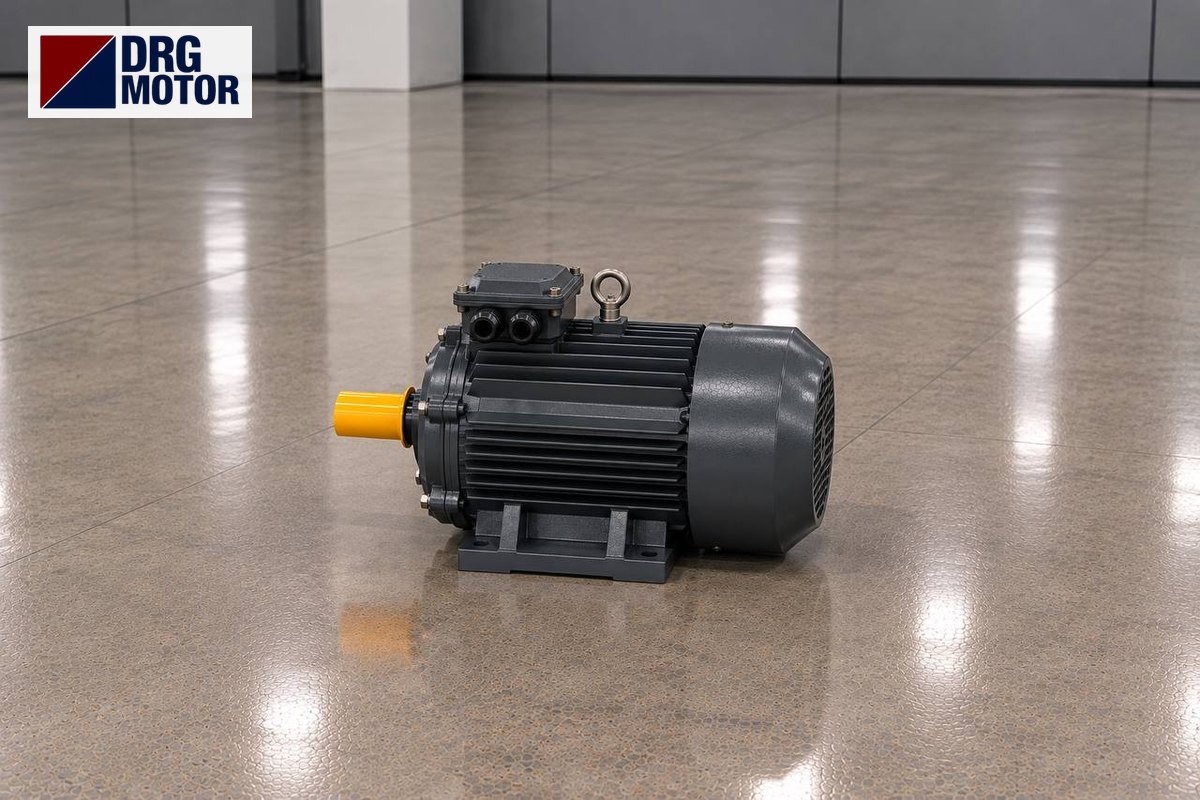

On an EPS pre-expander, the agitator motor turns the vertical shaft that keeps polystyrene beads expanding with steam from clumping, so they grow to an even density in the vessel. Two things decide motor selection: the restart torque with a full vessel of partly fused beads, and the hot, humid conditions on top of the vessel. Normal running torque usually stays below both of these.
DRG Motor is a manufacturer, supplier and seller of electric motors; cast iron three-phase asynchronous motors that connect to an agitator gearbox are listed with power and speed options on the buy electric motors online page. The gearbox is outside DRG's product range; DRG supplies the motor that fits the gearbox input.
What Happens Inside the Vessel During Pre-Expansion?
Raw EPS consists of small, hard beads containing a blowing agent (pentane). In a batch pre-expander the weighed beads are fed into a vertical cylindrical vessel and steam is introduced from below. The beads soften, the gas inside expands and their volume grows many times over; a level sensor or weighing system cuts the steam when the target density is reached, and the material is discharged through a side door to a fluid-bed dryer.
The agitator's job is to keep the beads moving between the arms turning on the central shaft and the fixed counter-arms. Without movement, softened beads stick together, lumps form and density distribution is lost. In other words, if the agitator stops, it is the batch that is lost, not just time.
How Does the Load Change Through a Batch?
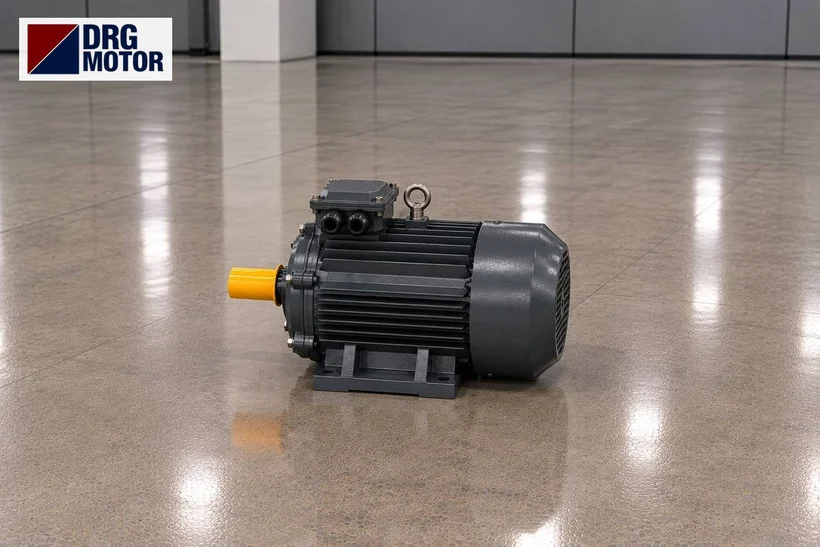
The mass of beads stays almost the same through the batch, but their volume and surface change. The agitator torque is therefore not constant:
| Batch stage | Vessel condition | Agitator load | Risk for the motor |
|---|---|---|---|
| Filling | Raw beads at bottom, hard | Low to medium | Low |
| Start of steaming | Beads soften, sticky | Rises | Torque up if lumps form |
| Expansion | Level rising fast | Most arms buried | Peak load |
| Discharge | Material flowing out | Drops quickly | Low |
| Power cut | Hot, full, stopped vessel | High breakaway torque | Fails to start |
The last row decides the selection. When power fails mid-batch, the beads cling to each other between the arms while still hot and soft. When power returns, the motor has to break that mass loose at the first moment; the starting torque ratio (Ts/Tn) then becomes more important than rated power.
Click to see current electric motor prices and order nowSEE PRICES →
From Agitator Shaft Torque to Motor Power: Assumed Calculation
Real agitator torque depends on vessel volume, number of arms and target density; the definitive value is the machine builder's nameplate or catalogue. The calculation below is an example given only to show the method.
Assumption: 1500 Nm at the agitator shaft during expansion, shaft speed 30 rpm, gearbox efficiency 0.9.
- Shaft power: P = 1500 × 30 / 9550 ≈ 4.71 kW.
- At the motor shaft, with gearbox losses: 4.71 / 0.9 ≈ 5.24 kW.
- With a 4-pole motor (1460 rpm) the ratio needed is i ≈ 48.7; with a 6-pole motor (968 rpm) i ≈ 32.3.
For 5.24 kW, the 5.5 kW DRG-132S-4 is enough on paper but leaves a margin of only about five percent. For this load the 7.5 kW DRG-132M-4 is the sounder choice: rated torque 49.1 Nm against 34.2 Nm needed at the motor; with a starting torque ratio of 2.0 it can deliver roughly 4300 Nm of breakaway torque to the shaft with a full vessel. Choosing the 6-pole DRG-132M2-6 for the same vessel does not add power, it only reduces the gearbox ratio; the power margin is still limited to 5.5 kW. Use the gearbox output speed and torque calculator for ratio and torque.
On small laboratory and workshop pre-expanders the motor is a few kW; on large production machines with big vessels it can exceed ten kW. Besides the agitator motor, the machine has separate drives such as the fluid-bed dryer fan and the discharge and feed screws.
Steam, Condensate and Heat on Top of the Vessel
On most machines the agitator motor sits on the vessel's top cover, vertically above the gearbox (shaft down). The vessel shell can exceed 100 °C during steaming; heat passes from the gearbox and motor flange into the motor, and the air above the cover warms up too. The motor's rated ambient range is −15…+40 °C; if the space above the cover goes beyond that, ventilation or a spacer that isolates the motor from heat should be considered.
When the discharge door opens, escaping steam condenses on the motor. IP55 protects against splashing water, not against steam condensing on it all the time. With vertical mounting the fan cover is on top, so ask for a rain canopy and do not point the cable entry upwards. Because of the risk of internal condensation during long stops, state "vertical shaft down, humid environment" with the order.
EPS beads release pentane vapour during pre-expansion. If the plant's risk assessment classifies the area around the machine as a hazardous zone, a standard IEC motor cannot do this job; an Ex-protected special motor is needed and DRG does not supply that type. In well-ventilated areas without zoning a standard motor is used; that decision belongs to the plant safety officer.
Flange, Shaft and Gearbox Fit for Vertical Mounting
Agitator gearboxes are usually bevel-helical or parallel-shaft types, and the motor connects vertically with a B5 large flange. What to measure when replacing:
- Frame 112M (DRG-112M-4): shaft 28 × 60 mm, flange M 215 / N 180 / P 250 mm.
- Frames 132S and 132M (DRG-132S-4, DRG-132M-4, DRG-132M2-6): shaft 38 × 80 mm, flange M 265 / N 230 / P 300 mm.
- Bearings: 6206-ZZ-C3 on 112M, 6208-ZZ-C3 on the 132 frames.
Going from 5.5 kW to 7.5 kW in the same 132 frame does not change the gearbox adapter; only the motor length grows from 438 mm to 476 mm. That means the motor takes 38 mm more height above the cover; check clearance to the crane hook and the steam line. Moving from 112M to 132 changes flange and shaft, so the gearbox adapter changes too. For suitable gearbox inputs see the electric motors for gearboxes page.
When the Agitator Motor Is Wrongly Chosen
- After a power cut the motor hums but does not turn: breakaway torque exceeds the motor's starting torque; the motor is too small in power or starting torque.
- More lumps in the batches: agitator speed drops during expansion; the motor slips under load.
- The overload trips at the end of steaming: peak load and heat above the cover together push the motor to its limit.
- Water and rust in the terminal box: with vertical mounting the cable entry points upwards, or the gasket is not seated.
- Early noise from the lower bearing: gearbox misalignment in vertical mounting, or moisture brought in by steam.
Checklist before replacement or order:
- Photo of the old motor's nameplate: kW, rpm, voltage, current.
- Gearbox type, ratio and agitator shaft speed.
- Mounting position: vertical shaft-down flange (B5) or horizontal foot-mounted.
- Shaft diameter and flange dimensions (M / N / P).
- Vessel volume and typical batch fill weight.
- Whether the area around the machine is classified as a hazardous zone.
- Starting method and whether the machine restarts automatically after a power cut.
DRG Motors Suited to an EPS Pre-Expander Agitator
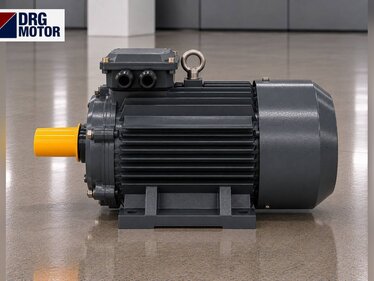
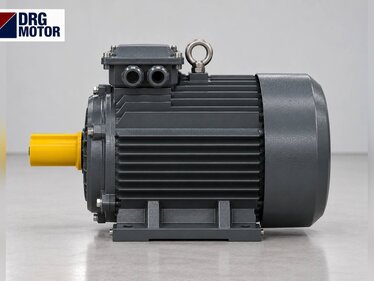
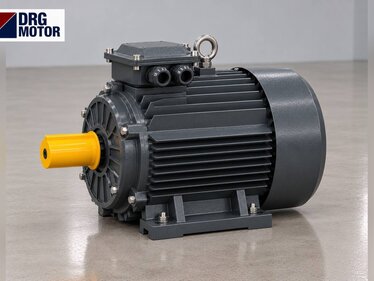
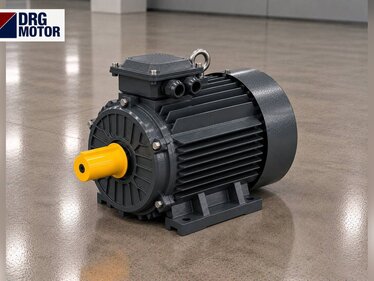
These are cast iron motors that can be mounted vertically on the agitator gearbox with a B5 flange; they cover the 5.5–7.5 kW range of the example calculation and smaller vessels.
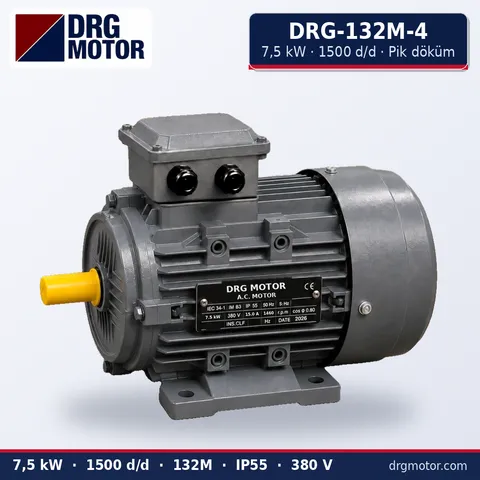
7.5 kW Three-Phase Motor 1500 rpm – DRG-132M-4 Cast Iron
- 7.5 kW · 1500 rpm (4 poles)
- Cast iron frame · IEC 132M
- Mounting: B3 · B5 · B14 · B35
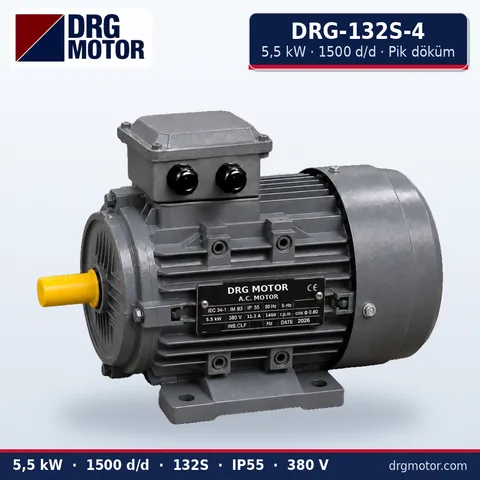
5.5 kW Three-Phase Motor 1500 rpm – DRG-132S-4 Cast Iron
- 5.5 kW · 1500 rpm (4 poles)
- Cast iron frame · IEC 132S
- Mounting: B3 · B5 · B14 · B35
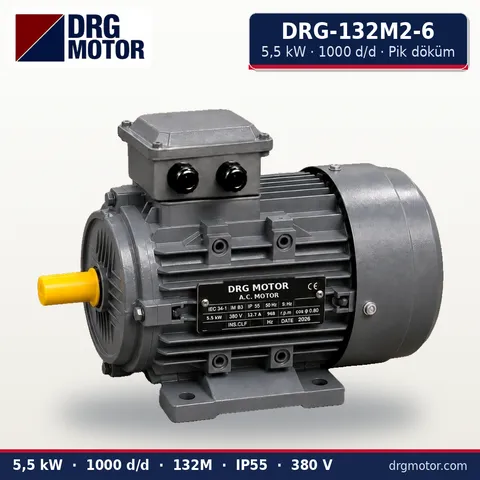
5.5 kW Three-Phase Motor 1000 rpm – DRG-132M2-6 Cast Iron
- 5.5 kW · 1000 rpm (6 poles)
- Cast iron frame · IEC 132M
- Mounting: B3 · B5 · B14 · B35
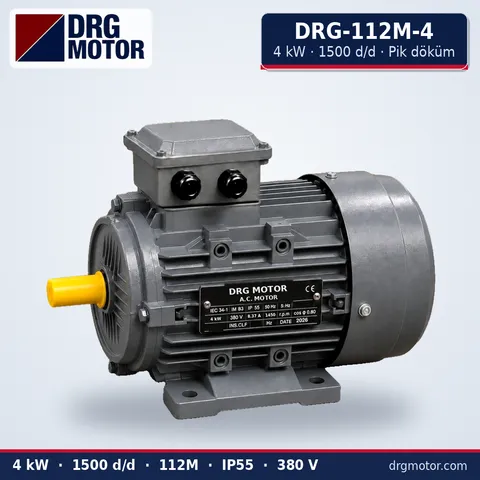
4 kW Three-Phase Motor 1500 rpm – DRG-112M-4 Cast Iron
- 4 kW · 1500 rpm (4 poles)
- Cast iron frame · IEC 112M
- Mounting: B3 · B5 · B14 · B35
Click to see current prices and order these motors nowSEE PRICES →
EPS Pre-Expander Agitator Motor: Frequently Asked Questions
What kW should an EPS pre-expander agitator motor be?
It depends on vessel volume and agitator speed; small machines use a few kW, large production machines go above ten kW. When replacing, do not go below the old motor's power; if you have restart problems after power cuts, go one size up.
Is an inverter used on a pre-expander agitator?
Agitator speed can be adjusted by inverter for different density recipes. Breakaway torque is then needed at low speed as well, so the drive's torque boost setting and the motor power must be chosen accordingly.
Which frame suits a polystyrene foam machine motor?
For an agitator running vertically on top of the vessel in hot, steamy conditions, a cast iron frame is preferred for mechanical strength and heat handling. Lighter drives such as the fluid-bed dryer fan can also use an aluminium frame.
Does pentane make an Ex motor mandatory on every EPS machine?
No; it depends on the plant's hazardous-area zoning. If a zone is defined, an Ex-protected special motor is needed; otherwise a standard IEC motor is used.
For a quote, send a photo of the motor nameplate, its power, speed, mounting (vertical flange or foot), shaft size and the pre-expander's vessel and gearbox details via WhatsApp, or add the models to the quote list. Phone: +90 (542) 666 11 11 · e-mail: info@drgmotor.com · contact. All models are in the online store.