English
 Le français
 Türkçe




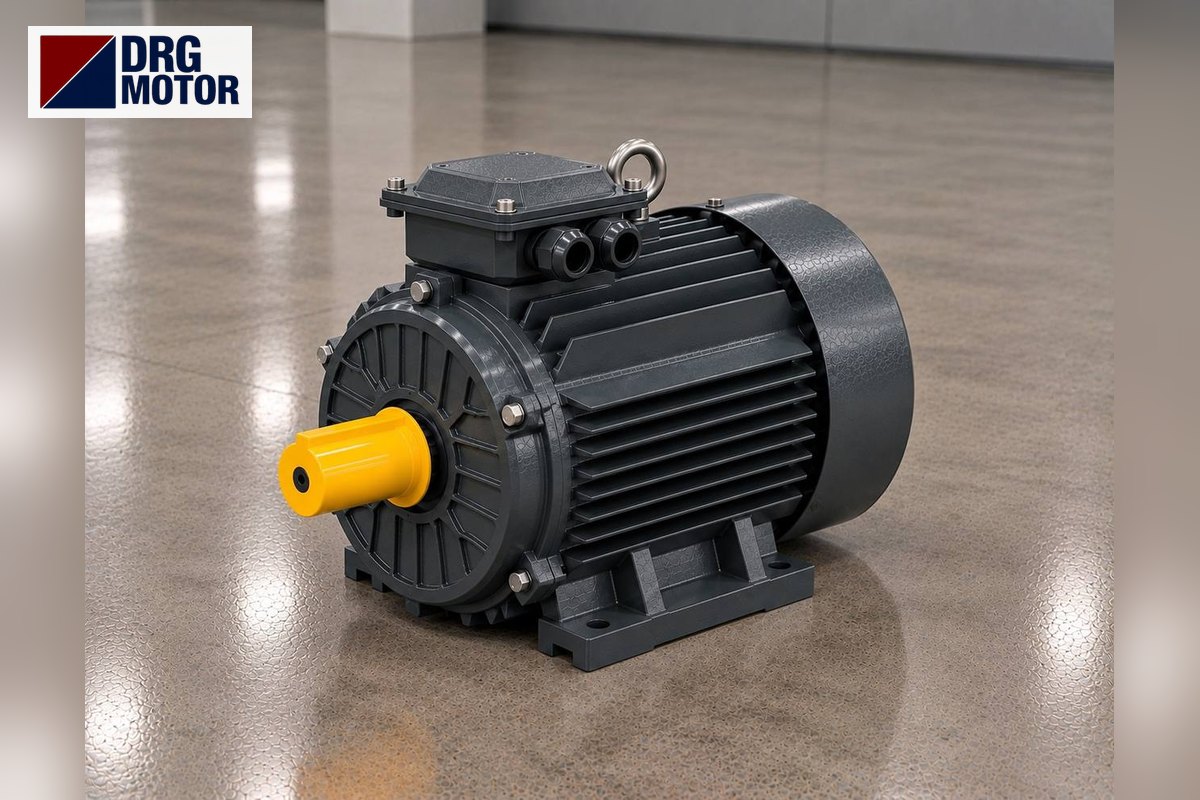

On a plastic film winding machine, the motor's real job is not to produce speed but to hold film tension constant. In centre winding, the torque needed for the same tension grows with the roll diameter, while roll speed falls by the same ratio. The winder motor is therefore chosen for the torque at the largest roll and the highest speed at the core diameter; the inverter covers the wide speed range in between. You can find the 4- and 6-pole three-phase motors fitted to winders in our online shop.
This article focuses on the winder itself: the winding shaft at the end of a blown film line or on a stretch film rewinder. Slitting knives and the unwind unit are a separate topic.
Centre Winding or Surface Winding?
In surface (contact) winding, the roll rests against a motor-driven drum that drags its outer surface. Film speed equals the peripheral speed of the drum; however large the roll grows, the drum turns at the same speed. Here the motor sees constant speed and roughly constant torque, and a standard motor and gearbox arrangement works without trouble.
In centre winding, the motor turns the core shaft directly. To keep film speed constant the shaft must slow down as the roll grows, and to keep tension constant the torque must rise. Sensitive, slippery or printed films are usually wound this way, and this is where motor selection gets difficult.
Why Torque Rises as the Roll Grows
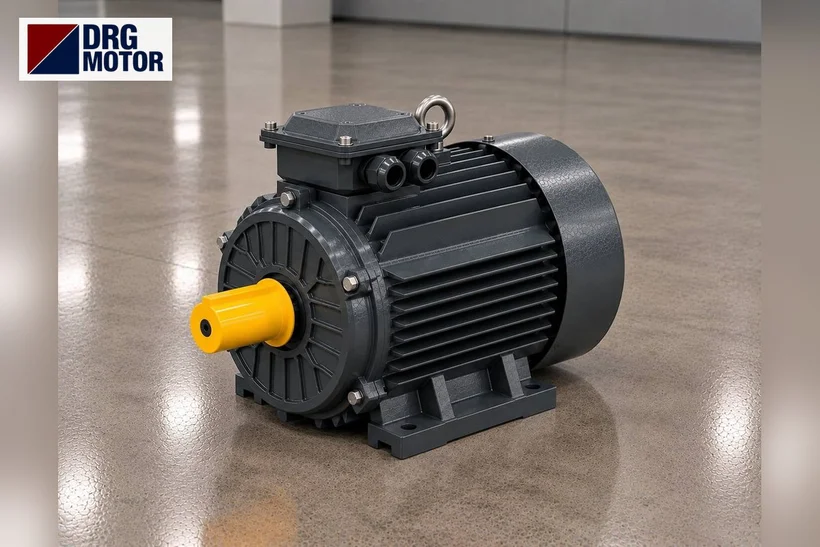
Torque on the winding shaft is film tension multiplied by roll radius: T = F · D / 2. Roll speed falls with diameter according to n = v / (π · D). The product of torque and speed, the power delivered to the film, stays constant. A winder is therefore a constant power load.
Example / assumption: line speed 80 m/min, total tension 150 N, 90 mm core and 600 mm full roll. The power delivered to the film is only 200 W. The gearbox ratio of 7.66 is chosen so that the motor runs at 75 Hz at core diameter.
| Roll diameter (mm) | Roll speed (rpm) | Roll torque (Nm) | Motor frequency (Hz) |
|---|---|---|---|
| 90 | 282.9 | 6.75 | 75.0 |
| 200 | 127.3 | 15.0 | 33.8 |
| 400 | 63.7 | 30.0 | 16.9 |
| 600 | 42.4 | 45.0 | 11.2 |
The table shows that while roll diameter grows 6.67 times, motor frequency drops from 75 Hz to 11.2 Hz. At the full roll, assuming a gearbox efficiency of 0.9, the motor shaft needs about 6.53 Nm. You can test the ratio and output torque with your own values in our gearbox output speed and torque calculator.
Click to see current electric motor prices and order nowSEE PRICES →
Choose the Motor by Torque, Not by Power
Looking at 200 W of film power and choosing a small motor is the most frequent mistake on this machine. What matters is the 6.53 Nm required at low frequency on the full roll. A 1.1 kW 4-pole motor has a rated torque of 7.27 Nm and leaves no margin. The 1.5 kW DRG-90L-4, with 9.91 Nm rated torque, covers both this load and the extra torque needed while the roll accelerates.
At the other end, at core diameter the motor runs at 2168 rpm at 75 Hz. Above 50 Hz torque falls in inverse proportion to frequency; for the DRG-90L-4 that is about 6.61 Nm, against 0.98 Nm required. If both ends are satisfied, the gearbox ratio is right.
Cooling at low frequency
- Cooling: IC411, fan on the shaft
- Effect: fan airflow drops around 11 Hz
- Advice: next power step or a separate fan if the full roll stage is long
Large rolls turn for minutes at low speed and high torque. Since the housing fan also slows down, the motor heats up. If winding time is long, consider the next power step or a 6-pole motor (same torque with a lower gearbox ratio).
Tension Control on an Inverter and the Servo Limit
There are three common ways to control tension with an induction motor. With a dancer roll, a loaded arm expresses film tension as a position and the inverter adjusts speed to keep the arm centred. With a load cell, tension is measured directly. With open-loop torque control, the inverter calculates the diameter from line speed and wound length and sets torque accordingly.
The last method needs the inverter's vector control mode; in scalar (V/f) mode torque cannot be delivered accurately at low frequency. DRG Motor does not sell inverters; the machine builder or your automation team selects the inverter and sets it up with the nameplate values.
Very fast lines, frequent quick roll changes or very thin films need torque response within milliseconds. These winders use servo motors, which a standard IEC motor cannot replace; DRG's range has no servo motors. On such a machine DRG can only cover the induction motor parts of the line (fans, cooling, auxiliary conveyors).
Gearbox Connection and Dimensions for Replacement
The winding shaft is usually driven through a helical or bevel-helical gearbox. The motor connects to it with a B5 large flange. On frame 90 the flange bolt circle is 165 mm, the spigot diameter 130 mm and the shaft 24×50 mm; on frames 100 and 112 these rise to 215 / 180 mm and 28×60 mm. A larger frame means a different gearbox input flange; keep the same frame. Suitable motors are also listed on our electric motors for gearboxes page.
Checklist before ordering
- Winding type: centre or surface?
- Largest roll diameter, core diameter and maximum line speed
- Gearbox ratio and input flange (B5 bolt circle, spigot diameter)
- Tension control: dancer, load cell or open loop
- Lowest and highest operating frequency of the inverter
- If the old motor is a servo: this winder will not run on a standard motor, consult the machine builder
Signs of the Wrong Motor on a Winder
If the film slackens and the edges shift as the roll grows, the motor cannot deliver torque at full roll. If the inside of the roll gets tight and crushes the core, torque is not being reduced with diameter; that is a control problem, not a motor problem. If the overload trips on long rolls, cooling at low speed is not enough.
DRG Motor is a manufacturer, supplier and seller of electric motors; it does not supply the winding mechanism, gearbox or drive, it supplies the motor that goes onto the gearbox. The environment is simple: the IP55 housing copes with the dust of a film hall and the motor is rated for −15…+40 °C.
DRG Motors Suited to Plastic Film Winders
All four models can be connected to a gearbox with a B5 flange. Light winders like the example above suit 1.5–2.2 kW; for large, heavy rolls a 4 kW 4-pole model or the 6-pole model with its higher rated torque is preferred.
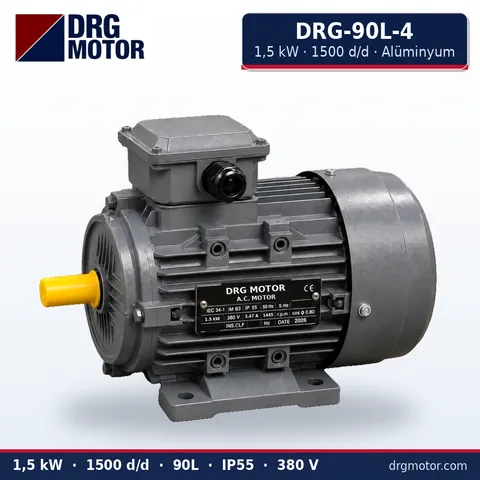
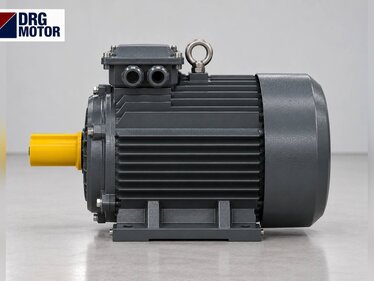
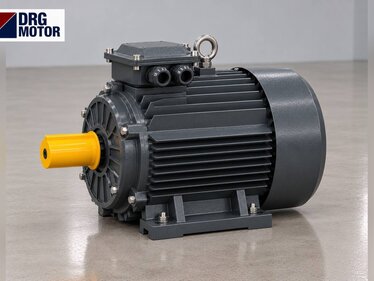
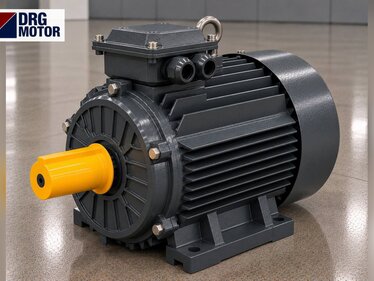
1.5 kW Three-Phase Motor 1500 rpm – DRG-90L-4 Aluminium
- 1.5 kW · 1500 rpm (4 poles)
- Aluminium frame · IEC 90L
- Mounting: B3 · B5 · B14 · B35
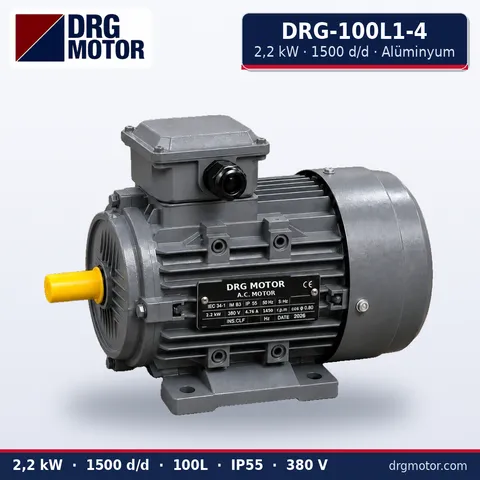
2.2 kW Three-Phase Motor 1500 rpm – DRG-100L1-4 Aluminium
- 2.2 kW · 1500 rpm (4 poles)
- Aluminium frame · IEC 100L
- Mounting: B3 · B5 · B14 · B35

4 kW Three-Phase Motor 1500 rpm – DRG-112M-4 Aluminium
- 4 kW · 1500 rpm (4 poles)
- Aluminium frame · IEC 112M
- Mounting: B3 · B5 · B14 · B35
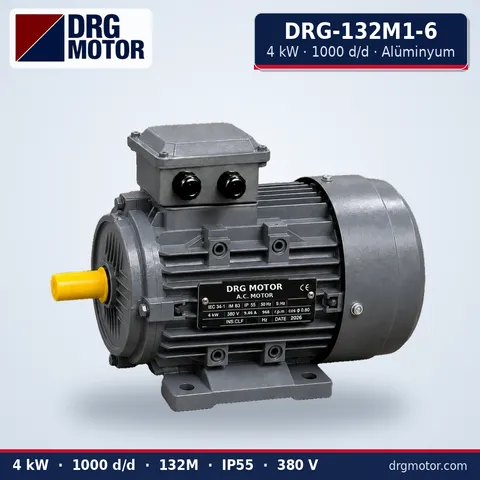
4 kW Three-Phase Motor 1000 rpm – DRG-132M1-6 Aluminium
- 4 kW · 1000 rpm (6 poles)
- Aluminium frame · IEC 132M
- Mounting: B3 · B5 · B14 · B35
Click to see current prices and order these motors nowSEE PRICES →
Film Winder Motor: Frequently Asked Questions
How is motor power calculated for a film winding machine?
First find the torque at the full roll (tension × radius) and, with the gearbox ratio, the torque at the motor shaft. The motor is chosen for a rated torque that can deliver it at low frequency without overheating; film power alone is misleading.
Which inverter mode does a winder motor need?
For speed control with a dancer, scalar mode is often enough. Torque control with diameter calculation requires vector control mode. The motor's nameplate data must be entered completely into the inverter.
Can an induction motor be used instead of a servo on a stretch film rewinder?
On medium-speed machines with a dancer, an inverter-fed induction motor is common. If the machine was designed around a servo, its drive and control software are built for it; replacing it with a standard motor is not possible.
Why does the winder motor overheat on a full roll?
At full roll the motor delivers maximum torque at minimum speed, and the shaft fan moves little air. If this lasts long, consider the next power step, a 6-pole motor or separately driven fan cooling.
For a quote, send a photo of the old motor's label, its power and speed, whether it is flange or foot mounted, the shaft size, the gearbox ratio and the largest roll diameter via WhatsApp, or add the models to the quote list. Phone +90 (542) 666 11 11, e-mail info@drgmotor.com; other details on our contact page. All power and speed options are on the buy electric motors online page.