English
 Le français
 Türkçe




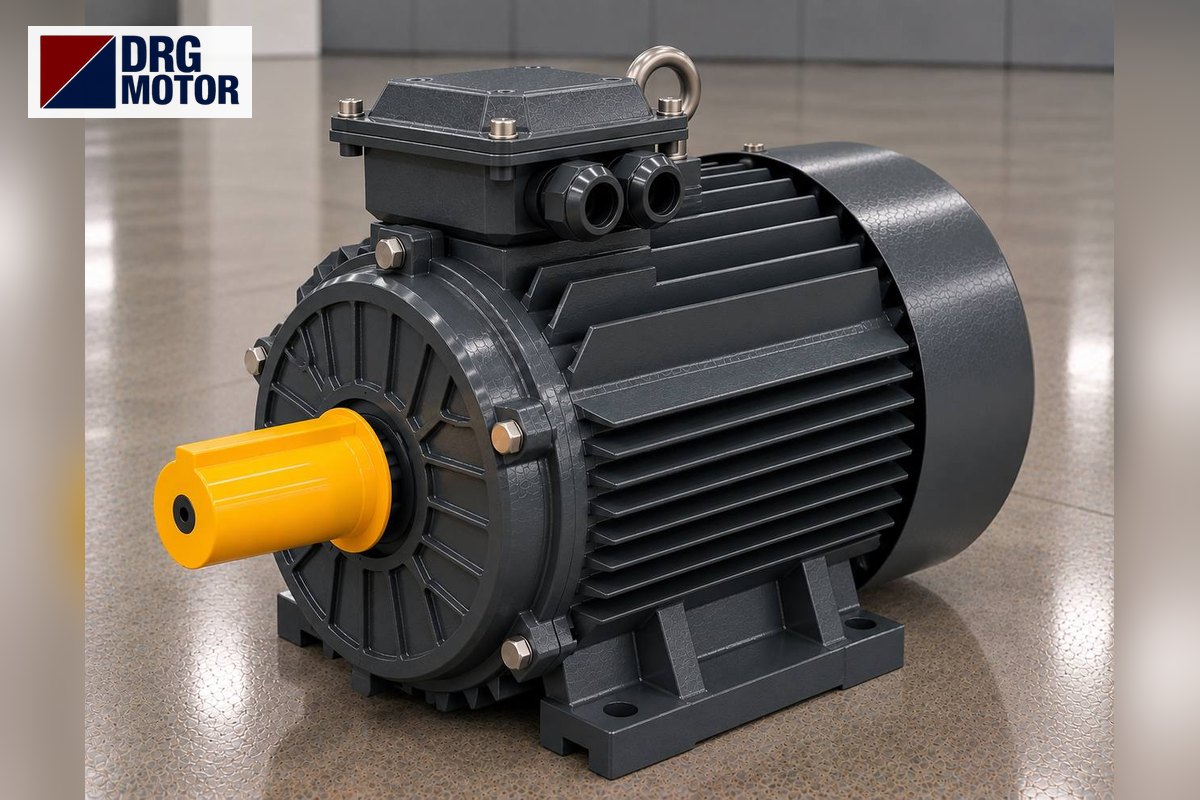

The main drive motor of a rope twisting machine turns the rotating member that wraps yarn or wire strands around each other, the flyer or the twisting cradle. At the same time the haul-off capstan pulls the rope forward at a set speed and the take-up reel collects the finished rope. What decides the motor is keeping the ratio of these three motions, that is the rope's lay length, intact, and delivering high torque at low speed safely over long periods.
The main drive usually uses a 6 or 4-pole three-phase motor together with a belt and a gearbox. You can filter suitable models by power and speed in our online motor store, and for similar stranding and winding drives see our cable production line electric motors page.
Flyer, Haul-Off and Take-Up: Three Motions, One Ratio
A rope is formed by wrapping several previously twisted strands around each other. Each turn of the flyer wraps the strands once around the rope axis; in that time the haul-off must have pulled the rope forward by one lay length. Lay length is the ratio of haul-off speed to flyer speed.
On older, simpler machines one main motor drives everything: the flyer by belt, and the haul-off and take-up through a gearbox and change gears taken from the main shaft. Lay length is set by changing the gear set, and motor speed does not affect it. On newer machines the flyer, haul-off and take-up are driven by separate motors on electronically linked inverters.
This distinction matters when replacing a motor. On a single-motor machine the lay is kept even if the new motor's speed differs slightly; only output changes. On a multi-motor machine, if only the flyer motor's speed changes, the lay changes too and the rope goes out of specification.
Worked Example: Flyer Speed, Lay Length and Haul-Off
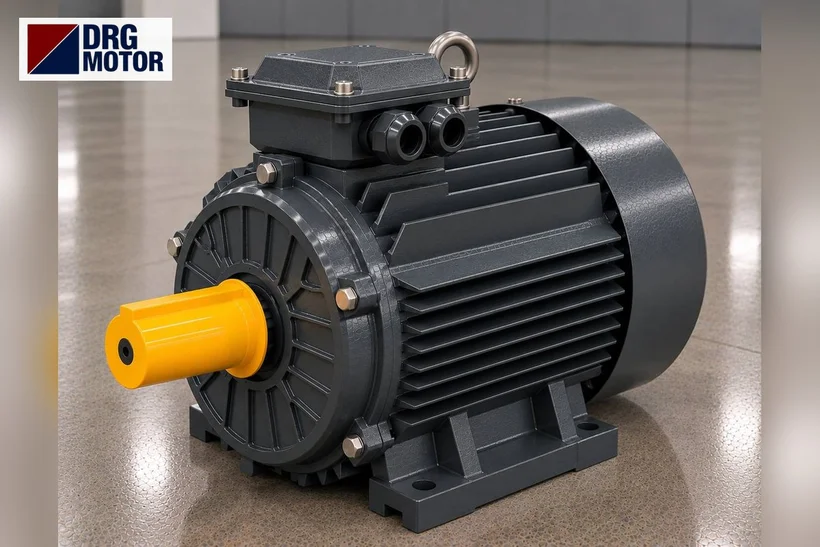
Example (assumption): a DRG-160L-6 (11 kW, 970 rpm) drives the flyer through 200 mm and 320 mm pulleys. Flyer speed from n2 = n1 · d1 / d2 is 606.25 rpm. For a target lay length of 40 mm, the haul-off must pull 24.25 m of rope per minute.
With a 400 mm haul-off capstan, the capstan turns at 19.3 rpm. Assume 3000 N is needed at the capstan to pull the rope: capstan torque is 600 Nm and power from P = T · n / 9550 is 1.21 kW. If the haul-off has its own motor, a 6-pole motor running at 955 rpm needs a gearbox ratio of about 49.5; taking gearbox efficiency as 0.85, 14.26 Nm is needed at the motor shaft.
This is below the 22.0 Nm rated torque of the DRG-112M-6 and leaves a margin for starting and sudden tension peaks. You can redo the ratios with your own values in our gearbox output speed and torque calculator. DRG does not sell gearboxes; it supplies the motor that connects to the gearbox input.
Main Drive Load: Constant Torque and Long Cycles
As the flyer turns, torque stays largely constant: bearing friction, air drag of the bobbins and the force needed to twist the strands. Torque rises as the rope gets thicker and the strands stiffer. On planetary machines the cradles carrying the bobbins are heavy, and the main drive turns a large inertia.
The machine may run for hours without stopping until a reel is full. In this long-cycle operation motor temperature is set by the nameplate current; if current stays below the plate value the motor can carry this duty. When the rope breaks the machine stops suddenly and then restarts; on machines that stop and start often, choosing the motor one size up reduces heating.
A 6-pole motor is preferred for low-speed flyers: at the same power it gives higher torque than a 4-pole motor and needs a smaller pulley or gear ratio. For example, the 11 kW DRG-160L-6 has a rated torque of 108.3 Nm; with the pulley ratio above this becomes about 173.3 Nm at the flyer shaft, losses excluded.
Click to see current electric motor prices and order nowSEE PRICES →
Changing Speed on the Take-Up Reel
When empty, the take-up reel has a small diameter and turns fast; as it fills, the diameter grows and it slows down for the same rope speed. Example: at 24.25 m/min rope speed, an empty 300 mm reel turns at 25.73 rpm and at 8.58 rpm when it has filled to 900 mm. Meanwhile the torque the reel demands rises with diameter.
On older machines this difference is absorbed by a slip clutch or friction brake, and the motor runs at constant speed. On inverter-driven machines the take-up motor runs under torque or tension control. On take-up motors that run for long periods at low frequency, check frame temperature, since the motor's own fan moves less air.
The exact torque-diameter relationship differs on every take-up; the machine builder's diagram gives the precise values. When replacing a take-up motor, not only the power but also the inverter parameters must be re-entered for the new motor.
Which Motor for Which Duty: Short Table
The table below summarises the load character of the motors on a typical rope twisting line. Power varies widely with machine size, so the table gives the feature that drives the choice rather than a power figure.
| Duty | Load character | Typical poles | Connection |
|---|---|---|---|
| Flyer / cradle | Constant torque, high inertia | 6 or 4 | Belt, gearbox |
| Haul-off capstan | Low speed, high torque | 6 or 4 | Gearbox + motor |
| Take-up reel | Speed varies with diameter | 4 | Gearbox, clutch |
| Traverse | Light, back and forth | 4 or 6 | Screw or cam |
On a multi-motor machine, if the failed motor is the haul-off or take-up, the new motor's rated speed may differ from the old one. In that case the motor nameplate data must be re-entered in the inverter and line synchronisation re-established by measuring line speeds.
How a Wrong Choice Shows in the Rope
If the flyer motor is changed from 6-pole to 4-pole, flyer speed rises from 606.25 rpm in the example to 915.6 rpm. Centrifugal force on the bobbin cradles grows with the square of speed, about 2.28 times; this strains the bearings and bobbin holders. On a multi-motor machine, if the haul-off stays at the same speed, lay length drops from 40 mm to about 26.5 mm and the rope becomes stiffer and shorter.
An under-powered haul-off motor slows on a thick strand; since the flyer keeps turning at the same speed, the lay shortens in that section. If the rope shows irregular tight and loose zones, check the haul-off motor current and the condition of the gearbox.
Fibre dust should not be overlooked either: in polypropylene and natural fibre rope production the motor fins soil quickly. The IP55 frame protects the inside; the outer surface must be cleaned regularly.
Pre-replacement checklist:
- The motor's duty: flyer, haul-off, take-up or traverse.
- Whether the machine is single-motor, or multi-motor with inverters.
- Nameplate: kW, rpm (pole number), voltage, connection; a photo of the old motor if possible.
- Mounting: foot (B3), flange (B5) or foot plus flange (B35); for flanges, the gearbox input flange dimensions.
- Shaft diameter, shaft length and key width.
- On belt drives both pulley diameters; on change-gear machines the gear combination in use.
DRG Motors Suited to Rope Twisting Machines
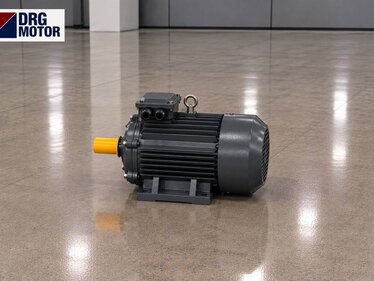
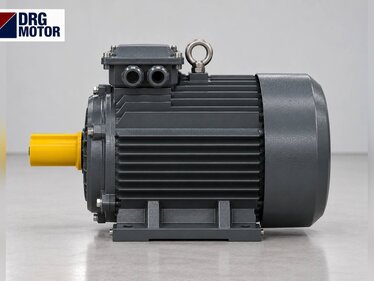
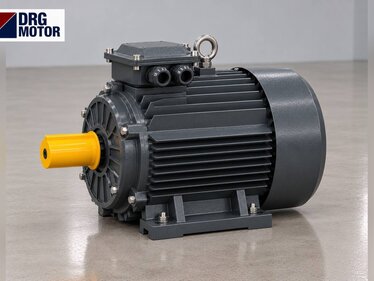
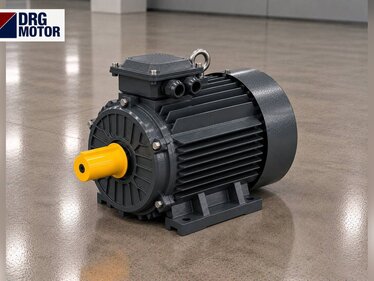
6-pole cast iron models for the flyer main drive, a small 6-pole option for the haul-off gearbox and an alternative for 4-pole machines. Choose the model to match the old motor's pole number.
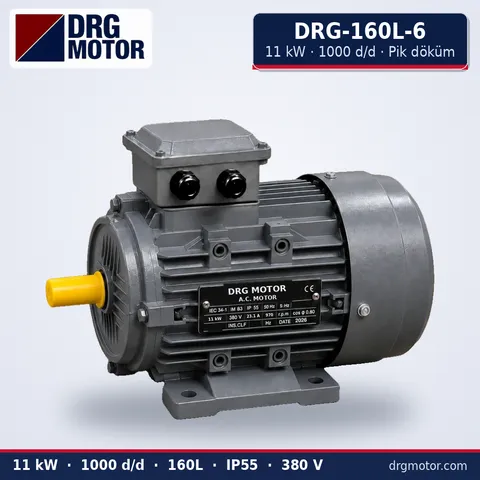
11 kW Three-Phase Motor 1000 rpm – DRG-160L-6 Cast Iron
- 11 kW · 1000 rpm (6 poles)
- Cast iron frame · IEC 160L
- Mounting: B3 · B5 · B14 · B35
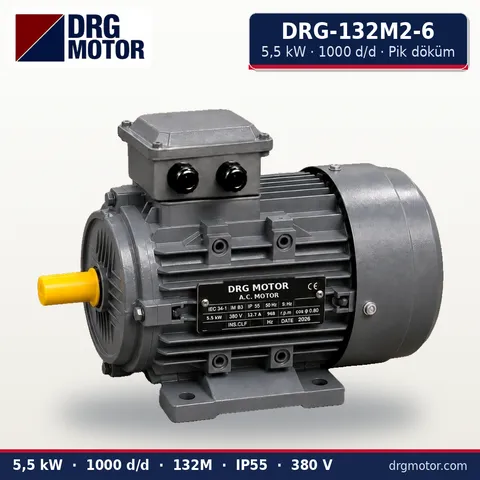
5.5 kW Three-Phase Motor 1000 rpm – DRG-132M2-6 Cast Iron
- 5.5 kW · 1000 rpm (6 poles)
- Cast iron frame · IEC 132M
- Mounting: B3 · B5 · B14 · B35
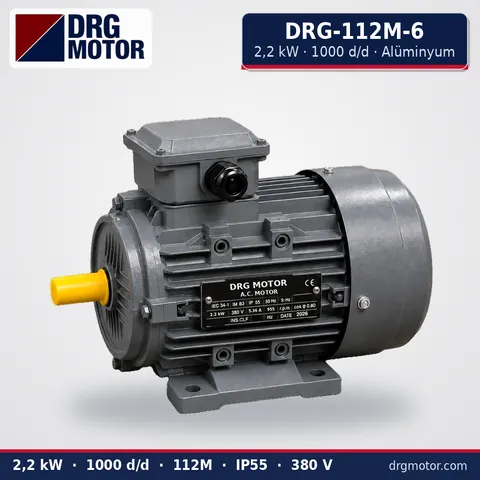
2.2 kW Three-Phase Motor 1000 rpm – DRG-112M-6 Aluminium
- 2.2 kW · 1000 rpm (6 poles)
- Aluminium frame · IEC 112M
- Mounting: B3 · B5 · B14 · B35
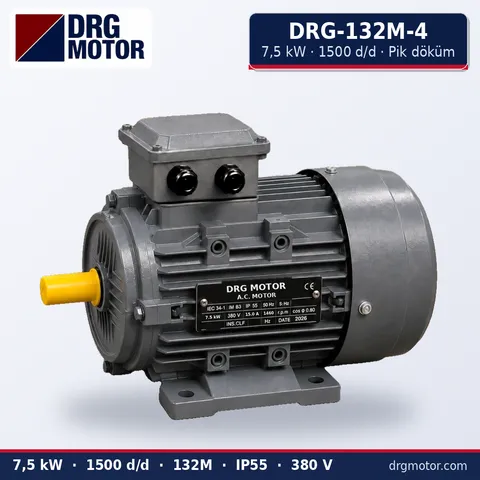
7.5 kW Three-Phase Motor 1500 rpm – DRG-132M-4 Cast Iron
- 7.5 kW · 1500 rpm (4 poles)
- Cast iron frame · IEC 132M
- Mounting: B3 · B5 · B14 · B35
Click to see current prices and order these motors nowSEE PRICES →
Rope Twisting Machine Motor: Frequently Asked Questions
What kW is the main motor of a rope twisting machine?
It depends on rope diameter, number of strands and machine type. Thin rope and twine machines may use a few kW, while heavy rope and planetary machines can reach tens of kW. The exact figure is on the machine nameplate or in the builder's catalogue.
Does lay length change if the motor speed on a rope machine changes?
If the haul-off and flyer are geared from the same motor, the lay does not change; only output does. On a multi-motor machine, if only one motor's speed changes, the lay changes and line synchronisation in the inverters must be reset.
Why does the haul-off capstan motor run hot?
Common causes are a gearbox ratio that is too small so the motor works at its limit, long periods at very low inverter frequency, and low gearbox oil. Compare current with the nameplate value; for example 5.09 A at 400 V for the DRG-112M-6.
Should a rope machine get a 6-pole or a 4-pole motor?
Use the same pole number as the old motor. If the pole number changes, the pulley or gear ratio must change too. When designing a new machine, a 6-pole motor gives the same torque at low flyer speeds with a smaller ratio.
DRG Motor is a manufacturer, supplier and seller of electric motors. To prepare a quotation for your rope twisting machine we only need a photo of the motor nameplate, its power, speed, foot or flange mounting, shaft size, and whether it drives the flyer, haul-off or take-up. Share the details on WhatsApp or add the models to the quote list. Phone +90 (542) 666 11 11, e-mail info@drgmotor.com; address and other channels are on the contact page. Current price information is in our online motor store.