English
 Le français
 Türkçe




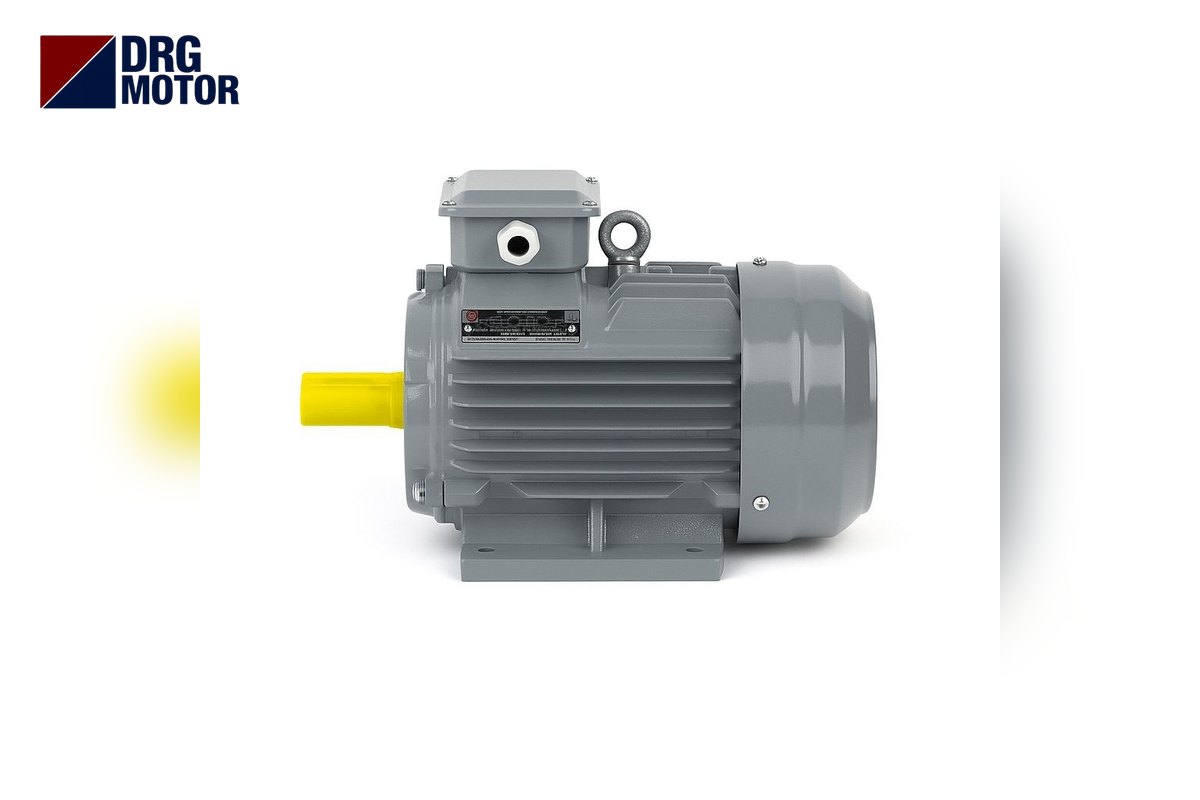

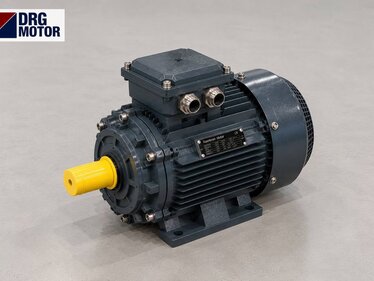
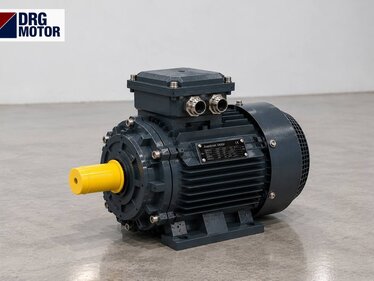
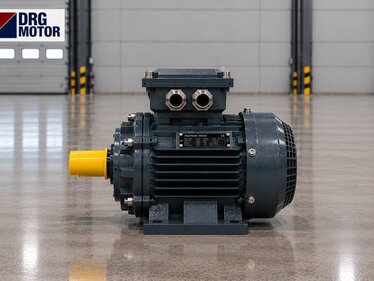
The motor of a rice whitening (polishing) machine turns a brown-rice-packed chamber with an abrasive stone or a steel roller for hours at the same load; the load is heavy throughout operation, not only at start. So the right motor is one that fully covers the power on the machine nameplate and lets the ammeter stay below rated current. Foot-mounted, 4-pole, belt-driven cast iron three-phase motors are common on these machines.
This article explains where the load in the whitening chamber comes from, what the ammeter tells the operator and what to check when changing the motor. 4-pole models in the 11–22 kW range are in our online motor store. For other machines in grain processing plants, our flour mill electric motors page is also a useful guide.
What Does the Motor Work Against in the Whitening Chamber?
In the abrasive type the shaft carries emery stone rings or a conical stone. Rice passes through the narrow space between the stone and the perforated screen around it; the stone surface scrapes off the bran layer, and the bran is drawn out through the screen holes. The friction type has a ribbed steel roller instead of a stone, and the grains polish by rubbing against each other. In the final polishing stage a fine water mist is fed into the chamber to smooth the surface.
In both types the motor load is set by how tightly the chamber is packed. A weighted gate or spring flap at the outlet holds the rice inside; the heavier the gate, the longer the grain stays, the whiter it gets and the more current the motor draws. Most of the motor power turns into heat, which is why the rice and the chamber warm up.
The load does not drop for hours, and fluctuations come from feed rate, paddy moisture and stone wear. There are no short shocks, but things change if power fails with a full chamber; we cover that below.
The Ammeter: The Polisher's Real Setting Gauge
Whitening machine panels carry an ammeter, and the operator sets the gate weight and feed by watching it. If the motor changes, the meaning of the reading changes too: if the old and new motors have different nameplate currents, old habits go wrong. The table below is an example for the 22 kW DRG-180L-4, whose nameplate current is 39.7 A at 400 V. The 35.7 A threshold is 90 percent of nameplate current and is suggested as an assumption.
| Ammeter (22 kW) | What it shows | Operator action |
|---|---|---|
| Below 35.7 A, steady | Load within a comfortable margin | Keep the setting |
| 35.7–39.7 A | Motor close to its limit | Lighten the gate weight |
| Above 39.7 A | Overload, winding heats up | Reduce feed at once |
| Needle keeps swinging | Uneven feed or clogged screen | Check feed and screen |
| Low current, same setting | Stone may be worn | Measure stone-screen gap |
The overload relay is set to this current as well, that is, 39.7 A. Plants sometimes raise the overload setting to get whiter rice; that means running the winding too hot for long periods and silently ageing the insulation. The overload is set from the motor nameplate, not the machine.
To use current as a gauge you also need to know the supply voltage: on a 380 V supply instead of 400 V, more current is drawn for the same power. You can compare typical currents by voltage in our motor current chart.
Click to see current electric motor prices and order nowSEE PRICES →
Why Power Should Not Be Reduced
On polishing machines power depends on capacity and stone diameter; small mill types use a few kW, line machines handling several tonnes per hour use tens of kW. The exact value is the machine builder's nameplate and catalogue.
This is not a machine that "will turn with a slightly smaller motor". Fit 18.5 kW to a 22 kW machine and, at the gate weight needed for the same whiteness, the motor exceeds rated current. The operator has to lighten the gate, and the rice comes out less white or throughput drops. From catalogue data the DRG-180L-4 gives 142.9 Nm at 1470 rpm and the DRG-180M-4 gives 120.2 Nm; the difference is torque missing throughout operation.
On the other hand an oversized motor makes the ammeter less meaningful: on a 30 kW motor the same load moves the needle less, and the operator notices overloading later.
Starting with a Full Chamber and Starting Method
The normal routine is to start the machine empty and open the feed once speed has settled. The real problem comes after a power cut: the chamber stays full and packed. In this power range motors usually start star-delta; in star, torque drops to roughly one third.
Example: on the DRG-180L-4 starting torque is 2.0 times rated torque, about 285.8 Nm direct-on-line. In star this falls to about 95.3 Nm, below rated torque. A full, packed chamber may not turn at that torque; the motor hangs in star and heats up.
So after an outage the gate should be opened and the chamber emptied, or loosened by turning it by hand. Direct-on-line, the motor draws about 309.7 A at 400 V; whether that is acceptable depends on transformer and cable capacity and is the plant electrician's decision.
Bran, Water Mist and Heat Around the Motor
Rice bran is oily; its fine dust sticks to the motor fins and fan cover and is harder to clean than dry dust. The coating reduces cooling, so the winding runs hotter while the ammeter shows the same value. Make sure the bran aspiration duct does not leak near the motor.
The polisher's water mist unit creates a damp environment near the motor. DRG motors are IP55, closed against dust and water jets, but direct water flow or washing onto the motor should not be planned. Ambient temperature should stay within −15…+40 °C; ventilation of closed, hot machine rooms matters for that.
Checklist before changing the motor:
- Old motor nameplate power, speed and current; the ammeter will be read against it.
- Shaft diameter and key; on the DRG-180L-4 the shaft is 48 × 110 mm, key 14 mm.
- Foot hole spacing and shaft height; on frame 180L A × B = 279 × 279 mm, H = 180 mm.
- Belt count and profile, pulley hub; belt slip in a high-torque duty makes the current swing.
- Starting method (direct or star-delta) and Δ connection at 400 V.
- Setting the overload relay to the new nameplate current.
- Keeping bran suction and the water mist line away from the motor.
DRG Motors Suitable for Rice Polishing Machines
These 4-pole cast iron models cover the power steps common on belt-driven whitening machines that run for long periods at the same load.
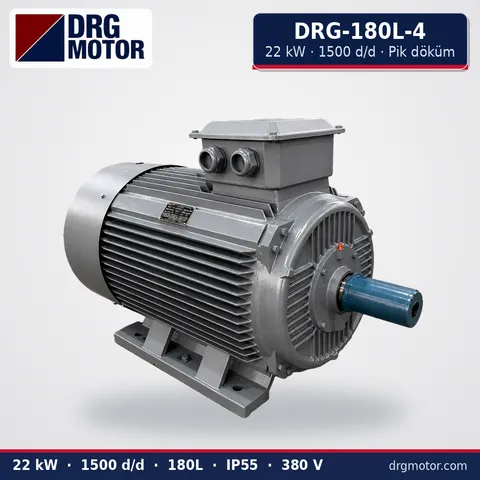
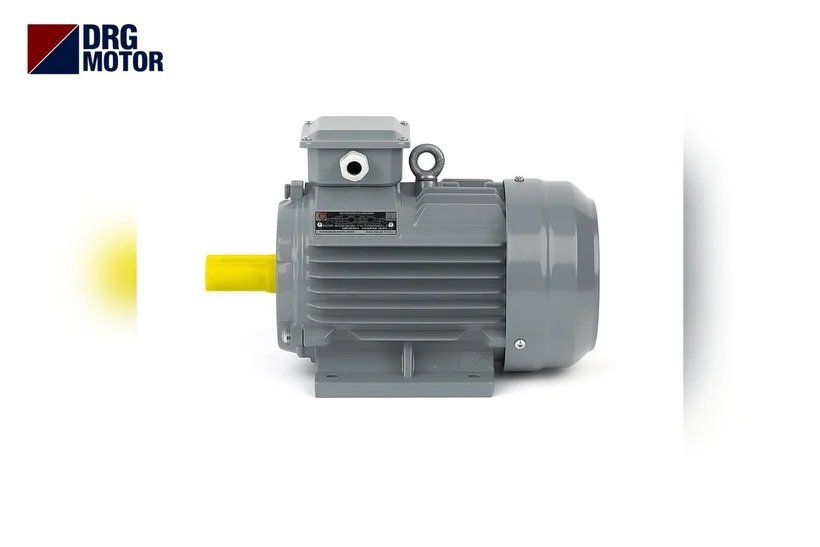
22 kW Three-Phase Motor 1500 rpm – DRG-180L-4 Cast Iron
- 22 kW · 1500 rpm (4 poles)
- Cast iron frame · IEC 180L
- Mounting: B3 · B5 · B14 · B35
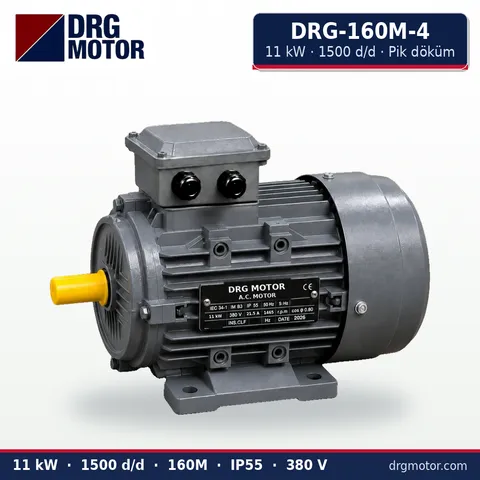
11 kW Three-Phase Motor 1500 rpm – DRG-160M-4 Cast Iron
- 11 kW · 1500 rpm (4 poles)
- Cast iron frame · IEC 160M
- Mounting: B3 · B5 · B14 · B35
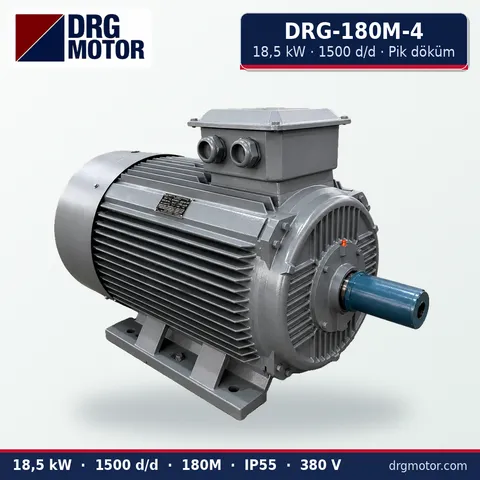
18.5 kW Three-Phase Motor 1500 rpm – DRG-180M-4 Cast Iron
- 18.5 kW · 1500 rpm (4 poles)
- Cast iron frame · IEC 180M
- Mounting: B3 · B5 · B14 · B35
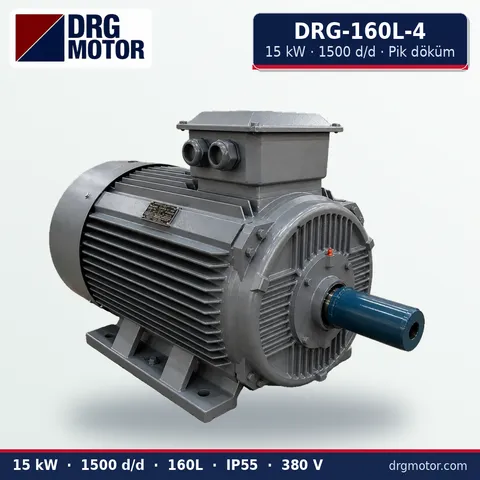
15 kW Three-Phase Motor 1500 rpm – DRG-160L-4 Cast Iron
- 15 kW · 1500 rpm (4 poles)
- Cast iron frame · IEC 160L
- Mounting: B3 · B5 · B14 · B35
Click to see current prices and order these motors nowSEE PRICES →
Rice Whitener Motor: Frequently Asked Questions
Why does the rice polisher motor run hot?
The machine turns most of the motor power into friction heat and the motor stays at high load for a long time. If current exceeds the nameplate value, the fins are coated with bran or the machine room is poorly ventilated, winding temperature rises. Check current first, then the cooling paths.
What reading should the ammeter be kept at?
Below nameplate current. For the 22 kW DRG-180L-4 the nameplate current is 39.7 A at 400 V; staying somewhat below it in operation protects the motor. The exact setting is determined by the machine builder and the process.
Why won't the machine start after a power cut?
The chamber is still full and packed; with star-delta starting, the torque in star may not be enough to turn that load. The chamber must be emptied or loosened; raising the overload setting is not a solution.
Is there a motor difference between abrasive and friction polishers?
The motor type is the same: a standard three-phase induction motor. The difference is in power and speed, which are taken from the machine nameplate.
DRG Motor is a manufacturer, supplier and seller of electric motors. To prepare a quotation for your whitener motor we need: a picture of the burnt motor's rating plate, its kW and rpm, whether it is foot or flange mounted, the shaft diameter and the starting arrangement in the panel. Write these to our WhatsApp line or collect the models you like in the quote list. You can reach us on +90 (542) 666 11 11 and at info@drgmotor.com, with further channels on the contact page. Up-to-date prices for the models are listed on our store page.