English
 Le français
 Türkçe




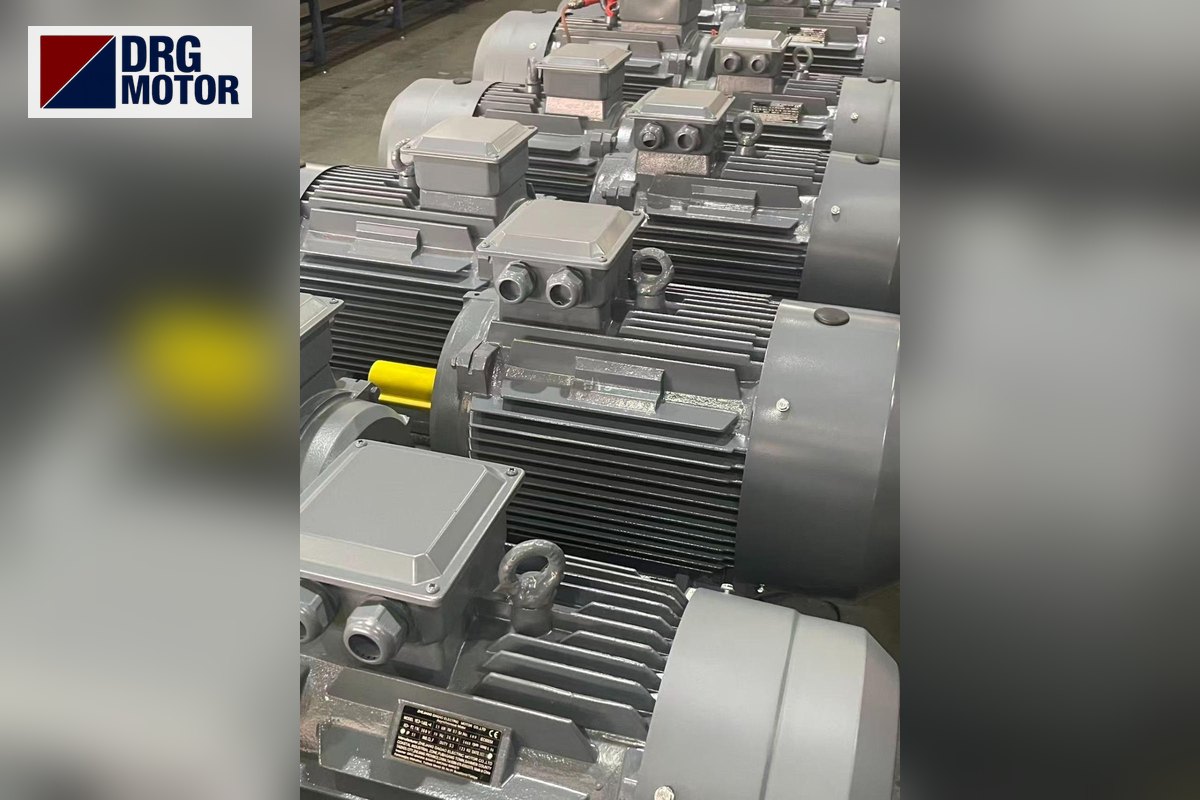

In a chocolate ball mill the electric motor turns the agitator shaft at the centre of a jacketed vertical vessel; the arms on the shaft move the steel balls in the vessel, and sugar and cocoa particles are crushed and refined between them. What decides the motor is the torque needed to break the shaft free while the balls and the cooled mass are at rest, i.e. the full-load starting torque. The second deciding factor is the temperature of the motor and the mass over hours of refining.
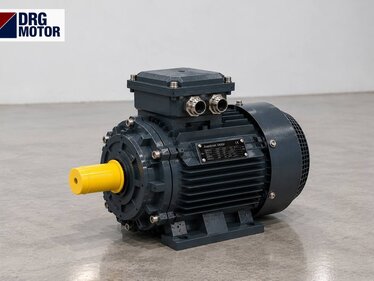
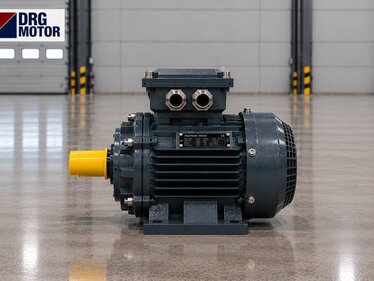
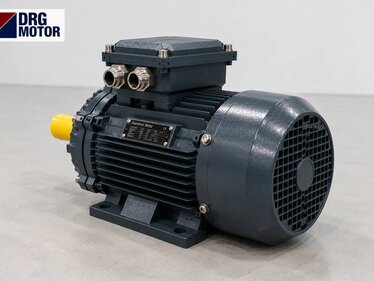
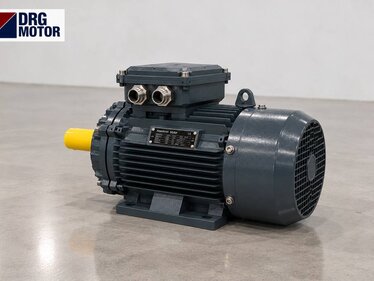
DRG Motor is a manufacturer, supplier and seller of electric motors; it supplies not the mill but the three-phase asynchronous IEC motor that turns the agitator shaft. All models in suitable power and speed ranges are on the buy electric motors online page. For the motors of other machines on a confectionery line, see the food machine motors page.
Shaft, Balls and Jacket in a Vertical Ball Mill
A chocolate ball mill works differently from the horizontal rotating-drum mills used for ore and cement. The vessel does not turn; inside an upright cylindrical vessel an armed shaft rotates and stirs steel balls a few millimetres in diameter that partly fill the vessel. As the balls rub against each other and the vessel wall, the cocoa mass, sugar and milk powder particles between them are reduced. Horizontal rotating mills have their own {a(bil, "ball mill motors")} page; their load pattern does not apply to this machine.
The vessel has a double wall. Warm or cold water flowing through this jacket holds the temperature of the mass. On most machines a pump circulates the product between the vessel and a holding tank, passing it through the ball bed many times until it reaches the required fineness.
The motor usually stands vertically on the vessel lid with the shaft pointing down and drives the agitator through a gearbox or a belt and pulleys. State in the order that the motor will run vertically with a flange (B5) or foot + flange (B35).
Full-Load Start: Cooled Mass and Settled Balls
When the mill stops, the balls settle at the bottom of the vessel and the chocolate mass between them stiffens as it cools. When the mill is started the next morning, the shaft has to break free the packed ball bed and the semi-solid mass together. This is the highest torque in the whole cycle of the mill.
That is why builders heat the jacket water before starting and wait until the mass becomes fluid. A start made without waiting long enough for the jacket heating keeps the motor at starting current for a long time; the overload trips or the coupling and shear pin are stressed. On the motor side, what can be done is to use a model with high starting torque and the right starting method.
Star-delta starting cuts starting torque to one third
Star-delta starting is common on motors of 5.5 kW and above to reduce starting current. On a 400 V supply this requires a motor rated 400/690 V; DRG motors from 4 kW upwards have this rating. In star, however, motor torque drops to roughly one third of its direct-on-line value. The table is calculated from the rated torque (Tn) and starting torque ratio in the DRG catalogue:
| Model | Tn (Nm) | Ts direct-on-line (Nm) | Ts in star (Nm) |
|---|---|---|---|
| DRG-132S-4 (5.5 kW) | 36.0 | 72.0 | 24.0 |
| DRG-132M-4 (7.5 kW) | 49.1 | 98.2 | 32.7 |
| DRG-160M-4 (11 kW) | 71.7 | 157.7 | 52.6 |
| DRG-160L-4 (15 kW) | 97.8 | 215.2 | 71.7 |
For all four motors, the starting torque in star is below rated torque. In a mill with settled balls and cooled mass this means the motor cannot begin to turn in star; switching to delta then causes a sudden current and torque surge. For a mill that starts loaded, consider direct-on-line starting, an inverter or another method that keeps starting torque high enough. We compare the methods on the motor starting methods and star-delta page. DRG does not sell inverters.
Click to see current electric motor prices and order nowSEE PRICES →
Shaft Speed, Gearbox Ratio and Shaft Torque
Example (assumption): a mill data sheet gives an agitator speed of about 80 rpm, and an 11 kW 4-pole DRG-160M-4 (1465 rpm) is to be used. The required ratio is i = 1465 / 80 ≈ 18.3; with a chosen ratio of 18, shaft speed is n2 = 1465 / 18 ≈ 81.4 rpm. At that speed 11 kW means 9550 × 11 / 81.4 ≈ 1291 Nm at the shaft (excluding gearbox losses).
The direct-on-line starting torque of the same motor is 157.7 Nm, and about 52.6 Nm in star. The gearbox multiplies this torque by its ratio; check in the gearbox catalogue that its permitted output torque can take this shock. DRG does not sell gearboxes; it supplies the motor that connects to the gearbox.
The mill motor power is set by the machine builder according to vessel volume, ball charge and required fineness. Small laboratory and workshop types may use a few kW, large production mills tens of kW; the definitive value is the machine nameplate or catalogue.
Temperature: Friction Heat, Jacket Water and the Motor
Friction between the balls heats the mass. The jacket removes this heat and keeps the mass in the range given by the builder; overheated chocolate loses flavour and milk powder may smell burnt. Higher shaft speed grinds faster but also raises friction heat. Changing to a 2-pole motor or a larger pulley to gain speed can therefore exceed the cooling capacity of the jacket.
The motor sits on the lid, directly above the warm vessel body. The jacket water and vessel heat warm the air around the motor; DRG motors are rated for −15…+40 °C ambient. If the compartment on the lid is enclosed, leave ventilation and keep the space in front of the motor's fan cover clear.
Refining a batch takes hours; in this long-cycle operation, if the motor runs close to its rated current, even a small temperature rise shortens insulation life. Measuring current towards the end of refining, when the mass is finest and thickest, shows the real load.
Hygiene, Cleaning and Motor Position
On a chocolate line the motor does not touch the product; the shaft seal and lid stand between motor and product. Where the motor area is cleaned dry, a standard IP55 motor is sufficient. If the motor has to sit where it will be washed with pressurised water and chemicals, a stainless hygienic-housing motor is required; that motor is not in the DRG range.
Checklist Before Replacement and Ordering
- Old motor nameplate: kW, rpm, voltage (is it 400/690 V?)
- Mounting: vertical, shaft down; flange (B5) or foot + flange (B35)
- Flange spigot diameter and shaft size (D × E)
- Gearbox ratio or pulley diameters; agitator shaft speed
- Starting method: direct-on-line, star-delta or inverter
- Jacket water temperature and waiting time before start
- Separate nameplates of the circulation pump and stirrer motors
Common mistakes: on a star-delta mill the motor hums in star without turning; the overload still trips at start after a power increase (the problem is the starting method, not the power); the mass overheats after a speed increase and the jacket cannot keep up; the motor runs backwards and the arms pack the balls instead of lifting them.
DRG Motors Suited to Chocolate Ball Mills
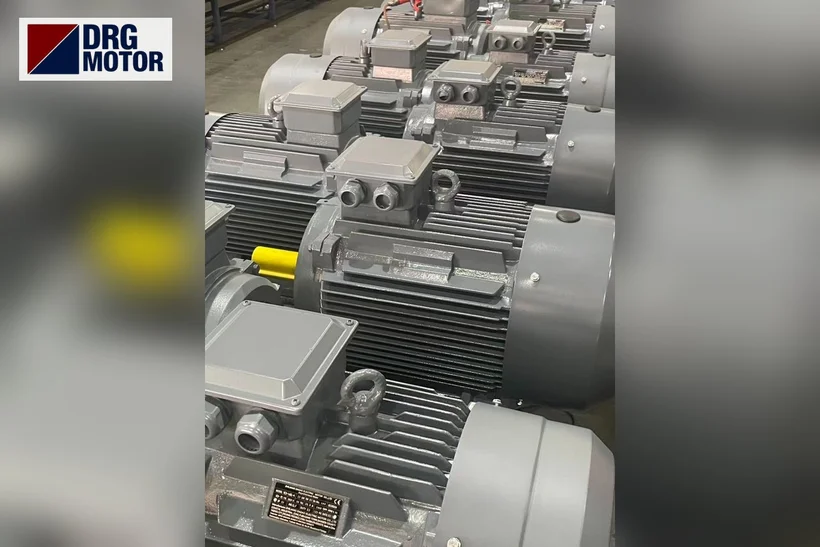
Four-pole models with a starting torque ratio of 2.0–2.2; 5.5–11 kW in aluminium housing, 15 kW in cast iron. All are 400/690 V, so they are connected in delta on a 400 V supply.
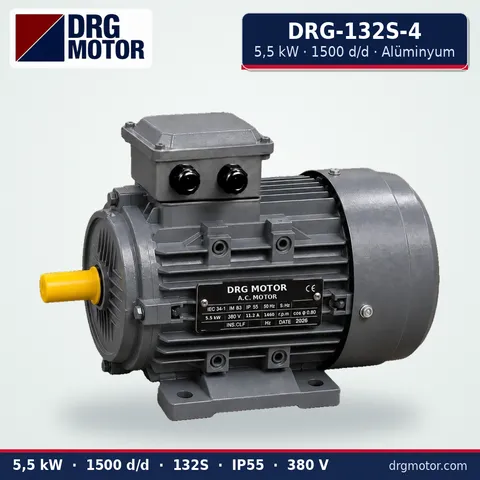
5.5 kW Three-Phase Motor 1500 rpm – DRG-132S-4 Aluminium
- 5.5 kW · 1500 rpm (4 poles)
- Aluminium frame · IEC 132S
- Mounting: B3 · B5 · B14 · B35
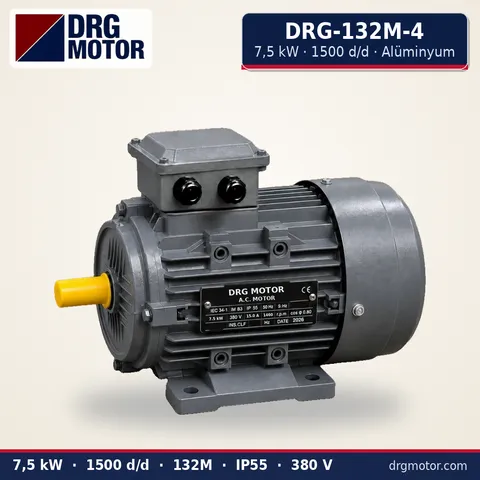
7.5 kW Three-Phase Motor 1500 rpm – DRG-132M-4 Aluminium
- 7.5 kW · 1500 rpm (4 poles)
- Aluminium frame · IEC 132M
- Mounting: B3 · B5 · B14 · B35
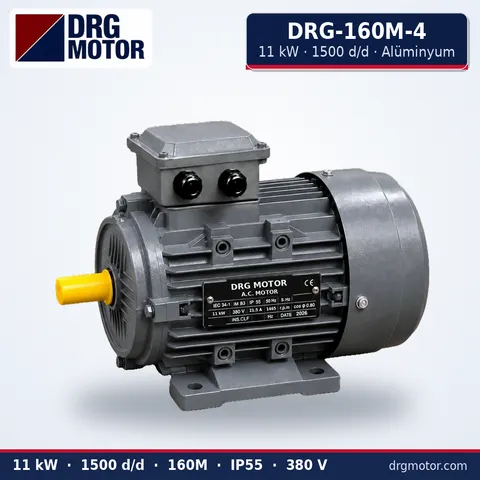
11 kW Three-Phase Motor 1500 rpm – DRG-160M-4 Aluminium
- 11 kW · 1500 rpm (4 poles)
- Aluminium frame · IEC 160M
- Mounting: B3 · B5 · B14 · B35
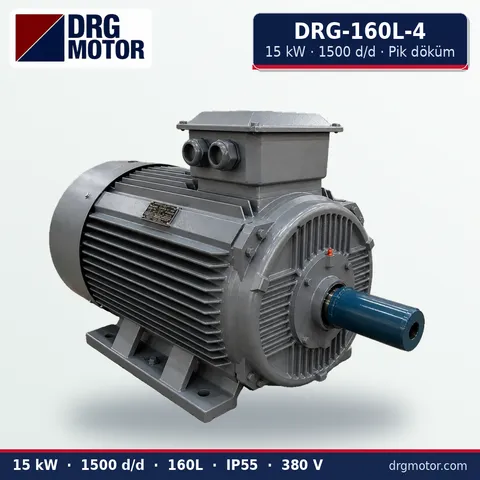
15 kW Three-Phase Motor 1500 rpm – DRG-160L-4 Cast Iron
- 15 kW · 1500 rpm (4 poles)
- Cast iron frame · IEC 160L
- Mounting: B3 · B5 · B14 · B35
Click to see current prices and order these motors nowSEE PRICES →
Chocolate Ball Mill Motor: Frequently Asked Questions
What kW should a chocolate ball mill motor be?
The builder sets power by vessel volume, ball charge and required fineness; keep the nameplate power of the old motor when replacing. If the mill struggles at start, check the starting method and jacket heating before increasing power.
My ball mill will not start in the morning and the motor hums. Why?
The balls have settled and the mass has cooled and stiffened, and the motor is usually trying to start in star with low torque. Heat the jacket water and wait for the mass to become fluid; if the problem continues, the starting method should be reviewed.
Can an inverter be fitted to the mill motor?
Yes; a standard asynchronous motor can run on an inverter to adjust shaft speed and deliver high starting torque in a controlled way. The inverter is sourced separately; DRG does not sell inverters. During long running at low speed the motor's own fan cools less.
Why does the motor stand upright on top of a chocolate mill?
The agitator shaft is vertical and runs down the centre of the vessel; the motor and gearbox sit at the top end of the shaft, outside the hot and wet zone. The motor must therefore be ordered with a flange suitable for vertical mounting.
For a quotation, send a photo of the motor nameplate with the power, speed, mounting (vertical flange / foot + flange), shaft size, gearbox ratio and starting method via WhatsApp, or add the models you have chosen to the quote list. Phone: +90 (542) 666 11 11 · e-mail: info@drgmotor.com · contact page. Current prices are in the online shop.