English
 Le français
 Türkçe




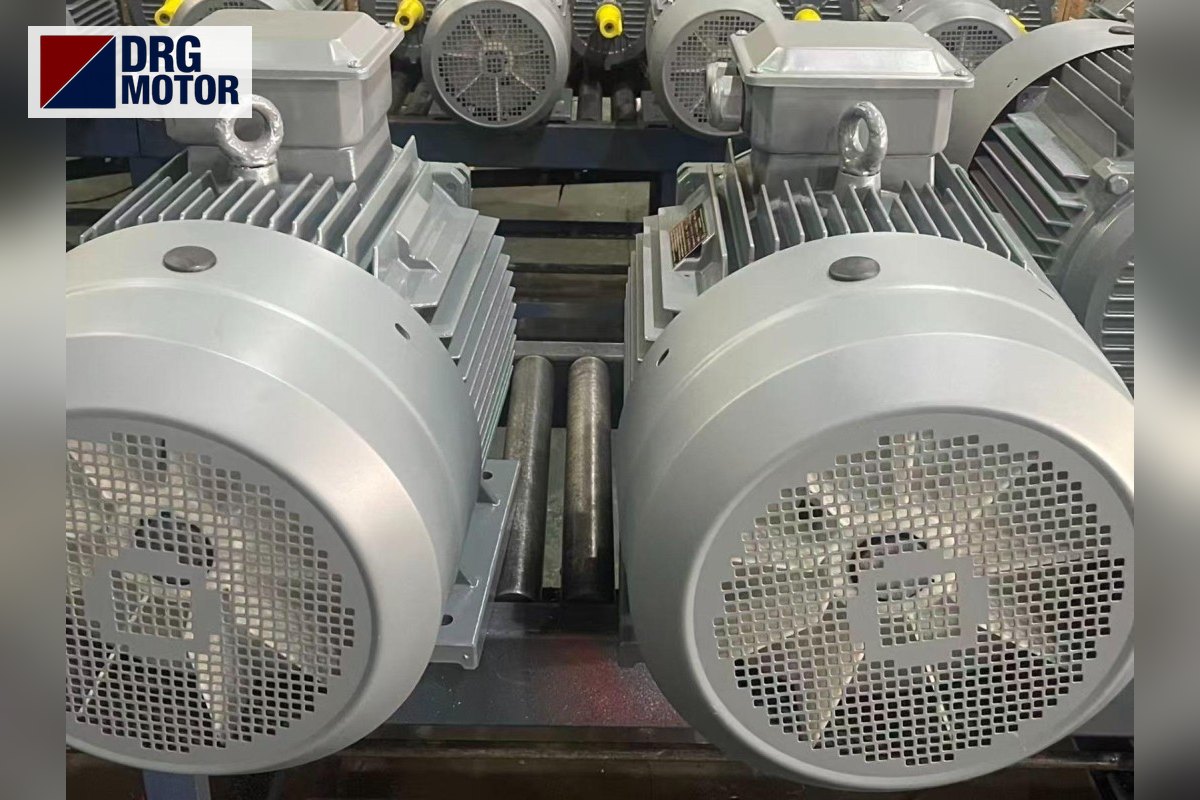

In an industrial coffee grinder the electric motor turns the toothed burrs or the corrugated roller pairs that cut roasted beans. Three things decide the motor: the grinder type (burr or roller), the speed the grinding element needs and the way the motor is attached to the machine. If you are replacing a burnt-out motor, the safest route is to keep the power and speed on the old nameplate and match the flange and shaft dimensions exactly.
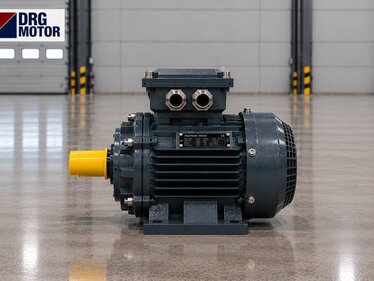
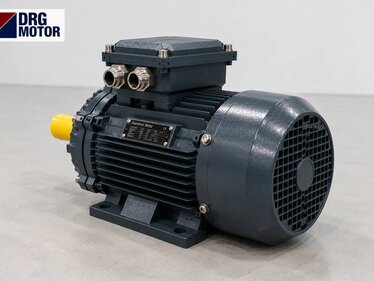
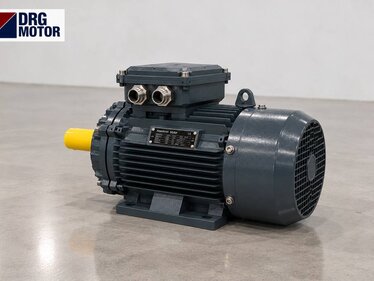
DRG Motor is a manufacturer, supplier and seller of electric motors; it supplies not the grinder itself but the three-phase asynchronous IEC motor that drives it. All models in the relevant power and speed range are listed on the buy electric motors online page.
The grinder carries a different load from the other food machines on a coffee line; for the motors of those machines see the food machine motors page.
Burr and Roller Grinders Load the Motor Differently
Flat and conical burr grinders
In a burr grinder one burr is fixed and the opposite one turns with the motor shaft. Beans enter at the centre, break between the teeth while moving outwards and keep shrinking until they fit through the gap between the burrs. As the gap closes, for instance down to the flour-like grind of Turkish coffee, the energy spent per kilogram rises sharply and the motor draws more current at the same throughput.
On small and medium burr grinders the burr is usually mounted directly on the motor shaft or through a short coupling. Motor speed is then burr speed; nothing in between changes it.
Roller grinders
Industrial granulating grinders pass the beans through two or three stages of corrugated roller pairs. Each stage has a slightly narrower gap, and the two rollers of a pair run at different speeds; that speed difference cuts the bean instead of crushing it and gives an even granule. Because the rollers are driven by belts or gears, motor speed and roller speed are not the same.
The load on a roller grinder is smoother than on a burr grinder, but a stone, a metal fragment or a lump of product between the rollers creates a sudden jamming torque. Most machines absorb this shock with spring-loaded rollers or a shear pin; the starting and breakdown torque of the motor is the second margin behind it.
Speed, Burr Diameter and Heat in the Grinding Chamber
Almost all the electrical energy spent on grinding ends up as heat, and most of that heat stays in the ground coffee. Coffee aromas are volatile; as the grinding chamber warms up, aroma loss and oil release increase. Machine builders therefore choose burr speed together with burr diameter: large burrs run slower, small burrs faster.
The figure that matters is the peripheral speed at which the teeth meet the coffee (v = π·D·n/60). The table shows the peripheral speed at the rated speed of DRG motors for two assumed burr diameters:
| Motor | Rated speed | Burr diameter (example) | Peripheral speed |
|---|---|---|---|
| DRG-100L2-4 | 1450 rpm | 150 mm | 11.4 m/s |
| DRG-100L2-4 | 1450 rpm | 250 mm | 19.0 m/s |
| DRG-112M-2 | 2905 rpm | 150 mm | 22.8 m/s |
| DRG-112M-2 | 2905 rpm | 250 mm | 38.0 m/s |
In practice, fitting a 2-pole motor in place of a 4-pole one nearly doubles the peripheral speed on the same burr. Burr bearings, seals and any water jacket or air blowing were designed for the old speed, so the change leads to burnt-smelling coffee, rapidly dulled burrs and an overloaded motor. Keep the same number of poles when replacing.
Click to see current electric motor prices and order nowSEE PRICES →
Reading Motor Power from the Nameplate and the Current
The power of a coffee grinder motor depends on fineness as much as on capacity; of two machines with the same capacity, the one grinding Turkish coffee needs the stronger motor. Small shop and workshop types may use a few kW, while line grinders in large roasting plants can reach tens of kW. The definitive value is the machine builder's nameplate or catalogue; do not estimate kW from capacity.
If the nameplate is unreadable, the current measured under load with a clamp meter is a good clue. Example (assumption): on a 400 V supply, a 4-pole grinder draws 6.5 A per phase at its finest setting, fully loaded. The 6.02 A rated current of the 3 kW DRG-100L2-4 is not enough for this load; the 4 kW DRG-112M-4 with the same pole count (7.95 A) is the one to consider. Take the reading after the motor has warmed up, with the machine at its hardest setting.
Keeping the power and changing the speed also changes the torque: the 4 kW 2-pole DRG-112M-2 delivers 13.1 Nm rated torque at the shaft, the 4-pole DRG-112M-4 delivers 26.3 Nm. On a roller grinder the pulley ratio was calculated around that difference; if the pole count changes, the pulley must be recalculated as well.
Flange, Shaft and Foot Dimensions When Replacing the Motor
When the burr sits directly on the motor shaft, the motor is flanged to the back wall of the grinding chamber and the motor spigot defines the burr axis. A motor whose spigot differs by a few millimetres turns the burr off-centre and the gap setting will not hold. The B5 large flange dimensions in the DRG catalogue (M bolt circle / N spigot / P outer diameter) are as follows; the B14 small flange dimension is confirmed with the order:
| Frame | Flange M / N / P (mm) | Shaft D × E (mm) | Example model |
|---|---|---|---|
| 90L | 165 / 130 / 200 | 24 × 50 | DRG-90L-2 |
| 100L | 215 / 180 / 250 | 28 × 60 | DRG-100L2-4 |
| 112M | 215 / 180 / 250 | 28 × 60 | DRG-112M-2, DRG-112M-4 |
Frames 100L and 112M share the same flange and shaft, so on a flanged grinder moving from 3 kW to 4 kW does not change the connection. A foot-mounted (B3) motor is different: shaft height H rises from 100 mm to 112 mm, the foot holes change and the belt alignment has to be reset.
Some grinders seat the burr hub on a special shaft that is longer than the standard IEC shaft or has a threaded end. Such a shaft cannot be met with a standard motor; it needs a special shaft, which DRG does not supply. If you want to move to a standard motor, work out an adapter bush or coupling for the burr hub together with the machine builder.
On a roller grinder the motor is usually foot-mounted and belt-driven; keep the motor speed and the roller speed stays the same. If the pulley must change, use the pulley and belt calculator for n2 = n1·d1/d2. Before replacing, check:
- kW, rpm and voltage on the old nameplate (230/400 V or 400/690 V)
- Mounting: foot (B3), large flange (B5), foot + flange (B35) or small flange (B14)
- Flange spigot N and bolt circle M; shaft diameter D and length E
- Does the burr sit directly on the shaft, or is there a coupling or belt?
- Motor position: horizontal, or vertical with shaft down or up
- Direction of rotation: burr teeth work one way, a reversed burr does not grind
- Orientation of the terminal box and cable entry
Coffee Dust and Oil: the Motor's Environment
Grinding releases fine, oily coffee dust that sticks to the fan cover and cooling fins. With IC411 cooling the motor cools its frame with its own fan, so a dust layer between the fins heats the motor directly. IP55 protection limits dust ingress, but the outer surface still needs regular cleaning.
In large plants, if the enclosed rooms where coffee dust accumulates are classified as explosive dust atmospheres, the motor there must be Ex (ATEX). That duty cannot be met with a standard IEC motor and is outside the DRG range; a grinder motor in an unclassified area can be a standard IP55 motor. Ambient temperature must be −15…+40 °C and altitude up to 1000 m.
Signs of the Wrong Motor on a Grinder
The overload trips often and the motor stalls at the finest setting: not enough power or the wrong connection. On a 400 V supply a motor rated 230/400 V is connected in star, a motor rated 400/690 V in delta.
The coffee smells burnt and the chamber is too hot to touch: speed is higher than before or the burrs are dull. If the complaint started after a motor change, check the pole count first.
Vibration and uneven granules: the flange spigot does not seat properly or the shaft runs out; the burr gap cannot be held.
The machine runs but does not grind: wrong direction of rotation. Swap two phases to correct it.
DRG Motors Suited to Coffee Grinders
Two-pole models suit direct burr drives; four-pole models suit belt-driven roller grinders and large burr types. All four have aluminium housings, and frames 100L and 112M share the same B5 flange.
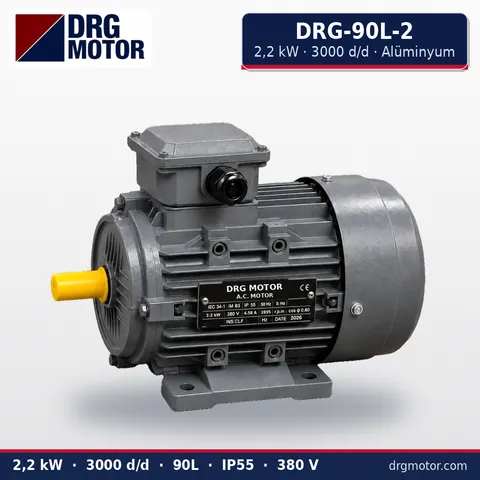
2.2 kW Three-Phase Motor 3000 rpm – DRG-90L-2 Aluminium
- 2.2 kW · 3000 rpm (2 poles)
- Aluminium frame · IEC 90L
- Mounting: B3 · B5 · B14 · B35
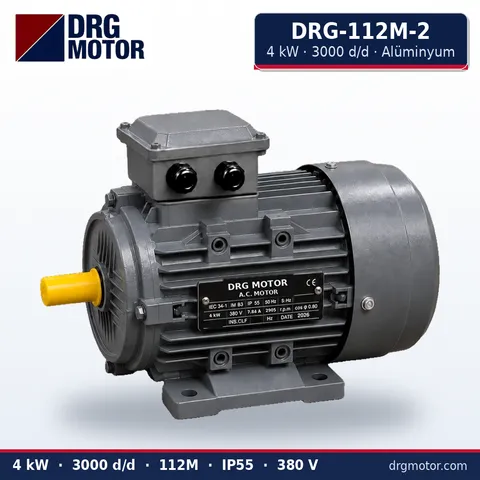
4 kW Three-Phase Motor 3000 rpm – DRG-112M-2 Aluminium
- 4 kW · 3000 rpm (2 poles)
- Aluminium frame · IEC 112M
- Mounting: B3 · B5 · B14 · B35
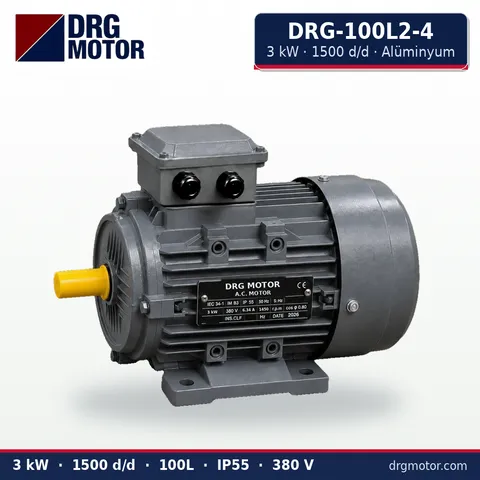
3 kW Three-Phase Motor 1500 rpm – DRG-100L2-4 Aluminium
- 3 kW · 1500 rpm (4 poles)
- Aluminium frame · IEC 100L
- Mounting: B3 · B5 · B14 · B35
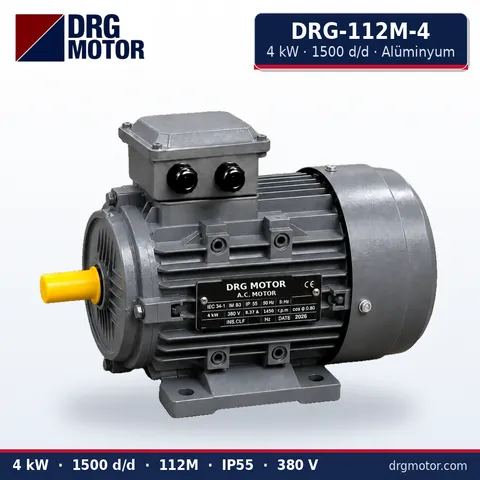
4 kW Three-Phase Motor 1500 rpm – DRG-112M-4 Aluminium
- 4 kW · 1500 rpm (4 poles)
- Aluminium frame · IEC 112M
- Mounting: B3 · B5 · B14 · B35
Click to see current prices and order these motors nowSEE PRICES →
Coffee Grinder Motor: Frequently Asked Questions
What speed should a Turkish coffee grinder motor run at?
The machine builder sets the speed according to burr diameter. Small burr grinders commonly use 2-pole motors (3000 rpm class), large burr and roller types 4-pole motors (1500 rpm class). When replacing, keep the speed on the old nameplate.
Why does my coffee grinder motor get so hot?
The usual causes are oily dust on the fan cover, dull burrs, running finer than the machine's capacity allows and a wrong star-delta connection. A frame too hot to touch is not on its own a fault sign for a motor with class F insulation; measure the current, and if it exceeds the nameplate value the problem lies in the load or the connection.
Is it a problem to fit 3 kW instead of 2.2 kW?
A motor only draws the current the load demands, so one size up does no harm on its own. However, the frame grows from 90L to 100L: the shaft goes from 24 × 50 mm to 28 × 60 mm and the flange outer diameter from 200 mm to 250 mm. Set the overload relay to the new motor's rated current.
For a quotation, send a photo of the motor nameplate with the power, speed, mounting (foot/flange), shaft size and grinder type (burr or roller) via WhatsApp, or add the models you have chosen to the quote list. Phone: +90 (542) 666 11 11 · e-mail: info@drgmotor.com · contact page. Current prices for all models are in the online shop.