English
 Le français
 Türkçe




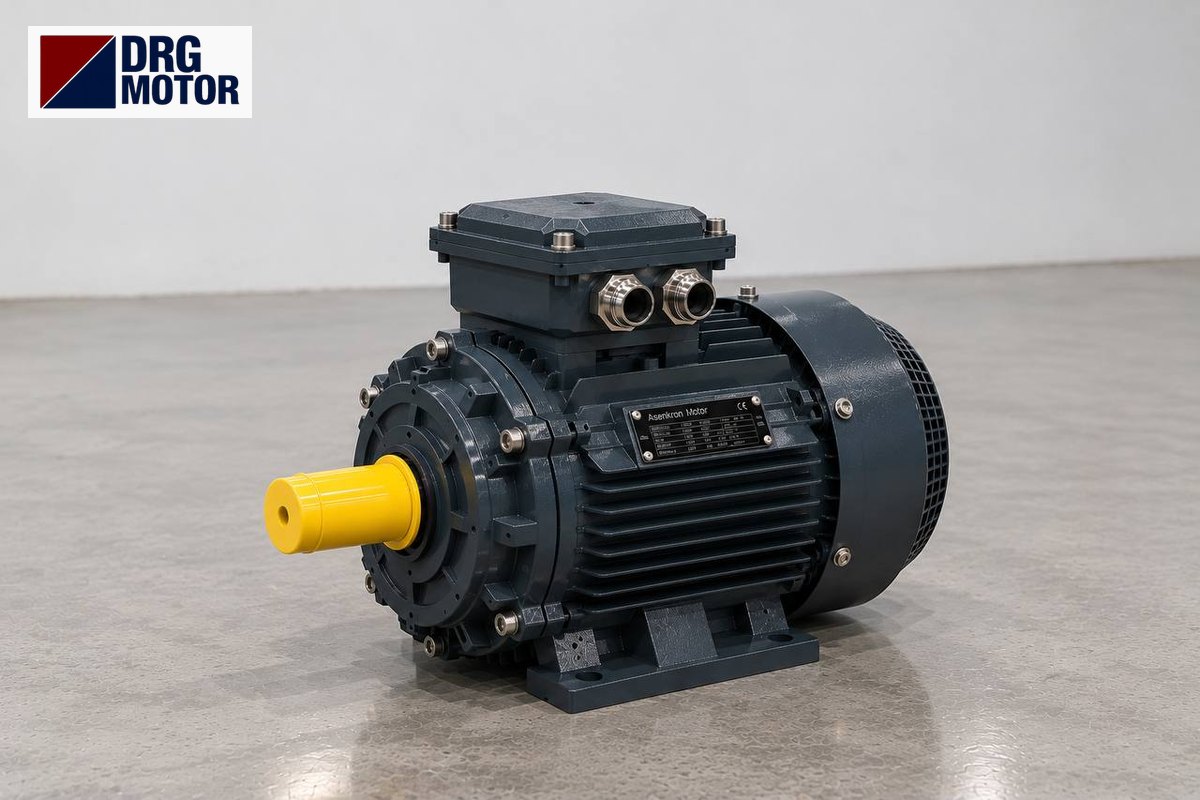

The motor of a paddy husker (rubber roll husker) drives two rubber rolls at different surface speeds; what strips the husk from the grain is that speed difference, not the raw power of the motor. So when you look for a replacement motor, start with the power and speed on the old motor's nameplate and with the belt and pulley layout: a motor with a different speed shifts the speed of both rolls and the difference between them. Most huskers use a 4-pole (1500 rpm class), foot-mounted (B3) three-phase motor driving through belts.
Below you will find how roll speeds are calculated, how wear upsets that calculation and which connection dimensions to measure when changing the motor. Suitable 4-pole models are listed on our buy electric motors online page, and motors for other post-harvest machines are covered on our agricultural machine electric motors page.
How Do Rubber Rolls Tear the Husk?
Paddy falls from the feed roll as a thin curtain into the narrow gap between the two rolls. The rolls turn towards each other in opposite directions. One sits in fixed bearings; the other is pressed against it by a pneumatic cylinder or a weighted lever.
Each grain is gripped by both rubber surfaces at once. The fast roll pulls one side of the hull forward while the slow roll holds the other side back, and the husk tears off the brown rice under this shearing action. More roll pressure raises the hulling ratio, but excessive pressure means broken grains and hot rubber.
The motor's job here is to turn both rolls against this friction and, through the belt layout, to keep the ratio between them. Current is set mainly by feed rate and roll pressure. The hulled mix then passes an air channel under the rolls; on most machines the aspirator fan that removes the light husk runs on a separate motor. When you order a spare, be clear whether the burnt motor is the roll drive, the aspirator or the feed roll.
Pulley Diameters, Roll Wear and Surface Speed
Each roll speed follows n2 = n1 · d1 / d2, and its surface speed v = π · D · n / 60. The table below is an example based on these assumptions: motor 1460 rpm, motor pulley 150 mm, fast roll pulley 180 mm, slow roll pulley 230 mm. The fast roll then turns at 1216.7 rpm and the slow roll at 952.2 rpm.
| Roll diameter | Fast roll | Slow roll | Speed difference |
|---|---|---|---|
| 255 mm (new) | 16.24 m/s | 12.71 m/s | 3.53 m/s |
| 240 mm | 15.29 m/s | 11.97 m/s | 3.32 m/s |
| 225 mm | 14.33 m/s | 11.22 m/s | 3.12 m/s |
| 210 mm | 13.38 m/s | 10.47 m/s | 2.91 m/s |
Two conclusions follow. If both rolls wear equally the ratio stays the same; at every diameter the fast roll is 21.7 percent faster than the slow one. But the difference in metres per second shrinks, and the rubber stresses the hull less.
In practice the fast roll wears quicker. If in the example it is down to 225 mm while the slow roll is at 245 mm, the surface speeds become 14.33 and 12.21 m/s and the difference falls to 2.12 m/s. That is why mills swap the rolls at intervals. When the hulling ratio drops, measure the roll diameters before blaming the motor.
When replacing the motor, keep the same number of poles. A 2-pole motor roughly doubles the speed of both rolls; a 6-pole motor cuts it by about one third. Pulleys can compensate, but that needs a new calculation; our pulley and belt calculator shows the diameter-to-speed relation quickly.
Click to see current electric motor prices and order nowSEE PRICES →
Power and Torque on a Husker Motor: Start from the Nameplate
On rubber roll huskers the motor power grows with roll length and hourly capacity. Small village-mill types run on a few kW, while line machines processing several tonnes per hour can exceed 10 kW. The exact value is on the machine builder's nameplate and catalogue; do not estimate power from capacity.
Keeping the same power means keeping the same torque (P = T · n / 9550). From catalogue data, the DRG-132M-4 gives 49.1 Nm at 7.5 kW, while the next size down, DRG-132S-4, gives 36.0 Nm at 5.5 kW. Fit a 5.5 kW motor to a husker rated 7.5 kW and, at the same pressure, it runs above its rated current, the overload trips and the operator has to back off the pressure; the result is a lower hulling ratio.
One size up does no harm, but the frame grows: 7.5 kW is a 132M frame, 11 kW moves to 160M. The shaft goes from 38 mm to 42 mm and the shaft height from 132 mm to 160 mm, so the pulley hub and the slide rails change too.
Slide Rails, Shaft and Belt Line When Changing the Motor
Husker motors are usually foot-mounted, and belt tension is set by sliding the motor on its rails. Within the same IEC frame number, foot holes, shaft height and shaft end are identical. Catalogue dimensions for the DRG-132M-4:
- Power: 7.5 kW – 1460 rpm
- IEC frame: 132M, shaft height H = 132 mm
- Foot hole spacing (A × B): 216 × 178 mm, holes 4–Φ12
- Shaft (D × E): 38 × 80 mm, key width 10 mm
- Current (400 V): 14.3 A
- Voltage: 400/690 V (Δ/Y)
Check the following before ordering:
- Old motor nameplate: kW, rpm, voltage and Δ/Y connection (take a photo).
- Shaft diameter and length, key width; does the existing pulley hub fit the new shaft?
- Foot hole spacing and shaft height; do the rail holes line up with the new feet?
- Belt line: are the motor pulley and both roll pulleys in one plane, and what belt profile and count?
- Current diameter of the fast and slow rolls and the date of the last swap.
- Direction of rotation: rolls turning the wrong way will not draw paddy into the gap; check at first start.
- Nameplates of the aspirator or feed roll motors if they are separate.
Husk Dust, Moisture and the Moment of Starting
Husk is a light, fine and abrasive dust with a high silica content. Once the motor's cooling fins and fan cover fill with it, the motor cannot draw its own air and runs hotter at the same load. IP55 protection seals the frame against dust and water jets; still, put fin cleaning in the maintenance schedule.
Paddy may arrive damp from storage, and huskers often stand in half-open sheds. DRG motors are rated for −15…+40 °C ambient and altitudes up to 1000 m; winter frost and summer heat under the roof should not push conditions outside that range.
At start-up, roll pressure should be released and the feed closed. A husker started this way is a light load, and in this power range direct-on-line or star-delta starting will do. From 4 kW upwards every DRG motor connects in delta to a 400 V supply, a winding arrangement that allows a star-delta starter. Starting with a full gap and pressure applied slips the belts and strains the motor.
DRG Motors Suitable for Paddy Huskers
These models are 4-pole, suit foot mounting and cover the power steps common on belt-driven huskers; choose by the old motor's nameplate.
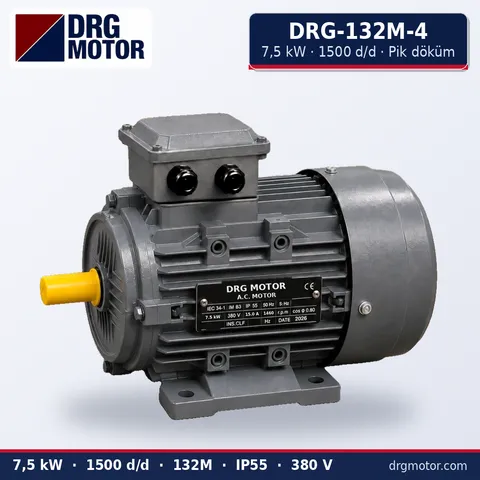
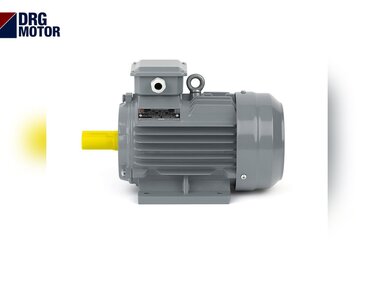
7.5 kW Three-Phase Motor 1500 rpm – DRG-132M-4 Cast Iron
- 7.5 kW · 1500 rpm (4 poles)
- Cast iron frame · IEC 132M
- Mounting: B3 · B5 · B14 · B35
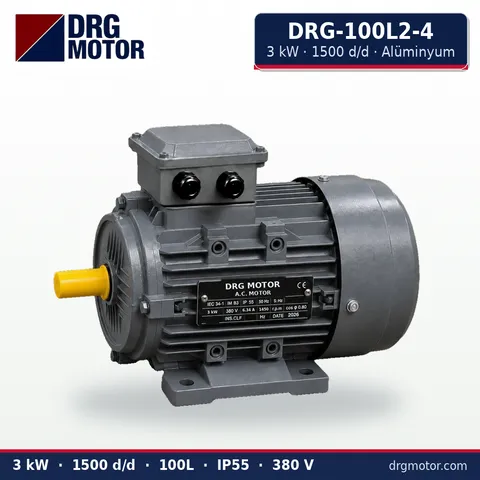
3 kW Three-Phase Motor 1500 rpm – DRG-100L2-4 Aluminium
- 3 kW · 1500 rpm (4 poles)
- Aluminium frame · IEC 100L
- Mounting: B3 · B5 · B14 · B35
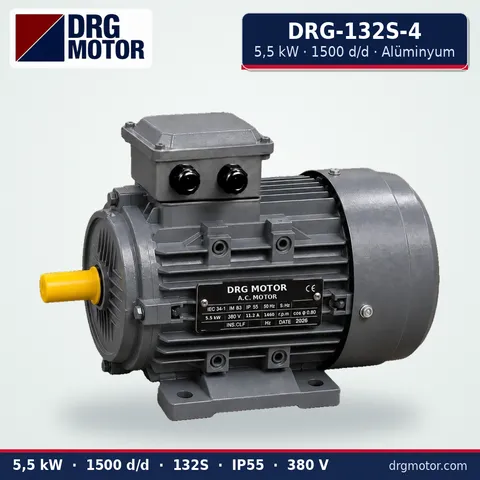
5.5 kW Three-Phase Motor 1500 rpm – DRG-132S-4 Aluminium
- 5.5 kW · 1500 rpm (4 poles)
- Aluminium frame · IEC 132S
- Mounting: B3 · B5 · B14 · B35
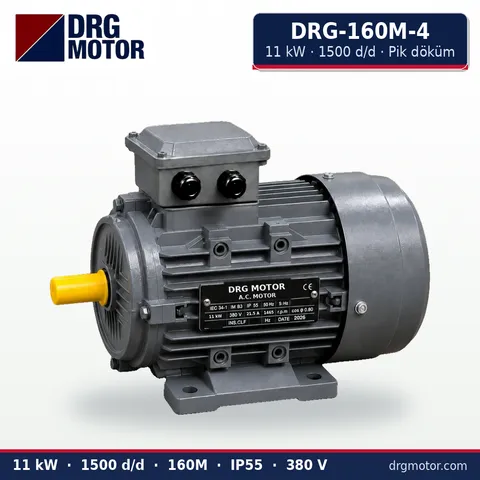
11 kW Three-Phase Motor 1500 rpm – DRG-160M-4 Cast Iron
- 11 kW · 1500 rpm (4 poles)
- Cast iron frame · IEC 160M
- Mounting: B3 · B5 · B14 · B35
Click to see current prices and order these motors nowSEE PRICES →
Paddy Husker Motor: Frequently Asked Questions
What kW motor does a paddy husker need?
It depends on roll length and capacity; small types use a few kW, large line machines go above 10 kW. The correct value is the machine nameplate or the builder's catalogue; if the motor has burnt out, its own nameplate is the most reliable source.
Should motor speed be raised as the rolls wear?
No. Wear does not change the speed ratio; it narrows the difference in metres per second. The fix is to swap or renew the rolls; changing the motor speed accelerates both rolls together and can increase breakage.
Why does the husker motor trip its overload?
The usual causes are excessive roll pressure, trying to make up for worn rolls with more pressure, dust-clogged fins and low supply voltage. The overload relay must be set to nameplate current; for example 14.3 A at 400 V for the 7.5 kW DRG-132M-4.
The old motor was 1000 rpm; can I fit a 1500 rpm motor?
Not without recalculating the pulleys. Moving from 6 poles to 4 raises roll speeds by about 50 percent; grain breakage and rubber heating speed up. Choosing the same pole count as the old motor is the shortest route.
DRG Motor is a manufacturer, supplier and seller of electric motors. To prepare a quotation for a husker motor, this is enough: a picture showing the plate of the removed motor, its kW and rpm, whether it is fixed by feet or flange, the shaft diameter and the roll length of the machine. Write to our WhatsApp number or gather the models you like in the quote list. For a call use +90 (542) 666 11 11, for written requests info@drgmotor.com; all channels are on the contact page. Up-to-date prices are in our motor store.