English
 Le français
 Türkçe




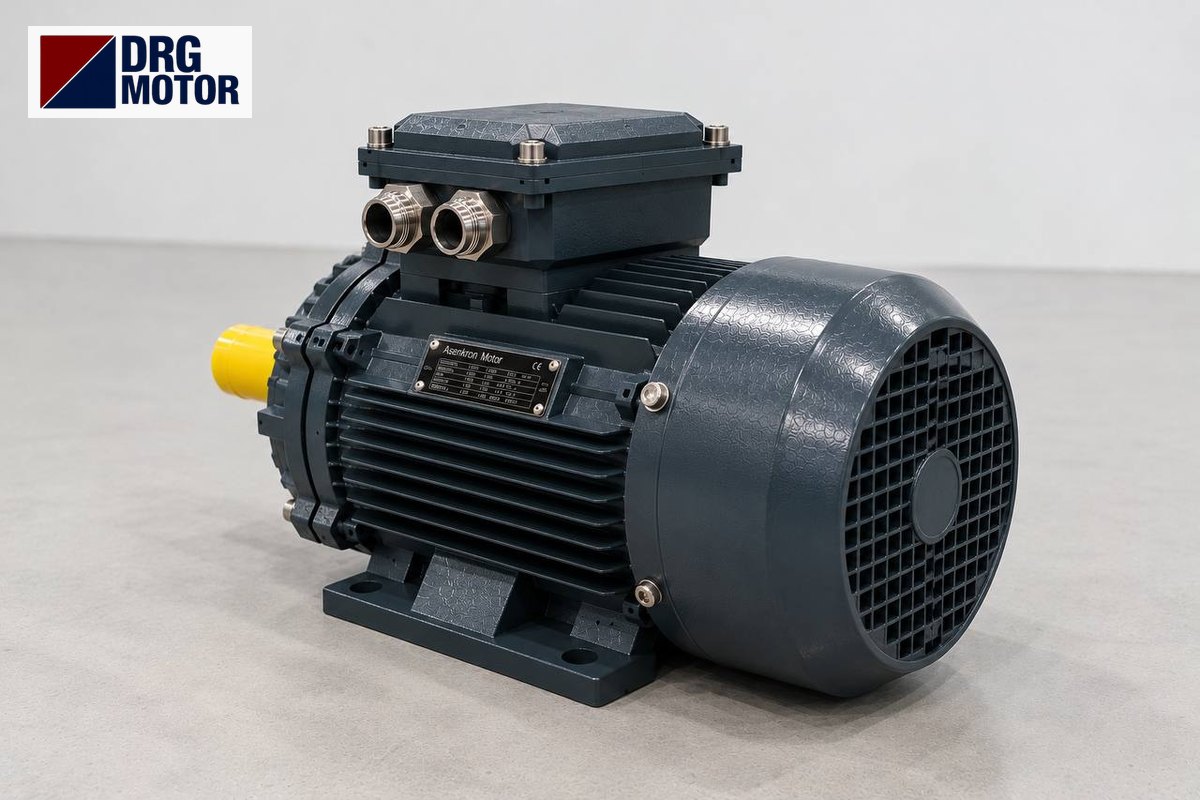

In a ribbon mixer, the electric motor turns the helical ribbon shaft running along the horizontal U-shaped trough through a gearbox at tens of revolutions per minute. Three things decide the motor choice: the torque to start in a powder-filled trough, the pole count that gives the correct ribbon speed together with the gearbox ratio, and a flange that fits the gearbox input. Power depends on powder density and trough volume; the exact value is on the machine maker's nameplate.
DRG Motor is a manufacturer, supplier and seller of electric motors. You can compare 4-pole and 6-pole three-phase IEC motors for gearbox mounting by power and speed on the buy electric motors online page.
Inner and Outer Ribbons Move Powder in Opposite Directions
The shaft carries two helical ribbons. The outer ribbon pushes powder towards one end of the trough, while the smaller inner ribbon pushes it towards the other. This creates a two-way axial flow; the powder mixes slowly and gently, constantly changing place without being broken down. That is why ribbon mixers are preferred for food powders, feed premixes, detergent powder, pigments and chemical granules.
The ribbons run a few millimetres from the trough bottom. The discharge valve under the trough is usually in the middle, and the shaft keeps turning during discharge; the ribbons sweep the powder towards the valve.
The load is constant-torque and rises directly with the bulk density of the powder. In a trough of the same volume, a light powder like flour and a heavy mineral filler like calcite require very different torque. If the machine was designed for one product and switched to another, reassess the motor power from this angle.
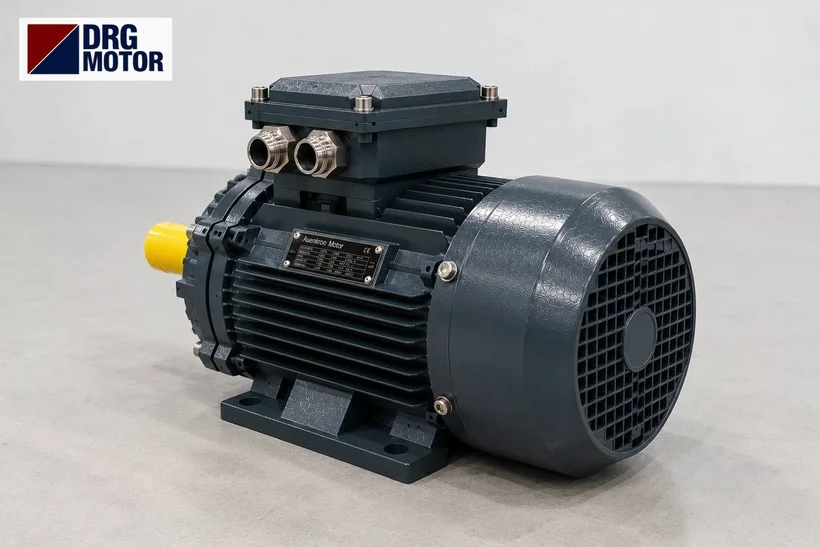
Starting With a Full Trough: Why 6-Pole Is Common
A ribbon mixer often starts with the trough full: the shaft may stop during filling, a recipe may be held, or power may be cut. Waiting powder settles and compacts; on the first turn the ribbon must cut through this bed. At that moment the torque required at the motor shaft rises above the rated value.
The same ribbon speed can be reached with a 4-pole motor and a high-ratio gearbox, or with a 6-pole motor and a lower-ratio gearbox. Gearbox output torque is the same for the same kW in both cases; the difference lies on the motor side. A 6-pole motor has a higher rated torque for the same power, and the gearbox can be chosen with a smaller ratio, often with fewer stages.
The table below shows the gearbox ratio required assuming the ribbon shaft turns at 40 rpm, and the starting torque (Tn × Ts/Tn) of DRG motors. You can test the ratio with your own values in the gearbox output speed and torque calculator.
| Model | Rated speed (rpm) | Ratio for 40 rpm | Starting torque (Nm) |
|---|---|---|---|
| DRG-112M-4 | 1450 | 36.3 | 57.9 |
| DRG-132M-4 | 1460 | 36.5 | 98.2 |
| DRG-132M2-6 | 968 | 24.2 | 108.6 |
| DRG-160M-6 | 970 | 24.3 | 147.6 |
Example: the DRG-160M-6 is 7.5 kW, 970 rpm with a rated torque of 73.8 Nm and a Ts/Tn ratio of 2.0. At a ribbon speed of 40 rpm, 7.5 kW means about 1790 Nm on the shaft, excluding gearbox losses. Assuming a ribbon diameter of 0.9 m, tip speed is π × 0.9 × 40 / 60 ≈ 1.9 m/s. These are worked examples only.
Click to see current electric motor prices and order nowSEE PRICES →
Gearbox Type and Motor Connection
The most common arrangement on ribbon mixers is a hollow-shaft gearbox slid directly onto the ribbon shaft with a torque arm; the motor connects to the gearbox input flange as B5. On some machines the motor is foot-mounted (B3) and drives the gearbox through a belt and pulleys or a chain. DRG does not sell gearboxes; you can find suitable motor options on the electric motors for helical gearboxes page.
When replacing, measure the old motor's flange. For example, on a 112M frame the B5 flange outside diameter is 250 mm, bolt circle 215 mm, spigot diameter 180 mm and shaft 28 × 60 mm. On a 132 frame these are 300 / 265 / 230 mm with a 38 × 80 mm shaft; on a 160 frame 350 / 300 / 250 mm with a 42 × 110 mm shaft. The same frame number gives the same flange; moving to a different frame also requires changing the gearbox input adaptor. For B14 (small flange) connections we confirm the dimensions with the order.
If a foreign object such as a bolt or a piece of bag gets between ribbon and trough, the shaft locks momentarily. The shock passes through the gearbox and coupling; the motor's overload relay cannot always catch such a sudden lock in time. If the machine has a shear pin or torque limiter, check its condition.
Dusty Atmosphere, Explosive Dust and Hygiene Limits
When packed glands or air-purged seals at the shaft ends leak, powder piles up first on the gearbox and motor. The IP55 protection of DRG motors prevents dust from entering the motor, but dust collecting on the fan cover cuts off cooling air. Clean the fins of the shaft-fan (IC411) motor regularly.
Flour, sugar, starch and some chemical and plastic powders can form an explosive mixture in air at certain concentrations. If the area where the mixer stands is classified as a potentially explosive atmosphere (Ex), this duty cannot be met by a standard IEC motor; an Ex-protected special motor is required and DRG does not offer such motors.
In food and pharmaceutical plants the motor usually sits outside the product zone, in the drive group at the end of the trough. If the drive area is washed down with pressurised water, a stainless/hygienic frame motor may be needed; DRG does not offer this frame type. In plants cleaned dry, a painted aluminium or cast iron frame can be used.
For feed plant mixers working on a similar principle, see also the feed mixer electric motors page. For general mixer and agitator motor supply, we have our mixer motor supply article.
Signs of the Wrong Motor on a Ribbon Mixer
- If a 2-pole motor is fitted instead of a 4-pole one, ribbon speed doubles; delicate powders are degraded and granules break.
- When switching to a heavier product, the motor struggles to start with a full trough and the overload trips.
- Raising the overload setting hides the problem; winding heating continues.
- A motor with a different shaft diameter cannot be connected to the gearbox without an adaptor; forcing it with a bushing causes misalignment.
What to check before replacing the motor
- Motor nameplate: kW, rpm, voltage (230/400 V up to 3 kW, 400/690 V from 4 kW)
- Gearbox nameplate: ratio and input flange
- Is the motor flange (B5), foot (B3) or both (B35)?
- Shaft diameter, shaft length, key width
- Bulk density of the powder mixed and fill level
- Is the area classified as explosive, or is it washed down?
DRG Motors Suitable for Ribbon Mixers
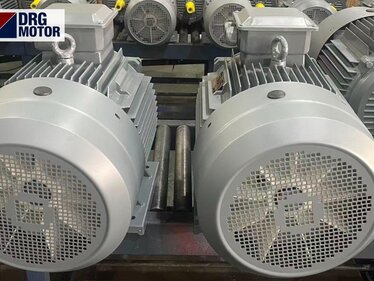
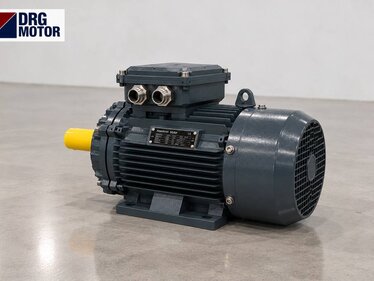
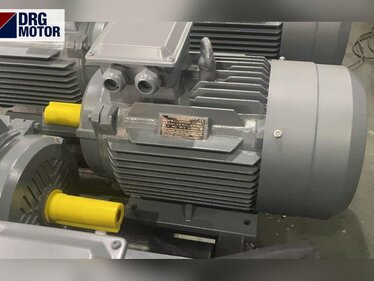
These 4-pole aluminium frame and 6-pole cast iron frame models cover the common power range connected by B5 flange to a ribbon shaft gearbox. 6-pole models stand out for heavy powders and when a high-ratio gearbox is to be avoided.

4 kW Three-Phase Motor 1500 rpm – DRG-112M-4 Aluminium
- 4 kW · 1500 rpm (4 poles)
- Aluminium frame · IEC 112M
- Mounting: B3 · B5 · B14 · B35
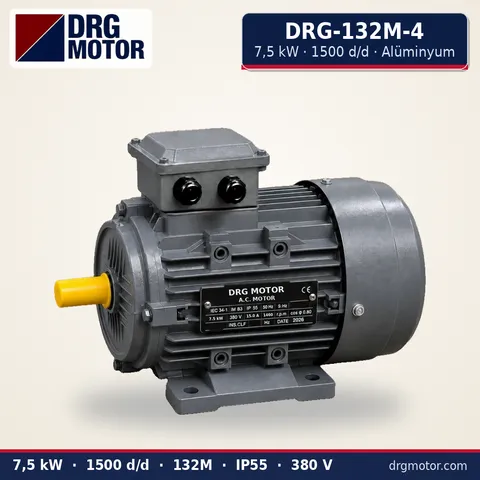
7.5 kW Three-Phase Motor 1500 rpm – DRG-132M-4 Aluminium
- 7.5 kW · 1500 rpm (4 poles)
- Aluminium frame · IEC 132M
- Mounting: B3 · B5 · B14 · B35
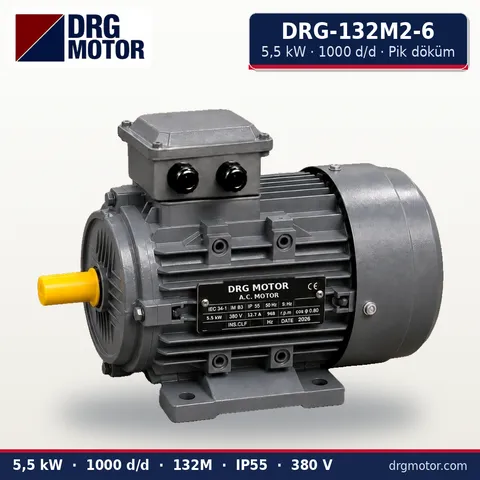
5.5 kW Three-Phase Motor 1000 rpm – DRG-132M2-6 Cast Iron
- 5.5 kW · 1000 rpm (6 poles)
- Cast iron frame · IEC 132M
- Mounting: B3 · B5 · B14 · B35
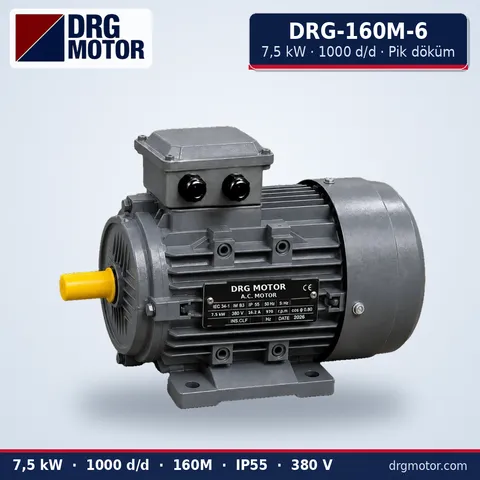
7.5 kW Three-Phase Motor 1000 rpm – DRG-160M-6 Cast Iron
- 7.5 kW · 1000 rpm (6 poles)
- Cast iron frame · IEC 160M
- Mounting: B3 · B5 · B14 · B35
Click to see current prices and order these motors nowSEE PRICES →
Ribbon Mixer Motor: Frequently Asked Questions
How many kW should a ribbon mixer motor be?
Power depends on trough volume, fill ratio and the bulk density of the powder; no single value can be given. When replacing, keep the kW on the machine nameplate; if the product has changed, have the maker check it by giving them the density.
Is a 4-pole or 6-pole motor used on a ribbon mixer?
Both are used; the real criterion is the gearbox ratio. If you keep the existing gearbox, do not change the old motor's pole count, otherwise the ribbon speed changes.
Can a standard motor be fitted to a ribbon mixer handling flour and sugar?
Yes, if the area is not classified as a potentially explosive atmosphere. If an Ex zone is defined, an Ex-protected motor is required; DRG does not offer this motor.
The ribbon mixer motor trips on a full start; what should I check?
Foreign objects in the trough, settled powder, product that has leaked through the seals and hardened, and gearbox oil are the first things to check. Then confirm that the motor connection (star/delta) matches the nameplate and that the supply voltage is not dropping.
For a quotation, send photos of the motor and gearbox nameplates, the power, speed, mounting type (foot/flange), shaft size and the product being mixed via WhatsApp, or add the models to the quote list. Phone: +90 (542) 666 11 11 · Email: info@drgmotor.com · Contact. Other powers and speeds are listed in our online store.