English
 Le français
 Türkçe




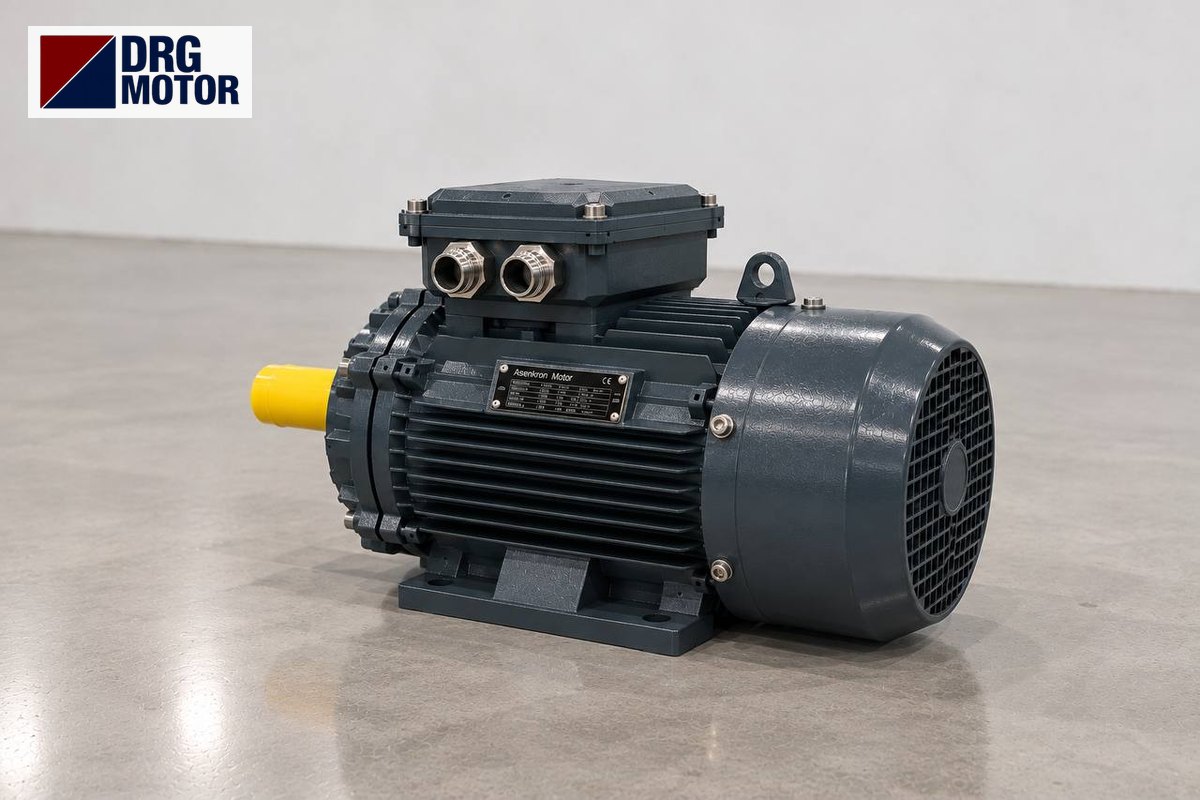

In a water-based paint mixing machine (dissolver), the motor's job is to spin the saw-tooth disc at a peripheral speed that disperses the pigment, and to hold that speed through the thick paste phase. Three things decide the selection: disc diameter, the peripheral speed the disc must reach and the resistance of the batch at its thickest point. Motor power follows from these three; the machine nameplate is always the first reference.
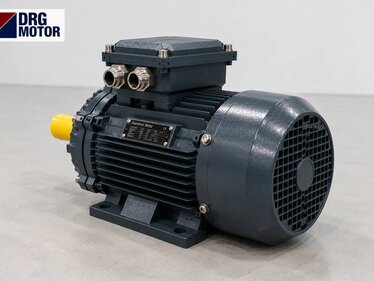
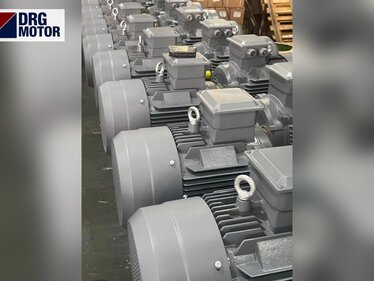
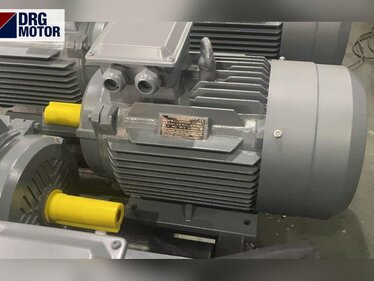
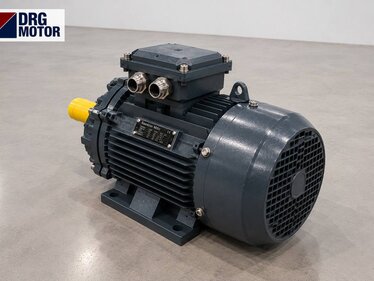
DRG Motor is a manufacturer, supplier and seller of electric motors; current three-phase asynchronous IEC motors used on dissolvers are listed by power, speed and frame type on the buy electric motors online page.
Below you will find how the disc works, then the speed and power calculation, and finally the flange and shaft values to measure when replacing the motor.
How Does a Dissolver Disc Disperse Paint?
A dissolver mixes by shear rather than by pushing with blades. When the toothed disc, with its teeth bent alternately up and down, turns at high speed, a narrow shear zone forms right around its edge; pigment agglomerates break up as they pass through it. Two ring-shaped flows form above and below the disc, and a slight vortex appears on the surface.
The measure of this effect is not motor speed but the peripheral speed of the disc edge: v = π · D · n / 60 (D in metres, n in rpm). In water-based emulsion paints the dispersion stage is commonly run at 18–25 m/s; the correct value is set by the formulator according to recipe and pigment.
Disc Diameter and the Speed It Requires
For the same peripheral speed a small disc needs high speed and a large disc low speed. The table shows the shaft speed needed for a 20 m/s target and the disc speed if the motor were coupled directly (rounded).
| Disc diameter | Speed for 20 m/s | Tip speed at 1460 rpm | Tip speed at 2930 rpm |
|---|---|---|---|
| 150 mm | 2546 rpm | 11.5 m/s | 23.0 m/s |
| 200 mm | 1910 rpm | 15.3 m/s | 30.7 m/s |
| 250 mm | 1528 rpm | 19.1 m/s | 38.4 m/s |
| 300 mm | 1273 rpm | 22.9 m/s | 46.0 m/s |
| 400 mm | 955 rpm | 30.6 m/s | 61.4 m/s |
The result: with a 250 mm disc a 4-pole motor runs close to target with direct coupling; 150–200 mm discs need a 2-pole motor or a step-up belt; at 300 mm and above a 2-pole motor is slowed down by a belt.
Example: 300 mm disc, belt drive
Assumption: 2-pole motor with 2945 rpm rated speed, 140 mm motor pulley, 300 mm disc shaft pulley. Disc shaft speed n2 = 2945 · 140 / 300 ≈ 1374 rpm; peripheral speed π · 0.3 · 1374 / 60 ≈ 21.6 m/s. You can check the same ratio with your own dimensions using the pulley and belt calculator.
Click to see current electric motor prices and order nowSEE PRICES →
Why Power Demand Grows So Fast With Disc Diameter
On high-speed discs absorbed power is roughly proportional to the cube of speed and the fifth power of diameter (P ∝ n³ · D⁵). In practice, enlarging the disc from 300 mm to 330 mm (10%) at the same speed raises power demand about 1.6 times. Simply fitting a larger disc because the old motor "struggles" therefore overheats the winding.
The second factor is batch consistency. During dispersion the tank holds water, dispersant and a high share of pigment and filler; this millbase phase is far thicker than the final let-down phase. Read motor current during the paste phase with the disc at full speed, not with the finished product. Small workshop dissolvers may use a few kW, large production tanks tens of kW; the exact value is on the machine builder's nameplate.
Starting, Star-Delta and Speed Control
DRG motors from 4 kW upwards are wound 400/690 V and run in delta on a 400 V supply, so star-delta starting can be applied. Note that starting torque drops to one third in star. For example, the 11 kW 4-pole DRG-160M-4 has 71.7 Nm rated torque and a Ts/Tn ratio of 2.2; in star, starting torque is about 52.6 Nm. If the disc is buried in thick paste, this may not be enough.
Two practical routes exist: start the disc before it is submerged, or ramp the speed with an inverter. Inverters are common on dissolvers anyway, giving low speed for pigment wetting, high speed for dispersion and low speed again for let-down. DRG does not sell inverters; state it in your order if the motor will be inverter-fed. For a comparison of starting methods see the star-delta starting page.
Vertical Mounting, Flange and Shaft Dimensions
On dissolvers the motor usually sits vertically at the top of the hydraulic lifting arm, shaft facing down. Where it drives the disc shaft through a coupling or belt, it is mostly B5 (large flange) or B35 (foot + flange). Vertical shaft-down use must always be stated in the order.
According to DRG catalogue B5 dimensions, frame 132 has flange outer diameter P 300 mm, bolt circle M 265 mm, spigot N 230 mm and shaft 38×80 mm; frame 160 has P 350 mm, M 300 mm, N 250 mm and shaft 42×110 mm. Do not choose a new motor before measuring these values on the old one. For B14 small-flange machines, dimensions are confirmed at order.
Lifting arm motor
The small pump motor of the hydraulic unit that raises the arm is a standard IEC motor and can be supplied separately; do not confuse it with the disc motor.
What the motor faces in water-based paint production
Water-based paint has no solvent vapour, so the area is usually not classed as explosive and a standard IP55 motor can be used. Solvent-based paint lines, however, need a special Ex-protected motor according to zone classification; that duty is not met by a standard IEC motor.
The real risks are different: pigment and filler dust building up on the fan cover, water splashing on the motor during tank cleaning, and hot air above a tank warmed by dispersion. An IP55 frame is protected against dust and splashing water but is not suited to direct hose washing. Keeping the fan cover clean lets the frame-fan (IC411) cooling work; ambient temperature should not exceed +40 °C.
Before Replacement: Symptoms and Checklist
Symptoms of a wrong selection
- Current peaks and the overload trips in the paste phase: power too low or disc enlarged.
- Agglomerates and colour deviation remain: peripheral speed too low; wrong speed or pulley ratio.
- Belt squeals, pulley heats up: starting torque cannot overcome paste resistance or belt tension is low.
- Excess foam and air bubbles on the surface: speed higher than needed, vortex too deep.
Checklist before replacing the motor
- kW, rpm, voltage and connection (Y/Δ) from the old motor's nameplate
- Disc diameter and target peripheral speed; both pulley diameters if belt-driven
- Mounting: B5 or B35, any vertical shaft-down use
- Flange P, M, N values plus shaft diameter and length
- Starting method: direct, star-delta or inverter
- Current measured with the thickest recipe (if available)
To choose a suitable frame, the aluminium frame electric motors page shows lightweight options up to 11 kW.
DRG Motors Suited to Dissolvers and Paint Mixers
These models are chosen by disc diameter and speed, from small workshop tanks to production dissolvers; the 2-pole model suits large discs via belt, the 4-pole models suit direct coupling.
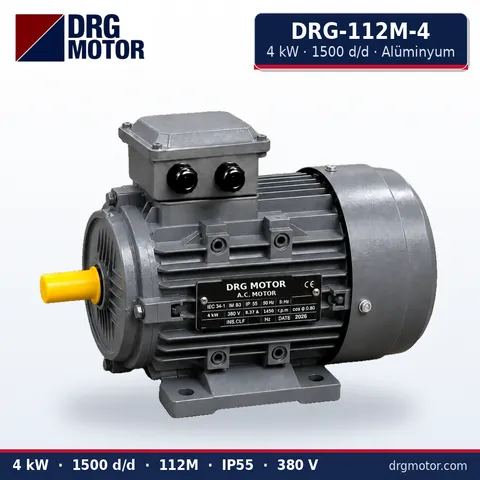
4 kW Three-Phase Motor 1500 rpm – DRG-112M-4 Aluminium
- 4 kW · 1500 rpm (4 poles)
- Aluminium frame · IEC 112M
- Mounting: B3 · B5 · B14 · B35
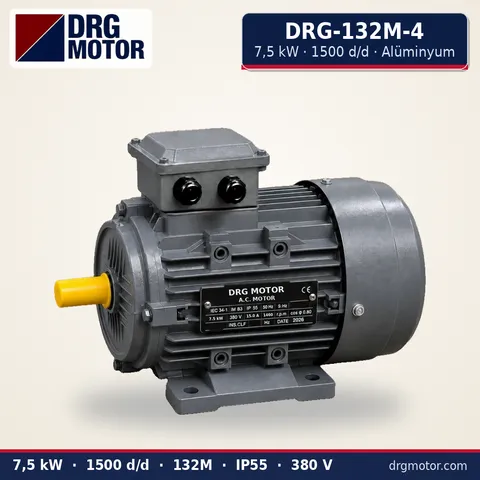
7.5 kW Three-Phase Motor 1500 rpm – DRG-132M-4 Aluminium
- 7.5 kW · 1500 rpm (4 poles)
- Aluminium frame · IEC 132M
- Mounting: B3 · B5 · B14 · B35
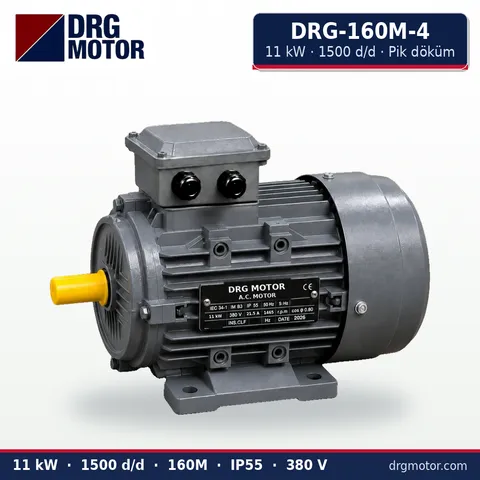
11 kW Three-Phase Motor 1500 rpm – DRG-160M-4 Cast Iron
- 11 kW · 1500 rpm (4 poles)
- Cast iron frame · IEC 160M
- Mounting: B3 · B5 · B14 · B35
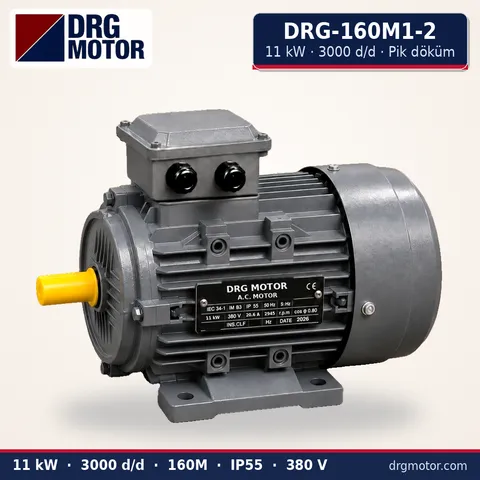
11 kW Three-Phase Motor 3000 rpm – DRG-160M1-2 Cast Iron
- 11 kW · 3000 rpm (2 poles)
- Cast iron frame · IEC 160M
- Mounting: B3 · B5 · B14 · B35
Click to see current prices and order these motors nowSEE PRICES →
Paint Dissolver Motor FAQ
What speed should a dissolver motor have?
Motor speed is chosen by disc diameter. With a 250 mm disc, a 1460 rpm 4-pole motor gives about 19.1 m/s with direct coupling; smaller discs need a 2-pole motor or a step-up belt.
Aluminium or cast iron frame for a paint mixer?
Both frames are available up to 11 kW. If the weight carried by the lifting arm matters, aluminium saves mass; on heavy-duty tanks with vibration, a cast iron frame can be preferred.
Can the same motor be used for solvent-based paint?
No. Areas with solvent vapour need a special Ex-protected motor. The standard IP55 motors supplied by DRG are not intended for explosive atmospheres.
Why does the motor overheat after changing the disc?
Because power rises roughly with the fifth power of disc diameter, even a small increase in diameter raises the load markedly. Measure current with the new disc and reduce speed or increase power if needed.
If you are unsure about the selection, send a photo of the old motor's nameplate with its power, speed, mounting type (foot/flange), shaft size and disc diameter via WhatsApp, or request a quote through the quote list. Phone: +90 (542) 666 11 11 · e-mail: info@drgmotor.com · contact. All models can be browsed in the online store.