English
 Le français
 Türkçe




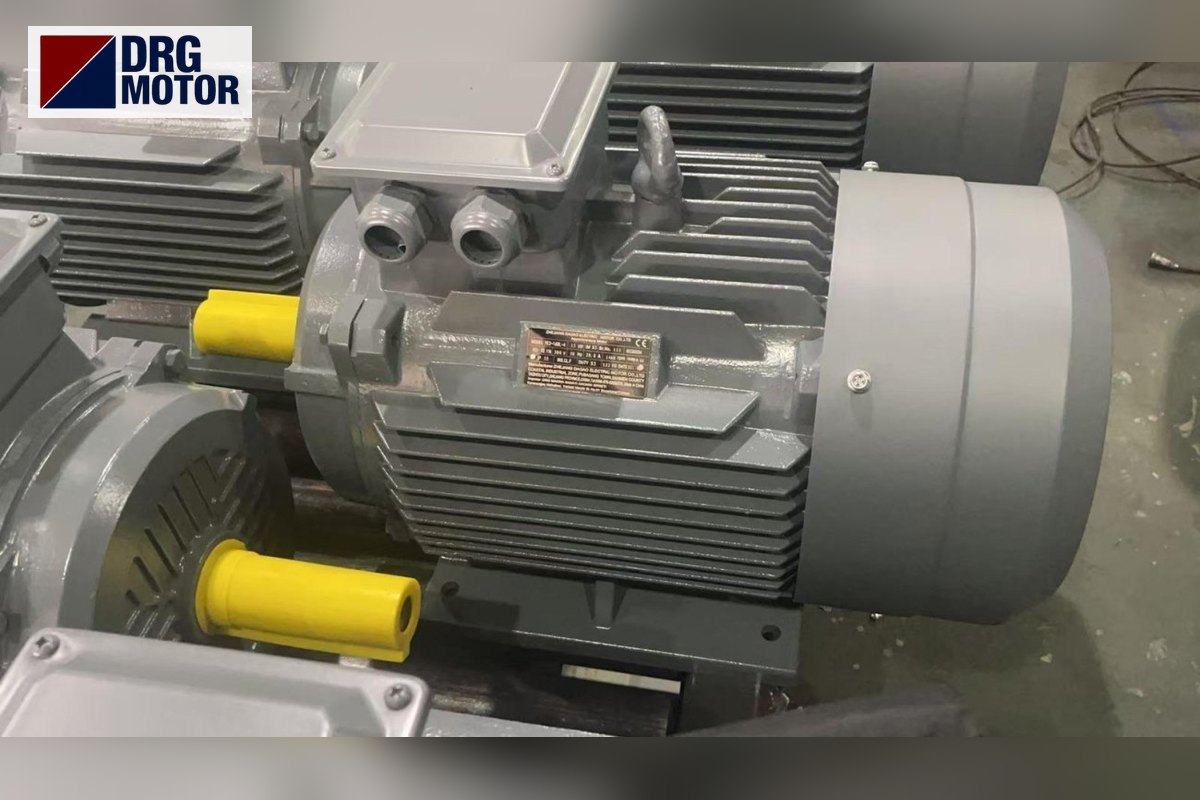

On a scrap cable stripping machine the motor has a single job: turning the feed rollers. The knurled rollers grip the cable and pull it over the blade, the blade slits the insulation lengthwise and the copper or aluminium conductor comes out. So what sizes the motor is not high power but the torque the rollers need to pull the cable without slipping, and the feed speed that results from roller speed. On bench and workshop machines the motor is in the small power class, usually below a few kW; the exact value is on the machine plate.
If you know the power and speed on the plate, you can compare DRG's small three-phase motors right away in the online motor store. Below you will find the motor's load on the machine, how feed speed is calculated and what to check when replacing it.
Rollers, Blade and Channels: Inside a Stripping Machine
In the common design, the front of the machine has channels sized for different cable diameters. Above each channel sits a circular blade whose height is set by a handwheel or screw. When a cable is pushed into a channel it is clamped between the driven lower roller and the upper pressure roller and drawn forward; the blade is set to cut as deep as the insulation is thick.
The motor usually turns the roller shaft through a gearbox or a chain-and-sprocket drive. On some machines the rollers are geared together and driven from both sides. The load is fairly smooth: there are no sudden impacts, but torque rises sharply when a thick or hard-insulated cable enters. If the blade is set too deep it tries to cut the conductor as well, and the rollers can no longer pull the cable.
Where Does Feed Speed Come From?
Feed speed is the roller's surface speed: v = π × D × n / 60 (D roller diameter, n roller speed). Roller speed is motor speed divided by the drive ratio. So on the same machine, a change in motor pole number changes feed speed in the same proportion.
Example (assumption): roller diameter 60 mm, total ratio between motor and roller 1:35.
- DRG-90L-4 (1.5 kW, 1445 rpm): the roller turns about 41.3 rpm, feed speed about 7.8 m/min.
- With a 2-pole motor (e.g. 2895 rpm) on the same machine, the roller turns about 82.7 rpm and feed speed is about 15.6 m/min.
- With the DRG-90L-6 (1.1 kW, 945 rpm), the roller turns about 27 rpm and feed speed drops to around 5.1 m/min.
Doubling the speed looks like more capacity on paper; in reality the torque the roller applies to the cable halves, the roller slips on thick cable and the blade no longer slits the insulation cleanly. On a hand-fed machine, high speed also makes it harder for the operator to keep up. To test your own ratios, use the gearbox output speed and torque calculator.
Click to see current electric motor prices and order nowSEE PRICES →
Pulling Force at the Roller: Example Torque Calculation
How hard the roller can pull the cable is found by multiplying motor torque by the drive ratio and efficiency, then dividing by the roller radius.
Example (assumption): the 1:35 ratio above with a drive efficiency of 0.6. According to DRG data, the DRG-90L-4 has a rated torque of 9.91 N·m. Torque at the roller shaft is 9.91 × 35 × 0.6 ≈ 208 N·m, which gives a pulling force of about 6,900 N at the circumference of a 30 mm radius roller. At the same ratio, the DRG-100L1-4 (2.2 kW, 14.5 N·m) raises roller torque to about 305 N·m.
How much of that force is actually usable depends on how well the roller knurling grips the cable. If a worn roller slips, a bigger motor does not solve it; check the roller and pressure setting first.
Load on the Motor by Cable Type
| Cable group | Load on the motor | Point to watch |
|---|---|---|
| Thin single-core wiring | Low; speed is decisive | Cable may buckle in channel |
| Multi-core PVC sheathed | Medium; rises with sheath | Set blade depth to sheath |
| Heavy power cable | High; torque peaks | Large channel, low speed |
| Steel armoured cable | Very high; blade strained | Do not feed unless allowed |
The table shows why the same motor power can be enough for one cable type and not another. A machine that strips thin cable quickly is limited on heavy power cable more by roller grip than by motor power. Going beyond the maximum cable diameter on the machine plate strains both the motor and the blade.
Workshop Conditions, Supply and Connection
Cable strippers mostly work in scrap yards, indoors but in dusty conditions; insulation crumbs and copper dust collect in the motor's fan cowl. DRG motors are IP55 and cooled by a shaft-mounted fan (IC411); cleaning the fan grille regularly is enough. Ambient temperature should stay within −15…+40 °C.
Some small workshop machines come with a single-phase 220 V motor. DRG does not offer single-phase motors; if the workshop has only single phase, this duty cannot be met with a DRG three-phase motor. Where a three-phase supply exists, the machine can be converted to a three-phase motor; the controls (switch, contactor, overload) are then renewed for three phase as well. DRG motors up to 3 kW are 230/400 V and star-connected on a 400 V supply.
For those wanting speed adjustment, changing the drive ratio between motor and roller is the simplest route. Speed control with a drive (inverter) is also possible, but DRG does not sell drives; the drive is sourced separately. Motors for recycling and other scrap-processing machines are grouped on the recycling plant electric motors page.
Before Replacing the Motor
When the motor fails, the fault is not always in the motor. A jammed roller, broken chain or locked gearbox will also stop the motor and trip the overload. Before fitting the new motor, check:
- Does the roller shaft turn by hand; is the gearbox jammed?
- Old motor label: kW, rpm, voltage, number of phases (single or three)
- Mounting: foot (B3) or flanged to the gearbox; if flanged, the dimensions
- Shaft diameter, shaft length and the gear/pulley hub on it
- Direction of rotation: the rollers must pull the cable inwards
DRG Motors Suited to Cable Stripping Machines
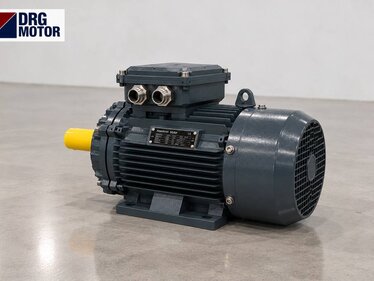
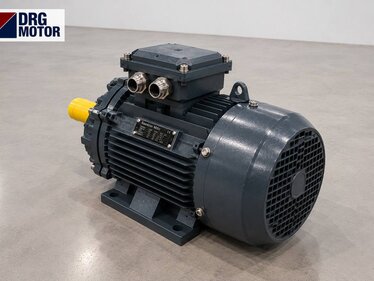
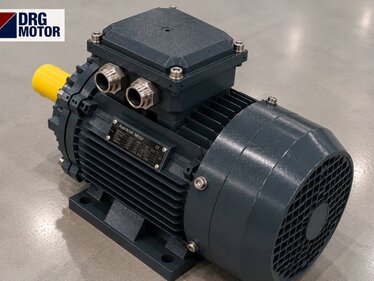
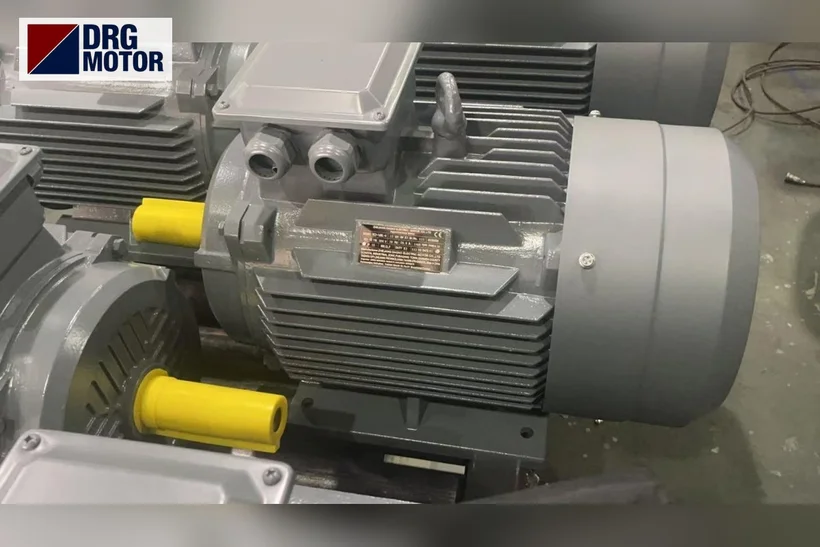
Light aluminium-housed models in the 1–2.2 kW range were chosen for the smooth, moderate-torque drive cable stripping needs; a 6-pole option is included for those wanting a lower feed speed.
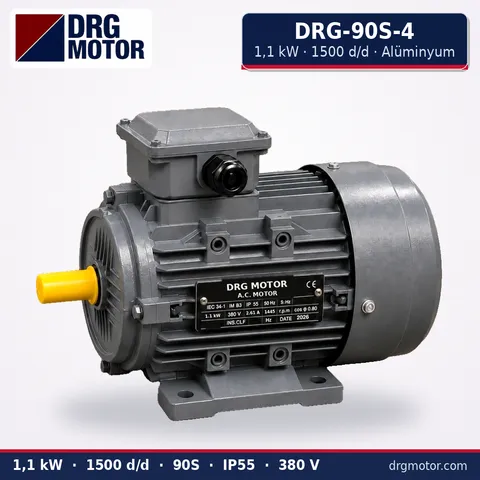
1.1 kW Three-Phase Motor 1500 rpm – DRG-90S-4 Aluminium
- 1.1 kW · 1500 rpm (4 poles)
- Aluminium frame · IEC 90S
- Mounting: B3 · B5 · B14 · B35
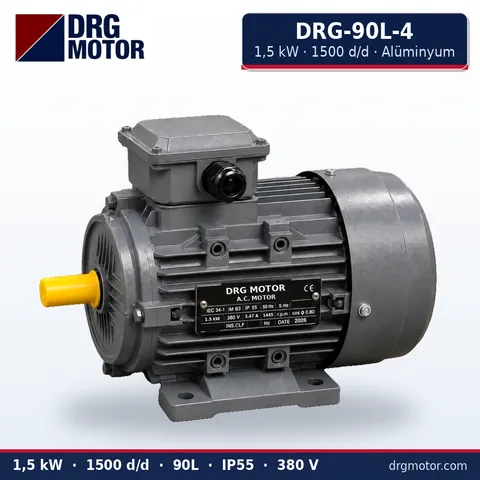
1.5 kW Three-Phase Motor 1500 rpm – DRG-90L-4 Aluminium
- 1.5 kW · 1500 rpm (4 poles)
- Aluminium frame · IEC 90L
- Mounting: B3 · B5 · B14 · B35
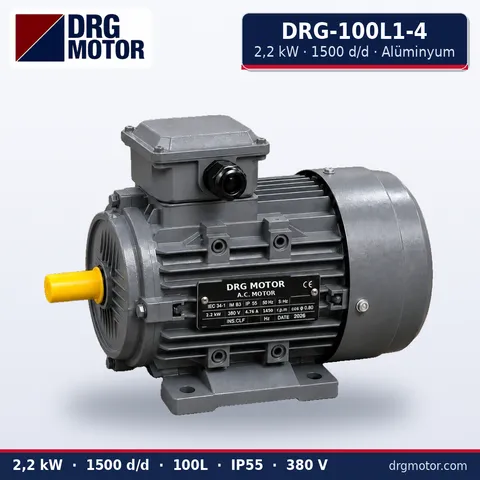
2.2 kW Three-Phase Motor 1500 rpm – DRG-100L1-4 Aluminium
- 2.2 kW · 1500 rpm (4 poles)
- Aluminium frame · IEC 100L
- Mounting: B3 · B5 · B14 · B35
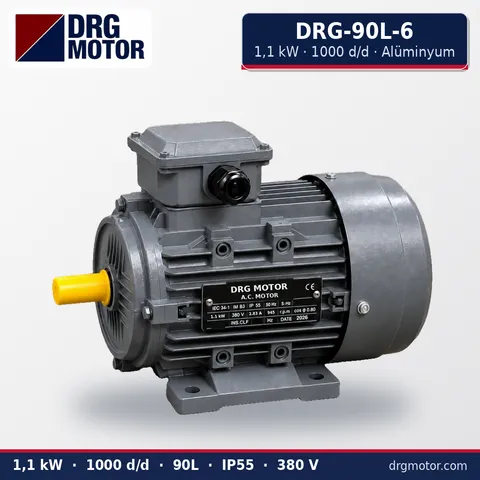
1.1 kW Three-Phase Motor 1000 rpm – DRG-90L-6 Aluminium
- 1.1 kW · 1000 rpm (6 poles)
- Aluminium frame · IEC 90L
- Mounting: B3 · B5 · B14 · B35
Click to see current prices and order these motors nowSEE PRICES →
Cable Stripping Machine Motor: FAQ
How many kW is a cable stripping machine motor?
Workshop types mostly use motors below a few kW; machines designed for thicker cable may need more. The exact value is set by the machine plate or the builder's catalogue.
Can a 3000 rpm motor be fitted to speed up a cable stripper?
If fitted, feed speed roughly doubles and roller torque halves. It may work on thin cable, but the roller slips on thick cable. If more speed is needed, changing the drive ratio is more controlled.
Can a three-phase motor replace the motor of a single-phase cable stripper?
Yes, if the workshop has a three-phase supply; the control components are also changed for three phase. If only single phase is available, a three-phase motor should not be run on it.
The machine does not pull the cable: is the motor too weak?
Usually the cause is worn roller knurling, insufficient pressure or a blade set too deep. If motor current is below rated, the problem is mechanical.
For a quotation, a photo of the motor plate plus power, speed, foot or flange mounting, shaft diameter and the thickest cable the machine strips is enough; send these by WhatsApp or add the models to your quote list. DRG Motor is an electric motor manufacturer, supplier and seller. Reach us on +90 (542) 666 11 11, at info@drgmotor.com or through the contact form. All small-power models are listed on our online sales page.