English
 Le français
 Türkçe




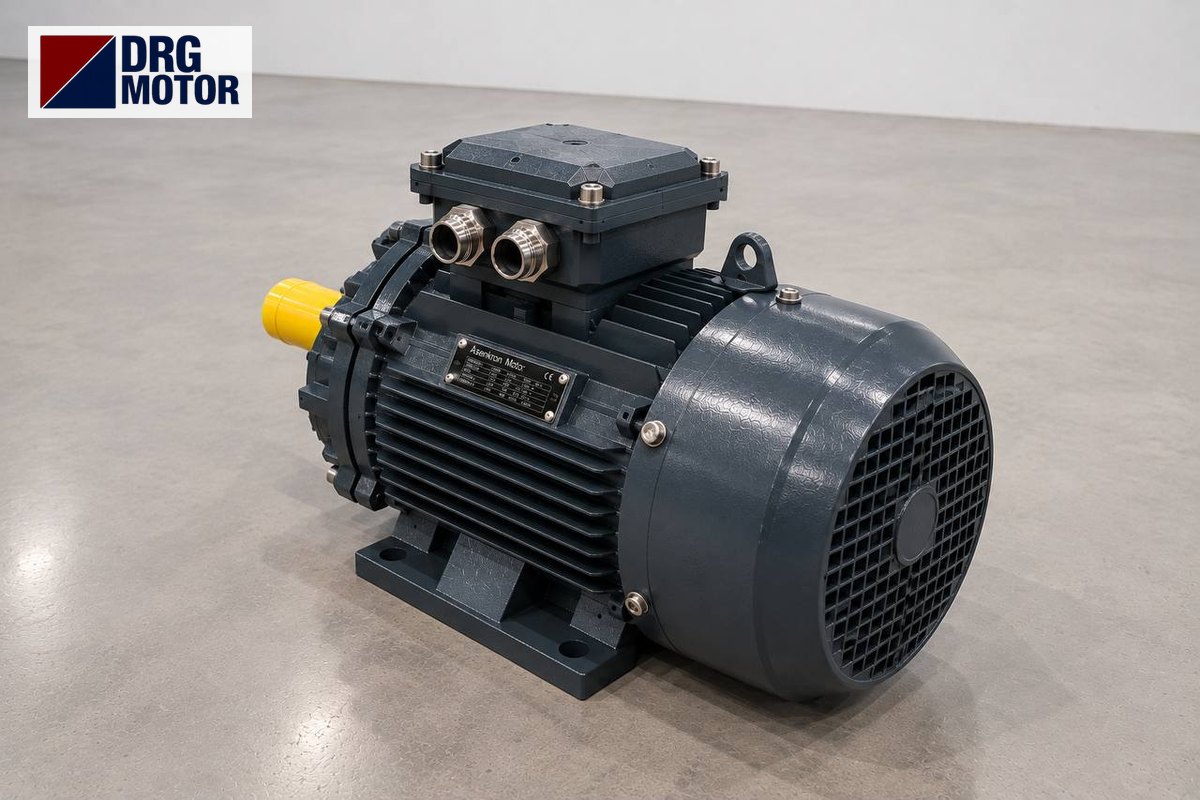

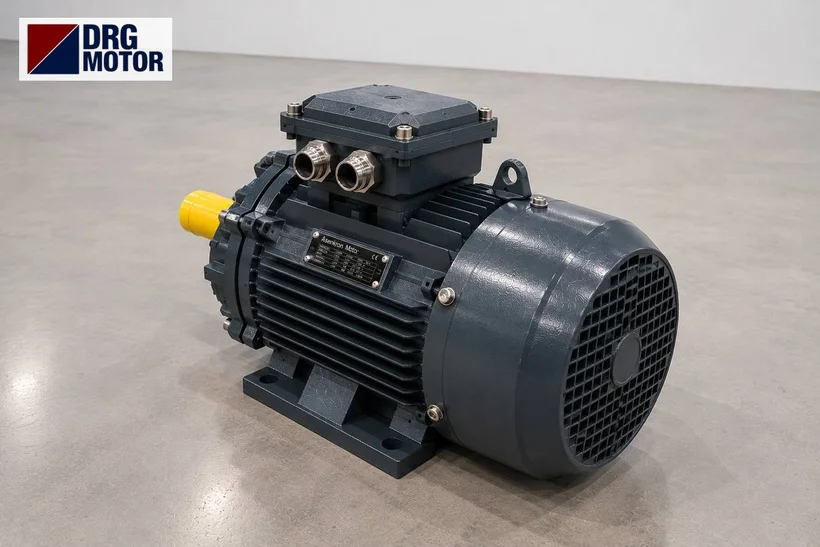
The motor of a hydraulic workshop press turns the pump of the electric power unit that replaces the hand pump; its power is not set by the press tonnage alone, but by the pressure that tonnage corresponds to together with how fast you want the ram to move (pump flow). On H-frame workshop presses this motor is usually 4-pole and a few kW; the exact value is on the press or unit manufacturer's nameplate.
When the pump or motor is changed the rule is simple: if the pump displacement grows, the motor grows too; if the frame size changes, the bell housing and coupling change. DRG Motor is a manufacturer, supplier and seller of electric motors; you can find 4-pole three-phase motors that fit workshop press units on the buy electric motors online page.
From Hand Pump to Electric Unit: What Changes?
On a hand-pump workshop press the operator usually works a two-stage piston pump with a lever: the first stage brings the ram quickly to the part, and once pressure rises the small piston takes over and force increases while the ram advances millimetre by millimetre. For pressing bearings, removing bushes or straightening shafts this means dozens of lever strokes per part.
In an electric unit the lever is replaced by the motor and a gear pump; a directional valve (usually manually operated) lowers, stops and retracts the ram. The cylinder, frame and gauge can stay the same. What changes is how much oil reaches the cylinder each second: with a hand pump it is the operator's arm, with an electric unit it is the pump displacement times the motor speed.
The cylinder's maximum working pressure must not be exceeded in the conversion. Hand pumps can often reach high pressure; the relief valve of the electric unit must be set to the pressure corresponding to the press's rated tonnage, not higher.
The Link Between Tonnage, Pressure and Cylinder Bore
Press force is F = p · A: pressure multiplied by piston area. Example and assumption: a 50-tonne workshop press with a single 160 mm bore cylinder. The piston area is ≈ 20,106 mm²; 50 tonnes (≈ 490 kN) needs ≈ 243.9 bar. The table below shows intermediate tonnages for the same cylinder.
| Press force | Pressure in Ø160 cylinder | What the gauge shows |
|---|---|---|
| 10 tonnes | 48.8 bar | light work |
| 20 tonnes | 97.5 bar | |
| 30 tonnes | 146.3 bar | |
| 40 tonnes | 195.1 bar | |
| 50 tonnes | 243.9 bar | rated press force |
This table does two jobs. First, it lets you read the actual force from the bar value on the gauge. Second, it sets the relief valve: on a 50-tonne press, setting the valve well above 243.9 bar strains the cylinder and frame and loads the motor unnecessarily. If your press has a different cylinder bore, recalculate the table with that bore.
Click to see current electric motor prices and order nowSEE PRICES →
Flow Sets Ram Speed, Pressure Sets Motor Power: Worked Example
Ram speed is v = Q / A; pump power is P = Q · p / (600 · η). The detailed general method is in the hydraulic pump electric motor selection article. Here, on the same 50-tonne press, we compare the effect of different pump displacements on speed and power (assumptions: motor 1450 rpm, pump efficiency 0.85, power at 50 tonnes, i.e. 243.9 bar).
| Pump (cm³/rev) | Pressing speed | Power at 50 t | Motor |
|---|---|---|---|
| 2.0 | 2.40 mm/s | 1.39 kW | 1.5 kW – DRG-90L-4 |
| 3.3 | 3.97 mm/s | 2.29 kW | 3 kW – DRG-100L2-4 |
| 5.0 | 6.01 mm/s | 3.47 kW | 4 kW – DRG-112M-4 |
A 3.3 cm³/rev pump delivers 4.79 l/min; the ram advances at ≈ 4 mm/s while pressing and a 150 mm stroke takes about 38 seconds. The peak power is 2.29 kW, so 2.2 kW is not enough and the next standard rating, 3 kW, is chosen. If fast approach is wanted, use a two-stage pump instead of enlarging the single pump: with 8 + 3.3 cm³/rev stages, for example, the ram approaches at ≈ 13.6 mm/s at 20 bar and this phase needs only ≈ 0.64 kW.
Why the Motor Falls Short When the Pump Is Enlarged
A common workshop change is to fit a 5 cm³/rev pump in place of a 3.3 cm³/rev one to make the press faster. Flow rises to 7.25 l/min, but the power needed at 50 tonnes becomes 3.47 kW. The existing 3 kW DRG-100L2-4 then has to deliver ≈ 22.8 Nm, about 1.15 times its 19.8 Nm rated torque. The motor survives short presses but trips the overload relay on long ones.
The correct match is the 4 kW DRG-112M-4 (rated torque 26.3 Nm). The good side of this step: frames 100L and 112M share the same B5 flange and shaft (M 215, N 180, P 250 mm; shaft 28×60 mm), so the bell housing and coupling can usually be reused. Going to 5.5 kW moves to frame 132S; the shaft becomes 38×80 mm and the flange N 230 mm, so the connecting parts change.
Holding Under Pressure, Heating and Starting
The hardest moment for a workshop press motor is when the operator holds the part under pressure: in shaft straightening the ram waits under load for several seconds. If the unit has no unloading valve, the pump delivers against the relief valve during this time; the motor runs at full load and the energy heats the oil. On presses with long holds, choose a unit that stops the motor with a pressure switch or unloads the pump.
For starting, DRG motors up to 3 kW are 230/400 V and are connected in star on a 400 V supply for direct-on-line start. From 4 kW upwards they are 400/690 V; they run in delta on the supply and are therefore suitable for star-delta starting. In star the torque falls to about one third, so the directional valve should be in centre position and the pump unloaded at start; you can compare the options on the star-delta and motor starting methods page.
In a workshop the motor is exposed to chips, weld spatter and oil mist. DRG motors are IP55 and fan-cooled; position the motor on the tank so that the front of the fan cover stays open.
What to Check When Replacing a Workshop Press Motor
- Cylinder bore and rated press tonnage; is the relief valve set to that tonnage's pressure?
- Is the pump displacement (cm³/rev) the same as before; if it changed, was the power recalculated?
- Old motor nameplate: kW, rpm, 230/400 V or 400/690 V, current.
- Mounting: B5 (flange only) or B35 (foot + flange); is the motor horizontal or vertical?
- Do the bell housing spigot (N), bolt circle (M) and coupling hub match the shaft diameter?
- Are long holds under pressure made; does the unit have an unloading valve or pressure switch?
- Have pump rotation and tank oil level been checked before commissioning?
DRG Motors Suitable for Hydraulic Workshop Presses
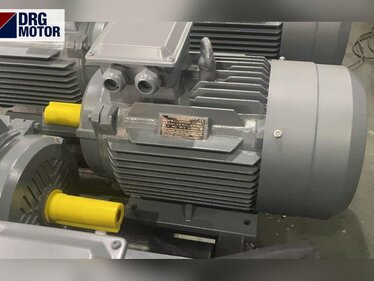
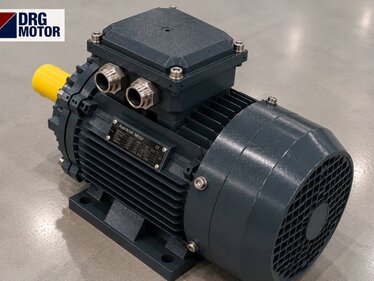
The 1.5–4 kW range from the worked example plus a 5.5 kW option for larger-tonnage or faster units; all are 4-pole and can be ordered with a flange.
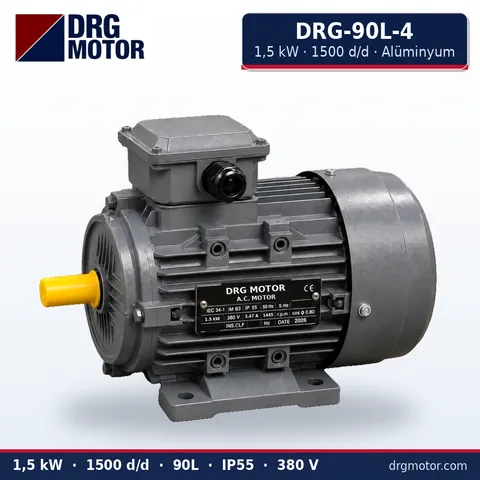
1.5 kW Three-Phase Motor 1500 rpm – DRG-90L-4 Aluminium
- 1.5 kW · 1500 rpm (4 poles)
- Aluminium frame · IEC 90L
- Mounting: B3 · B5 · B14 · B35
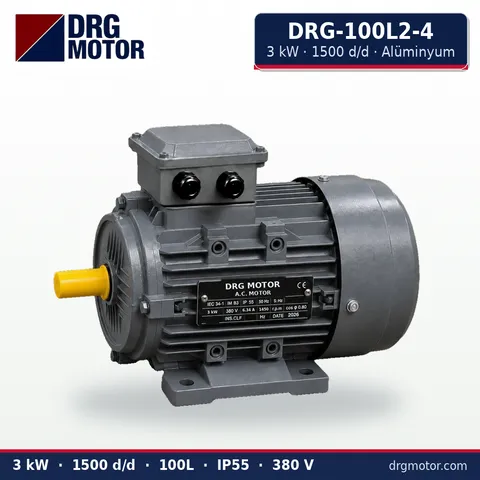
3 kW Three-Phase Motor 1500 rpm – DRG-100L2-4 Aluminium
- 3 kW · 1500 rpm (4 poles)
- Aluminium frame · IEC 100L
- Mounting: B3 · B5 · B14 · B35

4 kW Three-Phase Motor 1500 rpm – DRG-112M-4 Aluminium
- 4 kW · 1500 rpm (4 poles)
- Aluminium frame · IEC 112M
- Mounting: B3 · B5 · B14 · B35
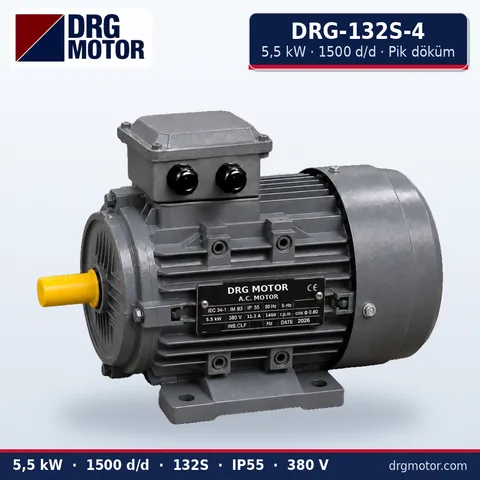
5.5 kW Three-Phase Motor 1500 rpm – DRG-132S-4 Cast Iron
- 5.5 kW · 1500 rpm (4 poles)
- Cast iron frame · IEC 132S
- Mounting: B3 · B5 · B14 · B35
Click to see current prices and order these motors nowSEE PRICES →
You can see the full power range of hydraulic unit motors on the hydraulic power unit electric motors page.
Workshop Press Motor: Frequently Asked Questions
What kW motor does a 50-ton hydraulic press need?
It depends on pressure and pump flow. In the example with a Ø160 cylinder and a 3.3 cm³/rev pump, 50 tonnes needs 2.29 kW and a 3 kW motor is chosen; a larger pump needs a larger motor.
What is needed to convert a hand-pump press to electric?
A power unit made of motor, pump, tank, directional valve and relief valve, plus a hose connection. The cylinder's allowed pressure must not be exceeded and the valve must be set to the rated tonnage.
Can a 2-pole motor be used on a workshop press?
If the pump allows it, yes, but with the same pump the flow and the required power roughly double. Keeping the old motor's speed is the safest route when replacing.
Why does the motor heat up while the press holds pressure?
Because the pump keeps delivering against the relief valve at full pressure, the motor runs at full load. An unloading valve or a pressure switch that stops the motor prevents this heating.
For a quote, send a photo of the motor nameplate, its power, speed, mounting (B5 or B35, horizontal or vertical), shaft size, plus the press tonnage and pump displacement via WhatsApp, or add the models to the quote list. Phone: +90 (542) 666 11 11 · e-mail: info@drgmotor.com · contact. For other ratings, browse the online store.