English
 Le français
 Türkçe





The main motor of an eccentric press does not push the ram directly; it turns the flywheel through belts and stores energy in it. When the clutch engages, this energy passes through the eccentric shaft to the ram, the flywheel slows down a little and the motor brings it back up to speed. Two questions therefore decide the motor: is there enough average power to recover the flywheel at the strokes per minute, and can the motor get the heavy flywheel moving from standstill?
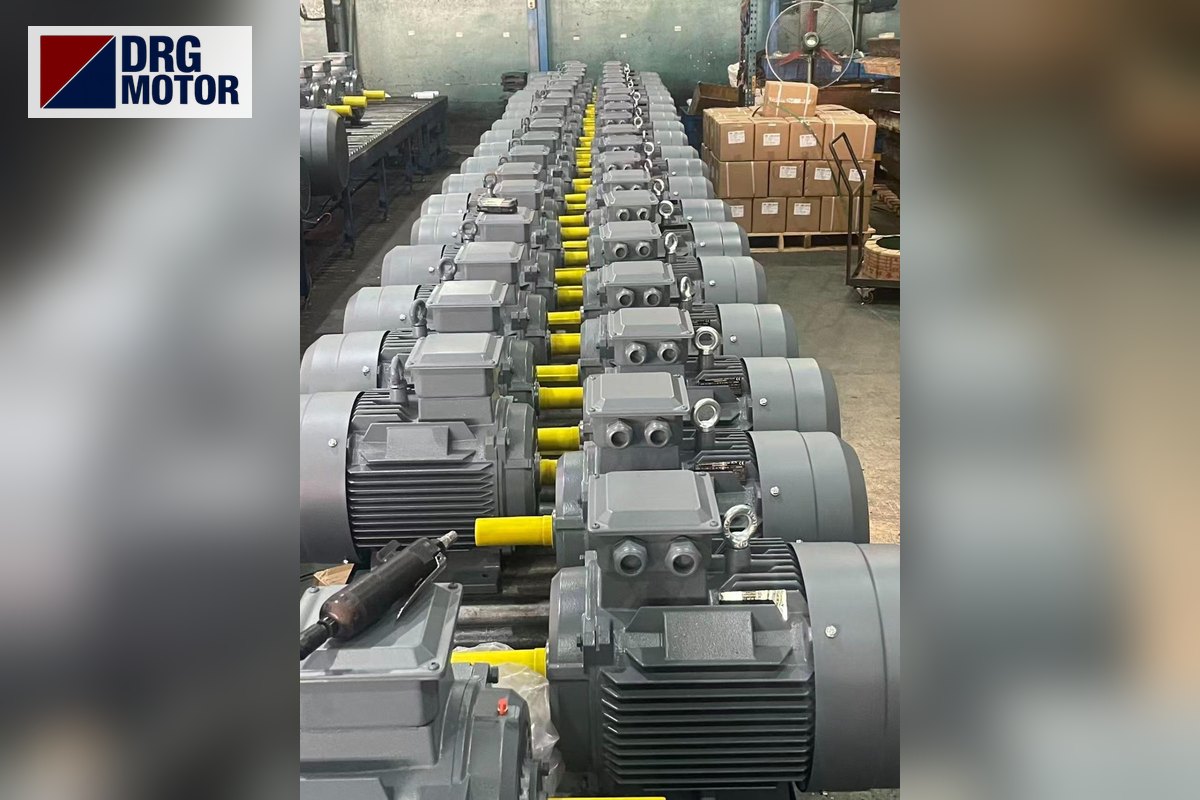
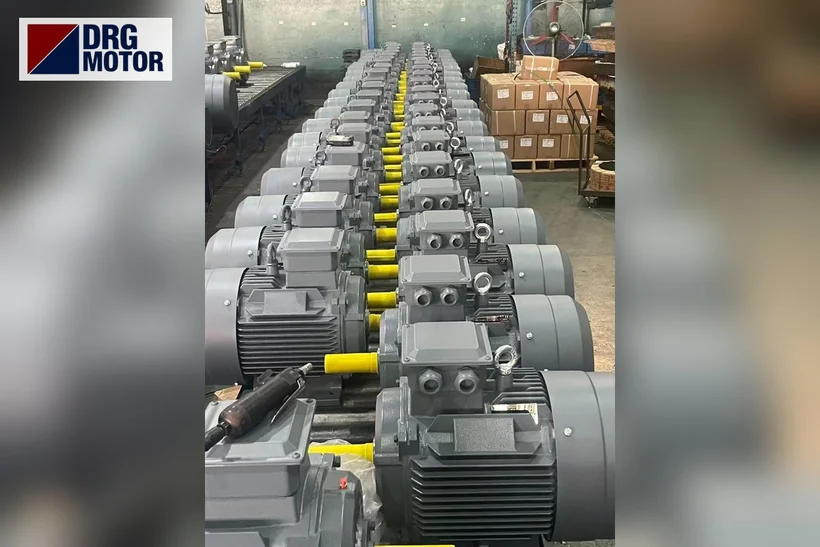
Small bench eccentric presses use a few kW, medium-tonnage C-frame presses 5.5–15 kW, and heavy straight-side presses more; the exact value is on the press nameplate. You can compare foot-mounted cast iron 4- and 6-pole DRG motors by kW and rpm in the buy electric motors online section.
DRG Motor is a manufacturer, supplier and seller of electric motors. The press clutch-brake unit, the flywheel and the safety system are part of the press; they are not a brake on the motor. DRG does not offer brake motors and an eccentric press does not need one: it is the press’s own brake that stops the ram.
Energy Is Stored in the Flywheel, the Motor Feeds the Flywheel
In a mechanical eccentric press the power path is: motor pulley → V-belts → flywheel → clutch → eccentric (or crank) shaft → connecting rod → ram. While the press runs, the flywheel keeps turning; the clutch engages only for the stroke. In single-stroke mode the ram makes one revolution and stops at top dead centre; in continuous mode the clutch stays engaged.
Cutting or forming takes place as the ram approaches bottom dead centre, within a small slice of crank angle. The power needed in that short moment is far above the motor rating and comes from the flywheel’s kinetic energy. The flywheel slows; motor slip increases, current rises, and the flywheel is brought back to rated speed before the next stroke.
A flywheel can only release energy when its speed drops. A standard induction motor has a small rated slip (about 2.7% on a 1460 rpm motor). A 10% drop in flywheel speed means the motor briefly runs with torque and current well above rated. This is the nature of an eccentric press, and the motor is expected to handle it without tripping.
Strokes per Minute and Average Power: Example Calculation
Example / assumptions: work per stroke 5,000 J (cutting force × effective cutting travel), 60 strokes per minute, mechanical efficiency between motor and ram 0.8. Average power = 5,000 × 60 / 60 / 0.8 = 6.25 kW. The flywheel turns at 300 rpm and should slow by no more than 10% per stroke. The flywheel then needs a kinetic energy of about 26,300 J at 300 rpm and a moment of inertia of about 53.3 kg·m².
In continuous stroking the motor must deliver the average power all the time. At a 6.25 kW load a 5.5 kW motor runs at 1.14 times rated and overheats. A 7.5 kW motor is adequate at 0.83. In single-stroke work the average load is lower because of the pauses between parts, but the calculation should follow the heaviest operating mode.
Click to see current electric motor prices and order nowSEE PRICES →
Run-Up Time: Getting a Heavy Flywheel Moving
When the flywheel inertia is referred to the motor shaft, it is multiplied by the square of the speed ratio: Jmotor = Jflywheel × (nflywheel/nmotor)². The 53.3 kg·m² of the example appears as about 2.25 kg·m² on a 1460 rpm motor shaft. That is many times the motor’s own rotor inertia and lengthens the start.
Run-up time is roughly t ≈ J·ω / Tacc. For the average accelerating torque, the approximation 0.45 × (Ts/Tn + Tmax/Tn) × Tn was used, with torques taken from the DRG data file. In star-delta the torque falls to one third, so the time roughly triples. The values apply to the example flywheel; verify them on your own press by measuring current.
| Motor | Direct start (example) | In star (rough) | Average load / Pn |
|---|---|---|---|
| DRG-132S-4 (5.5 kW) | ≈ 4.9 s | ≈ 15 s | 1.14 – insufficient |
| DRG-132M-4 (7.5 kW) | ≈ 3.6 s | ≈ 11 s | 0.83 |
| DRG-160M-4 (11 kW) | ≈ 2.4 s | ≈ 7 s | 0.57 |
| DRG-160L-6 (11 kW, 6-pole) | ≈ 2.6 s | ≈ 8 s | 0.57 |
With 14.3 A on the plate (400 V) and an Is/In of 7.5 in the data file, the 7.5 kW motor draws about 107 A on direct start and about 36 A in star. Because this current lasts for seconds, the overload relay and fuses must be of a class suitable for long starts. A 400/690 V motor (from 4 kW in the DRG range) runs in delta at 400 V and can be started star-delta; see the star-delta starting page for details.
If the star-delta changeover happens before the flywheel nears rated speed, a second current surge occurs. Set the timer to the actual run-up time measured with a stopwatch. The clutch must be disengaged during starting; the motor should accelerate the flywheel only.
Belts, Pulleys and Speed: Keeping Flywheel Speed Right
Flywheel speed = motor speed × motor pulley diameter / flywheel diameter. Example: with a 1460 rpm motor, a 160 mm pulley and a 300 rpm flywheel, the flywheel belt diameter is about 779 mm. Belt speed is about 12.2 m/s, within the usual range for V-belts. You can repeat the calculation with the pulley and belt calculator.
If you switch to a 6-pole motor (970 rpm), the motor pulley must grow to about 241 mm for the same flywheel speed. If the pulley is not changed, the flywheel drops to about 199 rpm and its energy falls to 0.44 times; the press can no longer do the same work. Conversely, a 2-pole motor doubles flywheel speed, quadruples the energy, and pushes the flywheel, clutch and bearings beyond the builder’s limits. Staying with the old motor’s pole number is the safest route.
Belt tension matters too. A slack belt slips at every stroke; the flywheel does not recover, the belt heats and motor current fluctuates. An over-tight belt puts radial load on the motor’s drive-end bearing. The pulley must sit fully on the shaft; the motor shaft is 38×80 mm on frame 132 and 42×110 mm on frame 160.
Motor Mounting and the Press Environment
On eccentric presses the motor usually sits on top of or behind the press, foot-mounted (B3) on a sliding motor base that provides belt tensioning. When replacing it, check the foot hole spacing (A and B), shaft height (H) and shaft diameter. Standard foot-mounted models are also grouped on the general purpose electric motors page.
The press frame vibrates at every stroke; motor fixing bolts and terminal connections can loosen over time. A cast iron frame withstands this vibration better than aluminium. The air carries oil mist and sheet dust; DRG motors are IP55 with frame-fan cooling, and keeping the fan cover clean is enough. The rated ambient range is −15…+40 °C.
What a Wrong Motor Looks Like on a Press
- Overload trips in continuous stroking: average power exceeds motor power, or the belt slips.
- Fuse blows every morning at start-up: fuse/overload class unsuited to a long start, or star-delta changeover too early.
- Ram sticking at bottom dead centre on consecutive strokes: a new stroke starts before the flywheel recovers; power or flywheel speed is too low.
- Motor with a different pole number: flywheel speed and stroke rate change; die and clutch are overstressed.
- Early motor bearing failure: excessive belt tension or a pulley running out of true on the shaft.
Checklist before replacing the motor:
- Old motor nameplate: kW, rpm, voltage (230/400 V or 400/690 V), frame size
- Press tonnage and strokes per minute; single-stroke or continuous
- Motor pulley diameter, belt type and number, flywheel diameter
- Foot hole dimensions (A, B), shaft height (H), shaft diameter and length
- Starting: direct or star-delta; actual run-up time (s)
- Motor slide base and belt tensioning travel
DRG Motors Suitable for Eccentric Presses
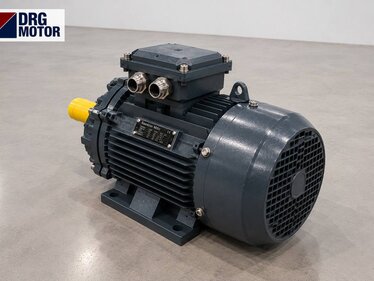
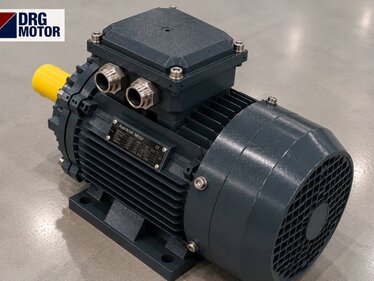
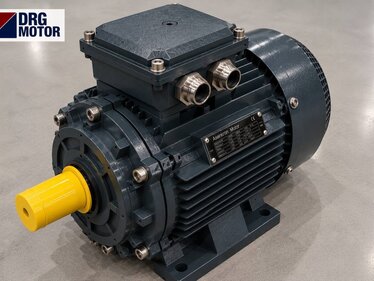
Foot-mounted cast iron motors in 400/690 V, startable in star-delta, which cover the average power and long run-up of the example; choose the pole number to match the existing pulley arrangement.
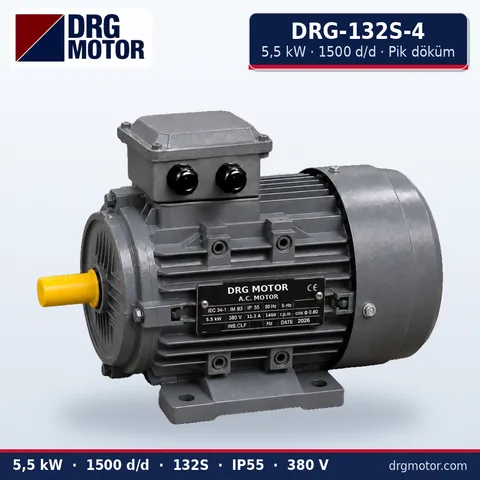
5.5 kW Three-Phase Motor 1500 rpm – DRG-132S-4 Cast Iron
- 5.5 kW · 1500 rpm (4 poles)
- Cast iron frame · IEC 132S
- Mounting: B3 · B5 · B14 · B35
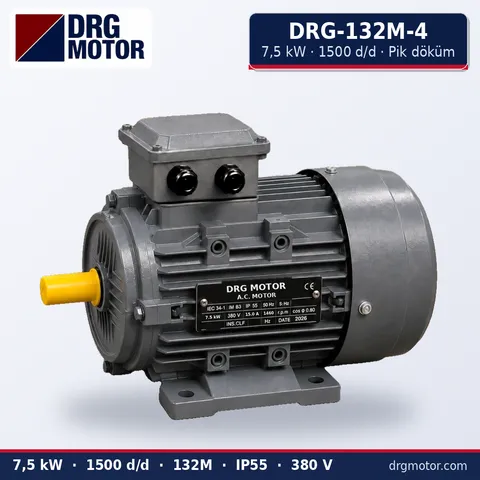
7.5 kW Three-Phase Motor 1500 rpm – DRG-132M-4 Cast Iron
- 7.5 kW · 1500 rpm (4 poles)
- Cast iron frame · IEC 132M
- Mounting: B3 · B5 · B14 · B35
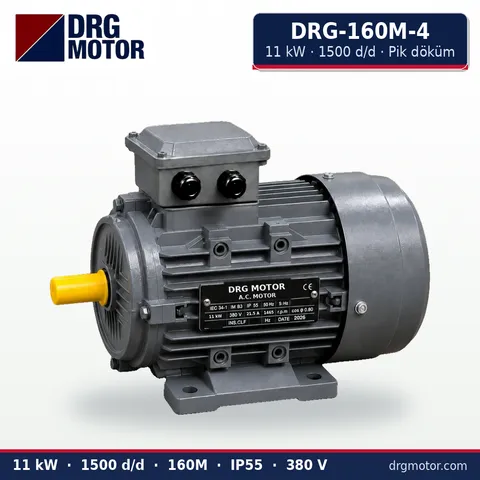
11 kW Three-Phase Motor 1500 rpm – DRG-160M-4 Cast Iron
- 11 kW · 1500 rpm (4 poles)
- Cast iron frame · IEC 160M
- Mounting: B3 · B5 · B14 · B35
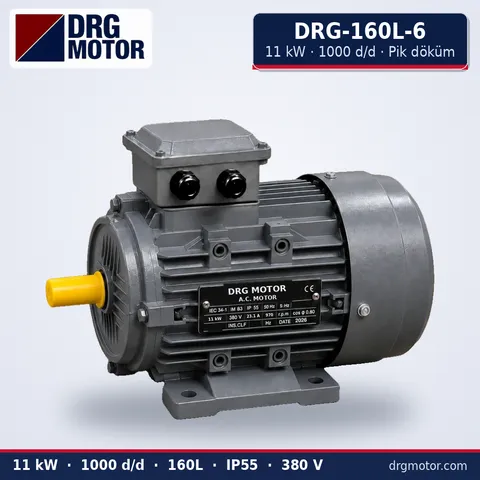
11 kW Three-Phase Motor 1000 rpm – DRG-160L-6 Cast Iron
- 11 kW · 1000 rpm (6 poles)
- Cast iron frame · IEC 160L
- Mounting: B3 · B5 · B14 · B35
Click to see current prices and order these motors nowSEE PRICES →
Eccentric Press Motor: Frequently Asked Questions
How many kW should an eccentric press motor be?
The value on the press nameplate comes first. Without a nameplate, average power is calculated from work per stroke, strokes per minute and mechanical efficiency, and the motor is chosen above that value. In the example above, 7.5 kW proved sufficient for a 6.25 kW average load.
Why does the eccentric press motor take so long to start?
The motor accelerates a flywheel whose inertia, referred to the shaft, is many times that of its own rotor. A direct start of a few seconds and more than ten seconds in star-delta are normal. What matters is that overload relay and fuses suit this time and the clutch is disengaged.
Does an eccentric press need a brake motor?
No. The ram is stopped by the press clutch-brake unit; the motor keeps turning the flywheel. A motor brake would not stop the ram. Brake adjustment and maintenance belong to the press safety system.
Should an eccentric press motor be 1000 rpm or 1500 rpm?
Whatever the old motor was. If the pole number changes, the pulley ratio must change too; otherwise flywheel speed, stroke rate and press energy change. A 6-pole motor gives more torque at the same power, but its shaft and frame size may differ.
When asking about a press motor, a clear photo of the nameplate is half the job. Add power and speed, foot or flange mounting, shaft diameter, press tonnage and strokes per minute in a WhatsApp message, or pass on the models you have picked through the quote list. You can also reach us on +90 (542) 666 11 11 and at info@drgmotor.com; other routes are on the contact page. Every 4- and 6-pole rating can be seen in the DRG motor shop.