English
 Le français
 Türkçe




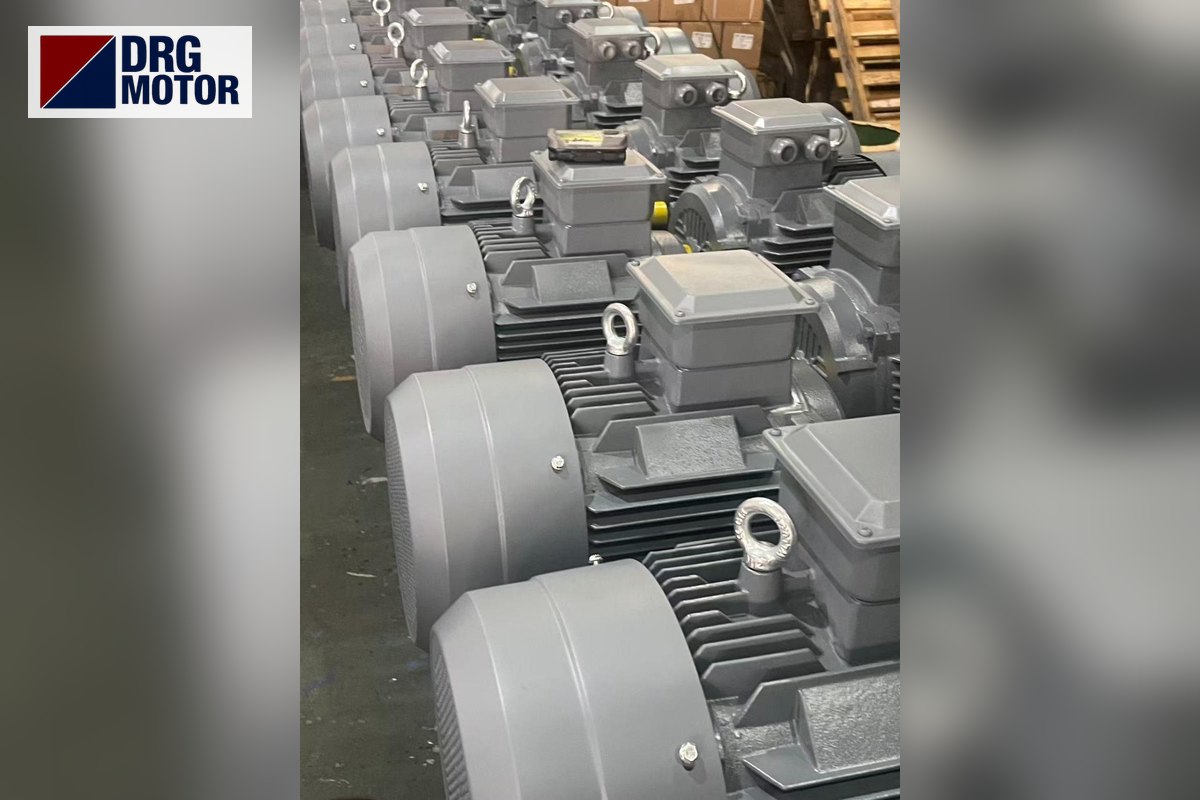

In a liquid detergent production tank, the agitator motor turns the impeller slowly but with high torque through a gearbox, and what really sets motor power is the peak consistency the product reaches after salt is added. The batch flows like water while the tank fills, then turns honey-thick in the last stage, and the load on the impeller at the same speed multiplies. The motor is therefore chosen for the thickened product, not for the initial water.
DRG Motor is a manufacturer, supplier and seller of electric motors; three-phase asynchronous IEC motors that connect to a gearbox input are listed by power and speed on the buy electric motors online page. DRG does not sell gearboxes; it supplies the motor to be fitted to your existing gearbox.
What Happens Inside the Tank: Dissolving, Neutralising, Thickening
For liquid products such as dishwashing and laundry detergent, the recipe typically runs in three stages. First, surfactants (e.g. sulphonic acid, SLES) are added to water and dissolved; if an acid is used, it is neutralised with caustic. Then additives, preservative, perfume and colour are dosed. Finally salt (sodium chloride) is added to bring the product to the target consistency.
Salt raises consistency sharply up to a certain point; beyond it, consistency falls again. Operators therefore add salt in portions, and the agitator runs heavier after each addition. The hardest moment for the motor is this peak consistency point.
How Agitator Power Demand Changes as Consistency Rises
The Reynolds number defines the flow type in an agitator: Re = ρ · n · D² / μ (ρ density kg/m³, n revolutions per second, D impeller diameter m, μ dynamic viscosity Pa·s). At high Re the flow is turbulent and absorbed power is almost independent of viscosity. At low Re the flow is laminar; there, at the same speed, power rises in direct proportion to viscosity.
A detergent tank goes through both regions in a single batch. The table is calculated for an example tank. Assumption: impeller diameter 0.8 m, impeller speed 72.5 rpm, product density 1050 kg/m³; consistency values are examples only.
| Stage | Example viscosity | Reynolds (rounded) | Flow regime |
|---|---|---|---|
| Water + surfactant dissolving | 1 mPa·s | 812,000 | Turbulent |
| After additives | 100 mPa·s | 8,120 | Near turbulent |
| Thickening with salt | 1,000 mPa·s | 812 | Transitional |
| Peak consistency | 5,000 mPa·s | 162 | Near laminar |
The takeaway: in the first stage the motor is relaxed and current looks low; as salt is added, Re drops into the transitional region and power demand starts climbing with viscosity. The motor's rated current must not be below the current measured at peak consistency.
Click to see current electric motor prices and order nowSEE PRICES →
Gearbox Output Speed and Torque Calculation
Detergent agitators usually run at low impeller speed; motor speed is reduced by a gearbox. Output speed is n2 = n1 / i, and output torque is roughly T2 = 9550 · P / n2 · η (η gearbox efficiency).
Example: 4 kW motor, i = 20 gearbox
Assumption: 4 kW 4-pole DRG-112M-4 (rated 1450 rpm), ratio 20, gearbox efficiency 0.95. Output speed 1450 / 20 = 72.5 rpm; output torque 9550 · 4 / 72.5 · 0.95 ≈ 501 Nm. With the same motor on an i = 25 gearbox, output drops to 58 rpm and torque rises to about 626 Nm: more torque for thick product, but weaker surface flow.
So when consistency rises, a "bigger motor" is not the only option; ratio and impeller type also change the load. The machine builder sets this balance, and the existing gearbox ratio is kept when the motor is replaced. Test your own values with the gearbox output speed and torque calculator.
Foam, Impeller Type and the Speed Limit
With any surfactant product, high speed means foam. If the impeller opens a vortex at the surface it draws air into the product; foam causes volume errors at filling and distorts viscosity readings. Detergent tanks therefore favour slow, wide flow rather than speed: anchor, gate or large pitched-blade impellers.
Raising speed by changing the motor (e.g. from 6-pole to 4-pole) is therefore usually wrong. Impeller speed rises about 50%, foam increases and in the laminar region power demand climbs too. If speed adjustment is needed an inverter can be used; DRG does not sell inverters, and inverter use should be stated in the order.
What you see in the field with the wrong motor
- Overload trips when salt is added: motor sized below peak consistency.
- Product stands still at the wall, only the centre turns: not low speed but an impeller type unsuited to thick product.
- Persistent foam and fill volume deviation: speed too high; a faster motor may have been fitted.
- Noise from the gearbox, oil at the flange: motor flange and input flange spigot mismatch.
Motor and Gearbox on Top of the Tank: Mounting and Environment
In these tanks the motor and gearbox stand vertically on the bridge above the lid, with the shaft going down into the tank. The motor does not touch the product; the wetted parts are the stainless shaft and impeller. The motor on the gearbox input is mostly a B5 large-flange type running vertically shaft-down; this use is stated in the order.
According to DRG catalogue B5 dimensions, frames 100 and 112 have flange outer diameter P 250 mm, bolt circle M 215 mm, spigot N 180 mm and shaft 28×60 mm; frame 132 has P 300 mm, M 265 mm, N 230 mm and shaft 38×80 mm. The gearbox input flange must match these values exactly. For small-flange (B14) inputs, dimensions are confirmed at order.
Two environmental points matter: humid vapour rising when the lid opens, and water splashing on the motor during floor washing. DRG motors are IP55 and resist splashing water, but DRG does not offer stainless/hygienic washdown frames. If the vessel is hosed down directly, cover the motor. For motors suited to gearboxes see electric motors for gearboxes.
Information to Gather Before Ordering
- Old motor nameplate: kW, rpm, voltage, connection (Y/Δ)
- Gearbox type and ratio, input flange P, M, N values
- Motor shaft diameter and length, key width
- Vertical shaft-down mounting; B5 or B14
- Tank volume, impeller diameter and thickest product
- Current measured at peak consistency and starting method
DRG Motors Suited to Detergent Tank Agitators
These models are chosen among motors for gearbox inputs, from small tanks to medium production tanks; the 6-pole model is for gearboxes needing a lower input speed.
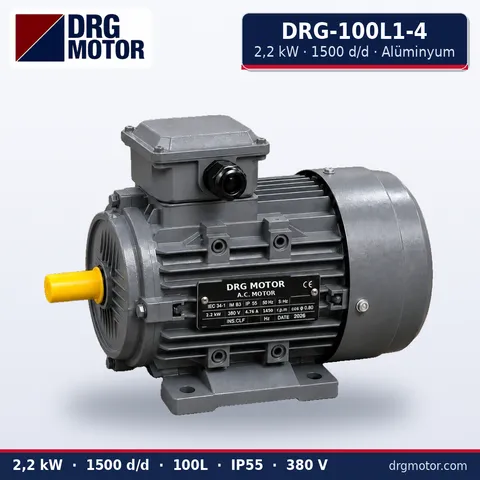
2.2 kW Three-Phase Motor 1500 rpm – DRG-100L1-4 Aluminium
- 2.2 kW · 1500 rpm (4 poles)
- Aluminium frame · IEC 100L
- Mounting: B3 · B5 · B14 · B35
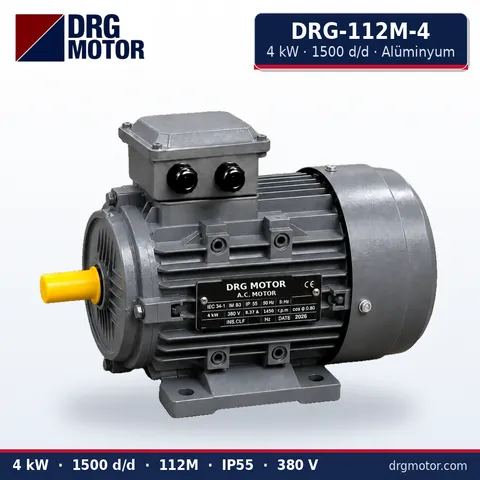
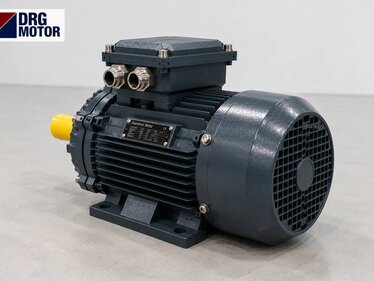
4 kW Three-Phase Motor 1500 rpm – DRG-112M-4 Aluminium
- 4 kW · 1500 rpm (4 poles)
- Aluminium frame · IEC 112M
- Mounting: B3 · B5 · B14 · B35
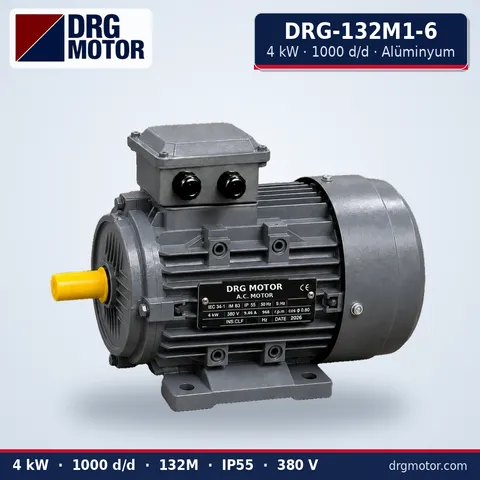
4 kW Three-Phase Motor 1000 rpm – DRG-132M1-6 Aluminium
- 4 kW · 1000 rpm (6 poles)
- Aluminium frame · IEC 132M
- Mounting: B3 · B5 · B14 · B35
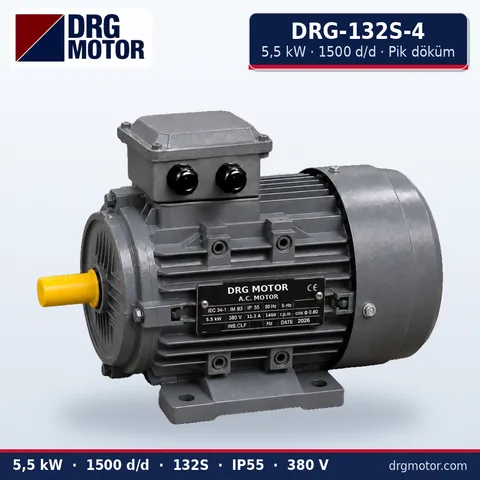
5.5 kW Three-Phase Motor 1500 rpm – DRG-132S-4 Cast Iron
- 5.5 kW · 1500 rpm (4 poles)
- Cast iron frame · IEC 132S
- Mounting: B3 · B5 · B14 · B35
Click to see current prices and order these motors nowSEE PRICES →
Detergent Agitator Motor FAQ
At what speed does a detergent tank agitator turn?
Impeller speed depends on tank and impeller design and is set by the gearbox. For example, a 1450 rpm motor with an i = 20 gearbox turns the impeller at 72.5 rpm; the exact value comes from the machine builder.
Why does the motor struggle when salt is added?
Salt raises product consistency. As the flow approaches the laminar region, power demand at the same speed rises with viscosity; if the motor was not sized for peak consistency, its current limit is exceeded.
Will a faster motor speed up mixing?
Usually not. Higher speed increases foam and raises power demand in thick product. Mixing time is improved through impeller type and speed control, with an inverter if needed.
Does the motor touch the detergent; is a stainless motor needed?
In a top-driven tank the motor does not touch the product; the shaft and impeller do. A standard IP55 motor is used; DRG does not offer stainless/hygienic frame motors.
Send a picture of the motor plate together with its kW and rpm, whether it is foot or flange mounted, the shaft diameter and the gearbox ratio via WhatsApp, or request a quote through the quote list. Phone: +90 (542) 666 11 11 · e-mail: info@drgmotor.com · contact. Other power and speed options are in the online store.