English
 Le français
 Türkçe

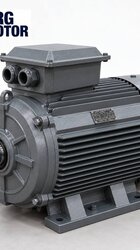
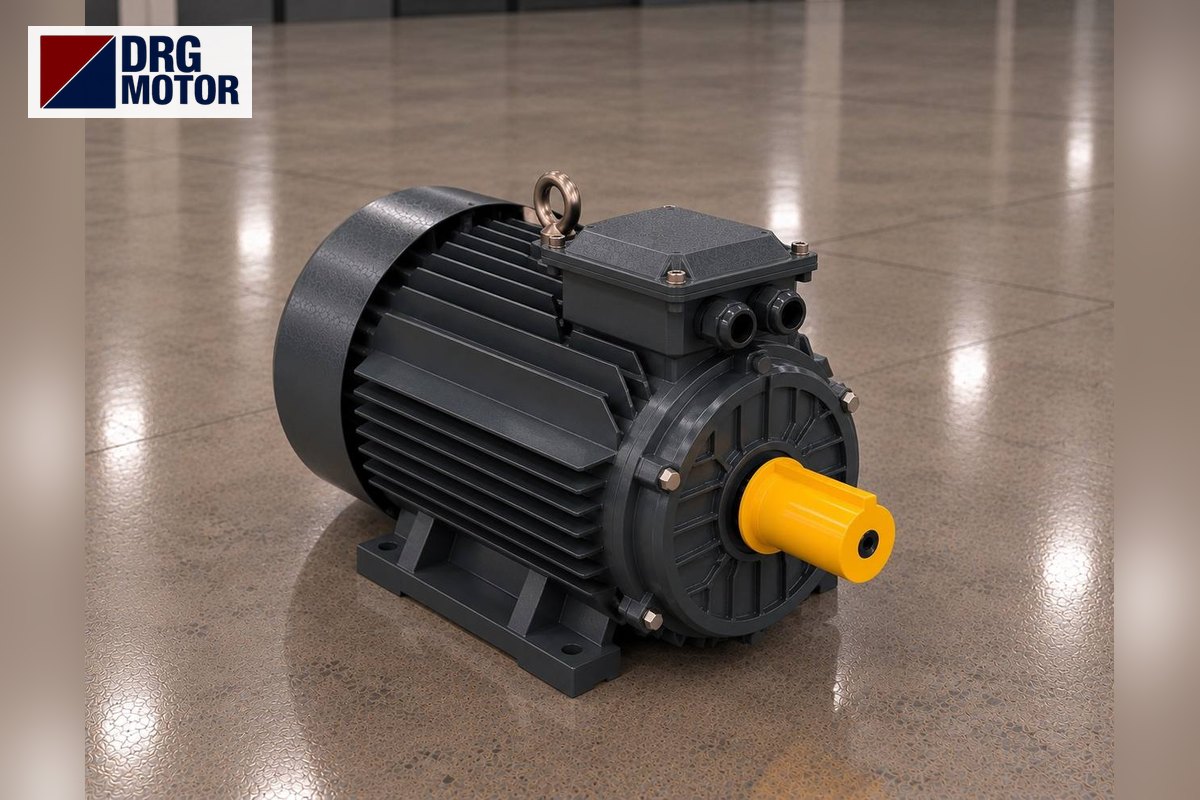

Most coolant pumps on machine tools are immersion pumps: motor and pump share one body, the impeller sits on an extension of the motor shaft, and the body hangs into the tank to a set length below its flange. When the motor of such a pump burns out, a standard IEC motor cannot replace it, because the shaft length and immersion depth are specific to the pump. DRG Motor does not sell immersion pumps or special-shaft motors; we say this clearly at the outset.
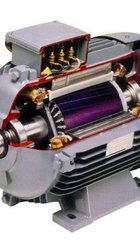
What DRG can cover is the second arrangement: a centrifugal pump placed outside or beside the tank and connected to a standard motor by a coupling or through its own bearing housing. In this layout the motor driving the pump is one of the 2-pole three-phase motors that DRG Motor manufactures and sells; DRG Motor is a manufacturer, supplier and seller of electric motors. Models are in the online motor store, and guidance on surface pumps is on the centrifugal pump motors page.
Why Immersion Depth Decides the Motor Change
Immersion depth is the distance from the pump flange sitting on the tank lid to the suction inlet. Pump makers offer several depths for the same motor power, and the machine builder chooses one to suit tank depth and the level of settled chips. If the inlet is too close to the bottom, the pump sucks up chip sludge; if too high, it draws air when the level drops.
This length is the part of the motor shaft that extends down into the pump. The shaft holds the impeller in the tank with no bearings other than the motor's own. So a standard motor with the same flange cannot take the old one's place: the shaft end does not reach the pump casing and the impeller cannot be fitted. With immersion pumps the right course is a spare pump unit with the same power, speed and immersion depth.
Comparing the Two Arrangements
If you are designing a new machine or want to permanently replace an immersion pump that keeps failing, the differences below help.
| Feature | Immersion pump | Separate motor + pump |
|---|---|---|
| Motor and pump | One body, common shaft | Joined by coupling or lantern |
| Space on tank | Small | Needs room beside tank |
| Suction | Impeller in the liquid | Needs flooded suction |
| If the motor fails | Whole unit is replaced | Only the motor is replaced |
| DRG's part | None | Standard IEC motor |
In the separate layout the pump is fixed to the tank side wall below liquid level, so the suction side is always flooded. For vertical installation, vertical-shaft tank pumps with their own bearing housing and long shaft are used, coupled to the motor; the motor then stands flange-mounted with the shaft pointing down. The pump maker decides which pump type fits; state vertical mounting in the motor order.
Click to see current electric motor prices and order nowSEE PRICES →
How Many kW and What Speed? Two Examples
Pump power is P = Q · p / (600 · η) (Q in l/min, p in bar, P in kW). Example 1: on a lathe delivering 60 l/min at 2 bar to the tool, with an assumed pump efficiency of 0.45, the motor shaft needs about 0.44 kW; a 0.55 kW 2-pole motor is enough.
Example 2: on a machining centre with through-spindle coolant at 20 l/min and 20 bar, with an assumed pump efficiency of 0.70, about 0.95 kW is needed. These pressures are usually produced by a screw or gear pump rather than a centrifugal pump, and a low-pressure pump runs as well. Real values are in the machine's coolant diagram and on the pump label.
Centrifugal coolant pumps almost always use 2-pole motors. Since head changes with the square of speed, a 4-pole motor on the same pump delivers roughly a quarter of the pressure; the coolant will not reach the tool. You can compare nameplate current and overload setting with the motor current chart.
Flange, Shaft and Lantern Dimensions
In the separate layout the motor usually joins the pump through a lantern (the housing between motor and pump) and a flexible coupling. The B5 flange that seats in the lantern and the shaft that enters the coupling hub are the first values to check. DRG catalogue dimensions:
| Frame | Flange M / N / P (mm) | Shaft D × E (mm) | Example model |
|---|---|---|---|
| 71 | 130 / 110 / 160 | 14 × 30 | DRG-712-2, 0.55 kW |
| 80 | 165 / 130 / 200 | 19 × 40 | DRG-801-2, 0.75 kW |
| 90S | 165 / 130 / 200 | 24 × 50 | DRG-90S-2, 1.5 kW |
For pumps coupled to a foot-mounted (B3) motor on a baseplate, shaft height H and foot hole spacing decide; on frame 80, H is 80 mm and the foot holes are 125 × 100 mm. For small-flange (B14) mounting we confirm the size with the order.
Emulsion, Fine Swarf and Sealing
Coolant is a water-based emulsion, so when the pump's mechanical seal wears, leakage runs straight to the motor end shield and bearing. In the separate layout the distance between seal and motor is an advantage; keep the lantern drain hole open. The motor is IP55, but it should not sit under a constant stream of liquid.
Fine chips and grinding dust in the coolant wear the impeller; as it wears, flow drops and so does current. Rising current usually means the impeller is jammed with swarf or the emulsion has become too thick. If you are also changing the spindle drive, our article on lathe motor selection may help.
Before Ordering a Coolant Pump Motor
- Is the existing pump an immersion pump, or a separate motor and pump? Is a coupling visible between them?
- Power, speed, voltage and connection on the nameplate (230/400 V, star/delta).
- Flange type (B5 or B14), bolt circle and spigot diameter.
- Shaft diameter, shaft length and key width; bore of the coupling hub.
- Is the motor horizontal or vertical; if vertical, does the shaft point down?
- Pump flow and head; with through-spindle coolant, separate data for the high-pressure pump.
- Type of fluid: water-based emulsion or neat cutting oil.
DRG Motors for Separate Coolant Pumps
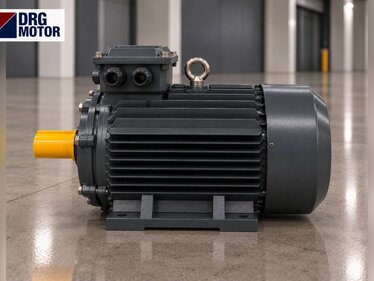
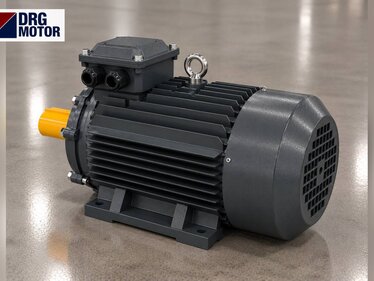
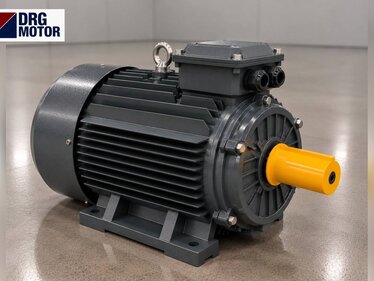
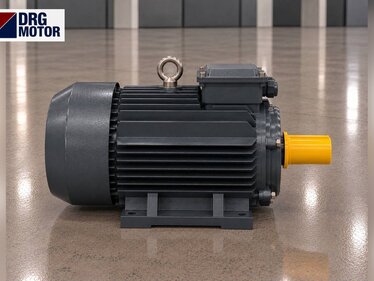
Aluminium-frame 2-pole motors for surface pumps driven through a coupling or lantern, suitable for B5 flange or B3 foot mounting. They do not replace an immersion pump unit.
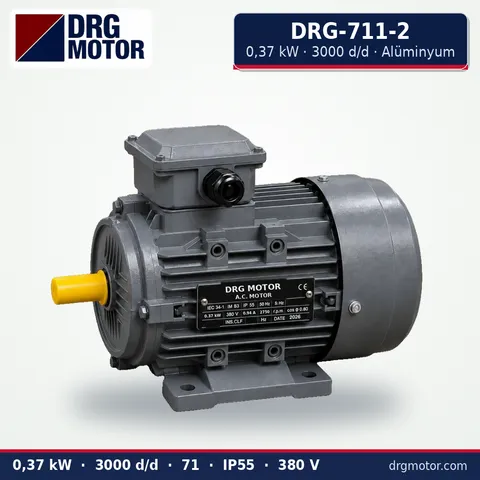
0.37 kW Three-Phase Motor 3000 rpm – DRG-711-2 Aluminium
- 0.37 kW · 3000 rpm (2 poles)
- Aluminium frame · IEC 71
- Mounting: B3 · B5 · B14 · B35
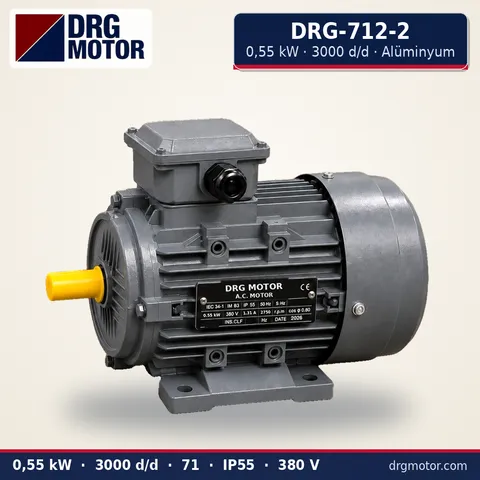
0.55 kW Three-Phase Motor 3000 rpm – DRG-712-2 Aluminium
- 0.55 kW · 3000 rpm (2 poles)
- Aluminium frame · IEC 71
- Mounting: B3 · B5 · B14 · B35
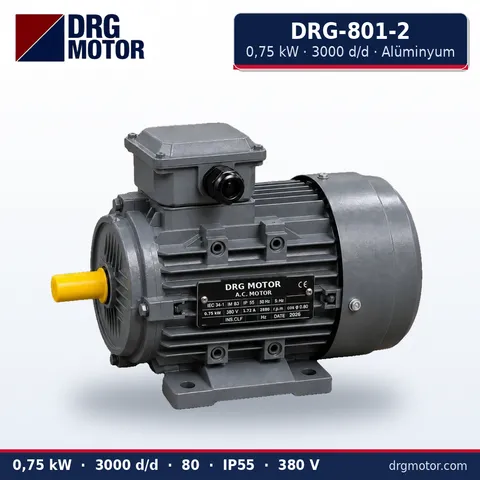
0.75 kW Three-Phase Motor 3000 rpm – DRG-801-2 Aluminium
- 0.75 kW · 3000 rpm (2 poles)
- Aluminium frame · IEC 80
- Mounting: B3 · B5 · B14 · B35
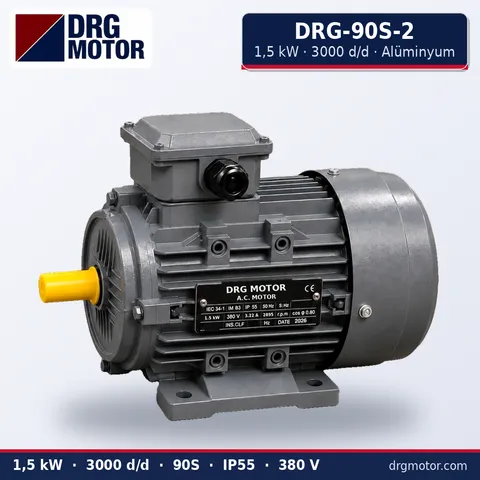
1.5 kW Three-Phase Motor 3000 rpm – DRG-90S-2 Aluminium
- 1.5 kW · 3000 rpm (2 poles)
- Aluminium frame · IEC 90S
- Mounting: B3 · B5 · B14 · B35
Click to see current prices and order these motors nowSEE PRICES →
Machine Tool Coolant Pump Motor FAQ
Can only the motor of an immersion coolant pump be replaced?
Not with a standard IEC motor; the pump shaft is an extension of the motor shaft and is specific to the immersion depth. Ask the pump maker for a spare unit with the same power, speed and depth, or convert the machine to a separate motor + pump layout.
How many kW is a lathe coolant pump motor?
On small lathes it is usually below 1 kW; on large machining centres it can be several kW, with a separate high-pressure pump for through-spindle coolant. The exact value is on the pump label and in the machine catalogue.
The coolant pump runs but delivers nothing. Why?
The usual causes are reverse rotation, a low tank level letting the inlet draw air, a suction strainer clogged with chips, and foaming emulsion. After a motor change, check the direction against the arrow on the pump casing.
Can a 4-pole motor drive a centrifugal coolant pump?
Not if the pump was selected for a 2-pole motor. Head falls with the square of speed, so on a 4-pole motor the pump delivers roughly a quarter of the pressure.
For a quotation, send a photo of the motor nameplate, its power and speed, mounting (foot or flange), shaft size and the pump type to our WhatsApp line, or add the models to the quote list. Phone +90 (542) 666 11 11, e-mail info@drgmotor.com, other channels on the contact page. All 2-pole ratings are in the DRG online store.