English
 Le français
 Türkçe

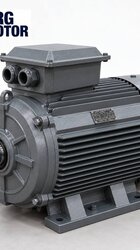
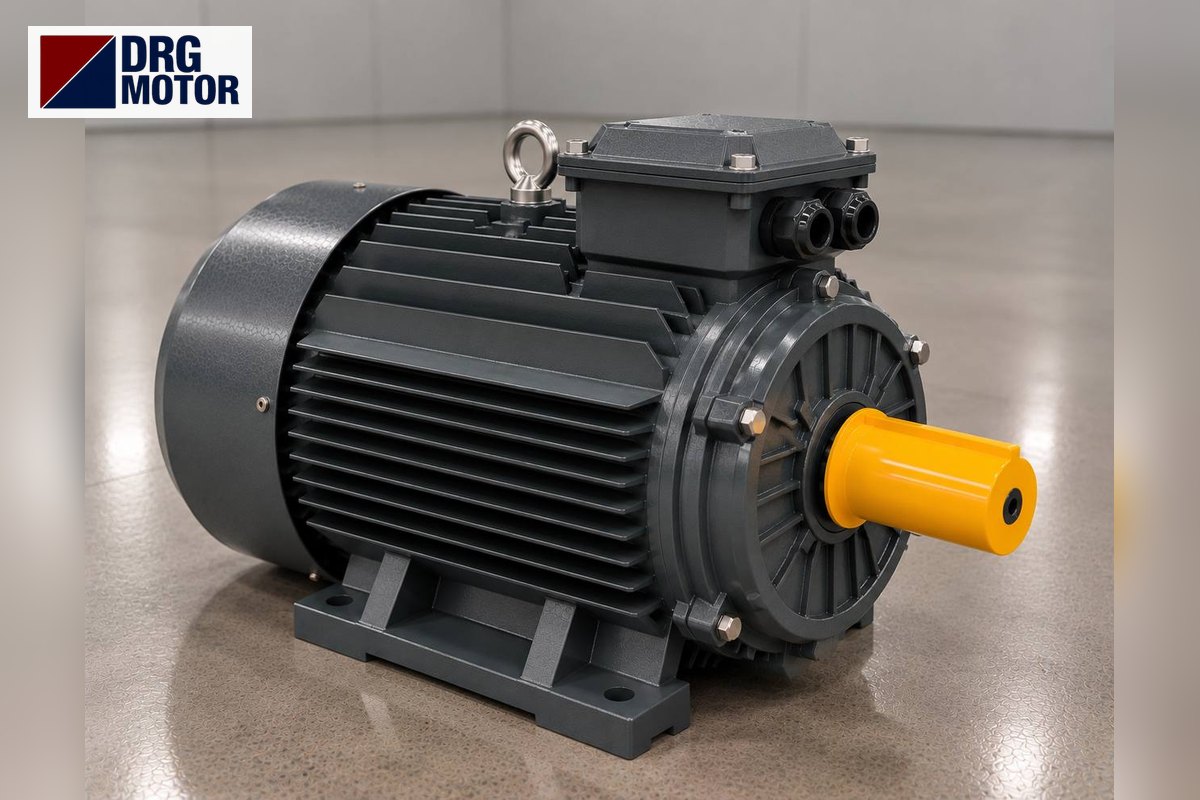

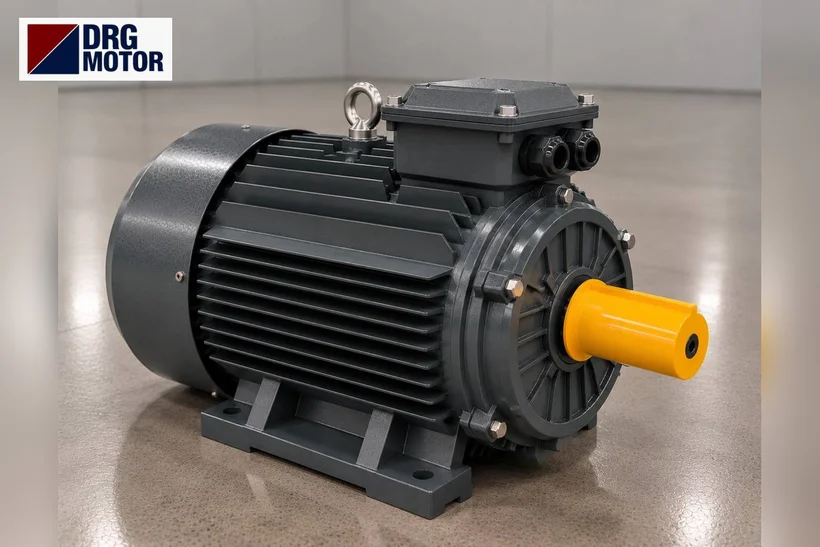
In an oil filtration unit (hydraulic oil filter cart, transformer oil purifier) the motor turns a gear pump that draws oil from the tank and pushes it through the filter elements. Two things decide the motor more than kW: how thick the oil gets when cold, and the pressure the pump meets as the filter clogs. That is why, for the same flow, a slow 6-pole motor with a larger pump often runs more smoothly than a fast 4-pole layout.
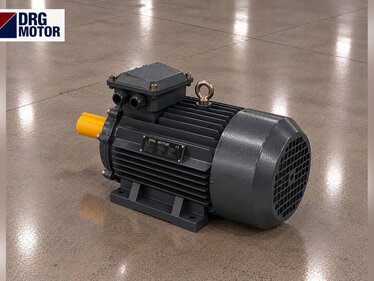
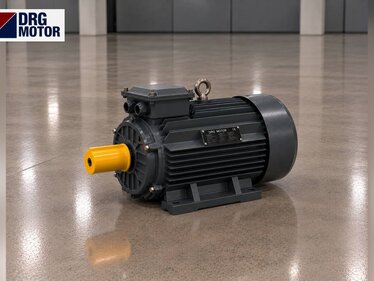
The filter cart itself, its pump and its elements fall outside what DRG sells. DRG Motor is a manufacturer, supplier and seller of electric motors; its share here is the three-phase IEC motor bolted to the pump lantern. Models listed by pole number are in the online motor store, and selection by pump type is covered on the pump motors page.
The Oil's Path Through a Filter Unit
On a typical filter cart the oil first passes the suction hose and a coarse strainer, enters the gear pump, and is then pushed through one or two stages of fine filter elements back to the tank. A relief (bypass) valve sits at the pump outlet; when the filter clogs, oil bypasses the element and pressure is capped at the valve setting. Gauges before and after the element, or a differential pressure indicator, show when the element needs changing.
Transformer oil purifiers have a longer path: oil passes a heater, moisture and gas are removed in a vacuum column, then a second pump draws it from the column and sends it through the filter back to the transformer. Several motors run on these machines: inlet pump, outlet pump and vacuum pump. Each should be assessed on its own nameplate.
What Oil Viscosity Changes
The viscosity of mineral oil rises quickly as it cools. Hydraulic oil left overnight in a tank on an open site is several times thicker on a winter morning than at working temperature. The gear pump does not lose its ability to draw oil, but suction pressure drops, oil cannot fill the gaps between the teeth and the pump cavitates. A fast pump reaches this point sooner.
| Condition | What the pump does | What the motor shows |
|---|---|---|
| Cold, thick oil | Hard suction, cavitation | High current, noise |
| Clean filter, warm oil | Low pressure | Current below nameplate |
| Dirty filter | Pressure rises to bypass set | Current rises clearly |
| Blocked suction strainer | Pump runs dry | Current drops, pump heats |
The last row matters: with a suction blockage the motor loses load and the overload relay does not notice. The gear pump, left without oil, wears quickly. Check the suction strainer as often as the filter elements.
Click to see current electric motor prices and order nowSEE PRICES →
Choosing the Speed: 4-Pole or 6-Pole?
Gear pump flow is displacement times speed: Q = V · n. Example: a filtration flow of 30 l/min is wanted. With a 4-pole motor (1445 rpm), a pump of about 21 cm³/rev gives 30.3 l/min. With a 6-pole motor (949 rpm) about 32 cm³/rev is needed for the same flow, giving 30.4 l/min. These figures are an example; actual displacement and permitted speed range are in the pump maker's data sheet.
The slow layout gives the teeth more time to fill with thick oil; suction velocity drops, and noise and wear fall. The price is a larger pump and, for the same power, a larger motor frame. For filtering high-viscosity gear oils, or for units working outdoors in winter, 6 poles is usually the safer choice. We cover the load behaviour of gear pumps in more detail in the article on gear pump motor power and speed selection.
Dirty Filter and Cold Start: Motor Torque
Torque at the gear pump shaft grows with displacement times pressure: T = V · Δp / (20π · ηhm) (V in cm³/rev, Δp in bar, T in Nm). The 32 cm³/rev pump in the example needs about 1.8 Nm at 3 bar with a clean filter, and about 6.0 Nm when the element clogs and pressure reaches a 10 bar bypass setting (assuming a mechanical-hydraulic efficiency of 0.85). Hydraulic power from P = Q · p / (600 · η) at 10 bar, with an assumed pump efficiency of 0.75, is about 0.67 kW.
In the catalogue, the DRG-90S-6 gives 7.66 Nm rated torque at 0.75 kW, and the DRG-90L-6 11.1 Nm at 1.1 kW. When a dirty filter and cold oil coincide, starting torque comes into play too; since pressure cannot exceed the bypass setting, choosing one size up is common on these units. To set the overload relay to nameplate current, use the overload, fuse and contactor selection tool.
Pump Connection and Site Conditions
On filter carts the pump is usually joined to the motor's B5 flange through a lantern and flexible coupling; small units also use a B14 flange. When replacing, take the lantern spigot diameter and coupling hub bore from the old motor. In the DRG catalogue the B5 flange of frame 90 is M 165, N 130, P 200 mm with a 24 × 50 mm shaft; moving to frame 100, the flange becomes M 215, N 180, P 250 mm and the shaft 28 × 60 mm. We confirm B14 sizes with the order.
- Model: DRG-90L-6, 1.1 kW, 945 rpm
- Current (400 V): 2.69 A, cos φ 0.73
- Rated torque: 11.1 Nm, Ts/Tn 2.0
- Voltage: 230/400 V (Δ/Y)
- Shaft (D × E): 24 × 50 mm
Transformer oil purifiers work outdoors at substations. DRG motors are IP55 and rated for −15…+40 °C ambient; in colder regions the machine's enclosure or heater should protect the motor too. Oil leaks collect dust on the motor ribs; keep the surface clean. On mobile carts the supply cable is often unplugged, so phase sequence may change; check rotation after every connection, because a gear pump running backwards sucks from its outlet.
Order Checklist for a Filtration Unit Motor
- Old motor nameplate: kW, rpm, voltage, connection (star/delta).
- Pump displacement (cm³/rev) or flow, and permitted speed range.
- Bypass valve setting and number of filter stages.
- Type of oil filtered and lowest working temperature.
- Flange type (B5 / B14), spigot diameter and shaft size; lantern and coupling type.
- Does the unit work outdoors or indoors?
- On a transformer oil machine, which pump motor (inlet, outlet, vacuum) is being replaced?
DRG Motors Suited to Oil Filtration Pumps
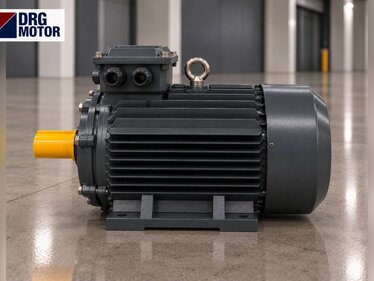
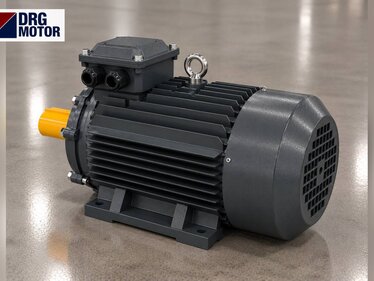
Aluminium-frame 6-pole motors for gear pumps that should run slowly in thick oil, and a 4-pole option for faster layouts; all can join the pump through a lantern on the B5 flange.
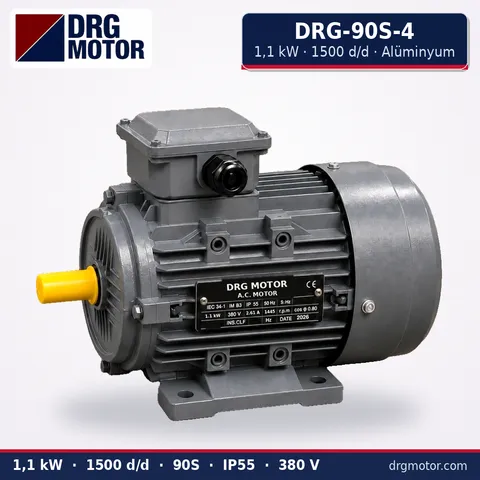
1.1 kW Three-Phase Motor 1500 rpm – DRG-90S-4 Aluminium
- 1.1 kW · 1500 rpm (4 poles)
- Aluminium frame · IEC 90S
- Mounting: B3 · B5 · B14 · B35
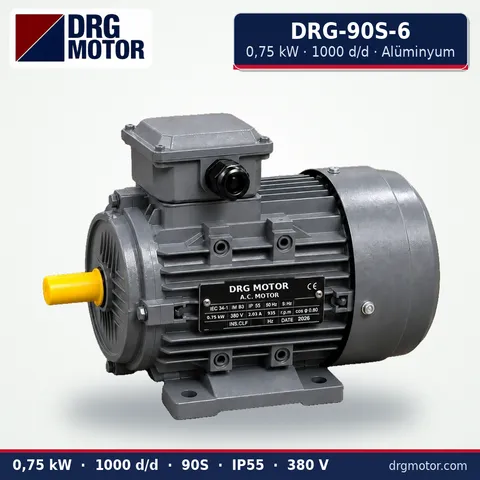
0.75 kW Three-Phase Motor 1000 rpm – DRG-90S-6 Aluminium
- 0.75 kW · 1000 rpm (6 poles)
- Aluminium frame · IEC 90S
- Mounting: B3 · B5 · B14 · B35
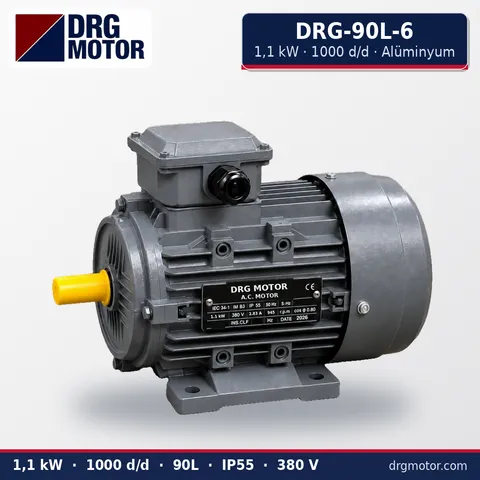
1.1 kW Three-Phase Motor 1000 rpm – DRG-90L-6 Aluminium
- 1.1 kW · 1000 rpm (6 poles)
- Aluminium frame · IEC 90L
- Mounting: B3 · B5 · B14 · B35
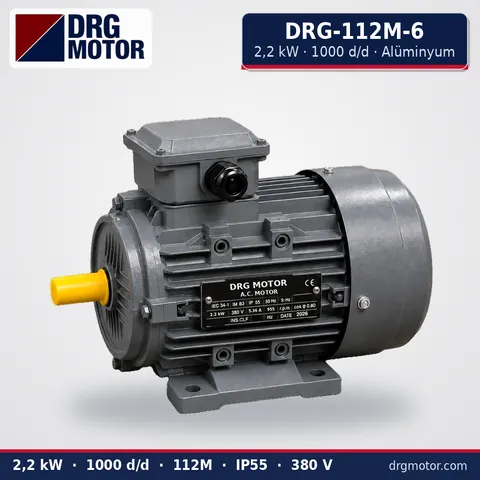
2.2 kW Three-Phase Motor 1000 rpm – DRG-112M-6 Aluminium
- 2.2 kW · 1000 rpm (6 poles)
- Aluminium frame · IEC 112M
- Mounting: B3 · B5 · B14 · B35
Click to see current prices and order these motors nowSEE PRICES →
Oil Filtration Pump Motor FAQ
What kW should an oil filter cart motor be?
Small hydraulic filter carts are usually around 1 kW or below; large-flow transformer oil purifiers go up to several kW. The exact value follows from pump displacement, bypass setting and the maker's nameplate; the example above only shows the method.
Why does the filter unit trip in cold weather?
Cold oil thickens, raising resistance on both suction and delivery sides; add a dirty filter and the pump builds pressure up to the bypass setting. Warming the oil, changing the filter and setting the overload to nameplate current are the first steps; if the problem persists, go one motor size up.
What happens if the oil filtration pump runs in reverse?
A gear pump that changes direction sucks from its delivery side; oil does not reach the filter, the suction hose sees pressure and seals may be strained. After every cable disconnection, check direction with a short run.
Is the vacuum pump motor on a transformer oil purifier also standard?
Vacuum pump motors that are foot or flange mounted and show a standard IEC frame on the nameplate can be replaced with a standard three-phase motor. Monobloc designs with a pump-specific shaft are not covered by a standard motor.
Let us work out the right motor for your filter unit together: a nameplate photo, motor power and speed, whether it is foot or flange mounted, shaft diameter and the pump displacement in cm³/rev are enough. Write them on our WhatsApp line, or send your chosen models through the quote list. You can reach us on +90 (542) 666 11 11 and at info@drgmotor.com; our address is on the contact page. Every 4-pole and 6-pole model is in the DRG online store.