English
 Le français
 Türkçe





The motor on a hydrocyclone feed pump has to push slurry (a mix of solids and water) into the cyclone’s tangential inlet at a set pressure, and the cut size of the separation depends on that pressure. Three things decide the motor: the shaft power the pump draws at the required flow and head, the density of the slurry, and the pulley ratio that sets pump speed. If you size the motor from a pump curve drawn for water, it will be overloaded on dense slurry.
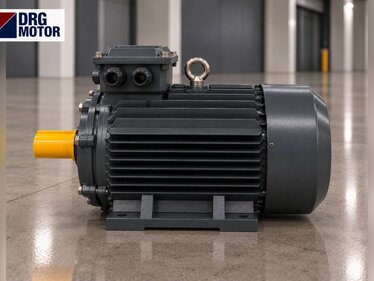
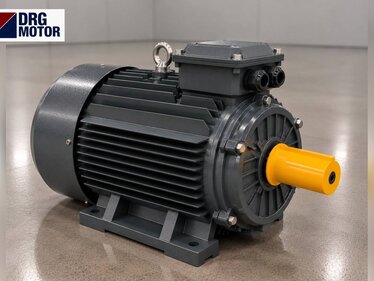
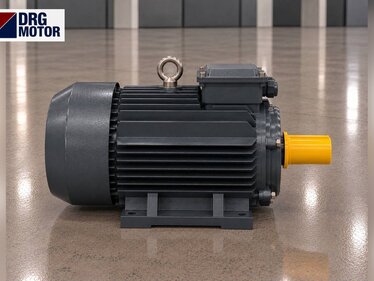
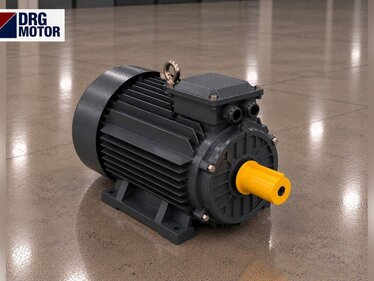
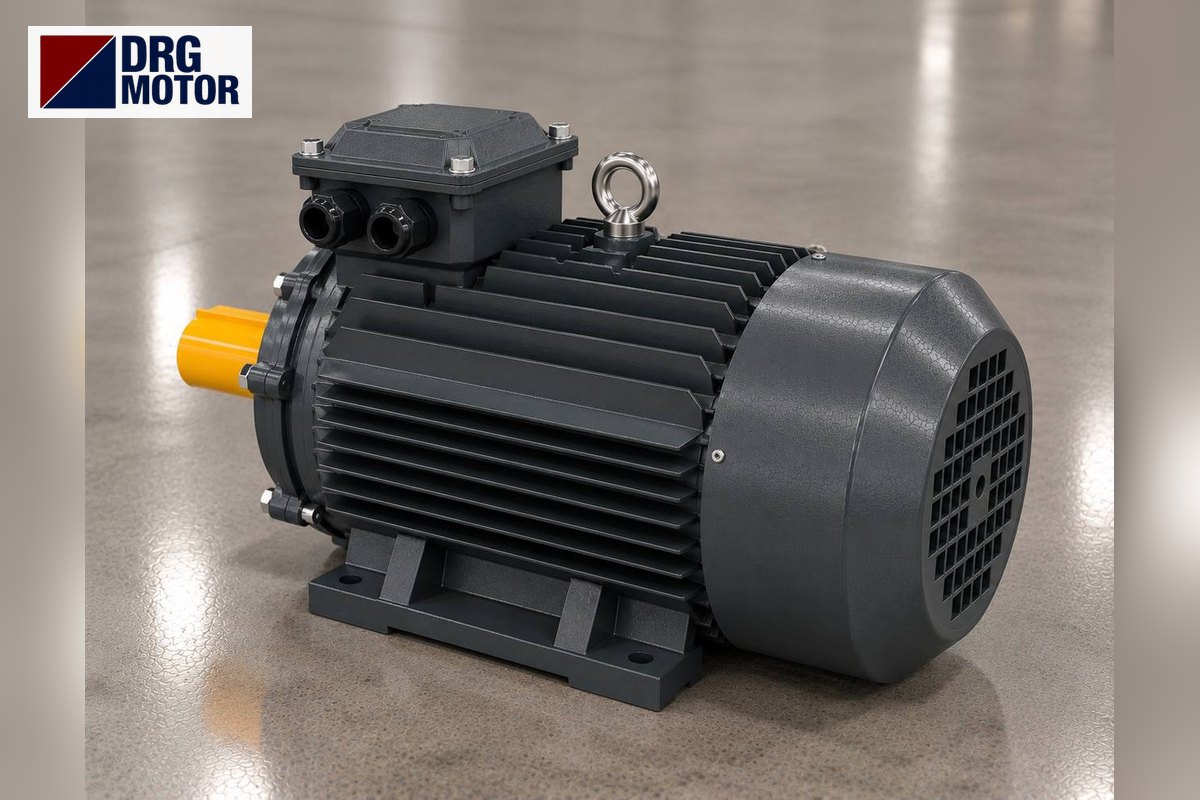
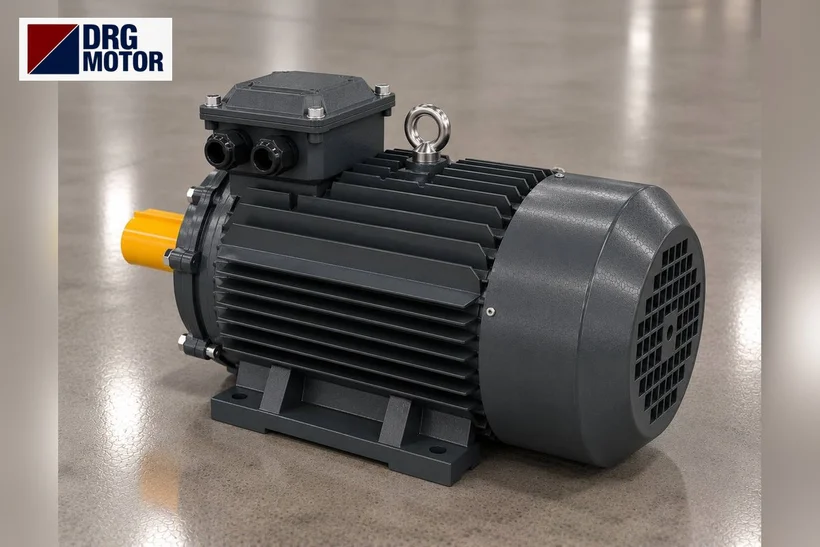
DRG Motor is a manufacturer, supplier and seller of electric motors; it offers three-phase asynchronous IEC motors in aluminium and cast iron frames for belt- or coupling-driven machines such as slurry pumps. Every model, filterable by kW and pole count, is listed in the buy electric motors online section.
The pump itself is outside DRG’s scope (DRG’s models for pump drives are grouped on the pump motors page); this article is about sizing the standard motor that drives it.
Pump Pressure Controls the Separation
A hydrocyclone has no moving parts. The pump feeds slurry tangentially into the conical body and the mixture spins fast; coarse, heavy particles are thrown to the wall and leave through the apex at the bottom (underflow), while fines and most of the water escape upwards through the central vortex finder (overflow).
If inlet pressure drops, the spin weakens and fines report to the underflow; in a sand washing plant that means silt and clay come out with the sand. If pressure climbs too high, the apex and liner wear quickly and the pump uses more energy than necessary. That is why a cyclone feed pump is set to a duty point, and the motor must run comfortably at that point.
Note: the air cyclone used in dust collection is a different machine; there the motor turns a fan, and the selection logic is covered on the dust collector fan motor page.
Why Slurry Density Increases Motor Power
The pump maker’s curve is usually drawn for clean water. The head a pump develops (in metres) barely depends on the liquid, but the pressure and shaft power needed for that head rise in direct proportion to specific gravity. With a slurry specific gravity of 1.4, the motor delivers roughly 1.4 times the power it would on water at the same flow.
Worked example (assumptions): flow 1500 l/min, total head 15 m, slurry specific gravity 1.4, pump efficiency 0.55. Pressure is 15 × 1.4 / 10.2 ≈ 2.06 bar. With P = Q·p/(600·η), shaft power is 1500 × 2.06 / (600 × 0.55) ≈ 9.4 kW. At the same point on clean water it is about 6.7 kW. Enter your own plant’s flow and head in the pump and fan motor power calculator to check the figure.
Slurry pump efficiency changes with wear and solids content; 0.55 is only an example here. The exact shaft power is in the duty point data supplied by the pump manufacturer.
Click to see current electric motor prices and order nowSEE PRICES →
Pulley Ratio: What a Speed Change Costs the Motor
Slurry pumps are mostly driven by V-belts, so speed can be adjusted by changing a pulley as the impeller wears or the cyclone is changed. Pump speed is n2 = n1 · d1 / d2: with a 4-pole motor at 1465 rpm, a 200 mm motor pulley and a 315 mm pump pulley give about 930 rpm at the pump.
The point often missed is that a centrifugal pump’s shaft power follows the cube of the speed. In the 9.4 kW example above, raising speed by 5 percent lifts power to about 10.8 kW; raising it by 10 percent lifts it to 12.5 kW. An 11 kW motor covers the first case; the second needs 15 kW.
So before fitting a smaller pump pulley because pressure is short, check the power on the motor nameplate. The pump also limits the speed increase; its maximum permitted speed is in the pump catalogue.
| Drive condition | Pump speed (example) | Shaft power (example) | Suitable motor |
|---|---|---|---|
| Initial setting | 930 rpm | 9.4 kW | DRG-160M-4 11 kW |
| Speed raised 5% | 977 rpm | 10.8 kW | DRG-160M-4 11 kW |
| Speed raised 10% | 1023 rpm | 12.5 kW | DRG-160L-4 15 kW |
| Trial on clean water | 930 rpm | 6.7 kW | DRG-132M-4 7.5 kW |
The last row is a warning: current measured on clean water during commissioning rises noticeably once slurry arrives. Do not downsize the motor based on a clean-water reading.
Starting: Full Pump, Settled Solids and Star-Delta
If the pump sits idle, solids settle at the bottom of the casing and in the suction line. On restart the motor must deliver enough torque to stir and move that settled material. Starting torque ratio therefore matters: for the DRG-160M-4 Ts/Tn is 2.2 and rated torque is 71.7 Nm.
Starting current also stresses the plant’s fuses and any generator. The same model’s rated current at 400 V is 20.4 A with an Is/In ratio of 7.7; on direct-on-line starting it draws about 157 A. DRG windings at 4 kW and above are 400/690 V, so on a 400 V supply the motor works in delta and suits star-delta starting.
In star, starting torque also falls to about one third. On a full pump with settled slurry that may not be enough; flushing and draining the pump with clean water before a shutdown makes restarting easier.
Where the Motor Sits in a Wet, Abrasive Plant
Cyclone feed duty runs in sand washing and ore plants, among splashing water and mud. DRG motors are IP55: dust ingress is limited and splashing water is tolerated, but not designed for direct pressure-wash jets or submersion. Do not mount the motor under leaking gland water or apex spray.
Cooling is IC411; the rear fan blows air over the frame fins. If the fins fill with mud, cooling drops and the winding heats up. A cast iron frame is the more robust choice against knocks and corrosion here. Nameplate ratings apply from −15 to +40 °C ambient and up to 1000 m above sea level; allow for summer sun on an open site.
With a belt drive the motor is foot-mounted (B3) on a tensioning rail or slide base. Belt tension puts a radial load on the motor bearing; an over-tightened belt is one of the most common causes of bearing failure.
Field signs of the wrong motor
Undersized motor: the overload relay trips when the slurry thickens, the frame gets too hot to touch, and the cyclone underflow turns watery because the operator has to keep pressure low.
Wrong pole count: swap a 4-pole unit for a 2-pole one while keeping the same pulleys and the pump turns twice as fast, so power demand rises roughly eightfold. The motor trips at once or the pump is badly damaged.
An oversized motor usually runs, but starting current and cable size grow, and the overload setting must still follow the real load.
What to Measure on Site Before Ordering
- Power, speed, voltage and connection (Δ/Y) on the old motor’s nameplate
- Frame size (e.g. 160M) plus the diameter, length and keyway of the shaft end
- Distance between the base bolt holes (A/B) and the shaft centre height H
- Motor and pump pulley diameters, belt type and number
- Pump duty point: flow, head, slurry density
- How the panel starts the motor (DOL, star-delta or soft starter)
- Whether water and mud splash onto the motor position
For example, the DRG-160M-4 is a 160M frame: shaft diameter 42 mm, shaft length 110 mm, shaft height 160 mm, foot spacing A 254 / B 210 mm. If your old motor’s dimensions differ, confirm the frame size.
DRG Motors for Hydrocyclone Feed Pumps
Foot-mounted cast iron 4-pole models used on belt-driven slurry pumps, plus a 6-pole option for pumps that need a slower drive to limit impeller wear; power follows the pump maker’s duty point data and slurry density.
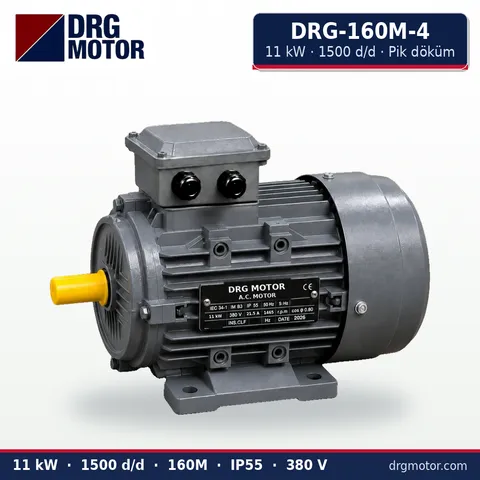
11 kW Three-Phase Motor 1500 rpm – DRG-160M-4 Cast Iron
- 11 kW · 1500 rpm (4 poles)
- Cast iron frame · IEC 160M
- Mounting: B3 · B5 · B14 · B35
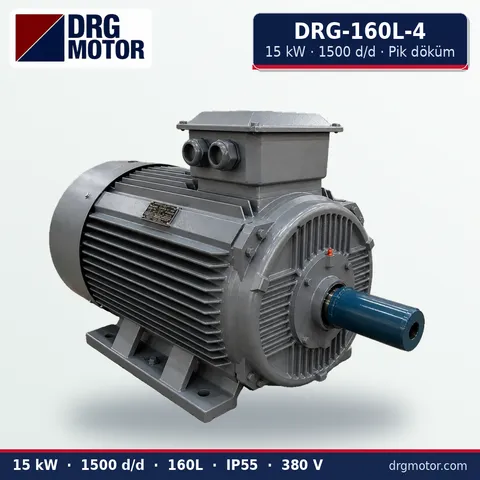
15 kW Three-Phase Motor 1500 rpm – DRG-160L-4 Cast Iron
- 15 kW · 1500 rpm (4 poles)
- Cast iron frame · IEC 160L
- Mounting: B3 · B5 · B14 · B35
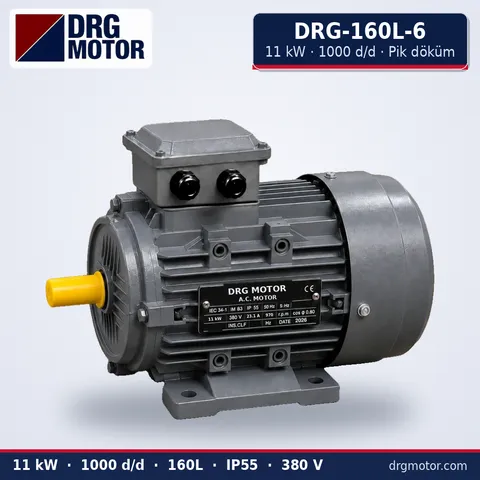
11 kW Three-Phase Motor 1000 rpm – DRG-160L-6 Cast Iron
- 11 kW · 1000 rpm (6 poles)
- Cast iron frame · IEC 160L
- Mounting: B3 · B5 · B14 · B35
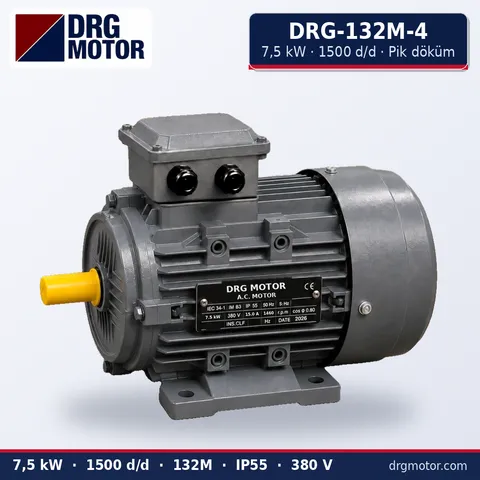
7.5 kW Three-Phase Motor 1500 rpm – DRG-132M-4 Cast Iron
- 7.5 kW · 1500 rpm (4 poles)
- Cast iron frame · IEC 132M
- Mounting: B3 · B5 · B14 · B35
Click to see current prices and order these motors nowSEE PRICES →
Cyclone Feed Pump Motor: Frequently Asked Questions
How many kW should a hydrocyclone pump motor be?
It depends on flow, head and slurry density. Small sand washing lines may need a few kW, large ore plants tens of kW. The exact value is in the pump maker’s duty point data and on the existing motor’s nameplate.
Is a 2-pole (3000 rpm) motor acceptable on a slurry pump?
Yes, if the pump and pulleys were selected for that speed. Most slurry pumps run at lower speed to limit wear, using a 4- or 6-pole motor with a belt drive. Changing the pole count changes pump speed.
Why does the cyclone pump motor trip on slurry?
Its power may have been chosen for clean water, or pump speed was raised with a pulley change. Slurry density and the cube law together overload the motor. Measure current while slurry is being fed.
Can an inverter be used on a hydrocyclone pump?
Yes; speed is then adjusted without changing pulleys. At low frequency the motor fan also turns slowly, so avoid long periods at very low speed. Inverters are not part of DRG’s range; DRG supplies the motor that the inverter feeds.
To request a quote, a nameplate photo of the installed motor, its kW and rpm, the fixing style (foot or flange), the shaft diameter and the pump’s duty point (flow, head) are enough; pass them on through WhatsApp or send the models you shortlisted through the quote list. Phone: +90 (542) 666 11 11 · E-mail: info@drgmotor.com · Contact. Neighbouring machines such as crushers, screens and conveyors are covered under stone crushing plant motors; the full range sits in the DRG online store.