English
 Le français
 Türkçe

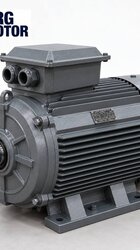
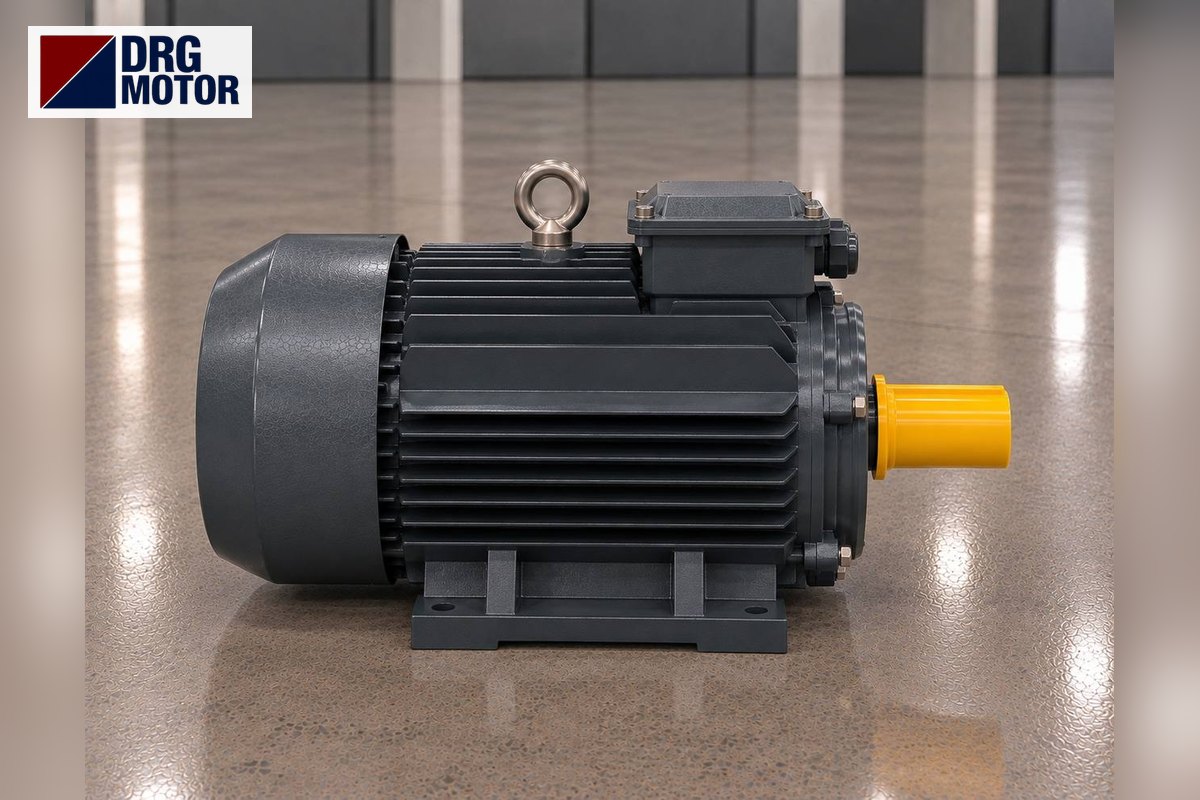

A steam boiler feed water pump is almost always a multistage centrifugal pump driven by a 2-pole motor (about 2900 rpm). Three things decide the motor: the discharge pressure the pump must reach above boiler pressure, the flow needed for the boiler’s steam output, and the heat that hot feed water passes to the motor through the pump. Power follows from flow times pressure, and mounting from whether the pump is vertical or horizontal.
DRG Motor is an electric motor manufacturer, supplier and seller. The 2-pole three-phase motors used on feed pumps are listed by power in the DRG online store; for general motor selection on vertical staged pumps, see also the multistage pump motor page.
How Does the Feed Pump Cut In on a Boiler?
The water level in the boiler falls as steam is drawn. When the level probe or float detects low level the pump starts, and it stops at high level; this on-off control is common on small and medium boilers. Each time it runs, the pump must push water against the pressure inside the boiler, so it is selected to exceed the boiler safety valve setting.
Large boilers use modulating feed: the pump runs without interruption and feed water is metered into the boiler by a control valve or by varying pump speed with a frequency inverter. For the motor the two regimes are very different. With on-off control the motor starts many times an hour; with modulating control it runs at one load for long periods, but when slowed down by an inverter its shaft-mounted fan cools less.
From Boiler Capacity to Pump Motor: Example Table
Feed flow is the boiler’s steam output plus a safety margin (1.25 is used below). Discharge pressure is boiler operating pressure plus line and valve losses and a control valve allowance. Motor power is P = Q·p/(600·η) (Q in l/min, p in bar, P in kW). All values in the table are examples/assumptions; small staged pumps have low efficiency, and the exact power comes from the pump curve or the boiler maker’s documents.
| Boiler (example) | Pump duty (assumption) | Shaft power | Motor |
|---|---|---|---|
| 1 t/h · 8 bar | 20.8 l/min · 11 bar · η 0.35 | ≈ 1.1 kW | DRG-90S-2 (1.5 kW) |
| 5 t/h · 10 bar | 104 l/min · 13 bar · η 0.50 | ≈ 4.5 kW | DRG-132S1-2 (5.5 kW) |
| 8 t/h · 13 bar | 167 l/min · 17 bar · η 0.55 | ≈ 8.6 kW | DRG-160M1-2 (11 kW) |
| 15 t/h · 13 bar | 313 l/min · 17 bar · η 0.55 | ≈ 16.1 kW | DRG-160L-2 (18.5 kW) |
For the 15 t/h example the calculation gives 16.1 kW; a 15 kW motor would be at its limit there, and power rises as the pump moves right on its curve with the control valve fully open. So the 18.5 kW DRG-160L-2 is chosen: 2940 rpm, 32.5 A at 400 V. On a smaller boiler the 5.5 kW DRG-132S1-2 gives 17.9 Nm rated torque at 2930 rpm.
A boiler house usually has two feed pumps: one duty, one standby. Both should have the same power; if the standby motor sits idle for long periods, run it briefly once a month to check that its bearings and seal stay healthy.
Click to see current electric motor prices and order nowSEE PRICES →
Hot Feed Water and Boiler House Temperature
Feed water usually comes from the deaerator or condensate tank at 90–105 °C. At this temperature the vapour pressure is high; if there is not enough pressure (NPSH) at the pump suction, cavitation starts and the pump runs rough and noisy. The fix is to place the tank high enough above the pump, which is not a motor selection issue; but the vibration of a cavitating pump also damages motor bearings.
The main path for heat to reach the motor is the pump body. On a vertical staged pump the motor is mounted right above the hot pump head on the lantern; heat coming up the shaft and lantern warms the motor’s drive-end bearing. Pump makers use a cooled seal chamber or an extended lantern at high temperature; leave these parts in place when changing the motor.
DRG motors deliver rated power at −15…+40 °C ambient and up to 1000 m altitude. At ceiling level in a boiler house, especially in summer, temperature can exceed 40 °C. Then ventilation should be improved or the motor chosen with derating; state the ambient temperature when asking for a quote. The fan motor that supplies combustion air shares the same room; its selection is covered in the boiler fan motor article.
V1 and V18 Mounting on Vertical Pumps
On vertical staged feed pumps the motor is bolted by its flange to the pump lantern with the shaft pointing down. The vertical shaft-down position of a large-flange (B5) motor is called V1, and that of a small-flange (B14) motor V18. V18 is common on small vertical pumps; the small flange size is confirmed separately when ordering.
For V1, the large flange sizes depend on frame size. For example, on frame 132S the B5 flange bolt circle is 265 mm, spigot 230 mm, flange outer diameter 300 mm and shaft 38×80 mm. On frames 160M and 160L these are 300 mm, 250 mm, 350 mm and 42×110 mm. Do not order a new motor without measuring the old flange; if the spigot differs by a few millimetres the motor will not seat on the lantern. Fit a rain cowl over the fan cover on a vertical motor and turn the terminal box so the cable entry faces down.
On horizontal staged feed pumps the motor is foot-mounted (B3) and coupled to the pump on a common baseplate. Here shaft height and coupling alignment matter; the hot pump casing expands in operation, so check final alignment in the hot condition if possible.
Number of Starts, Starting Method and Protection
With on-off level control the pump may cut in many times an hour. 2-pole motors draw a high starting current: on the 5.5 kW model it is 8.3 times rated. If the level probes are too close together the pump starts and stops often and the winding heats up. Keep the probe gap reasonable, or move to modulating feed on large boilers.
Direct-on-line starting is common at low power; from 11 kW, depending on the supply, a soft starter or inverter is preferred. There should be low-level protection in the feed tank against dry running, and an overload set to nameplate current on the motor line. To compare current values you can use the motor current chart. DRG does not sell inverters; our motors can run on a separately sourced drive.
Pre-replacement checklist
- Old motor kW, rpm and voltage (230/400 V up to 3 kW, 400/690 V from 4 kW).
- Is the pump vertical (V1 large flange / V18 small flange) or horizontal foot-mounted?
- Flange bolt circle, spigot diameter, shaft diameter × length and key.
- Boiler operating pressure, safety valve setting and steam output.
- Feed water temperature and boiler house ambient in summer.
- Control type: on-off level control, modulating feed, inverter or not.
- Whether the standby pump motor will also be replaced.
DRG Motors Suited to Boiler Feed Pumps
2-pole models covering the feed pump powers of the 1–15 t/h boilers in the example table; chosen flange-mounted for vertical pumps and foot-mounted for horizontal pumps:
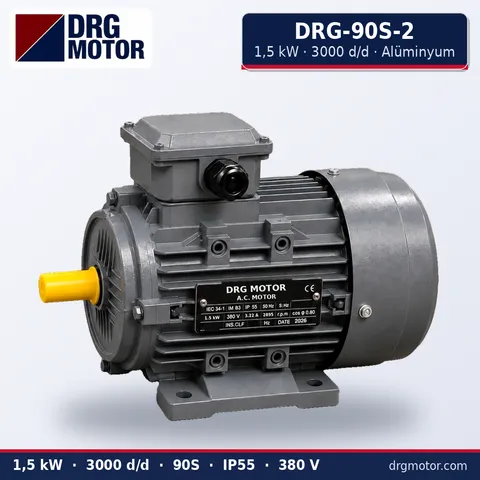
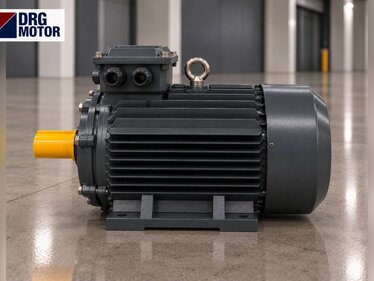
1.5 kW Three-Phase Motor 3000 rpm – DRG-90S-2 Aluminium
- 1.5 kW · 3000 rpm (2 poles)
- Aluminium frame · IEC 90S
- Mounting: B3 · B5 · B14 · B35
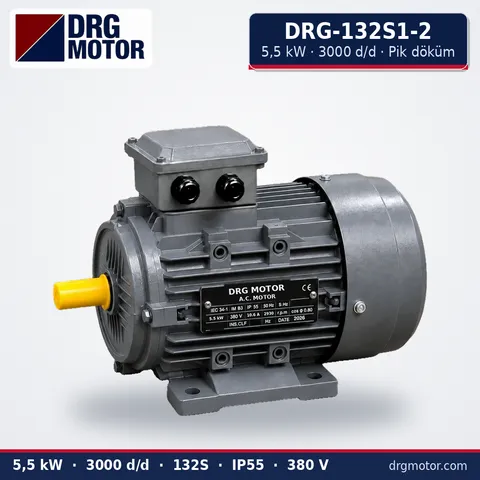
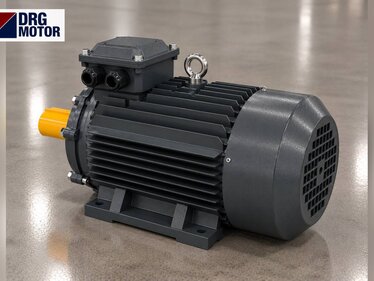
5.5 kW Three-Phase Motor 3000 rpm – DRG-132S1-2 Cast Iron
- 5.5 kW · 3000 rpm (2 poles)
- Cast iron frame · IEC 132S
- Mounting: B3 · B5 · B14 · B35
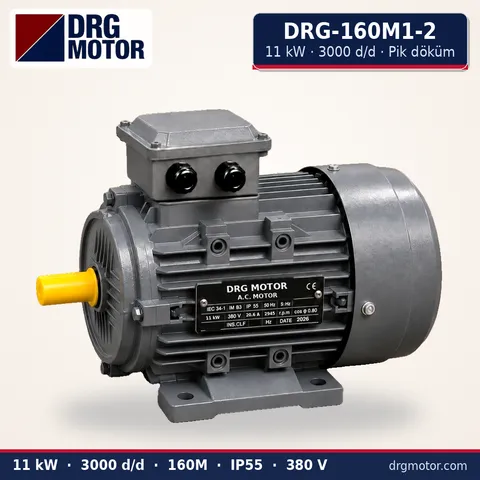
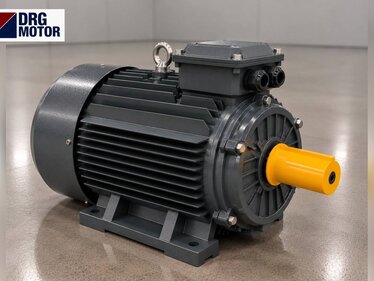
11 kW Three-Phase Motor 3000 rpm – DRG-160M1-2 Cast Iron
- 11 kW · 3000 rpm (2 poles)
- Cast iron frame · IEC 160M
- Mounting: B3 · B5 · B14 · B35
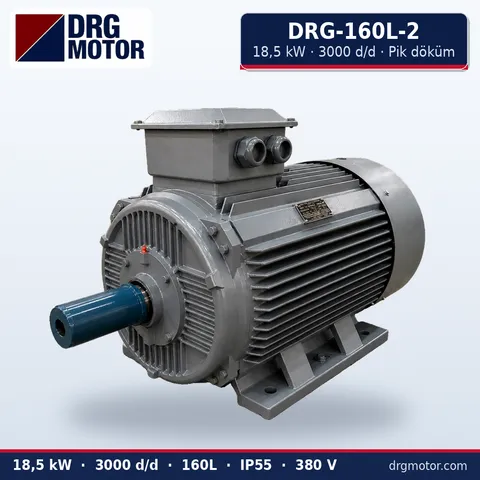
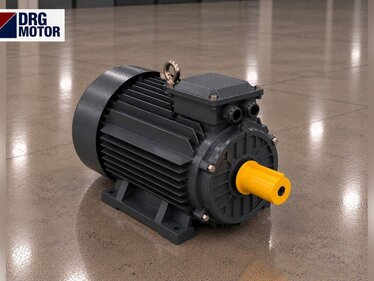
18.5 kW Three-Phase Motor 3000 rpm – DRG-160L-2 Cast Iron
- 18.5 kW · 3000 rpm (2 poles)
- Cast iron frame · IEC 160L
- Mounting: B3 · B5 · B14 · B35
Click to see current prices and order these motors nowSEE PRICES →
Boiler Feed Pump Motor FAQ
How many kW should a boiler feed pump motor be?
The boiler’s steam output and pressure decide it. Small boilers may use 1–2 kW, medium ones 4–11 kW, and large boilers higher powers. Take the exact value from the pump plate and the boiler maker’s documents.
Why does the feed pump motor run so hot?
The usual causes are frequent starts (level probes too close), a hot boiler house, heat from the hot pump body, and the pump running at the right of its curve with the control valve fully open.
Which flange motor fits a vertical feed pump?
If the old motor has a large flange you need a B5 flange motor in V1; with a small flange, a B14 flange motor in V18. Flange sizes and shaft length must match the old motor, and vertical mounting must be stated on the order.
Can a 4-pole motor be used on a feed pump?
Not if the pump was selected for 2 poles: at half speed the discharge pressure falls to a quarter and the pump cannot feed the boiler. Some large horizontal pumps are designed for 4 poles; follow the speed on the pump plate.
To determine the right motor, send a photo of the motor plate, the power, speed, mounting type (foot or flange, vertical or horizontal), shaft size and the boiler’s output and pressure via WhatsApp, or create a quote list. Phone: +90 (542) 666 11 11 · e-mail: info@drgmotor.com · contact. All 2-pole motors are in the online store.