English
 Le français
 Türkçe

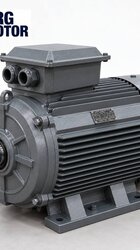
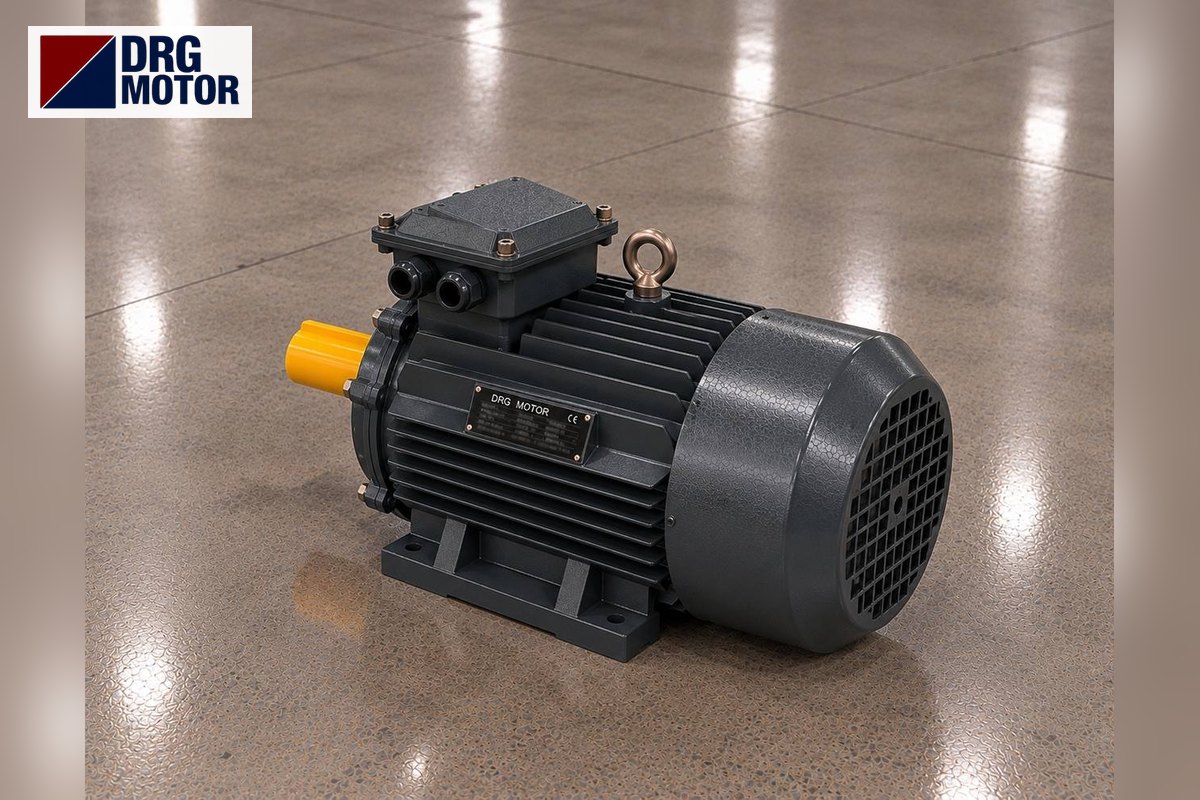

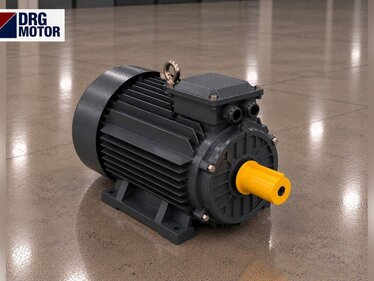
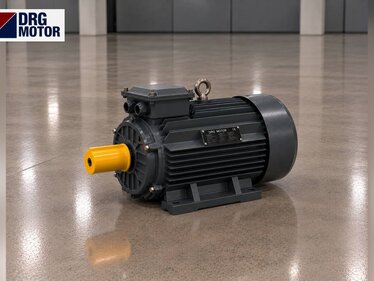
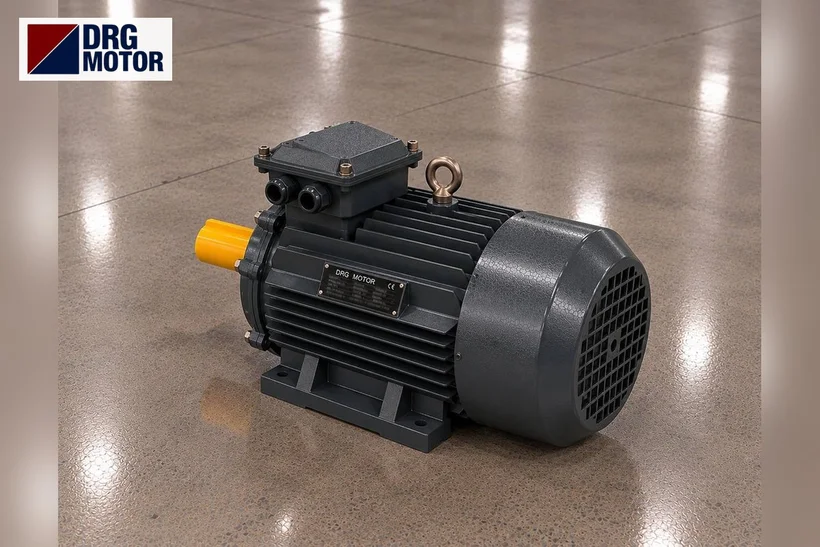
On a hydraulic oil cooler the electric motor has one job: it turns the axial fan fitted on its shaft end, drives air through the aluminium core and carries the heat of the oil away. Three things decide the replacement motor: the same number of poles as the old one (the fan speed depends on it), a shaft and flange that fit the fan hub and the cooler housing, and whether the motor sits in air already heated by the core or in ambient air.
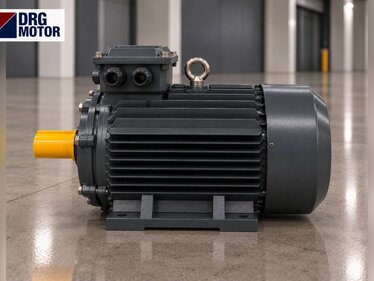
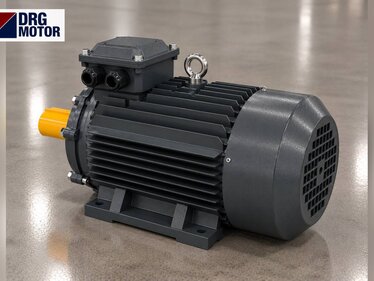
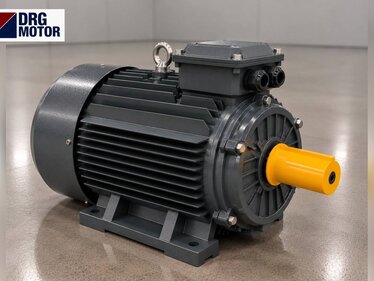
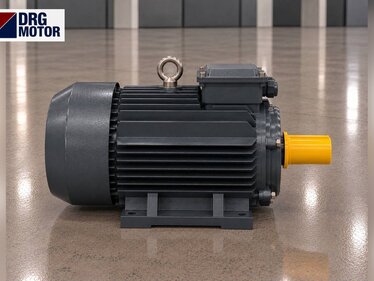
DRG Motor is a manufacturer, supplier and seller of electric motors; it does not sell coolers or fans, but supplies the standard three-phase IEC motor that drives the fan. Models by power and speed are listed in the online motor store; for general guidance by fan type see our axial fan motors page.
Where Does the Air Pass, and Where Is the Motor?
An air-oil cooler looks like a car radiator: the oil flows through channels laced with thin fins, and the fan pushes or pulls air between the fins. The fan is clamped on a keyed hub on the motor shaft, and the motor is usually bolted to the fan shroud by a flange or a bracket. There is no coupling or belt; motor speed is fan speed.
There are two arrangements, and this difference decides motor life. In a blowing layout the fan takes ambient air and pushes it into the core; the motor stays in cool air. In a sucking layout the fan draws air through the core and blows it out; the motor sits right in the air that has picked up the oil's heat. The ambient limit on the nameplate must be read against the air the motor breathes, not the room thermometer.
Worked Example: How Hot Is the Air After the Core?
Air temperature rise across the core is estimated with ΔT = Q / (ρ · V · c). As an example, assume the cooler rejects 15 kW, the fan moves 1.0 m³/s, air density is 1.2 kg/m³ and specific heat is 1.005 kJ/kg·K. The air warms by about 12.4 K in the core. On a summer day in a 35 °C machine room, a motor in a sucking layout stands in air at about 47.4 °C.
DRG motors are rated for −15…+40 °C ambient and altitudes up to 1000 m. In the example above the motor is beyond that limit; not only the winding but also the bearing grease ages faster in heat. Options are to switch the fan to a blowing layout, ventilate the room, or assess with the builder a larger frame running at reduced load. The values are an example; the real heat load comes from the hydraulic circuit losses and the cooler catalogue.
Click to see current electric motor prices and order nowSEE PRICES →
How the Number of Poles Changes Fan Power
On an axial fan, flow rises with speed, pressure with the square of speed and absorbed power with the cube of speed. So fitting a 4-pole motor in place of a 6-pole one in the hope that it "cools a bit better" is a mistake. Fan power is P = Q · Δp / η. Example: assuming 1.5 m³/s, 120 Pa and a fan efficiency of 0.40, the fan shaft needs 450 W; a 0.55 kW 6-pole motor is enough for this fan.
| Motor | Fan speed | Fan power (example) | Result |
|---|---|---|---|
| 0.55 kW, 6-pole | 890 rpm | 0.45 kW | Fan at its design point |
| 0.55 kW, 4-pole | 1400 rpm | About 1.75 kW | Motor is overloaded |
| Blade tip, 450 mm fan | 890 → 1400 rpm | 21.0 → 33.0 m/s | More noise and blade stress |
In the catalogue, the DRG-802-6 draws 1.43 A (400 V) at a rated 890 rpm, and the DRG-801-4 draws 1.31 A at 1400 rpm; a 4-pole motor turning the same fan will soon trip the overload relay. To work with your own fan values, use the pump and fan motor power calculator.
Fan Hub, Flange and Direction of Rotation
The fan hub bore is machined to the motor shaft diameter and key width. Two frames carrying the same flange can have different shafts: in the DRG catalogue the B5 flange of frames 80 and 90 is identical (M 165, N 130, P 200 mm), yet the shaft grows from 19 mm to 24 mm in diameter and from 40 mm to 50 mm in length. Do not assume that the hub will fit because the flange does. For small-flange (B14) motors we confirm the flange size with the order.
- Model: DRG-802-6, 0.55 kW, 890 rpm
- Frame: IEC 80, aluminium, IP55
- Shaft (D × E): 19 × 40 mm, key 6 mm
- B5 flange (M / N / P): 165 / 130 / 200 mm
- Current (400 V): 1.43 A, cos φ 0.72
When an axial fan runs backwards the air does not stop, it flows the wrong way at a much lower rate; so the fault often goes unnoticed until the oil heats up. After the change, check the arrow on the shroud and swap two phases if needed. If the cooler lies flat and the motor shaft is vertical, state this separately in the order.
Thermostat, Frequent Starts and Speed Control
On many hydraulic units the fan is switched by a thermostat on oil temperature. If the gap between switch-on and switch-off is narrow, the motor starts dozens of times an hour; each start draws several times rated current and heats the winding. Widening the thermostat band is a better fix than oversizing the motor for a small fan.
The motor can also be run on an inverter for speed control; DRG three-phase motors suit this use, and the inverter is sourced separately. Because fan load drops very quickly with speed, the reduced air from the motor's own fan is usually not a problem; but if the motor sits in hot air in a sucking layout, measure its temperature at low speed.
If the fins get clogged with oil mist and dust, airflow drops, the oil heats up and the thermostat keeps the fan on longer. Leaking oil also sticks to the motor frame and builds a felt-like layer on the cooling ribs. Clean the core and the motor surface under the same maintenance plan.
Before Replacing an Oil Cooler Motor
- Photograph the power, speed, voltage and connection (star/delta) on the nameplate.
- Note whether the layout is blowing or sucking, and the air temperature around the motor.
- Measure the fan hub bore and key width.
- Identify the mounting: B5 flange, B14 flange, or foot plus bracket; measure the flange bolt circle.
- Is the shaft horizontal or vertical; if vertical, does it point up or down?
- Record the fan diameter and number of blades, and if possible the cooler label.
- Is the fan run by a thermostat, an inverter or a plain contactor?
For the main motor that drives the pump of the hydraulic unit, see the hydraulic power unit motors page.
DRG Motors Suited to Oil Cooler Fans
Aluminium-frame 4-pole and 6-pole motors for the fans of small and medium air-oil coolers, available for flange or foot mounting. Keep the pole number of the old motor.
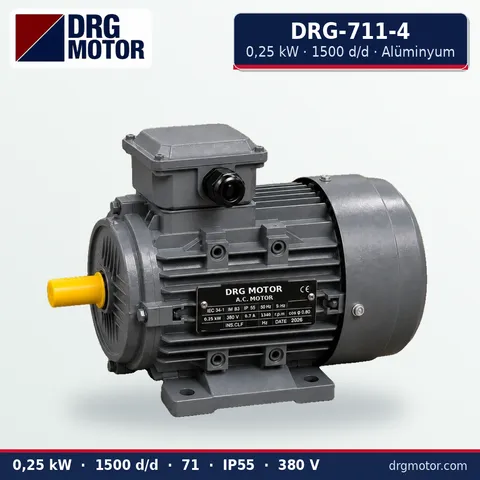
0.25 kW Three-Phase Motor 1500 rpm – DRG-711-4 Aluminium
- 0.25 kW · 1500 rpm (4 poles)
- Aluminium frame · IEC 71
- Mounting: B3 · B5 · B14 · B35
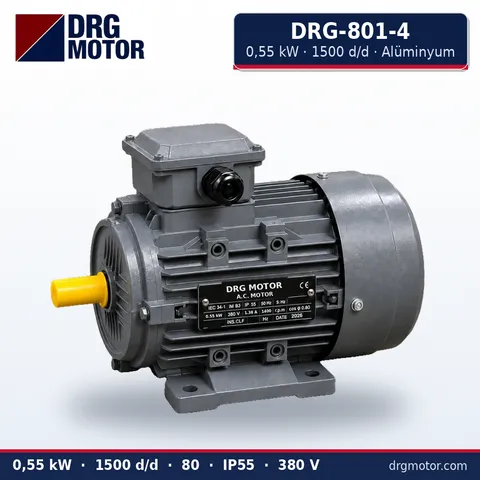
0.55 kW Three-Phase Motor 1500 rpm – DRG-801-4 Aluminium
- 0.55 kW · 1500 rpm (4 poles)
- Aluminium frame · IEC 80
- Mounting: B3 · B5 · B14 · B35
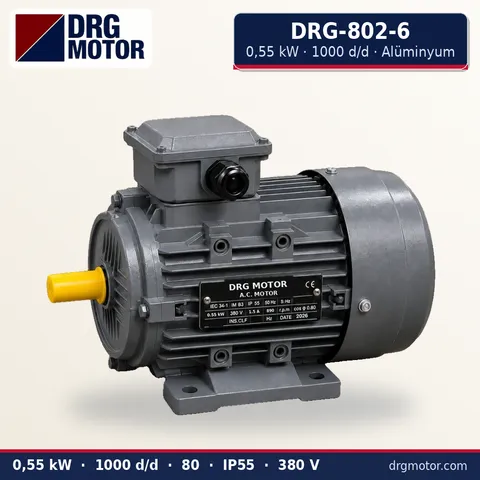
0.55 kW Three-Phase Motor 1000 rpm – DRG-802-6 Aluminium
- 0.55 kW · 1000 rpm (6 poles)
- Aluminium frame · IEC 80
- Mounting: B3 · B5 · B14 · B35
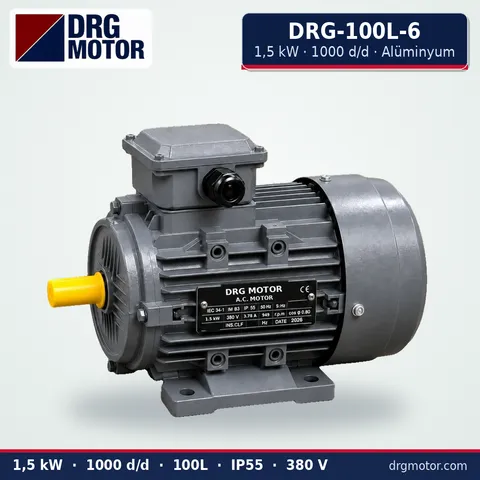
1.5 kW Three-Phase Motor 1000 rpm – DRG-100L-6 Aluminium
- 1.5 kW · 1000 rpm (6 poles)
- Aluminium frame · IEC 100L
- Mounting: B3 · B5 · B14 · B35
Click to see current prices and order these motors nowSEE PRICES →
Oil Cooler Fan Motor FAQ
Why does a hydraulic oil cooler fan motor burn out?
The most common causes are a motor in a sucking layout standing in air above +40 °C, a spare motor with the wrong number of poles, frequent starts from a narrow thermostat band, and oily dust on the ribs. Reverse rotation is an indirect cause: the oil heats up and the fan never stops.
What speed should an oil cooler fan motor have?
The same speed as the old motor. Small coolers commonly use 4 poles (about 1400–1450 rpm); large, quiet fans use 6 poles (about 900–950 rpm). The exact value is on the cooler builder's label or catalogue.
Can a three-phase motor replace a single-phase cooler fan motor?
Yes, if three-phase supply is available; keep flange, shaft and speed the same and adapt the control circuit to three-phase. DRG does not sell single-phase motors. Mobile coolers with 12/24 V DC fans or fans driven by a hydraulic motor are not covered by a standard IEC motor.
Does the cooler work if the fan motor runs in reverse?
Only partly: air flows the wrong way at a very low rate and oil temperature rises. Swap two phases at the motor terminals and check against the arrow on the shroud.
So that we can identify the right motor, send a photo of the old nameplate, its power and speed, mounting (foot or flange), shaft size and the cooler's fan diameter via WhatsApp, or add the models to the quote list. Phone: +90 (542) 666 11 11 · e-mail: info@drgmotor.com · contact page. Other powers and speeds are in the DRG online store.